Ever catch yourself using the phrase Other Ways to Say Circle Back over and over in emails, meetings, or workplace conversations? While “circle back” is widely used in professional settings, it can sometimes feel repetitive, vague, or even overused.
The challenge is that you want to sound professional and collaborative without relying on the same business buzzword every time. And here’s the kicker: using more precise language can make your communication clearer, more engaging, and easier for others to understand.
Many professionals look for alternative ways to say circle back, professional follow-up phrases, or business communication alternatives that sound fresh while conveying the same idea.
But the good news is that there are plenty of effective options.
In this guide, you’ll discover Other Ways to Say Circle Back, including professional, polite, and conversational alternatives you can use in emails, meetings, and workplace discussions. You’ll also learn when each phrase works best so your communication feels more natural and polished.
So if you’re ready to expand your professional vocabulary and improve your workplace communication, keep reading—you’ll find the perfect phrase for every situation.
What Does “Circle Back” Mean?
“Circle back” means to return to a topic, discussion, task, or issue at a later time. People often use it when they need more information, want to revisit a conversation, or plan to continue discussing something in the future.
When to Use “Circle Back”
This phrase is commonly used in workplace conversations, meetings, emails, and project discussions. It works well when you need to postpone a discussion temporarily and revisit it once more details become available.
Is It Professional/Polite to Say “Circle Back”?
Yes, “circle back” is generally professional and polite. However, some people consider it corporate jargon. In formal communication, alternatives such as “follow up,” “revisit this matter,” or “return to this discussion” may sound clearer and more direct.
1. Follow Up
Scenario: Checking on progress after a previous conversation.
Examples:
- I’ll follow up with you next week about the proposal.
- Let’s follow up after the client meeting.
- Can we follow up once we have the final numbers?
- I’ll follow up regarding your request tomorrow.
- We should follow up before making a final decision.
Tone: Professional and direct.
Best Use: Emails, meetings, and workplace communication.
2. Revisit This
Scenario: Returning to a topic later.
Examples:
- Let’s revisit this after reviewing the data.
- We can revisit this next month.
- I’d like to revisit this discussion later.
- Let’s revisit this once everyone has provided input.
- We should revisit this before launch.
Tone: Thoughtful and collaborative.
Best Use: Strategic planning and decision-making discussions.
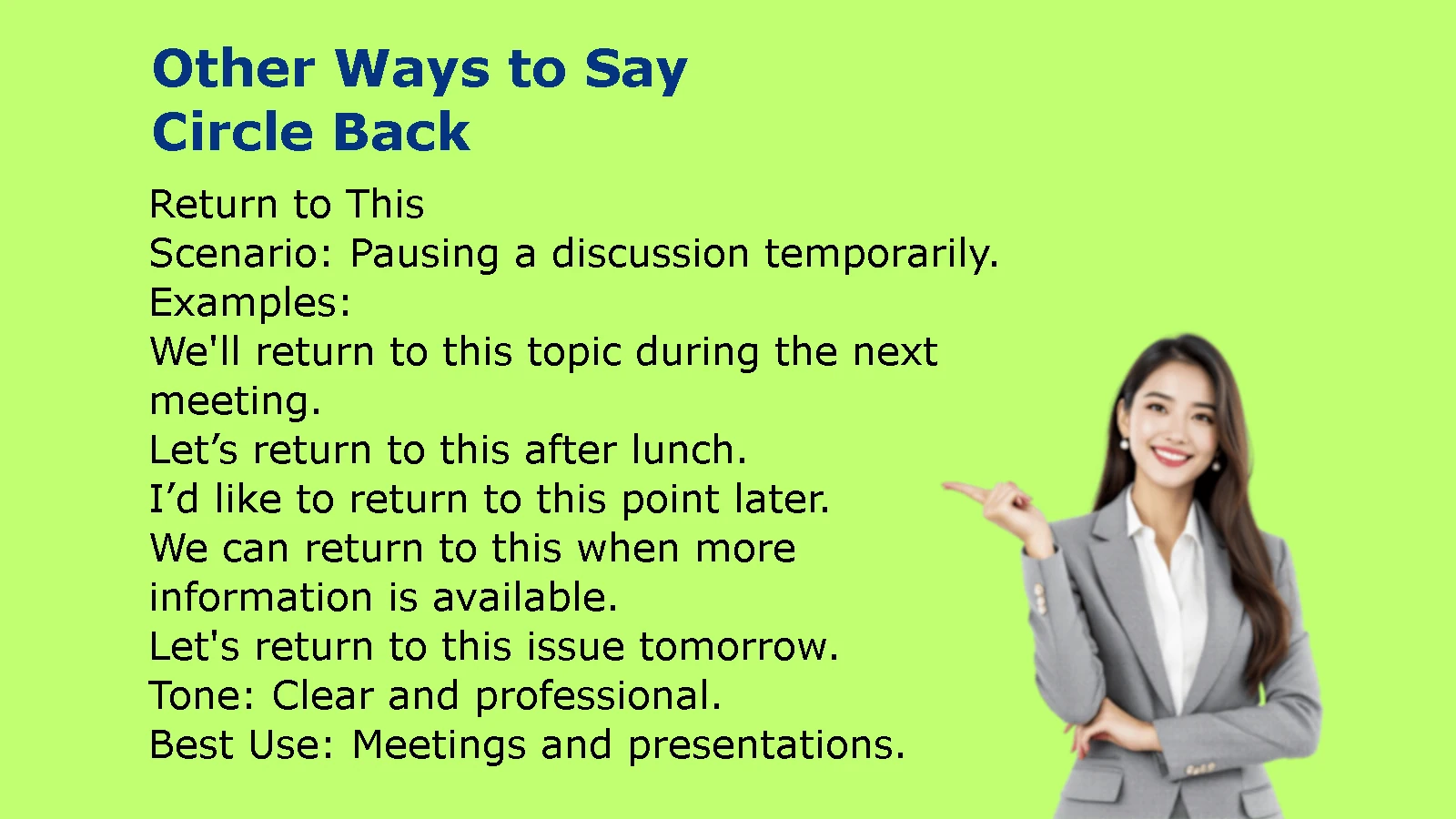
3. Return to This
Scenario: Pausing a discussion temporarily.
Examples:
- We’ll return to this topic during the next meeting.
- Let’s return to this after lunch.
- I’d like to return to this point later.
- We can return to this when more information is available.
- Let’s return to this issue tomorrow.
Tone: Clear and professional.
Best Use: Meetings and presentations.
4. Touch Base Later
Scenario: Scheduling a future check-in.
Examples:
- Let’s touch base later this week.
- I’ll touch base with you after the conference.
- Can we touch base tomorrow?
- We should touch base before submitting the report.
- Let’s touch base once the project is complete.
Tone: Friendly and professional.
Best Use: Team communication and networking.
5. Check Back In
Scenario: Revisiting progress or updates.
Examples:
- Let’s check back in next Friday.
- We can check back in after testing is complete.
- I’ll check back in with you later today.
- Let’s check back in once the issue is resolved.
- We should check back in after receiving feedback.
Tone: Supportive and conversational.
Best Use: Ongoing projects and status updates.
6. Continue This Conversation Later
Scenario: Delaying a discussion.
Examples:
- Let’s continue this conversation later.
- We can continue this conversation tomorrow.
- I’d like to continue this conversation after the meeting.
- Let’s continue this conversation when everyone is available.
- We can continue this conversation once we have more details.
Tone: Polite and straightforward.
Best Use: Formal and informal discussions.
7. Reconnect
Scenario: Planning another discussion.
Examples:
- Let’s reconnect next week.
- We can reconnect after the holidays.
- I’d like to reconnect once the report is finished.
- Let’s reconnect after gathering feedback.
- We should reconnect before the deadline.
Tone: Warm and professional.
Best Use: Networking and client relationships.
8. Review It Again
Scenario: Looking at something later.
Examples:
- Let’s review it again next month.
- We can review it again after testing.
- I’d like to review it again before approval.
- Let’s review it again when the updates are complete.
- We should review it again before publishing.
Tone: Analytical and careful.
Best Use: Projects, reports, and planning.
9. Come Back to This
Scenario: Putting a discussion on hold.
Examples:
- Let’s come back to this later.
- We can come back to this after the break.
- I’d like to come back to this point.
- Let’s come back to this once we have more clarity.
- We should come back to this tomorrow.
Tone: Casual and approachable.
Best Use: Meetings and everyday conversations.
10. Readdress This
Scenario: Revisiting an issue.
Examples:
- We’ll readdress this next quarter.
- Let’s readdress this concern later.
- We can readdress this after reviewing the feedback.
- I’d like to readdress this issue soon.
- Let’s readdress this once the situation changes.
Tone: Formal and professional.
Best Use: Workplace discussions and problem-solving.
11. Pick This Up Later
Scenario: Pausing and resuming later.
Examples:
- Let’s pick this up later.
- We can pick this up after lunch.
- I’d like to pick this up tomorrow.
- Let’s pick this up once everyone arrives.
- We should pick this up during our next meeting.
Tone: Casual and collaborative.
Best Use: Team discussions.
12. Follow Through Later
Scenario: Continuing action on a topic.
Examples:
- We’ll follow through later this week.
- Let’s follow through once the plan is approved.
- I’ll follow through after receiving confirmation.
- We can follow through tomorrow.
- Let’s follow through after discussing it further.
Tone: Action-oriented.
Best Use: Project management and commitments.
13. Resume the Discussion
Scenario: Continuing a paused conversation.
Examples:
- Let’s resume the discussion tomorrow.
- We can resume the discussion after the presentation.
- I’d like to resume the discussion later.
- Let’s resume the discussion once the team arrives.
- We should resume the discussion next week.
Tone: Formal and organized.
Best Use: Meetings and negotiations.
14. Return to the Topic
Scenario: Refocusing on a subject.
Examples:
- Let’s return to the topic later.
- We can return to the topic after reviewing the data.
- I’d like to return to the topic next week.
- Let’s return to the topic once we have answers.
- We should return to the topic tomorrow.
Tone: Professional and structured.
Best Use: Presentations and discussions.
15. Check In Again
Scenario: Following up at a later time.
Examples:
- Let’s check in again next week.
- We can check in again after the rollout.
- I’ll check in again tomorrow.
- Let’s check in again after the review.
- We should check in again before making changes.
Tone: Friendly and supportive.
Best Use: Team management and mentoring.
16. Revisit the Matter
Scenario: Returning to a specific issue.
Examples:
- Let’s revisit the matter next month.
- We can revisit the matter after legal review.
- I’d like to revisit the matter later.
- Let’s revisit the matter when more information is available.
- We should revisit the matter before final approval.
Tone: Formal and professional.
Best Use: Business and legal discussions.
17. Continue Where We Left Off
Scenario: Resuming a previous discussion.
Examples:
- Let’s continue where we left off tomorrow.
- We can continue where we left off after lunch.
- I’d like to continue where we left off next week.
- Let’s continue where we left off once everyone returns.
- We should continue where we left off during our next call.
Tone: Friendly and conversational.
Best Use: Meetings and collaborative work.
18. Follow Up on This Later
Scenario: Delaying action temporarily.
Examples:
- Let’s follow up on this later.
- We can follow up on this after the review.
- I’d like to follow up on this next week.
- Let’s follow up on this once the report is complete.
- We should follow up on this tomorrow.
Tone: Professional and practical.
Best Use: Workplace communication.
19. Discuss This Further
Scenario: Planning a deeper conversation.
Examples:
- Let’s discuss this further tomorrow.
- We can discuss this further after gathering feedback.
- I’d like to discuss this further later.
- Let’s discuss this further with the team.
- We should discuss this further before deciding.
Tone: Collaborative and thoughtful.
Best Use: Strategic discussions.
20. Reopen the Discussion
Scenario: Bringing a topic back into focus.
Examples:
- Let’s reopen the discussion next week.
- We can reopen the discussion after the audit.
- I’d like to reopen the discussion later.
- Let’s reopen the discussion when more data arrives.
- We should reopen the discussion before launch.
Tone: Formal and professional.
Best Use: Policy and project reviews.
21. Take Another Look
Scenario: Reviewing something again.
Examples:
- Let’s take another look next week.
- We can take another look after revisions.
- I’d like to take another look tomorrow.
- Let’s take another look before finalizing.
- We should take another look after testing.
Tone: Open-minded and collaborative.
Best Use: Creative and analytical work.
22. Reexamine This
Scenario: Reevaluating a topic.
Examples:
- Let’s reexamine this later.
- We can reexamine this after the results arrive.
- I’d like to reexamine this next month.
- Let’s reexamine this before making changes.
- We should reexamine this with fresh data.
Tone: Analytical and professional.
Best Use: Research and planning.
23. Touch Base Again
Scenario: Future communication.
Examples:
- Let’s touch base again next week.
- We can touch base again after the conference.
- I’d like to touch base again tomorrow.
- Let’s touch base again before the deadline.
- We should touch base again after receiving updates.
Tone: Friendly and professional.
Best Use: Business relationships and teamwork.
24. Revisit the Conversation
Scenario: Returning to a previous discussion.
Examples:
- Let’s revisit the conversation later.
- We can revisit the conversation next week.
- I’d like to revisit the conversation after reviewing feedback.
- Let’s revisit the conversation tomorrow.
- We should revisit the conversation before deciding.
Tone: Thoughtful and collaborative.
Best Use: Team meetings and negotiations.
25. Reengage on This
Scenario: Restarting involvement in a topic.
Examples:
- Let’s reengage on this next month.
- We can reengage on this after approval.
- I’d like to reengage on this later.
- Let’s reengage on this after gathering insights.
- We should reengage on this soon.
Tone: Professional and proactive.
Best Use: Long-term projects.
26. Revisit It Later
Scenario: Postponing consideration.
Examples:
- Let’s revisit it later.
- We can revisit it later this week.
- I’d like to revisit it later after reviewing the details.
- Let’s revisit it later when we have more information.
- We should revisit it later before making a decision.
Tone: Neutral and flexible.
Best Use: Everyday workplace communication.
27. Loop Back
Scenario: Returning to a discussion or task.
Examples:
- Let’s loop back next week.
- We can loop back after the meeting.
- I’d like to loop back on this tomorrow.
- Let’s loop back once the data is ready.
- We should loop back after gathering feedback.
Tone: Casual business language.
Best Use: Internal team communication.
28. Pick Up the Conversation Again
Scenario: Resuming dialogue.
Examples:
- Let’s pick up the conversation again tomorrow.
- We can pick up the conversation again next week.
- I’d like to pick up the conversation again after the event.
- Let’s pick up the conversation again when everyone is available.
- We should pick up the conversation again soon.
Tone: Friendly and conversational.
Best Use: Informal and professional discussions.
29. Return for Further Discussion
Scenario: Formal future discussion.
Examples:
- Let’s return for further discussion next week.
- We can return for further discussion after the review.
- I’d like to return for further discussion tomorrow.
- Let’s return for further discussion once the report is complete.
- We should return for further discussion before implementation.
Tone: Formal and professional.
Best Use: Executive meetings and formal communications.
30. Revisit the Issue
Scenario: Returning to a problem or concern.
Examples:
- Let’s revisit the issue next week.
- We can revisit the issue after the investigation.
- I’d like to revisit the issue tomorrow.
- Let’s revisit the issue once new information becomes available.
- We should revisit the issue before making changes.
Tone: Professional and solution-focused.
Best Use: Problem-solving, project reviews, and workplace discussions.
31. Revisit This Later
Scenario: Delaying a decision until more information is available.
Examples:
- Let’s revisit this later once we have all the facts.
- We can revisit this later this week.
- I’d like to revisit this later after speaking with the client.
- Let’s revisit this later when the team is available.
- We should revisit this later before making a final call.
Tone: Professional and flexible.
Best Use: Project planning and decision-making.
32. Get Back to This
Scenario: Returning to a topic after a pause.
Examples:
- Let’s get back to this tomorrow.
- We can get back to this after the meeting.
- I’d like to get back to this next week.
- Let’s get back to this once the report is ready.
- We should get back to this after receiving feedback.
Tone: Direct and conversational.
Best Use: Everyday workplace communication.
33. Revisit the Details
Scenario: Reviewing specifics at a later time.
Examples:
- Let’s revisit the details tomorrow.
- We can revisit the details after the presentation.
- I’d like to revisit the details before signing off.
- Let’s revisit the details next week.
- We should revisit the details once we have updated figures.
Tone: Careful and professional.
Best Use: Contracts, proposals, and planning.
34. Reconnect on This
Scenario: Scheduling a future discussion.
Examples:
- Let’s reconnect on this next week.
- We can reconnect on this after the launch.
- I’d like to reconnect on this once we have results.
- Let’s reconnect on this tomorrow afternoon.
- We should reconnect on this before the deadline.
Tone: Collaborative and professional.
Best Use: Team projects and client communication.
35. Come Back to the Discussion
Scenario: Returning to an ongoing conversation.
Examples:
- Let’s come back to the discussion tomorrow.
- We can come back to the discussion after lunch.
- I’d like to come back to the discussion later today.
- Let’s come back to the discussion next week.
- We should come back to the discussion once everyone is present.
Tone: Friendly and approachable.
Best Use: Meetings and brainstorming sessions.
36. Continue the Discussion Later
Scenario: Pausing a conversation temporarily.
Examples:
- Let’s continue the discussion later.
- We can continue the discussion later this week.
- I’d like to continue the discussion after reviewing the report.
- Let’s continue the discussion tomorrow morning.
- We should continue the discussion once we have more information.
Tone: Professional and cooperative.
Best Use: Workplace and academic discussions.
37. Follow Back Up
Scenario: Checking on progress after some time.
Examples:
- I’ll follow back up next week.
- Let’s follow back up after the review.
- We can follow back up once the task is complete.
- I’d like to follow back up tomorrow.
- We should follow back up before implementation.
Tone: Professional and action-oriented.
Best Use: Project management and client relations.
38. Revisit the Plan
Scenario: Reviewing a strategy or proposal.
Examples:
- Let’s revisit the plan next month.
- We can revisit the plan after gathering feedback.
- I’d like to revisit the plan before moving forward.
- Let’s revisit the plan once the budget is approved.
- We should revisit the plan after the pilot phase.
Tone: Strategic and thoughtful.
Best Use: Business planning and project development.
39. Check on This Again
Scenario: Returning to monitor progress.
Examples:
- Let’s check on this again next week.
- We can check on this again after the rollout.
- I’d like to check on this again tomorrow.
- Let’s check on this again after testing.
- We should check on this again before closing the project.
Tone: Supportive and practical.
Best Use: Progress tracking and team management.
40. Reevaluate This
Scenario: Assessing something again with new information.
Examples:
- Let’s reevaluate this next quarter.
- We can reevaluate this after reviewing the results.
- I’d like to reevaluate this before making a decision.
- Let’s reevaluate this once the market changes.
- We should reevaluate this after receiving customer feedback.
Tone: Analytical and professional.
Best Use: Strategic planning and problem-solving.
41. Return to the Matter
Scenario: Revisiting an issue or concern.
Examples:
- Let’s return to the matter tomorrow.
- We can return to the matter after legal review.
- I’d like to return to the matter later this week.
- Let’s return to the matter once we have more details.
- We should return to the matter before approval.
Tone: Formal and professional.
Best Use: Business, legal, and administrative discussions.
42. Revisit Our Conversation
Scenario: Referring back to a previous discussion.
Examples:
- Let’s revisit our conversation next week.
- We can revisit our conversation after the meeting.
- I’d like to revisit our conversation tomorrow.
- Let’s revisit our conversation once we have updates.
- We should revisit our conversation before making changes.
Tone: Thoughtful and collaborative.
Best Use: Team discussions and client communication.
43. Circle Around to This
Scenario: Returning to a topic after handling other priorities.
Examples:
- Let’s circle around to this later today.
- We can circle around to this next week.
- I’d like to circle around to this after the presentation.
- Let’s circle around to this when we have more time.
- We should circle around to this after reviewing the feedback.
Tone: Casual and conversational.
Best Use: Informal workplace communication.
44. Resume This Later
Scenario: Continuing a paused task or conversation.
Examples:
- Let’s resume this later this afternoon.
- We can resume this later after the break.
- I’d like to resume this later tomorrow.
- Let’s resume this later when everyone is available.
- We should resume this later once we have the required documents.
Tone: Direct and organized.
Best Use: Meetings and collaborative projects.
45. Take This Up Again
Scenario: Restarting discussion on a topic.
Examples:
- Let’s take this up again next week.
- We can take this up again after the review.
- I’d like to take this up again tomorrow.
- Let’s take this up again once new information arrives.
- We should take this up again before the final deadline.
Tone: Professional and proactive.
Best Use: Ongoing projects and planning sessions.
46. Discuss This Again Later
Scenario: Scheduling another conversation.
Examples:
- Let’s discuss this again later.
- We can discuss this again later this week.
- I’d like to discuss this again after reviewing the proposal.
- Let’s discuss this again tomorrow morning.
- We should discuss this again once the team provides feedback.
Tone: Friendly and collaborative.
Best Use: Team meetings and decision-making.
47. Return to This Later
Scenario: Delaying a topic until a better time.
Examples:
- Let’s return to this later when we have more information.
- We can return to this later this week.
- I’d like to return to this later after speaking with management.
- Let’s return to this later once the project progresses.
- We should return to this later before making a final decision.
Tone: Professional and flexible.
Best Use: Workplace discussions, planning sessions, and project reviews.
conclusion
Conclusion
“Circle back” is a widely used phrase in professional and everyday conversations, but relying on it too often can make your communication sound repetitive or overly corporate. By using alternatives such as “follow up,” “touch base,” “reconnect,” “revisit this,” or “return to the discussion,” you can express the same idea with greater clarity and variety. Whether you’re writing emails, leading meetings, managing projects, or having casual conversations, these 47 alternatives help you communicate more effectively while keeping your language fresh, professional, and engaging. Choosing the right phrase for the situation can also make your message sound more natural and easier for others to understand.