Finding the right words matters more than we think. Saying “great job” is kind and encouraging, but using other ways to say great job can make your message feel more personal, warmer, and more thoughtful. Whether you’re talking to a friend, coworker, student, or loved one, the words you choose can deeply impact how appreciated someone feels. Below, you’ll find 30 meaningful alternatives, each with clear scenarios, examples, tone, and best use—so you can express praise with care and confidence.
What Does “Great Job” Mean?
“Great job” is a phrase used to praise someone’s effort, skill, or success. It shows approval, encouragement, and appreciation for what someone has done.
When to Use “Great Job”
You can use great job when someone:
- Completes a task successfully
- Puts in visible effort
- Achieves a goal
- Tries hard, even if the result isn’t perfect
It’s especially useful in supportive, casual, or motivational situations.
Is It Professional or Polite to Say “Great Job”?
Yes, “great job” is polite and professional, especially in friendly workplaces. However, in formal settings, more specific praise can sound stronger and more sincere.
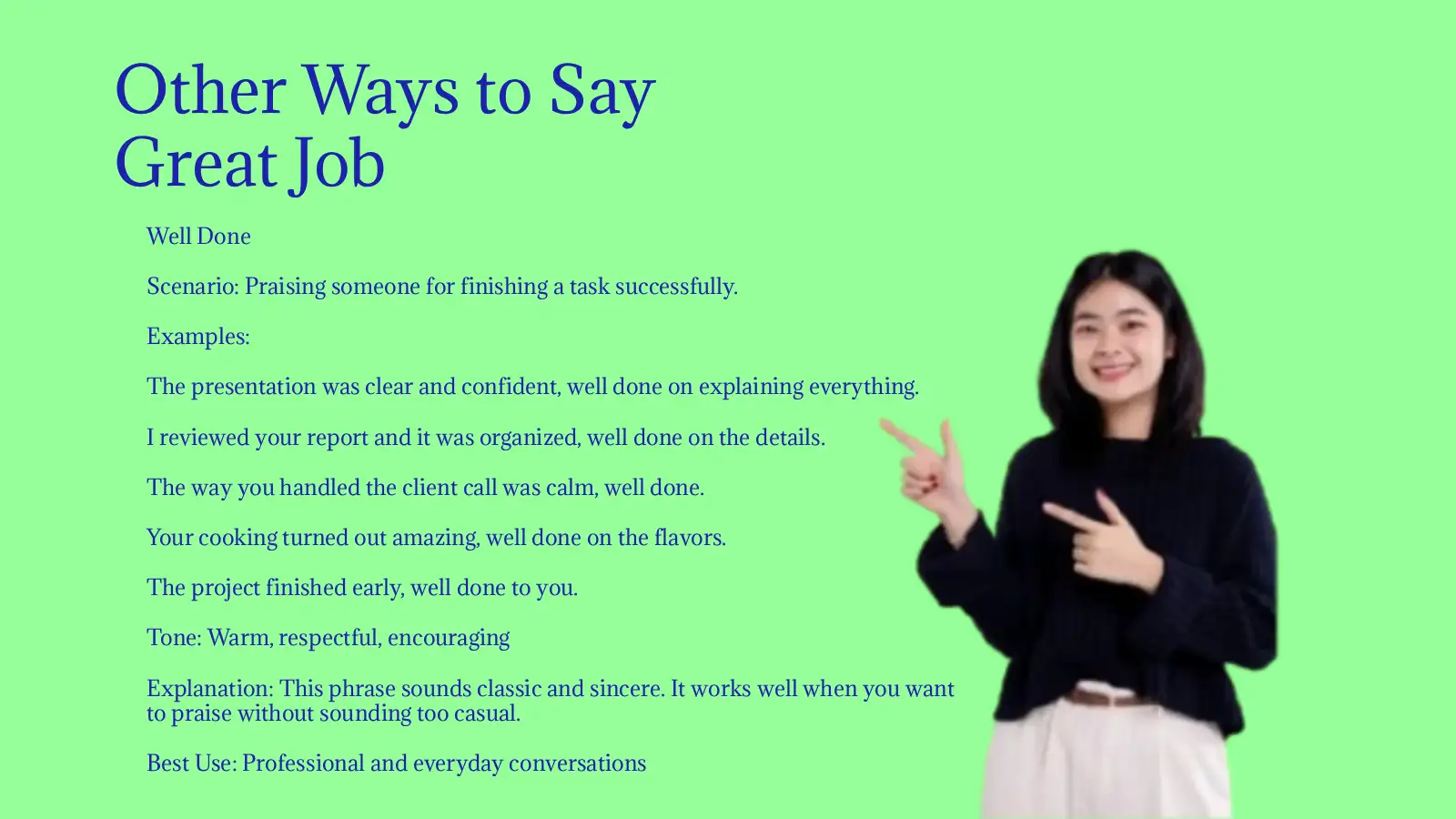
1. Well Done
Scenario: Praising someone for finishing a task successfully.
Examples:
- The presentation was clear and confident, well done on explaining everything.
- I reviewed your report and it was organized, well done on the details.
- The way you handled the client call was calm, well done.
- Your cooking turned out amazing, well done on the flavors.
- The project finished early, well done to you.
Tone: Warm, respectful, encouraging
Explanation: This phrase sounds classic and sincere. It works well when you want to praise without sounding too casual.
Best Use: Professional and everyday conversations
2. Excellent Work
Scenario: Recognizing high-quality results.
Examples:
- The design looks polished, excellent work on the layout.
- I checked the numbers and they’re accurate, excellent work.
- Your writing flows smoothly, excellent work throughout.
- The event planning was flawless, excellent work by you.
- Your performance today was strong, excellent work.
Tone: Professional, confident
Explanation: This phrase emphasizes quality and skill.
Best Use: Workplace, academic, formal praise
3. Fantastic Job
Scenario: Celebrating a success with enthusiasm.
Examples:
- The photos turned out vibrant, fantastic job capturing the moment.
- You led the meeting smoothly, fantastic job staying focused.
- The kids loved the activity, fantastic job organizing it.
- Your speech was engaging, fantastic job delivering it.
- The results improved quickly, fantastic job adapting.
Tone: Energetic, cheerful
Explanation: This adds excitement and positivity to your praise.
Best Use: Friendly and motivational moments
4. Nice Work
Scenario: Casual appreciation for effort.
Examples:
- The edits improved the article, nice work on the changes.
- You solved that issue fast, nice work.
- The setup looks neat, nice work arranging everything.
- Your timing was perfect, nice work there.
- The explanation helped a lot, nice work.
Tone: Relaxed, supportive
Explanation: Simple and friendly, it feels easygoing and genuine.
Best Use: Casual conversations and teamwork
5. You Nailed It
Scenario: When someone does something perfectly.
Examples:
- The answer was spot on, you nailed it completely.
- That performance felt natural, you nailed it.
- The color choice fits perfectly, you nailed it.
- Your response cleared all doubts, you nailed it.
- The timing was flawless, you nailed it.
Tone: Confident, upbeat
Explanation: This phrase shows strong approval and excitement.
Best Use: Informal praise and encouragement
6. Impressive Work
Scenario: Acknowledging skill or effort.
Examples:
- The research was thorough, impressive work overall.
- You handled pressure well, impressive work today.
- The creativity stood out, impressive work.
- Your progress has been steady, impressive work.
- The solution was clever, impressive work.
Tone: Respectful, admiring
Explanation: Highlights talent and dedication.
Best Use: Professional and academic settings
7. Outstanding Effort
Scenario: Praising dedication, not just results.
Examples:
- The long hours paid off, outstanding effort from you.
- Even under stress, you stayed focused, outstanding effort.
- Your preparation showed clearly, outstanding effort.
- The teamwork improved things, outstanding effort.
- You kept pushing forward, outstanding effort.
Tone: Encouraging, appreciative
Explanation: Focuses on hard work and commitment.
Best Use: Motivation and support
8. Bravo
Scenario: Applauding a performance or achievement.
Examples:
- The performance moved everyone, bravo to you.
- You completed the task confidently, bravo.
- The idea was bold, bravo for trying.
- Your leadership showed growth, bravo.
- The delivery was smooth, bravo.
Tone: Celebratory, classy
Explanation: Short but powerful praise.
Best Use: Creative and performance-based praise
9. Kudos to You
Scenario: Giving public appreciation.
Examples:
- The success came from your planning, kudos to you.
- You stepped up when needed, kudos to you.
- The improvement is clear, kudos to you.
- Your patience helped everyone, kudos to you.
- The results speak for themselves, kudos to you.
Tone: Positive, respectful
Explanation: Sounds modern and appreciative.
Best Use: Workplace and group recognition
10. Keep It Up
Scenario: Encouraging continued effort.
Examples:
- Your progress is steady, keep it up.
- The consistency is paying off, keep it up.
- You’re improving fast, keep it up.
- The attitude is great, keep it up.
- Your focus is strong, keep it up.
Tone: Motivational, supportive
Explanation: Encourages ongoing effort and growth.
Best Use: Coaching and encouragement
11. Amazing Work
Scenario: Praising someone for exceptional achievement.
Examples:
- The project exceeded expectations, amazing work by the team.
- Your presentation was clear and engaging, amazing work.
- The design turned out beautifully, amazing work on it.
- You solved the problem quickly, amazing work.
- The effort you put in really shows, amazing work.
Tone: Excited, appreciative
Explanation: Conveys genuine admiration and delight.
Best Use: Creative, informal, or celebratory settings
12. That Was Brilliant
Scenario: When someone shows clever thinking or talent.
Examples:
- Your idea solved the issue perfectly, that was brilliant.
- The way you explained it made sense, that was brilliant.
- Your strategy improved efficiency, that was brilliant.
- The solution is simple and effective, that was brilliant.
- The way you handled that challenge, that was brilliant.
Tone: Admiring, impressed
Explanation: Highlights intelligence, skill, or creativity.
Best Use: Professional or casual praise for clever solutions
13. You Did a Great Job
Scenario: Reinforcing someone’s overall success.
Examples:
- The report is thorough, you did a great job.
- Your speech impressed everyone, you did a great job.
- The painting turned out beautiful, you did a great job.
- The presentation was organized, you did a great job.
- Your leadership really helped, you did a great job.
Tone: Sincere, encouraging
Explanation: Classic phrase that reinforces effort and accomplishment.
Best Use: Any setting, formal or informal
14. Exceptional Performance
Scenario: When someone goes above expectations.
Examples:
- Your coding skills improved the software, exceptional performance.
- The team delivered early, exceptional performance by everyone.
- Your customer service was outstanding, exceptional performance.
- The experiment results were accurate, exceptional performance.
- Your presentation inspired confidence, exceptional performance.
Tone: Professional, admiring
Explanation: Recognizes high-quality effort or results.
Best Use: Formal workplaces or academic settings
15. Strong Work
Scenario: Highlighting consistency and reliability.
Examples:
- You handled the task quickly, strong work.
- Your report is clear and precise, strong work.
- The analysis is accurate, strong work.
- You managed the team effectively, strong work.
- The results were excellent, strong work.
Tone: Professional, confident
Explanation: Emphasizes reliability and skill without overdoing praise.
Best Use: Workplace feedback or peer acknowledgment
16. Terrific Job
Scenario: Celebrating success with enthusiasm.
Examples:
- Your article captured the audience, terrific job.
- The project met every goal, terrific job.
- You handled the event perfectly, terrific job.
- The results improved dramatically, terrific job.
- Your teamwork was excellent, terrific job.
Tone: Cheerful, uplifting
Explanation: Expresses enthusiasm and positive energy.
Best Use: Friendly or motivational praise
17. Way to Go
Scenario: Congratulating someone casually.
Examples:
- You solved the problem quickly, way to go.
- The presentation was engaging, way to go.
- You reached your milestone, way to go.
- The team exceeded expectations, way to go.
- You completed the task early, way to go.
Tone: Casual, encouraging
Explanation: Great for informal praise or cheering someone on.
Best Use: Friendly or peer-to-peer contexts
18. Hats Off to You
Scenario: Recognizing exceptional effort or achievement.
Examples:
- You handled the difficult client well, hats off to you.
- Your design was creative and professional, hats off to you.
- The project succeeded under pressure, hats off to you.
- You stayed calm and organized, hats off to you.
- Your contribution was crucial, hats off to you.
Tone: Respectful, celebratory
Explanation: Expresses admiration and respect.
Best Use: Professional or formal acknowledgment
19. Job Well Done
Scenario: General acknowledgment of achievement.
Examples:
- The assignment was thorough, job well done.
- Your presentation impressed the client, job well done.
- The event went smoothly, job well done.
- You maintained patience under pressure, job well done.
- The project is completed ahead of schedule, job well done.
Tone: Sincere, classic
Explanation: Simple and universally acceptable phrase.
Best Use: Formal or casual recognition
20. You Did Wonderfully
Scenario: Praising effort and success.
Examples:
- The report was clear and precise, you did wonderfully.
- Your explanation helped everyone understand, you did wonderfully.
- You handled the situation calmly, you did wonderfully.
- Your presentation was engaging, you did wonderfully.
- The task is completed efficiently, you did wonderfully.
Tone: Warm, appreciative
Explanation: Highlights effort and skill in a gentle way.
Best Use: Educational or personal encouragement
21. That’s Impressive
Scenario: Praising someone for noticeable skill or achievement.
Examples:
- Your coding solution fixed the bug quickly; that’s impressive.
- The way you presented the data was clear; that’s impressive.
- Your painting shows incredible attention to detail; that’s impressive.
- The team achieved the target early; that’s impressive.
- Your dedication to learning the new system that’s impressive.
Tone: Admiring, respectful
Explanation: Shows genuine appreciation for skill or effort without being over-the-top.
Best Use: Professional or casual recognition of achievement
22. Super Work
Scenario: Recognizing well-executed tasks in an upbeat way.
Examples:
- Your report was concise and accurate, super work.
- You organized the event flawlessly, super work.
- The campaign results exceeded expectations, super work.
- You managed the team effectively, super work.
- Your attention to detail really helped, super work.
Tone: Cheerful, encouraging
Explanation: Conveys energy and positivity while praising effort.
Best Use: Informal workplace or peer acknowledgment
23. Great Effort
Scenario: Highlighting someone’s hard work, even if the results aren’t perfect.
Examples:
- You tried multiple approaches, great effort.
- The project wasn’t easy, but great effort on your part.
- You stayed focused through challenges, great effort.
- Your presentation was detailed, great effort.
- You handled the client call well, great effort.
Tone: Encouraging, supportive
Explanation: Focuses on effort and persistence rather than just results.
Best Use: Motivational praise and personal development
24. Remarkable Job
Scenario: Recognizing something truly exceptional or unique.
Examples:
- The design was innovative, a remarkable job.
- Your storytelling captured everyone. It was a remarkable job.
- The project exceeded expectations, a remarkable job.
- You handled challenges smoothly, a remarkable job.
- The results speak for themselves, a remarkable job.
Tone: Admiring, impactful
Explanation: Highlights extraordinary accomplishment with a sense of awe.
Best Use: Special recognition in professional or personal contexts
25. You Exceeded Expectations
Scenario: When someone goes above and beyond.
Examples:
- The client was delighted; you exceeded expectations.
- The report is thorough; you exceeded expectations.
- Your performance today was outstanding; you exceeded expectations.
- The project results are better than planned; you exceeded expectations.
- Your problem-solving skills were excellent; you exceeded expectations.
Tone: Respectful, motivational
Explanation: Shows high appreciation for effort and results beyond the norm.
Best Use: Professional praise and formal recognition
26. Solid Performance
Scenario: Recognizing steady, dependable work.
Examples:
- You handled the task without errors, with solid performance.
- The team’s coordination was excellent, with a solid performance.
- Your analysis was accurate and reliable, a solid performance.
- The presentation flowed well, solid performance.
- You stayed consistent under pressure, solid performance.
Tone: Professional, confident
Explanation: Emphasizes dependability and competence.
Best Use: Workplace or team feedback
27. You Handled That Well
Scenario: Praising someone’s approach to a challenge.
Examples:
- The customer was upset, but you handled that well.
- The unexpected changes didn’t disrupt your work; you handled that well.
- The team’s conflict was resolved smoothly; you handled that well.
- The presentation went smoothly despite issues; you handled that well.
- You adapted quickly to the new software; you handled that well.
Tone: Supportive, appreciative
Explanation: Recognizes skillful management of challenges.
Best Use: Coaching, mentoring, or supportive feedback
28. First-Rate Work
Scenario: Recognizing top-quality results.
Examples:
- The design exceeded our expectations, first-rate work.
- The article was insightful and clear, first-rate work.
- Your coding was clean and efficient, first-rate work.
- The presentation was professional, first-rate work.
- You maintained accuracy throughout, first-rate work.
Tone: Professional, admiring
Explanation: Highlights high-quality, reliable results.
Best Use: Professional and formal praise
29. Splendid Job
Scenario: Adding a touch of elegance to praise.
Examples:
- Your attention to detail was remarkable, splendid job.
- The project was executed flawlessly, splendid job.
- Your teamwork helped everyone succeed, splendid job.
- The report is thorough and clear, splendid job.
- You exceeded expectations in your presentation, splendid job.
Tone: Elegant, warm
Explanation: Feels refined and genuine for meaningful praise.
Best Use: Personal, formal, or creative acknowledgment
30. Excellent Effort
Scenario: Praising determination and hard work.
Examples:
- You stayed focused through the challenge, excellent effort.
- The project benefited from your dedication and excellent effort.
- Your preparation was thorough and an excellent effort.
- You adapted well to unexpected changes, excellent effort.
- The results show your persistence and excellent effort.
Tone: Encouraging, appreciative
Explanation: Highlights hard work and dedication, not just results.
Best Use: Motivational and educational contexts
Conclusion
Using these 30 alternatives to “great job” allows you to express praise with warmth, thoughtfulness, and sincerity. Each phrase fits different scenarios, tones, and relationships, from casual to professional, friendly to formal. By choosing the right words, you can uplift, motivate, and make people feel truly appreciated, turning a simple compliment into a meaningful connection.