Finding the right words matters, especially when you want to sound polite, caring, and clear. The phrase “just to confirm” is useful, but using it too often can feel flat or repetitive. In this guide, you’ll discover warm, professional, and thoughtful alternatives to just to confirm, so your messages feel more human, respectful, and intentional—whether you’re texting a friend or emailing a colleague.
What Does “Just to Confirm” Mean?
Just to confirm is used when you want to double-check information or make sure everyone is on the same page. It shows care for accuracy and avoids confusion before moving forward.
When to Use “Just to Confirm”
You can use just to confirm when:
- You want to verify details
- You’re avoiding misunderstandings
- You’re following up politely
- You need clarity before action
Is It Professional or Polite to Say “Just to Confirm”?
Yes, just to confirm is both polite and professional. However, in formal writing or sensitive conversations, choosing a softer or more thoughtful alternative can sound more refined and considerate.
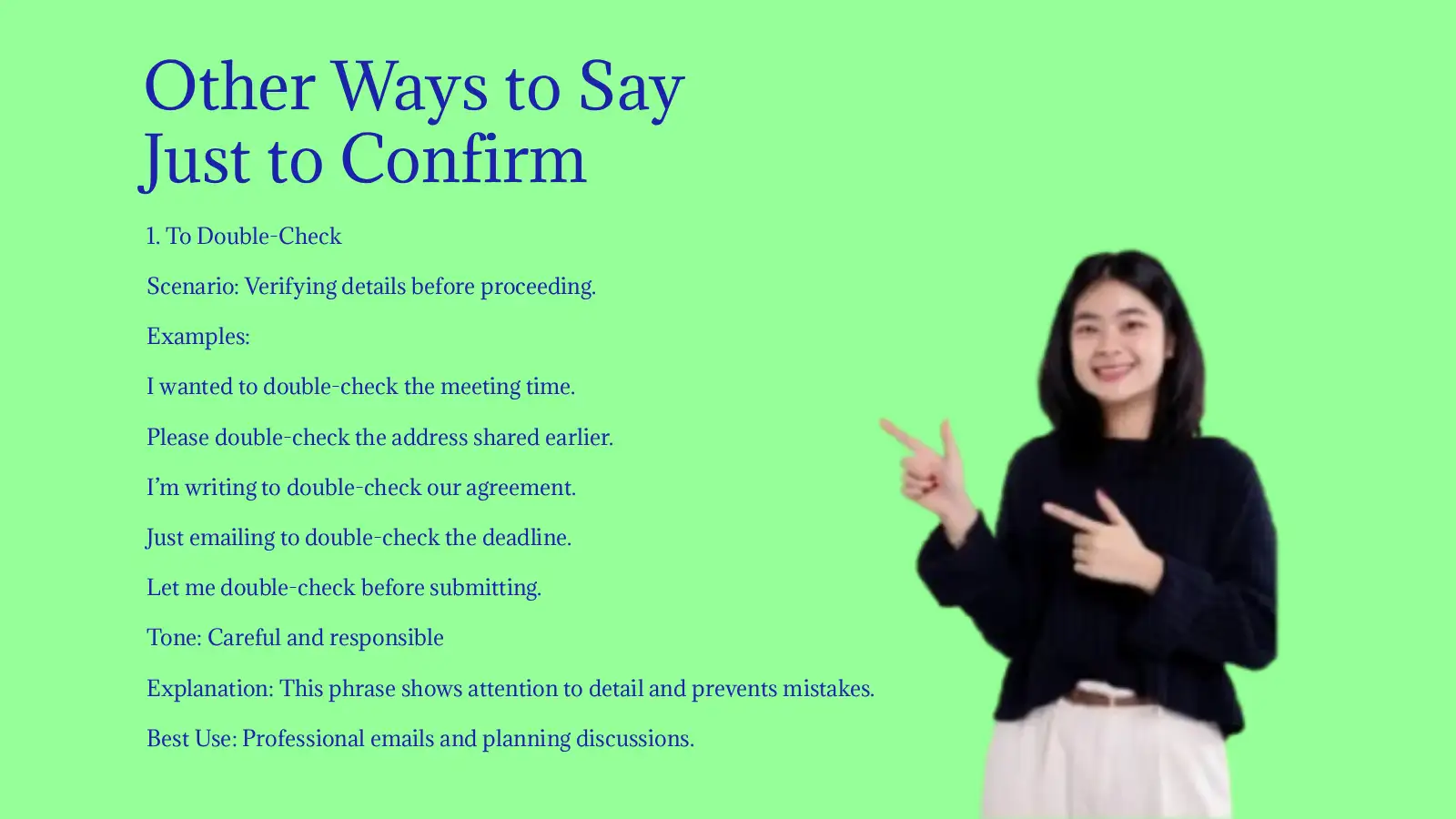
1. To Double-Check
Scenario: Verifying details before proceeding.
Examples:
- I wanted to double-check the meeting time.
- Please double-check the address shared earlier.
- I’m writing to double-check our agreement.
- Just emailing to double-check the deadline.
- Let me double-check before submitting.
Tone: Careful and responsible
Explanation: This phrase shows attention to detail and prevents mistakes.
Best Use: Professional emails and planning discussions.
2. To Make Sure
Scenario: Ensuring accuracy gently.
Examples:
- I’m reaching out to make sure everything is correct.
- Just wanted to make sure we’re aligned.
- I called to make sure the time still works.
- Checking in to make sure nothing changed.
- This message is to make sure I understood correctly.
Tone: Warm and friendly
Explanation: Sounds natural and caring without pressure.
Best Use: Friendly or semi-formal conversations.
3. Just Checking
Scenario: Casual follow-up.
Examples:
- I’m just checking if you received my email.
- This is just checking on our plan.
- I wanted to ask, just checking, about tomorrow.
- I’m just checking before I proceed.
- Sending this message just checking for updates.
Tone: Relaxed and polite
Explanation: Keeps the conversation light and approachable.
Best Use: Texts or informal emails.
4. To Clarify
Scenario: Clearing confusion.
Examples:
- I’m writing to clarify a small detail.
- Just calling to clarify the instructions.
- I wanted to clarify what was discussed.
- This email is to clarify expectations.
- Reaching out to clarify one point.
Tone: Clear and respectful
Explanation: Focuses on understanding, not correction.
Best Use: Professional or academic settings.
5. Just Verifying
Scenario: Confirming facts.
Examples:
- I’m just verifying the schedule.
- This message is just verifying the details.
- I wanted to ask, just verifying, the date.
- I’m just verifying before confirming.
- Sending this email just verifying information.
Tone: Neutral and careful
Explanation: Emphasizes accuracy without sounding demanding.
Best Use: Work-related confirmations.
6. To Ensure
Scenario: Making sure everything is correct before moving forward.
Examples:
- I’m reaching out to ensure all details are accurate.
- This email is to ensure nothing was missed.
- I wanted to ensure we’re aligned on this.
- Just checking in to ensure the plan works.
- I’m following up to ensure clarity.
Tone: Professional and reassuring
Explanation: This phrase sounds confident and thoughtful without pressure.
Best Use: Business emails and formal messages.
7. I Want to Confirm
Scenario: Direct but polite verification.
Examples:
- I want to confirm the appointment time.
- I’m writing because I want to confirm details.
- I want to confirm what we discussed earlier.
- Just calling as I want to confirm plans.
- I want to confirm before proceeding.
Tone: Clear and respectful
Explanation: Straightforward and polite, ideal when clarity is needed.
Best Use: Professional and official communication.
8. Checking In to Confirm
Scenario: Gentle follow-up.
Examples:
- I’m checking in to confirm tomorrow’s meeting.
- Just checking in to confirm availability.
- I wanted to reach out, checking in to confirm.
- This message is checking in to confirm details.
- I’m checking in to confirm next steps.
Tone: Friendly and considerate
Explanation: Adds warmth and avoids sounding demanding.
Best Use: Follow-up emails and team chats.
9. For Confirmation
Scenario: Requesting confirmation formally.
Examples:
- I’m emailing for confirmation of the booking.
- This message is for confirmation of details.
- Please reply for confirmation when convenient.
- I’m writing for confirmation before finalizing.
- This note is sent for confirmation only.
Tone: Formal and precise
Explanation: Keeps the message short and professional.
Best Use: Official requests and documentation.
10. Just to Be Sure
Scenario: Soft and friendly reassurance.
Examples:
- I’m asking just to be sure about the time.
- Just checking to be sure nothing changed.
- I wanted to confirm, just to be sure.
- This message is sent just to be sure.
- Reaching out just to be sure everything’s fine.
Tone: Warm and relaxed
Explanation: Sounds caring and non-intrusive.
Best Use: Friendly or casual conversations.
11. To Reconfirm
Scenario: Confirming something already discussed.
Examples:
- I’m writing to reconfirm our schedule.
- Just calling to reconfirm details.
- This email is to reconfirm arrangements.
- I wanted to reconfirm before traveling.
- Reaching out to reconfirm plans.
Tone: Professional and organized
Explanation: Shows responsibility and attention to detail.
Best Use: Meetings, travel, or appointments.
12. Seeking Confirmation
Scenario: Polite and formal request.
Examples:
- I’m seeking confirmation of the submission.
- This email is seeking confirmation.
- I’m writing while seeking confirmation.
- Please respond, as I’m seeking confirmation.
- Just reaching out, seeking confirmation.
Tone: Formal and respectful
Explanation: Sounds courteous and structured.
Best Use: Professional or academic settings.
13. As a Quick Check
Scenario: Short and casual verification.
Examples:
- This message is sent as a quick check.
- I wanted to ask, as a quick check, about timing.
- Just calling as a quick check.
- Reaching out as a quick check before confirming.
- Sending this email as a quick check.
Tone: Light and friendly
Explanation: Keeps things easy and stress-free.
Best Use: Informal emails or texts.
14. Just Touching Base to Confirm
Scenario: Friendly follow-up.
Examples:
- I’m just touching base to confirm plans.
- Just touching base to confirm availability.
- This message is just touching base to confirm.
- I wanted to check in, just touching base to confirm.
- I’m reaching out, just touching base to confirm.
Tone: Warm and approachable
Explanation: Builds connection while staying polite.
Best Use: Workplace communication and networking.
15. Confirming Details
Scenario: Final check before action.
Examples:
- I’m emailing about confirming details.
- Just calling for confirming details.
- This message focuses on confirming details.
- I wanted to ask while confirming details.
- Reaching out for confirming details.
Tone: Neutral and professional
Explanation: Keeps the focus on accuracy.
Best Use: Planning and coordination.
16. I’d Like to Verify
Scenario: Polite and formal checking.
Examples:
- I’d like to verify the information shared.
- I’m reaching out as I’d like to verify details.
- This email is sent because I’d like to verify.
- I wanted to ask, as I’d like to verify.
- Just checking since I’d like to verify.
Tone: Respectful and professional
Explanation: Sounds thoughtful and careful.
Best Use: Business or legal communication.
17. To Confirm Details
Scenario: Clarifying specifics.
Examples:
- I’m writing to confirm details.
- Just calling to confirm details.
- This email is to confirm details.
- I wanted to follow up to confirm details.
- Reaching out to confirm details.
Tone: Clear and professional
Explanation: Focuses on specifics without confusion.
Best Use: Formal communication.
18. Making Sure Everything Is Correct
Scenario: Friendly reassurance.
Examples:
- I’m checking in, making sure everything is correct.
- This email is sent making sure everything is correct.
- I wanted to ask while making sure everything is correct.
- Just calling, making sure everything is correct.
- Reaching out while making sure everything is correct.
Tone: Caring and calm
Explanation: Shows concern for accuracy and comfort.
Best Use: Customer service or teamwork.
19. Just Confirming Details
Scenario: Casual confirmation.
Examples:
- I’m just confirming details before proceeding.
- This message is just confirming details.
- I wanted to ask, just confirming details.
- Just calling, confirming details quickly.
- Reaching out, just confirming details.
Tone: Friendly and simple
Explanation: Keeps things easy and clear.
Best Use: Informal work communication.
20. To Check Accuracy
Scenario: Ensuring correctness.
Examples:
- I’m writing to check accuracy.
- This email is sent to check accuracy.
- I wanted to confirm, to check accuracy.
- Just calling to check accuracy.
- Reaching out to check accuracy.
Tone: Professional and careful
Explanation: Highlights precision and responsibility.
Best Use: Reports, data, or instructions.
21. Following Up to Confirm
Scenario: Gentle reminder.
Examples:
- I’m following up to confirm details.
- This email is following up to confirm.
- I wanted to reach out, following up to confirm.
- Just checking in, following up to confirm.
- Reaching out again, following up to confirm.
Tone: Polite and patient
Explanation: Sounds respectful and non-pushy.
Best Use: Follow-up emails.
22. For Clarity
Scenario: Avoiding confusion.
Examples:
- I’m writing for clarity on this matter.
- This message is sent for clarity.
- I wanted to ask, for clarity, about details.
- Just checking, for clarity, before proceeding.
- Reaching out for clarity.
Tone: Calm and respectful
Explanation: Focuses on understanding, not correction.
Best Use: Sensitive or complex topics.
23. To Validate
Scenario: Confirming correctness.
Examples:
- I’m reaching out to validate information.
- This email is sent to validate details.
- I wanted to check, to validate accuracy.
- Just calling to validate plans.
- Reaching out to validate before finalizing.
Tone: Formal and confident
Explanation: Sounds precise and professional.
Best Use: Data, approvals, or reviews.
24. Confirming This Information
Scenario: Verifying shared data.
Examples:
- I’m emailing while confirming this information.
- This message is confirming this information.
- I wanted to ask, confirming this information.
- Just checking in, confirming this information.
- Reaching out, confirming this information.
Tone: Neutral and professional
Explanation: Keeps the focus on facts.
Best Use: Emails and documentation.
25. Just a Quick Confirmation
Scenario: Short and polite check.
Examples:
- I’m writing for just a quick confirmation.
- This email is sent for a quick confirmation.
- Just calling for a quick confirmation.
- I wanted to ask, just a quick confirmation.
- Reaching out for just a quick confirmation.
Tone: Friendly and efficient
Explanation: Saves time while staying polite.
Best Use: Busy work environments.
26. To Ensure Accuracy
Scenario: Preventing mistakes.
Examples:
- I’m reaching out to ensure accuracy.
- This message is sent to ensure accuracy.
- I wanted to confirm, to ensure accuracy.
- Just checking in to ensure accuracy.
- Reaching out again to ensure accuracy.
Tone: Professional and responsible
Explanation: Shows care and attention.
Best Use: Formal communication.
27. Double-Checking Details
Scenario: Final review.
Examples:
- I’m emailing while double-checking details.
- This message is sent for double-checking details.
- I wanted to ask, double-checking details.
- Just calling, double-checking details.
- Reaching out while double-checking details.
Tone: Careful and organized
Explanation: Shows diligence and reliability.
Best Use: Planning and coordination.
28. Confirming Once More
Scenario: Reassurance.
Examples:
- I’m writing, confirming once more.
- This email is sent, confirming once more.
- I wanted to check, confirming once more.
- Just calling, confirming once more.
- Reaching out, confirming once more.
Tone: Polite and calm
Explanation: Emphasizes certainty.
Best Use: Important arrangements.
29. Checking for Confirmation
Scenario: Waiting for response.
Examples:
- I’m emailing while checking for confirmation.
- This message is sent, checking for confirmation.
- I wanted to ask, checking for confirmation.
- Just calling, checking for confirmation.
- Reaching out, checking for confirmation.
Tone: Respectful and patient
Explanation: Encourages response politely.
Best Use: Follow-ups.
30. To Confirm Understanding
Scenario: Ensuring mutual clarity.
Examples:
- I’m writing to confirm understanding.
- This email is sent to confirm understanding.
- I wanted to check, to confirm understanding.
- Just calling to confirm understanding.
- Reaching out again to confirm understanding.
Tone: Thoughtful and empathetic
Explanation: Shows care for mutual agreement.
Best Use: Sensitive or important discussions.
Conclusion
Using other ways to say “just to confirm” helps your communication sound more kind, clear, and human. Whether you’re writing professionally or speaking casually, choosing the right words builds trust, respect, and understanding. Small changes in phrasing can make a big emotional difference—and now you have plenty of thoughtful options to choose from. 💬✨