Need a better way to say “please let me know the next steps” without sounding robotic or overused? It’s a common line in emails, but relying on it too often can make your message feel routine and less engaging.
A small change in phrasing can make a big difference. The right words can sound more confident, more collaborative, and even more professional—without adding extra length. Whether you’re checking in on a project or waiting for direction, how you ask matters.
In this guide, you’ll find clear, modern alternatives that help you request next steps in a way that feels natural, polished, and effective.
What Does “Please Let Me Know the Next Steps” Mean?
“Please let me know the next steps” is a polite request asking someone to provide guidance on what to do next. It shows readiness to proceed and willingness to follow instructions.
When to Use “Please Let Me Know the Next Steps”
This phrase is commonly used in professional emails, project discussions, client communication, and follow-ups. It’s especially useful when waiting for direction after completing a task or during ongoing collaboration.
Is It Professional/Polite to Say “Please Let Me Know the Next Steps”?
Yes, it is both professional and polite. However, using varied alternatives can make your communication sound more natural, confident, and less repetitive, especially in frequent email exchanges.
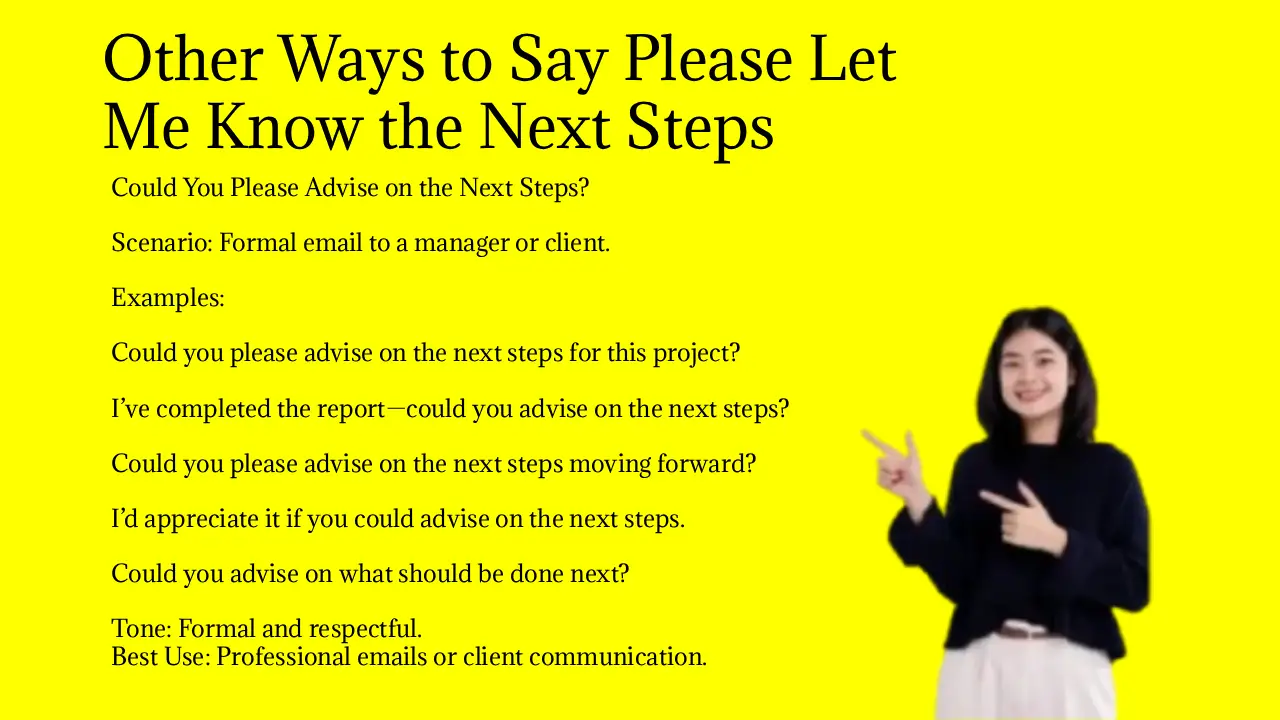
1. Could You Please Advise on the Next Steps?
Scenario: Formal email to a manager or client.
Examples:
- Could you please advise on the next steps for this project?
- I’ve completed the report—could you advise on the next steps?
- Could you please advise on the next steps moving forward?
- I’d appreciate it if you could advise on the next steps.
- Could you advise on what should be done next?
Tone: Formal and respectful.
Best Use: Professional emails or client communication.
2. What Should I Do Next?
Scenario: Direct and simple request.
Examples:
- I’ve finished the task—what should I do next?
- What should I do next regarding this assignment?
- Could you tell me what I should do next?
- What should I do next to proceed?
- I’m ready—what should I do next?
Tone: Straightforward and clear.
Best Use: Quick chats or internal communication.
3. Please Guide Me on the Next Steps
Scenario: Seeking direction politely.
Examples:
- Please guide me on the next steps for this task.
- Could you guide me on what to do next?
- Please guide me on the next steps moving forward.
- I’d appreciate your guidance on the next steps.
- Please guide me on how to proceed.
Tone: Polite and respectful.
Best Use: Emails to supervisors or clients.
4. What Are the Next Steps?
Scenario: Neutral and concise inquiry.
Examples:
- What are the next steps for this project?
- Could you confirm what the next steps are?
- I’d like to know what the next steps are.
- What are the next steps from here?
- Can you outline the next steps?
Tone: Neutral and professional.
Best Use: Meetings, emails, or reports.
5. How Should We Proceed?
Scenario: Collaborative discussion.
Examples:
- How should we proceed with this plan?
- Could you suggest how we should proceed?
- How should we proceed from here?
- I’d like your input on how we should proceed.
- How should we proceed with the next phase?
Tone: Collaborative and professional.
Best Use: Team discussions or group projects.
6. Kindly Let Me Know the Way Forward
Scenario: Formal and polite communication.
Examples:
- Kindly let me know the way forward on this matter.
- Could you let me know the way forward?
- Kindly advise the way forward.
- Please let me know the way forward for this task.
- I’d appreciate knowing the way forward.
Tone: Formal and courteous.
Best Use: Business emails and client communication.
7. What Would You Like Me to Do Next?
Scenario: Showing willingness to act.
Examples:
- What would you like me to do next?
- Please let me know what you’d like me to do next.
- I’m available—what would you like me to do next?
- What would you like me to handle next?
- Let me know what you’d like me to do next.
Tone: Helpful and proactive.
Best Use: Team communication or manager check-ins.
8. Please Share the Next Steps
Scenario: Direct yet polite request.
Examples:
- Please share the next steps for this project.
- Could you share the next steps with me?
- Please share what needs to be done next.
- I’d appreciate it if you could share the next steps.
- Please share the next steps at your convenience.
Tone: Professional and clear.
Best Use: Emails and formal messages.
9. How Would You Like to Move Forward?
Scenario: Respectful and collaborative.
Examples:
- How would you like to move forward with this?
- Could you suggest how you’d like to move forward?
- How would you like to move forward from here?
- Please let me know how you’d like to proceed.
- How would you like to move forward on this project?
Tone: Polite and collaborative.
Best Use: Client or team discussions.
10. What’s the Next Course of Action?
Scenario: Slightly formal phrasing.
Examples:
- What’s the next course of action here?
- Could you outline the next course of action?
- I’d like to know the next course of action.
- What’s the next course of action for this task?
- Please confirm the next course of action.
Tone: Formal and structured.
Best Use: Reports or formal emails.
11. Please Advise on How to Proceed
Scenario: Formal request for direction.
Examples:
- Please advise on how to proceed with this task.
- Could you advise on how to proceed from here?
- I’d appreciate your advice on how to proceed.
- Please advise on how to proceed with the next phase.
- Kindly advise on how to proceed further.
Tone: Formal and respectful.
Best Use: Professional emails and client communication.
12. What Are the Next Steps on Your End?
Scenario: Clarifying responsibilities.
Examples:
- What are the next steps on your end for this project?
- Could you share the next steps on your end?
- I’d like to know the next steps on your side.
- What are the next steps on your end moving forward?
- Please confirm the next steps on your end.
Tone: Clear and collaborative.
Best Use: Team coordination and project updates.
13. Could You Provide the Next Steps?
Scenario: Polite and direct request.
Examples:
- Could you provide the next steps for this task?
- I’d appreciate it if you could provide the next steps.
- Could you provide the next steps moving forward?
- Please provide the next steps when convenient.
- Could you provide guidance on the next steps?
Tone: Professional and courteous.
Best Use: Emails and formal communication.
14. What Comes Next?
Scenario: Casual and concise inquiry.
Examples:
- I’ve completed this—what comes next?
- What comes next for this project?
- Could you tell me what comes next?
- What comes next after this step?
- I’m ready—what comes next?
Tone: Casual and direct.
Best Use: Informal chats or quick check-ins.
15. Please Let Me Know How to Proceed
Scenario: Standard professional phrasing.
Examples:
- Please let me know how to proceed from here.
- Kindly let me know how to proceed with this task.
- I’d appreciate it if you could let me know how to proceed.
- Please let me know how to proceed further.
- Let me know how to proceed when you can.
Tone: Polite and professional.
Best Use: Emails and workplace communication.
16. What’s the Plan Moving Forward?
Scenario: Strategic discussion.
Examples:
- What’s the plan moving forward for this project?
- Could you share the plan moving forward?
- I’d like to know the plan moving forward.
- What’s the plan moving forward from here?
- Let’s discuss the plan moving forward.
Tone: Collaborative and forward-thinking.
Best Use: Meetings and project discussions.
17. How Should I Move Forward?
Scenario: Seeking personal direction.
Examples:
- How should I move forward with this task?
- Could you guide me on how to move forward?
- I’d like to know how I should move forward.
- How should I move forward from here?
- Please advise how I should move forward.
Tone: Respectful and proactive.
Best Use: Manager or mentor communication.
18. What’s the Next Step for Me?
Scenario: Role-specific inquiry.
Examples:
- What’s the next step for me in this project?
- Could you clarify the next step for me?
- I’d like to know my next step.
- What’s the next step for me moving forward?
- Please confirm my next step.
Tone: Clear and focused.
Best Use: Task assignments and role clarity.
19. Please Share Your Instructions
Scenario: Formal request for guidance.
Examples:
- Please share your instructions for the next phase.
- Could you share your instructions with me?
- I’d appreciate your instructions on what to do next.
- Please share your instructions moving forward.
- Kindly share your instructions at your convenience.
Tone: Formal and respectful.
Best Use: Client or supervisor communication.
20. What Would Be the Next Step?
Scenario: Polite and neutral inquiry.
Examples:
- What would be the next step in this process?
- Could you tell me what would be the next step?
- I’d like to know what the next step would be.
- What would be the next step from here?
- Please confirm what the next step would be.
Tone: Neutral and professional.
Best Use: Emails and meetings.
21. Could You Clarify the Next Steps?
Scenario: When instructions are unclear.
Examples:
- Could you clarify the next steps for me?
- I’d appreciate it if you could clarify the next steps.
- Could you clarify what needs to be done next?
- Please clarify the next steps moving forward.
- Could you clarify the process from here?
Tone: Polite and inquisitive.
Best Use: Follow-ups and clarifications.
22. What’s Required Next?
Scenario: Task-focused communication.
Examples:
- What’s required next for this task?
- Could you tell me what’s required next?
- I’d like to know what’s required next.
- What’s required next from my side?
- Please confirm what’s required next.
Tone: Direct and efficient.
Best Use: Work-related tasks.
23. Please Point Me in the Right Direction
Scenario: Friendly request for guidance.
Examples:
- Please point me in the right direction for this task.
- Could you point me in the right direction?
- I’d appreciate it if you could guide me.
- Please point me in the right direction moving forward.
- Can you point me in the right direction here?
Tone: Friendly and approachable.
Best Use: Informal or semi-formal communication.
24. What Should Be Done Next?
Scenario: Practical inquiry.
Examples:
- What should be done next for this project?
- Could you tell me what should be done next?
- I’d like to know what should be done next.
- What should be done next from here?
- Please confirm what should be done next.
Tone: Neutral and practical.
Best Use: General work conversations.
25. Please Let Me Know What Follows
Scenario: Slightly formal phrasing.
Examples:
- Please let me know what follows after this step.
- Could you let me know what follows next?
- I’d appreciate knowing what follows.
- Please let me know what follows in the process.
- Let me know what follows when possible.
Tone: Formal and structured.
Best Use: Reports and formal emails.
26. What’s the Next Phase?
Scenario: Project-based inquiry.
Examples:
- What’s the next phase of this project?
- Could you explain the next phase?
- I’d like to know the next phase.
- What’s the next phase moving forward?
- Please confirm the next phase.
Tone: Professional and structured.
Best Use: Project planning and updates.
27. Could You Outline the Next Steps?
Scenario: Requesting detailed guidance.
Examples:
- Could you outline the next steps for me?
- I’d appreciate it if you could outline the next steps.
- Could you outline what needs to be done next?
- Please outline the next steps clearly.
- Could you outline the process from here?
Tone: Formal and detailed.
Best Use: Complex tasks or projects.
28. What’s the Next Move?
Scenario: Casual and strategic tone.
Examples:
- What’s the next move for this project?
- Could you tell me the next move?
- I’d like to know the next move from here.
- What’s the next move after this step?
- Let me know the next move.
Tone: Casual and proactive.
Best Use: Informal team chats.
29. Please Confirm the Next Steps
Scenario: Seeking confirmation.
Examples:
- Please confirm the next steps for this task.
- Could you confirm the next steps?
- I’d appreciate confirmation of the next steps.
- Please confirm what comes next.
- Kindly confirm the next steps moving forward.
Tone: Professional and precise.
Best Use: Follow-up emails.
30. What’s Next on the Agenda?
Scenario: Meeting or planning context.
Examples:
- What’s next on the agenda for today?
- Could you share what’s next on the agenda?
- I’d like to know what’s next on the agenda.
- What’s next on the agenda moving forward?
- Please confirm the next agenda item.
Tone: Organized and professional.
Best Use: Meetings and planning sessions.
31. How Do We Move Ahead?
Scenario: Collaborative inquiry.
Examples:
- How do we move ahead with this project?
- Could you suggest how we move ahead?
- I’d like to know how we move ahead.
- How do we move ahead from here?
- Let’s decide how to move ahead.
Tone: Collaborative and inclusive.
Best Use: Team discussions.
32. What Should We Tackle Next?
Scenario: Team-focused conversation.
Examples:
- What should we tackle next as a team?
- Could you suggest what we should tackle next?
- I’d like to know what we should tackle next.
- What should we tackle next moving forward?
- Let’s decide what to tackle next.
Tone: Casual and collaborative.
Best Use: Team meetings or brainstorming.
33. Please Direct Me on the Next Steps
Scenario: Formal and respectful request.
Examples:
- Please direct me on the next steps for this task.
- Could you direct me on what to do next?
- I’d appreciate your direction on the next steps.
- Please direct me moving forward.
- Kindly direct me on the next steps.
Tone: Formal and respectful.
Best Use: Supervisor or client communication.
34. What’s the Next Item to Address?
Scenario: Task prioritization.
Examples:
- What’s the next item to address?
- Could you tell me the next item to address?
- I’d like to know the next item to address.
- What’s the next item to address on the list?
- Please confirm the next item to address.
Tone: Professional and structured.
Best Use: Task management and planning.
35. How Should This Progress?
Scenario: Process-focused inquiry.
Examples:
- How should this progress from here?
- Could you guide how this should progress?
- I’d like to know how this should progress.
- How should this progress moving forward?
- Please advise how this should progress.
Tone: Thoughtful and analytical.
Best Use: Ongoing projects.
36. What’s the Next Task?
Scenario: Simple task-based inquiry.
Examples:
- What’s the next task for me?
- Could you tell me the next task?
- I’d like to know the next task.
- What’s the next task moving forward?
- Please confirm the next task.
Tone: Direct and clear.
Best Use: Daily workflow communication.
37. Please Let Me Know What to Do Next
Scenario: Straightforward and polite.
Examples:
- Please let me know what to do next.
- Could you let me know what to do next?
- I’d appreciate knowing what to do next.
- Please let me know what to do next moving forward.
- Let me know what to do next when possible.
Tone: Polite and simple.
Best Use: General communication in any setting.
Conclusion
While “Please let me know the next steps” is clear and professional, using a variety of alternatives can make your communication feel more natural, confident, and engaging. From formal emails to casual team chats, these 37 alternatives help you express initiative and clarity without sounding repetitive. Choosing the right phrase for each situation ensures better communication, stronger collaboration, and a more professional tone overall.