Have you ever come across the words Nosey vs. Nosy and wondered whether they are two different spellings of the same word or if they actually carry different meanings? This small but confusing word pair often creates uncertainty for English learners, writers, and even native speakers because both versions look correct at first glance, yet only one is widely accepted in standard English.
Many people mistakenly write sentences like “Stop being so nosey” or “She is very nosy about everyone’s business” without realizing that one spelling is more grammatically standard while the other is often considered informal or variant usage. The confusion grows because both forms sound identical when spoken, and both are commonly seen in casual writing, social media, and everyday conversation.
Understanding the difference between Nosey vs. Nosy is important if you want to write clearly and confidently. While both words relate to someone who is overly curious about other people’s private matters, their spelling preference and usage style can vary depending on region, tone, and formality.
In this guide, you’ll learn the exact difference between Nosey vs. Nosy, their meanings, correct usage, spelling rules, common mistakes, and real-life examples. You’ll also discover simple memory tricks to help you always choose the right form without hesitation.
So, let’s break down Nosey vs. Nosy and clear up the confusion once and for all.
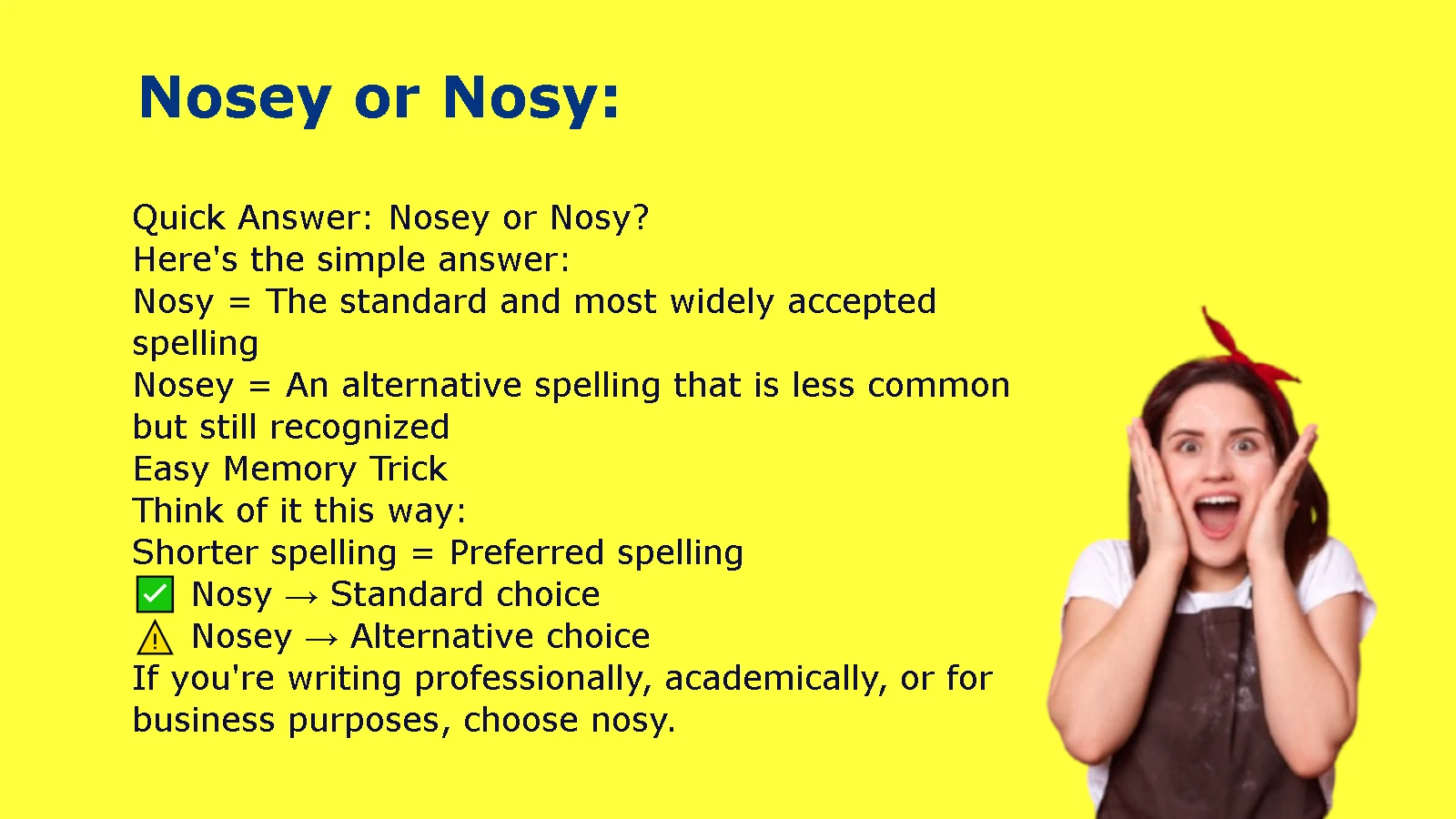
Quick Answer: Nosey or Nosy?
Here’s the simple answer:
Nosy = The standard and most widely accepted spelling
Nosey = An alternative spelling that is less common but still recognized
Easy Memory Trick
Think of it this way:
Shorter spelling = Preferred spelling
✅ Nosy → Standard choice
⚠️ Nosey → Alternative choice
If you’re writing professionally, academically, or for business purposes, choose nosy.
What Does “Nosy” Mean?
The word nosy describes someone who is overly interested in other people’s private affairs.
Simple Definition
A nosy person:
- Asks too many personal questions
- Wants information that doesn’t concern them
- Frequently interferes in others’ business
Example Sentences
- My neighbor is incredibly nosy and always asks where I’m going.
- Don’t be so nosy about other people’s salaries.
- The reporter was criticized for asking nosy questions.
Key Idea
Being nosy means showing curiosity where it isn’t welcome.
Why Are There Two Spellings?
This is where the confusion begins.
The word comes from nose, based on the idea of someone “sticking their nose” into other people’s affairs.
Over time, two spellings developed:
- Nosey
- Nosy
Both appeared in English usage, but one eventually became more popular.
How Language Evolved
Originally, writers often used nosey because it clearly connected to the word nose.
Later, nosy became the preferred simplified spelling and gained acceptance in dictionaries and style guides.
Key Insight
The meanings are identical.
The difference is primarily spelling preference.
Which Spelling Do Dictionaries Prefer?
Most modern dictionaries list nosy as the primary spelling.
Common Dictionary Preference
| Dictionary Style | Preferred Form |
| Modern American English | Nosy |
| Most Style Guides | Nosy |
| Alternative Accepted Form | Nosey |
What This Means
If you’re unsure which version to choose:
Use “nosy.”
It’s the safer option in almost every situation.
The History Behind “Nosy” and “Nosey”
Understanding the word’s history makes the spelling difference easier to remember.
The Origin
The expression comes from the idea of:
Putting your nose where it doesn’t belong.
Over time, English speakers began describing curious people as:
- Nosey
- Nosy
Both spellings spread through newspapers, books, and conversation.
Modern Usage
Today:
- Nosy dominates formal writing.
- Nosey survives as a recognized variant.
Key Takeaway
The language accepted both forms, but one became more popular.
“Nosy” Explained With Examples
Let’s look at the preferred spelling in action.
Everyday Examples
- Stop being so nosy.
- My little brother is nosy about everything.
- She asked a few nosy questions during dinner.
Workplace Examples
- The employee was considered nosy because she monitored everyone’s projects.
- Avoid asking nosy questions during interviews.
Social Situations
- Some people mistake friendliness for being nosy.
- A nosy guest can make others uncomfortable.
Key Observation
This spelling appears most often in modern English.
“Nosey” Explained With Examples
Although less common, nosey still appears in many contexts.
Example Sentences
- My nosey aunt always wants family gossip.
- He made a few nosey comments about my finances.
- The kids were being nosey and listening at the door.
Is It Wrong?
No.
Many dictionaries still recognize nosey as a valid alternative spelling.
The Catch
Readers may view it as less standard than nosy.
The Biggest Mistake Writers Make
Many people assume one spelling is completely wrong.
That’s not true.
Common Misunderstanding
People often believe:
- Nosy = Correct
- Nosey = Incorrect
Reality:
- Nosy = Preferred
- Nosey = Acceptable variant
Why This Matters
Correcting someone for using nosey may not be justified because the spelling is recognized by many dictionaries.
Side-by-Side Comparison Table
Here’s a quick comparison you can save for future reference.
| Feature | Nosy | Nosey |
| Meaning | Curious about others’ affairs | Same meaning |
| Accepted in dictionaries | Yes | Yes |
| Most common today | Yes | No |
| Professional writing | Recommended | Less common |
| Informal writing | Yes | Yes |
Winner
For most situations, nosy is the better choice.
Real-Life Examples of “Nosy”
Here are examples you might hear every day.
Family
“Don’t be so nosy about your sister’s plans.”
School
“The students were nosy about the teacher’s personal life.”
Office
“A nosy coworker can create unnecessary tension.”
Online
“People can become nosy on social media.”
Real-Life Examples of “Nosey”
You may still encounter the alternative spelling.
Family Conversation
“My nosey neighbor watches everyone who walks by.”
Community Life
“Small towns sometimes develop a reputation for nosey gossip.”
Informal Writing
“She’s too nosey for her own good.”
Key Point
The meaning never changes.
Only the spelling does.
Regional Differences in Usage
English varies around the world.
United States
Nosy is overwhelmingly preferred.
United Kingdom
Both spellings appear, though nosy remains more common.
Online Writing
You’ll find both forms across blogs, forums, and social media.
Important Note
Regardless of location, readers understand both spellings.
How to Avoid Spelling Confusion
Want a simple solution?
Use These Rules
For formal writing:
- Use nosy
For business communication:
- Use nosy
For school assignments:
- Use nosy
For casual writing:
- Either spelling works
Why This Works
You’ll match the spelling preferred by most dictionaries and editors.
Better Alternatives to “Nosy”
Sometimes you may want a different word altogether.
Similar Words
- Inquisitive
- Curious
- Meddlesome
- Intrusive
- Prying
- Interfering
- Snooping
Example
Instead of:
“She’s very nosy.”
You could say:
“She’s extremely inquisitive.”
Tip
Choose the alternative that best matches your intended tone.
Quick Decision Guide
Use this simple rule:
Need a standard spelling?
→ Nosy
Need an accepted alternative?
→ Nosey
Want maximum clarity?
→ Nosy
Simple. Reliable. Done.
FAQ: Nosey or Nosy
Is “nosey” a real word?
Yes. It is a recognized alternative spelling of nosy.
Which spelling is more common?
Nosy is significantly more common in modern English.
Is “nosey” incorrect?
No. Most dictionaries still accept it.
Which spelling should I use in professional writing?
Use nosy.
Do the words have different meanings?
No. They mean exactly the same thing.
Case Study: A Simple Editing Decision
A content writer was preparing an article for a business website.
The original sentence read:
“Customers may view the survey as nosey.”
The editor changed it to:
“Customers may view the survey as nosy.”
Why?
The editor wanted to follow modern style preferences and maintain consistency.
Result
The article matched common dictionary standards and looked more professional.
Lesson
When in doubt, choose nosy.
Key Facts You Should Remember
- Nosy and nosey mean the same thing.
- Both spellings are recognized.
- Nosy is the preferred modern spelling.
- Nosey is less common but acceptable.
- Professional writing generally favors nosy.
- Readers understand both forms.
Final Takeaway: Which Should You Use?
Here’s the bottom line.
The debate over nosey or nosy isn’t really about right versus wrong. Both spellings have existed for years, and both are understood by English speakers. The real difference is popularity and style preference.
If you want the safest choice, use nosy. It’s the version favored by modern dictionaries, editors, teachers, and professional writers.
Think of it like choosing between two roads that lead to the same destination. Both will get you there, but one is more commonly traveled.
So remember:
Nosy = Preferred spelling
Nosey = Accepted alternative
When clarity matters, stick with nosy and you’ll rarely go wrong.