Looking for other ways to ask someone to reply to your email without sounding rude or impatient? You’re not alone.
Waiting for a response can be frustrating, especially when your email is important or time-sensitive.
However, directly saying “please reply” too often may sound demanding or repetitive.
Using the right wording helps you stay polite, professional, and respectful while still encouraging a response.
A thoughtful follow-up message can increase your chances of getting a timely reply.
In this article, you’ll discover effective and courteous ways to ask someone to respond to your email with examples.
What Does “Ask Someone to Reply to Your Email” Mean?
It simply means requesting a response from the recipient after sending an email. This can include confirming information, answering questions, or providing updates. The goal is to encourage timely and clear communication.
When to Use These Email Reply Requests
These phrases are useful in professional emails, business communication, client follow-ups, job applications, and even casual messages. They help ensure your email doesn’t get ignored while keeping the tone respectful and clear.
Is It Professional/Polite to Ask Someone to Reply to Your Email?
Yes, it is both professional and polite—as long as the wording is respectful. Using softer or more thoughtful alternatives can improve your chances of getting a response without sounding demanding.
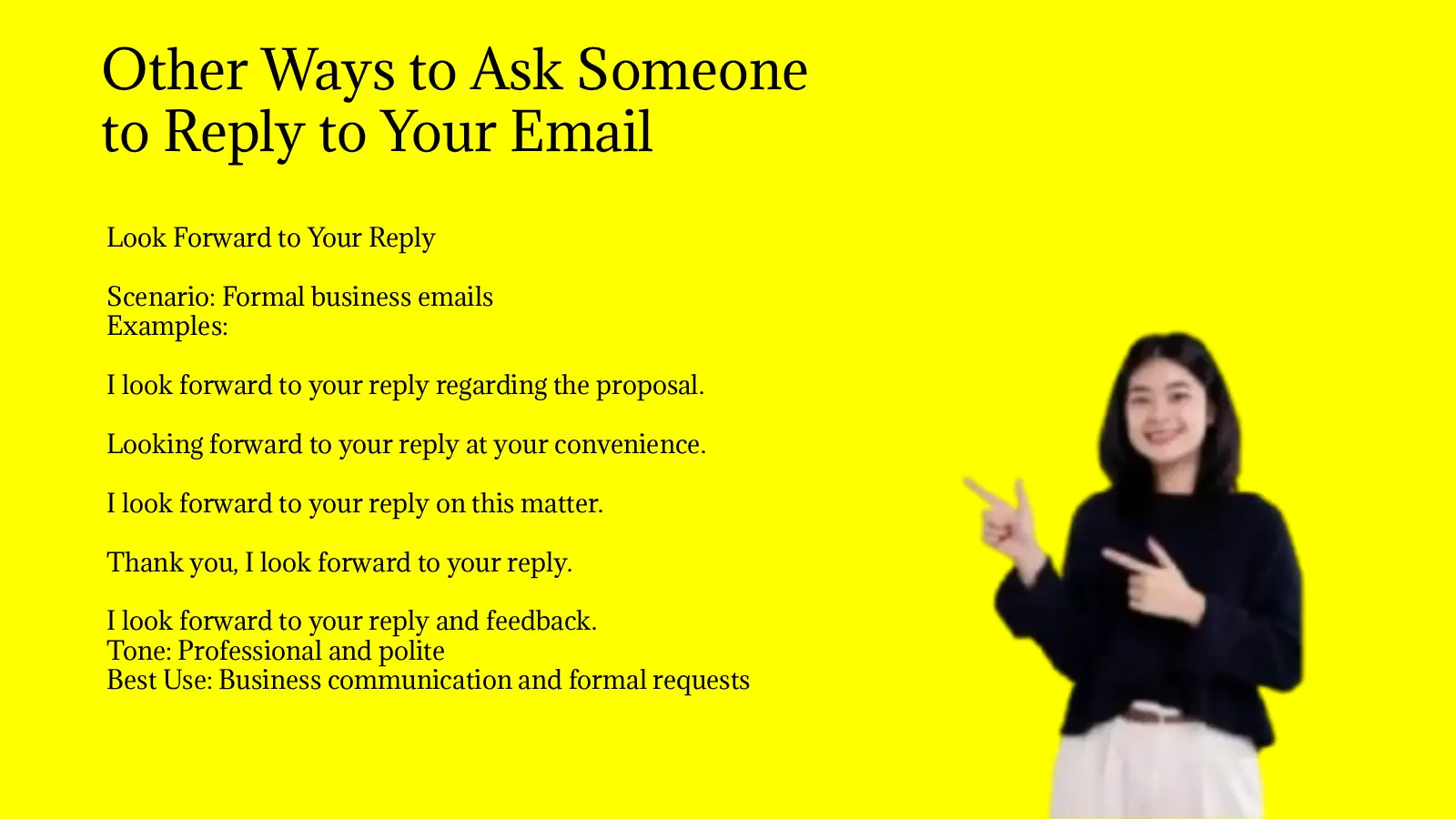
1. I Look Forward to Your Reply
Scenario: Formal business emails
Examples:
- I look forward to your reply regarding the proposal.
- Looking forward to your reply at your convenience.
- I look forward to your reply on this matter.
- Thank you, I look forward to your reply.
- I look forward to your reply and feedback.
Tone: Professional and polite
Best Use: Business communication and formal requests
2. I Would Appreciate Your Response
Scenario: Respectful professional request
Examples:
- I would appreciate your response by tomorrow.
- I would appreciate your response on this issue.
- I would appreciate your response when possible.
- Kindly note, I would appreciate your response.
- I would appreciate your response at your earliest convenience.
Tone: Polite and courteous
Best Use: Work emails and formal follow-ups
3. Please Let Me Know Your Thoughts
Scenario: Seeking feedback or opinion
Examples:
- Please let me know your thoughts on this proposal.
- I’d appreciate it if you could let me know your thoughts.
- Please let me know your thoughts when you review this.
- Let me know your thoughts at your convenience.
- Please share your thoughts on this matter.
Tone: Friendly and open
Best Use: Collaborative discussions
4. Kindly Respond at Your Earliest Convenience
Scenario: Polite urgency
Examples:
- Kindly respond at your earliest convenience.
- Please kindly respond when you have time.
- I would be grateful if you could respond soon.
- Kindly respond at your earliest convenience regarding this matter.
- Please respond when possible.
Tone: Respectful and formal
Best Use: Professional and client emails
5. I Would Be Grateful for Your Reply
Scenario: Polite formal request
Examples:
- I would be grateful for your reply on this issue.
- I would be grateful for your prompt reply.
- I would be grateful for your reply regarding the update.
- I would be grateful if you could reply soon.
- I would be grateful for your response.
Tone: Courteous and formal
Best Use: Official communication
6. Looking Forward to Hearing From You
Scenario: Friendly follow-up
Examples:
- Looking forward to hearing from you soon.
- I’m looking forward to hearing from you.
- Looking forward to hearing from you regarding this matter.
- Hope to hear from you soon.
- Looking forward to hearing your response.
Tone: Warm and professional
Best Use: General business emails
7. Please Respond When You Have a Moment
Scenario: Casual professional tone
Examples:
- Please respond when you have a moment.
- Kindly respond when you get time.
- Please reply when convenient.
- Respond when you have a moment.
- Please get back to me when you can.
Tone: Friendly and flexible
Best Use: Internal team communication
8. Could You Kindly Reply?
Scenario: Direct but polite request
Examples:
- Could you kindly reply to this email?
- Could you kindly reply with details?
- Could you kindly reply when possible?
- Could you kindly reply by tomorrow?
- Could you kindly reply regarding this matter?
Tone: Polite and professional
Best Use: Work emails requiring response
9. I’d Appreciate a Quick Response
Scenario: Slight urgency
Examples:
- I’d appreciate a quick response on this.
- Please provide a quick response if possible.
- I’d appreciate a quick response today.
- A quick response would be appreciated.
- Kindly send a quick response when possible.
Tone: Polite but slightly urgent
Best Use: Time-sensitive communication
10. Please Get Back to Me
Scenario: General follow-up
Examples:
- Please get back to me on this issue.
- Kindly get back to me soon.
- Please get back to me when you can.
- I’d appreciate it if you get back to me.
- Please get back to me with your feedback.
Tone: Neutral and direct
Best Use: Everyday communication
11. Awaiting Your Reply
Scenario: Formal waiting tone
Examples:
- I am awaiting your reply.
- Awaiting your reply on this matter.
- We are awaiting your reply.
- Awaiting your prompt response.
- I remain awaiting your reply.
Tone: Formal and professional
Best Use: Business correspondence
12. Please Advise
Scenario: Seeking guidance
Examples:
- Please advise on how to proceed.
- Kindly advise at your earliest convenience.
- Please advise regarding the next steps.
- Please advise if any changes are needed.
- Kindly advise your decision.
Tone: Professional and concise
Best Use: Corporate communication
13. I Would Love Your Feedback
Scenario: Collaborative tone
Examples:
- I would love your feedback on this idea.
- Please share your feedback when possible.
- I would love your feedback on the draft.
- Kindly provide your feedback.
- Looking forward to your feedback.
Tone: Friendly and open
Best Use: Team collaboration
14. Please Reply at Your Convenience
Scenario: Non-urgent request
Examples:
- Please reply at your convenience.
- Kindly reply when you have time.
- Please respond when convenient.
- Reply when possible.
- Please share your reply at your convenience.
Tone: Polite and relaxed
Best Use: General emails
15. I Would Appreciate Hearing Back From You
Scenario: Warm professional tone
Examples:
- I would appreciate hearing back from you soon.
- I would appreciate hearing back regarding this.
- Kindly let me hear back from you.
- I’d appreciate hearing your response.
- Looking forward to hearing back from you.
Tone: Courteous and warm
Best Use: Client and partner communication
16. I Would Be Glad to Hear From You
Scenario: Polite and warm follow-up
Examples:
- I would be glad to hear from you regarding this update.
- I would be glad to hear from you soon.
- I would be glad to hear your thoughts on this matter.
- I would be glad to hear from you at your convenience.
- I would be glad to hear your response.
Tone: Friendly and respectful
Best Use: Professional yet warm communication
17. Your Response Would Be Greatly Appreciated
Scenario: Formal and respectful request
Examples:
- Your response would be greatly appreciated.
- Your response on this issue would be greatly appreciated.
- A prompt response would be greatly appreciated.
- Your response would be greatly appreciated at this stage.
- I would greatly appreciate your response.
Tone: Formal and courteous
Best Use: Business and official emails
18. I’m Eager to Hear From You
Scenario: Engaged and active interest
Examples:
- I’m eager to hear from you about the proposal.
- I’m eager to hear your feedback.
- I’m eager to hear your response soon.
- I’m eager to hear from you when possible.
- I’m eager to hear your thoughts on this.
Tone: Enthusiastic and positive
Best Use: Collaborative or project-based emails
19. Please Don’t Hesitate to Reply
Scenario: Friendly and encouraging tone
Examples:
- Please don’t hesitate to reply if you have questions.
- Don’t hesitate to reply at any time.
- Please don’t hesitate to reply with feedback.
- Don’t hesitate to reply when convenient.
- Please don’t hesitate to reply to this message.
Tone: Supportive and open
Best Use: Customer service or friendly communication
20. I Would Value Your Reply
Scenario: Respectful and professional tone
Examples:
- I would value your reply on this matter.
- I would highly value your reply.
- I would value your reply when possible.
- I would truly value your response.
- I would value your reply and feedback.
Tone: Professional and appreciative
Best Use: Formal communication or client emails
21. Hoping to Hear From You Soon
Scenario: Friendly follow-up
Examples:
- Hoping to hear from you soon regarding this.
- I’m hoping to hear from you soon.
- Hoping to hear from you at your convenience.
- We’re hoping to hear from you soon.
- Hoping to hear your response shortly.
Tone: Warm and polite
Best Use: General professional or personal emails
22. Please Share Your Response
Scenario: Clear and direct request
Examples:
- Please share your response when ready.
- Kindly share your response with us.
- Please share your response on this issue.
- Share your response at your convenience.
- Please share your response via email.
Tone: Neutral and professional
Best Use: Work communication and updates
23. I Would Appreciate Your Input
Scenario: Seeking opinion or feedback
Examples:
- I would appreciate your input on this matter.
- I would appreciate your input regarding the proposal.
- Kindly provide your input when possible.
- I would truly appreciate your input.
- Your input would be appreciated.
Tone: Respectful and collaborative
Best Use: Teamwork and decision-making emails
24. Please Respond at Your Earliest Opportunity
Scenario: Slight urgency but polite
Examples:
- Please respond at your earliest opportunity.
- Kindly respond at your earliest opportunity.
- I would appreciate a response at your earliest opportunity.
- Please get back at your earliest opportunity.
- Respond at your earliest opportunity when possible.
Tone: Formal and slightly urgent
Best Use: Time-sensitive professional emails
25. I Look Forward to Your Prompt Reply
Scenario: Formal closing request
Examples:
- I look forward to your prompt reply on this matter.
- Looking forward to your prompt reply.
- I look forward to your prompt reply and confirmation.
- I appreciate your help and look forward to your prompt reply.
- I look forward to your prompt reply at your convenience.
Tone: Professional and respectful
Best Use: Business, clients, and official communication
26. I’d Be Grateful for Your Reply
Scenario: Polite professional follow-up
Examples:
- I’d be grateful for your reply at your convenience.
- I’d be grateful for your reply regarding this matter.
- I’d be grateful for your prompt reply.
- I’d be grateful for your reply and feedback.
- I’d be grateful if you could reply soon.
Tone: Respectful and courteous
Best Use: Formal emails and client communication
27. Please Respond Soon
Scenario: Slight urgency
Examples:
- Please respond soon regarding this issue.
- Kindly respond soon when possible.
- Please respond soon so we can proceed.
- I would appreciate it if you respond soon.
- Please respond soon at your convenience.
Tone: Direct but polite
Best Use: Time-sensitive messages
28. Looking Forward to Your Response
Scenario: Professional closing
Examples:
- Looking forward to your response on this matter.
- I am looking forward to your response.
- Looking forward to your response and feedback.
- Looking forward to your response soon.
- We look forward to your response.
Tone: Warm and professional
Best Use: Business emails
29. Kindly Let Me Know
Scenario: Simple request for reply
Examples:
- Kindly let me know your thoughts.
- Kindly let me know your decision.
- Please kindly let me know when you’re available.
- Kindly let me know your response.
- Kindly let me know if this works for you.
Tone: Polite and neutral
Best Use: General communication
30. I Await Your Response
Scenario: Formal and structured tone
Examples:
- I await your response on this matter.
- We await your response.
- I await your prompt response.
- I await your feedback.
- I await your confirmation.
Tone: Formal and professional
Best Use: Official or business emails
31. Please Reply at Your Earliest Convenience
Scenario: Polite and flexible urgency
Examples:
- Please reply at your earliest convenience.
- Kindly reply at your earliest convenience.
- I would appreciate your reply at your earliest convenience.
- Please get back at your earliest convenience.
- Reply at your earliest convenience when possible.
Tone: Respectful and formal
Best Use: Professional communication
32. I’d Appreciate Hearing From You
Scenario: Friendly follow-up
Examples:
- I’d appreciate hearing from you soon.
- I’d appreciate hearing your response.
- I’d appreciate hearing your thoughts.
- I’d appreciate hearing from you on this matter.
- I’d appreciate hearing back from you.
Tone: Warm and polite
Best Use: General business or personal emails
33. Please Keep Me Updated
Scenario: Ongoing communication
Examples:
- Please keep me updated on progress.
- Kindly keep me updated.
- Please keep me updated with any changes.
- Keep me updated as things move forward.
- Please keep me updated regarding this matter.
Tone: Friendly and professional
Best Use: Projects and ongoing tasks
34. I Hope to Hear Back Soon
Scenario: Gentle follow-up
Examples:
- I hope to hear back soon from you.
- Hoping to hear back soon.
- I hope to hear back soon regarding this.
- We hope to hear back soon.
- I truly hope to hear back soon.
Tone: Warm and polite
Best Use: Friendly or professional emails
35. Please Don’t Forget to Reply
Scenario: Casual reminder
Examples:
- Please don’t forget to reply when you can.
- Don’t forget to reply to this email.
- Kindly don’t forget to reply.
- Please don’t forget to reply with details.
- Don’t forget to reply at your convenience.
Tone: Friendly but slightly firm
Best Use: Informal communication
36. Your Feedback Would Be Appreciated
Scenario: Requesting opinion
Examples:
- Your feedback would be appreciated on this.
- I would appreciate your feedback.
- Your feedback would be greatly appreciated.
- Kindly share your feedback.
- Please provide your feedback when possible.
Tone: Professional and respectful
Best Use: Work and collaboration emails
37. Please Reply When You Can
Scenario: Casual and relaxed tone
Examples:
- Please reply when you can.
- Kindly reply when you have time.
- Reply when you can.
- Please get back when you can.
- Respond when you can.
Tone: Friendly and flexible
Best Use: Informal or internal communication
38. I’d Love a Response From You
Scenario: Friendly and engaging
Examples:
- I’d love a response from you soon.
- I’d love a response when possible.
- I’d love a response on this matter.
- I’d love to hear your response.
- I’d love a response regarding this.
Tone: Warm and conversational
Best Use: Friendly emails or casual chats
39. Please Get Back to Me Soon
Scenario: Slight urgency
Examples:
- Please get back to me soon on this issue.
- Kindly get back to me soon.
- Please get back to me soon when possible.
- I would appreciate it if you get back to me soon.
- Please get back to me soon regarding this.
Tone: Direct but polite
Best Use: Time-sensitive communication
40. I Would Welcome Your Reply
Scenario: Formal and polite request
Examples:
- I would welcome your reply on this matter.
- I would welcome your reply at your convenience.
- I would welcome your feedback and reply.
- I would welcome your prompt reply.
- I would welcome your response soon.
Tone: Respectful and formal
Best Use: Business or official emails
41. Please Share Your Thoughts
Scenario: Seeking opinion
Examples:
- Please share your thoughts on this idea.
- Kindly share your thoughts when possible.
- Please share your thoughts with me.
- Share your thoughts at your convenience.
- I would appreciate if you share your thoughts.
Tone: Friendly and open
Best Use: Collaboration or brainstorming
42. I’m Waiting for Your Response
Scenario: Direct follow-up
Examples:
- I’m waiting for your response on this matter.
- We are waiting for your response.
- I’m waiting for your response soon.
- I’m waiting for your reply.
- I’m still waiting for your response.
Tone: Neutral to slightly firm
Best Use: Follow-ups or reminders
43. Please Confirm and Reply
Scenario: Verification needed
Examples:
- Please confirm and reply to this email.
- Kindly confirm and reply soon.
- Please confirm and reply when possible.
- Confirm and reply at your convenience.
- Please confirm and reply regarding this.
Tone: Professional and clear
Best Use: Business instructions or approvals
44. I’d Appreciate a Response Soon
Scenario: Polite urgency
Examples:
- I’d appreciate a response soon.
- I’d appreciate a response at your earliest convenience.
- I’d appreciate a response regarding this matter.
- I’d appreciate a quick response soon.
- I’d appreciate your response soon.
Tone: Professional and courteous
Best Use: Work emails
45. Please Don’t Hesitate to Respond
Scenario: Encouraging reply
Examples:
- Please don’t hesitate to respond if needed.
- Don’t hesitate to respond anytime.
- Please don’t hesitate to respond with questions.
- Don’t hesitate to respond soon.
- Please don’t hesitate to respond at your convenience.
Tone: Friendly and supportive
Best Use: Customer service or friendly emails
46. I Look Forward to Hearing From You Soon
Scenario: Closing statement
Examples:
- I look forward to hearing from you soon.
- Looking forward to hearing from you soon.
- I look forward to hearing from you shortly.
- We look forward to hearing from you soon.
- I sincerely look forward to hearing from you soon.
Tone: Professional and warm
Best Use: Business closing lines
47. Kindly Reply to This Email
Scenario: Direct request
Examples:
- Kindly reply to this email at your convenience.
- Please kindly reply to this email.
- Kindly reply to this email soon.
- Kindly reply to this email with details.
- Kindly reply to this email when possible.
Tone: Formal and clear
Best Use: Straightforward business communication
Conclusion
Using varied ways to ask someone to reply to your email helps you sound more natural, polite, and professional. Instead of repeating the same phrase, you can choose expressions based on tone, urgency, and context. This improves communication, increases response rates, and builds stronger professional relationships.