Other Ways to Say Don’t Get Me Wrong is a useful guide for anyone who wants to express themselves clearly without being misunderstood—have you ever said something and immediately felt the need to soften it so it doesn’t come across the wrong way? You’re not alone. Many people rely on this phrase to clarify tone, especially in sensitive conversations.
But here’s the kicker: repeating the same expression can make your communication feel repetitive or less natural. Agreeing with that challenge, it’s not always easy to find polite and flexible alternatives that fit different situations. But here’s the promise: you don’t have to stick to just one phrase. In this guide, you will learn other ways to say don’t get me wrong, along with how and when to use each one so your message always sounds respectful, clear, and confident.
What Does “Don’t Get Me Wrong” Mean?
The phrase “don’t get me wrong” is used to clarify your intentions before or after making a statement that could be misunderstood. In other words, it helps prevent confusion and shows that you want your meaning to be interpreted correctly.
When to Use “Don’t Get Me Wrong”
You can use this phrase during conversations, workplace discussions, debates, friendly chats, or written communication. Moreover, it’s especially useful when expressing criticism, disagreement, or mixed opinions while still wanting to sound respectful.
Is It Professional/Polite to Say “Don’t Get Me Wrong”?
Yes, it is generally polite and acceptable. However, in professional settings, some alternatives may sound more polished and diplomatic. As a result, choosing a softer or clearer phrase can improve communication and avoid sounding defensive.
1. To Be Clear
Scenario: Clarifying a statement in professional communication.
Examples:
- To be clear, I appreciate your effort on this project.
- I support the idea; to be clear, I just think we need more time.
- To be clear, I’m not criticizing your work.
- To be clear, the issue is with the process, not the team.
- I agree overall; to be clear, I only have a few concerns.
Tone: Professional and direct.
Best Use: Workplace discussions, presentations, and emails.
2. I Don’t Mean to Sound Harsh
Scenario: Softening criticism or feedback.
Examples:
- I don’t mean to sound harsh, but we need better communication.
- I don’t mean to sound harsh, though the deadline was missed.
- I don’t mean to sound harsh, but this approach may not work.
- I don’t mean to sound harsh; however, the report needs revisions.
- I don’t mean to sound harsh, but we should reconsider the plan.
Tone: Gentle and considerate.
Best Use: Constructive criticism and sensitive conversations.
3. I’m Not Saying This Negatively
Scenario: Explaining a potentially sensitive opinion.
Examples:
- I’m not saying this negatively, but the project needs improvement.
- I’m not saying this negatively; I simply want better results.
- I’m not saying this negatively, though we need a stronger strategy.
- I’m not saying this negatively, but communication could improve.
- I’m not saying this negatively; I just want to help.
Tone: Reassuring and calm.
Best Use: Workplace feedback and discussions.
4. I Mean This Respectfully
Scenario: Sharing disagreement politely.
Examples:
- I mean this respectfully, but I disagree with the decision.
- I mean this respectfully; however, there may be a better solution.
- I mean this respectfully, though the timing seems difficult.
- I mean this respectfully, but we should review the proposal again.
- I mean this respectfully, and I value your opinion.
Tone: Respectful and diplomatic.
Best Use: Professional disagreements and formal conversations.
5. Just to Clarify
Scenario: Preventing misunderstanding.
Examples:
- Just to clarify, I’m fully supportive of the project.
- Just to clarify, my concern is about the budget.
- Just to clarify, I wasn’t blaming anyone.
- Just to clarify, I agree with most of your points.
- Just to clarify, this suggestion is optional.
Tone: Neutral and informative.
Best Use: Meetings, emails, and team discussions.
6. I’m Simply Saying
Scenario: Emphasizing your actual intention.
Examples:
- I’m simply saying we should review the details again.
- I’m simply saying there may be another solution.
- I’m simply saying we need more preparation.
- I’m simply saying communication matters here.
- I’m simply saying the timeline feels too short.
Tone: Calm and conversational.
Best Use: Casual and workplace discussions.
7. That’s Not What I Mean
Scenario: Correcting a misunderstanding.
Examples:
- That’s not what I mean; I’m only suggesting improvements.
- That’s not what I mean, though I understand your concern.
- That’s not what I mean; I actually support the idea.
- That’s not what I mean, and I apologize if it sounded harsh.
- That’s not what I mean; I’m trying to help.
Tone: Clarifying and reassuring.
Best Use: Resolving confusion during conversations.
8. I’m Not Trying to Criticize
Scenario: Giving feedback carefully.
Examples:
- I’m not trying to criticize, but we need better organization.
- I’m not trying to criticize; however, this process seems inefficient.
- I’m not trying to criticize, though improvements are necessary.
- I’m not trying to criticize, but communication could improve.
- I’m not trying to criticize; I only want success for the team.
Tone: Supportive and diplomatic.
Best Use: Team feedback and workplace communication.
9. Please Don’t Take This the Wrong Way
Scenario: Introducing sensitive comments.
Examples:
- Please don’t take this the wrong way, but the design needs changes.
- Please don’t take this the wrong way; I’m only being honest.
- Please don’t take this the wrong way, though I have concerns.
- Please don’t take this the wrong way, but I expected different results.
- Please don’t take this the wrong way; I respect your effort.
Tone: Polite and cautious.
Best Use: Delicate conversations and constructive feedback.
10. I’m Only Being Honest
Scenario: Sharing truthful opinions carefully.
Examples:
- I’m only being honest, but the presentation could be stronger.
- I’m only being honest; however, the strategy feels risky.
- I’m only being honest, though I appreciate your hard work.
- I’m only being honest, but we should improve communication.
- I’m only being honest because I want this to succeed.
Tone: Honest yet considerate.
Best Use: Personal and professional discussions.
11. To Put It Another Way
Scenario: Rephrasing for clarity.
Examples:
- To put it another way, we need more preparation time.
- To put it another way, the process lacks structure.
- To put it another way, I support the idea with adjustments.
- To put it another way, communication is the real issue.
- To put it another way, we should rethink the timeline.
Tone: Clear and explanatory.
Best Use: Clarifications and presentations.
12. I Hope This Doesn’t Sound Wrong
Scenario: Softening sensitive remarks.
Examples:
- I hope this doesn’t sound wrong, but we need more planning.
- I hope this doesn’t sound wrong; however, I expected more detail.
- I hope this doesn’t sound wrong, though I have concerns.
- I hope this doesn’t sound wrong, but the approach seems risky.
- I hope this doesn’t sound wrong; I’m trying to help.
Tone: Gentle and careful.
Best Use: Sensitive conversations.
13. Let Me Explain What I Mean
Scenario: Clarifying intentions further.
Examples:
- Let me explain what I mean before we continue.
- Let me explain what I mean; I’m not opposing the idea.
- Let me explain what I mean regarding the proposal.
- Let me explain what I mean because I may have sounded unclear.
- Let me explain what I mean in a simpler way.
Tone: Helpful and explanatory.
Best Use: Meetings and discussions.
14. I’m Not Against It
Scenario: Expressing partial agreement.
Examples:
- I’m not against it, but I think we need adjustments.
- I’m not against it; however, timing is important.
- I’m not against it, though there are risks involved.
- I’m not against it, but we should plan carefully.
- I’m not against it; I just want better results.
Tone: Neutral and balanced.
Best Use: Professional discussions and debates.
15. What I’m Trying to Say Is
Scenario: Restating your point more clearly.
Examples:
- What I’m trying to say is that we need more support.
- What I’m trying to say is communication matters here.
- What I’m trying to say is we should reconsider the timeline.
- What I’m trying to say is that teamwork will help.
- What I’m trying to say is the idea has potential.
Tone: Conversational and explanatory.
Best Use: Casual and professional conversations.
16. I’m Coming From a Good Place
Scenario: Showing positive intentions.
Examples:
- I’m coming from a good place with this feedback.
- I’m coming from a good place, though my words may sound direct.
- I’m coming from a good place because I care about the project.
- I’m coming from a good place and want the best outcome.
- I’m coming from a good place while sharing these concerns.
Tone: Warm and sincere.
Best Use: Personal conversations and teamwork.
17. I’m Not Blaming Anyone
Scenario: Avoiding conflict.
Examples:
- I’m not blaming anyone, but we should improve the process.
- I’m not blaming anyone; however, mistakes happened.
- I’m not blaming anyone, though we need accountability.
- I’m not blaming anyone, but communication broke down.
- I’m not blaming anyone; I just want solutions.
Tone: Neutral and solution-focused.
Best Use: Workplace problem-solving.
18. I’m Just Being Straightforward
Scenario: Honest communication.
Examples:
- I’m just being straightforward about the challenges.
- I’m just being straightforward; we need more planning.
- I’m just being straightforward because transparency matters.
- I’m just being straightforward, though I respect your opinion.
- I’m just being straightforward about my concerns.
Tone: Honest and direct.
Best Use: Professional discussions.
19. I’m Not Dismissing Your Opinion
Scenario: Respecting someone’s viewpoint.
Examples:
- I’m not dismissing your opinion, but I see it differently.
- I’m not dismissing your opinion; however, there are risks involved.
- I’m not dismissing your opinion, though I have concerns.
- I’m not dismissing your opinion because your ideas matter.
- I’m not dismissing your opinion; I simply disagree.
Tone: Respectful and diplomatic.
Best Use: Debates and meetings.
20. I See Your Point, But
Scenario: Polite disagreement.
Examples:
- I see your point, but we should review the numbers again.
- I see your point; however, there may be another solution.
- I see your point, but timing could be an issue.
- I see your point, though I still have concerns.
- I see your point, but we should discuss alternatives.
Tone: Respectful and collaborative.
Best Use: Professional disagreements.
21. I’m Not Trying to Be Rude
Scenario: Softening direct comments.
Examples:
- I’m not trying to be rude, but the schedule needs improvement.
- I’m not trying to be rude; however, communication was unclear.
- I’m not trying to be rude, though I expected better results.
- I’m not trying to be rude, but we should reconsider the plan.
- I’m not trying to be rude; I just want honesty here.
Tone: Careful and polite.
Best Use: Difficult conversations and feedback.
22. I Say This With Respect
Scenario: Expressing disagreement professionally.
Examples:
- I say this with respect, but the strategy may not work.
- I say this with respect; however, there are concerns.
- I say this with respect, though we should review the details.
- I say this with respect, but the timing feels rushed.
- I say this with respect because I value your perspective.
Tone: Formal and respectful.
Best Use: Workplace discussions and debates.
23. I’m Merely Pointing Out
Scenario: Highlighting observations calmly.
Examples:
- I’m merely pointing out that the process could improve.
- I’m merely pointing out the risks involved.
- I’m merely pointing out that deadlines are becoming tighter.
- I’m merely pointing out a possible issue here.
- I’m merely pointing out what may affect the results.
Tone: Neutral and analytical.
Best Use: Professional conversations and reports.
24. I’m Not Questioning Your Effort
Scenario: Respecting someone’s hard work.
Examples:
- I’m not questioning your effort, but we need adjustments.
- I’m not questioning your effort; however, the outcome needs work.
- I’m not questioning your effort, though improvements are necessary.
- I’m not questioning your effort because I know you worked hard.
- I’m not questioning your effort; I simply have concerns.
Tone: Appreciative and diplomatic.
Best Use: Performance feedback and teamwork discussions.
25. I’m Simply Being Transparent
Scenario: Honest workplace communication.
Examples:
- I’m simply being transparent about the challenges ahead.
- I’m simply being transparent; we need more resources.
- I’m simply being transparent regarding the timeline.
- I’m simply being transparent because communication matters.
- I’m simply being transparent about my concerns.
Tone: Honest and professional.
Best Use: Leadership and business discussions.
26. I’m Not Trying to Offend Anyone
Scenario: Sensitive group discussions.
Examples:
- I’m not trying to offend anyone, but changes are needed.
- I’m not trying to offend anyone; however, we need honesty.
- I’m not trying to offend anyone, though I disagree.
- I’m not trying to offend anyone, but the process feels unfair.
- I’m not trying to offend anyone; I’m sharing my perspective.
Tone: Careful and respectful.
Best Use: Group meetings and debates.
27. If I’m Being Honest
Scenario: Sharing sincere opinions.
Examples:
- If I’m being honest, the timeline seems unrealistic.
- If I’m being honest, we need a stronger strategy.
- If I’m being honest, communication could improve.
- If I’m being honest, I expected different results.
- If I’m being honest, the project still has potential.
Tone: Honest and conversational.
Best Use: Casual and workplace discussions.
28. I’m Just Trying to Help
Scenario: Offering constructive advice.
Examples:
- I’m just trying to help by sharing my thoughts.
- I’m just trying to help; however, we need changes.
- I’m just trying to help improve the situation.
- I’m just trying to help because I care about the outcome.
- I’m just trying to help the team succeed.
Tone: Supportive and sincere.
Best Use: Team collaboration and personal conversations.
29. I Hope You Understand What I Mean
Scenario: Clarifying intentions politely.
Examples:
- I hope you understand what I mean about the project.
- I hope you understand what I mean; I’m not criticizing anyone.
- I hope you understand what I mean regarding the concerns.
- I hope you understand what I mean because clarity matters.
- I hope you understand what I mean about the timeline.
Tone: Gentle and explanatory.
Best Use: Professional and personal discussions.
30. I’m Looking at This Objectively
Scenario: Analytical discussions.
Examples:
- I’m looking at this objectively, and risks remain.
- I’m looking at this objectively; however, changes are needed.
- I’m looking at this objectively because results matter.
- I’m looking at this objectively, though I respect your view.
- I’m looking at this objectively from a business perspective.
Tone: Rational and professional.
Best Use: Workplace analysis and strategy meetings.
31. I’m Not Making a Personal Attack
Scenario: Avoiding emotional misunderstandings.
Examples:
- I’m not making a personal attack; I’m discussing the issue.
- I’m not making a personal attack, though we disagree.
- I’m not making a personal attack because this is business-related.
- I’m not making a personal attack; I simply want improvement.
- I’m not making a personal attack, but concerns exist.
Tone: Calm and defensive.
Best Use: Conflict resolution and debates.
32. I Respectfully Disagree
Scenario: Professional disagreement.
Examples:
- I respectfully disagree with the proposed strategy.
- I respectfully disagree; however, I value your input.
- I respectfully disagree because the risks are significant.
- I respectfully disagree, though I understand your perspective.
- I respectfully disagree with the final conclusion.
Tone: Professional and diplomatic.
Best Use: Meetings and formal discussions.
33. I’m Sharing This Constructively
Scenario: Giving feedback positively.
Examples:
- I’m sharing this constructively to improve results.
- I’m sharing this constructively because the team matters.
- I’m sharing this constructively; however, changes are needed.
- I’m sharing this constructively to support the project.
- I’m sharing this constructively, not negatively.
Tone: Positive and helpful.
Best Use: Workplace feedback.
34. I’m Trying to Be Fair
Scenario: Balanced opinions.
Examples:
- I’m trying to be fair while reviewing the situation.
- I’m trying to be fair; however, mistakes happened.
- I’m trying to be fair regarding everyone involved.
- I’m trying to be fair because both sides matter.
- I’m trying to be fair, though concerns remain.
Tone: Balanced and thoughtful.
Best Use: Team discussions and evaluations.
35. I’m Not Saying You’re Wrong
Scenario: Soft disagreement.
Examples:
- I’m not saying you’re wrong, but there may be another way.
- I’m not saying you’re wrong; however, I see risks.
- I’m not saying you’re wrong because your idea has merit.
- I’m not saying you’re wrong, though I disagree slightly.
- I’m not saying you’re wrong; I just see things differently.
Tone: Respectful and calm.
Best Use: Debates and brainstorming sessions.
36. I’m Speaking Honestly
Scenario: Direct communication.
Examples:
- I’m speaking honestly about the current challenges.
- I’m speaking honestly because transparency is important.
- I’m speaking honestly, though the topic is sensitive.
- I’m speaking honestly to help the project improve.
- I’m speaking honestly regarding my concerns.
Tone: Open and sincere.
Best Use: Honest discussions and meetings.
37. I Don’t Want This to Sound Negative
Scenario: Softening criticism.
Examples:
- I don’t want this to sound negative, but revisions are needed.
- I don’t want this to sound negative; however, concerns remain.
- I don’t want this to sound negative because I value the effort.
- I don’t want this to sound negative, though we need changes.
- I don’t want this to sound negative; I’m trying to help.
Tone: Gentle and considerate.
Best Use: Workplace feedback and reviews.
38. I’m Offering Another Perspective
Scenario: Sharing alternative viewpoints.
Examples:
- I’m offering another perspective on the strategy.
- I’m offering another perspective because the issue is complex.
- I’m offering another perspective; however, I respect your opinion.
- I’m offering another perspective to improve discussion.
- I’m offering another perspective regarding the timeline.
Tone: Open-minded and collaborative.
Best Use: Brainstorming and team discussions.
39. I’m Not Trying to Cause Conflict
Scenario: Preventing tension.
Examples:
- I’m not trying to cause conflict, but concerns exist.
- I’m not trying to cause conflict; however, we need solutions.
- I’m not trying to cause conflict because teamwork matters.
- I’m not trying to cause conflict, though I disagree.
- I’m not trying to cause conflict; I simply want clarity.
Tone: Peaceful and diplomatic.
Best Use: Conflict resolution and meetings.
40. I’m Sharing My Honest Opinion
Scenario: Personal viewpoints.
Examples:
- I’m sharing my honest opinion about the proposal.
- I’m sharing my honest opinion; however, I respect yours.
- I’m sharing my honest opinion because transparency matters.
- I’m sharing my honest opinion regarding the timeline.
- I’m sharing my honest opinion to help improve results.
Tone: Honest and respectful.
Best Use: Discussions and evaluations.
41. I’m Not Suggesting Anything Negative
Scenario: Clarifying intentions.
Examples:
- I’m not suggesting anything negative about the team.
- I’m not suggesting anything negative; however, improvements are needed.
- I’m not suggesting anything negative because I support the idea.
- I’m not suggesting anything negative regarding your effort.
- I’m not suggesting anything negative; I only want clarity.
Tone: Reassuring and polite.
Best Use: Team communication and reviews.
42. Let Me Rephrase That
Scenario: Correcting wording.
Examples:
- Let me rephrase that because it sounded too harsh.
- Let me rephrase that to make my point clearer.
- Let me rephrase that; I’m not criticizing anyone.
- Let me rephrase that because I meant something different.
- Let me rephrase that in a more respectful way.
Tone: Helpful and corrective.
Best Use: Clarifications during discussions.
43. I’m Speaking From Experience
Scenario: Advice or professional insight.
Examples:
- I’m speaking from experience about project delays.
- I’m speaking from experience; however, every case is different.
- I’m speaking from experience because I’ve seen similar issues.
- I’m speaking from experience regarding communication challenges.
- I’m speaking from experience to help avoid mistakes.
Tone: Wise and informative.
Best Use: Mentorship and workplace advice.
44. I’m Not Trying to Sound Critical
Scenario: Soft feedback.
Examples:
- I’m not trying to sound critical, but improvements are necessary.
- I’m not trying to sound critical; however, concerns remain.
- I’m not trying to sound critical because I appreciate the effort.
- I’m not trying to sound critical, though revisions are needed.
- I’m not trying to sound critical; I simply want progress.
Tone: Diplomatic and careful.
Best Use: Professional feedback and evaluations.
45. I Understand Your Perspective, But
Scenario: Respectful disagreement.
Examples:
- I understand your perspective, but there are risks involved.
- I understand your perspective; however, we need another solution.
- I understand your perspective because your concerns are valid.
- I understand your perspective, though I see things differently.
- I understand your perspective, but timing is still an issue.
Tone: Respectful and collaborative.
Best Use: Workplace conversations and negotiations.
46. I’m Trying to Be Helpful
Scenario: Offering advice positively.
Examples:
- I’m trying to be helpful by sharing my concerns.
- I’m trying to be helpful because the project matters.
- I’m trying to be helpful; however, changes are needed.
- I’m trying to be helpful with this feedback.
- I’m trying to be helpful to improve the results.
Tone: Warm and supportive.
Best Use: Teamwork and mentoring.
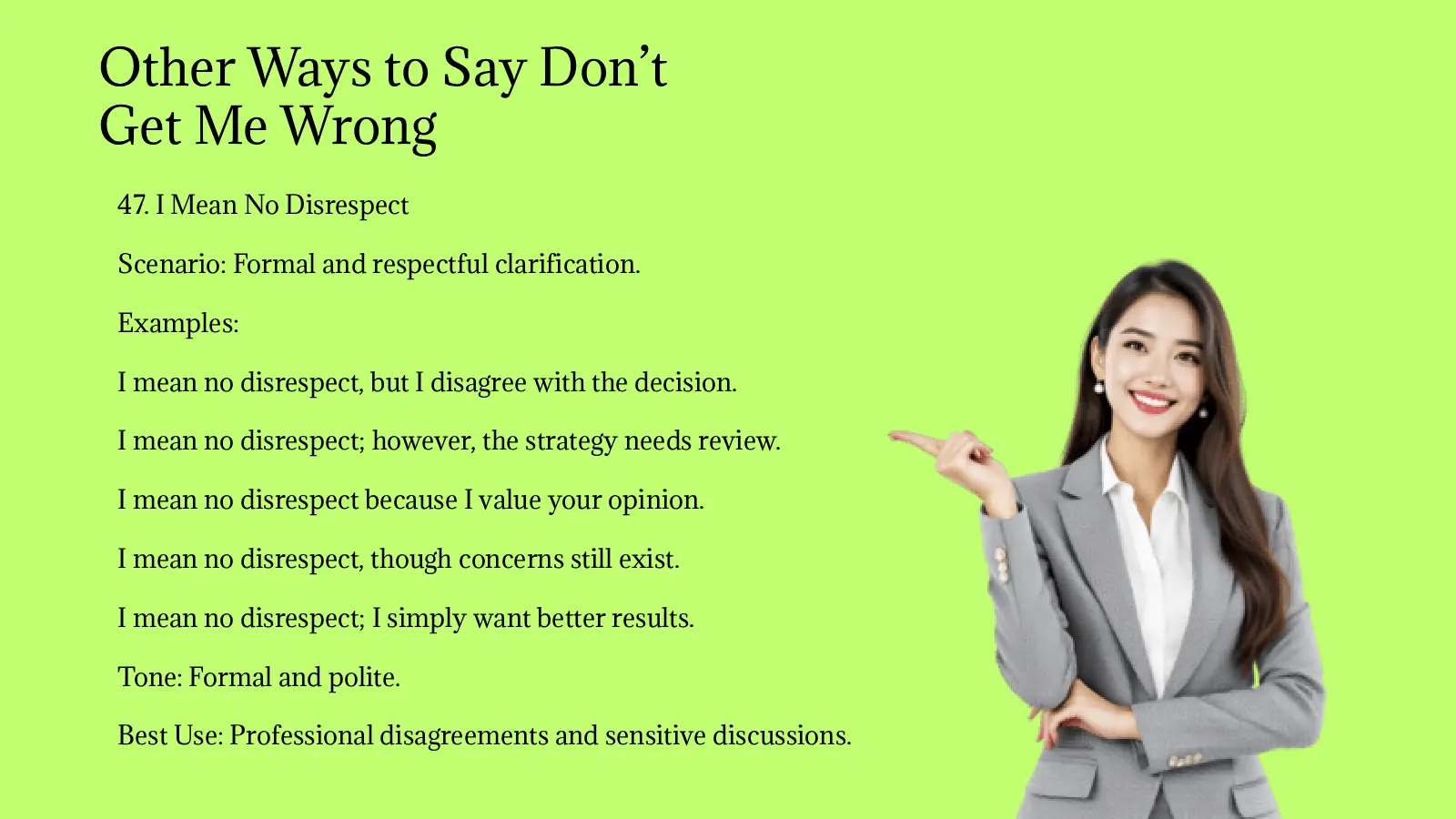
47. I Mean No Disrespect
Scenario: Formal and respectful clarification.
Examples:
- I mean no disrespect, but I disagree with the decision.
- I mean no disrespect; however, the strategy needs review.
- I mean no disrespect because I value your opinion.
- I mean no disrespect, though concerns still exist.
- I mean no disrespect; I simply want better results.
Tone: Formal and polite.
Best Use: Professional disagreements and sensitive discussions.
Conclusion
Although “don’t get me wrong” is a common phrase, using stronger and more thoughtful alternatives can make your communication sound more polished, respectful, and professional. Furthermore, these 47 alternatives help you express disagreement, clarify intentions, and give feedback without sounding defensive or harsh. Whether you’re speaking in a workplace meeting, writing an email, or having a personal conversation, these phrases can help you communicate more effectively and confidently.