Finding other ways to say “make sure” is the quickest way to polish your writing and sound like an authority. Whether you are drafting a formal business email or writing a technical guide, using the same phrase repeatedly can make your content feel repetitive and less impactful.
In this guide, we’ve rounded up the most effective other ways to say “make sure” categorized by tone and context. You’ll learn how to ensure your message is clear, verify your details are accurate, and confirm your instructions are followed—all without overusing the same two words.
What Does “Make Sure” Mean?
“Make sure” is a phrase used to instruct, remind, or emphasize that something should be checked, completed, or confirmed. It conveys attention, responsibility, and caution.
While simple and effective, using it too often can feel repetitive. Alternatives allow you to adjust tone, add clarity, or sound more polished depending on the situation.
When to Use Alternatives to “Make Sure”
You can use these alternatives in situations such as:
- Writing professional emails or instructions
- Texting reminders to friends or family
- Giving guidance or directions
- Preparing checklists or manuals
- Encouraging careful action
37 Alternatives to “Make Sure” and How to Use Them
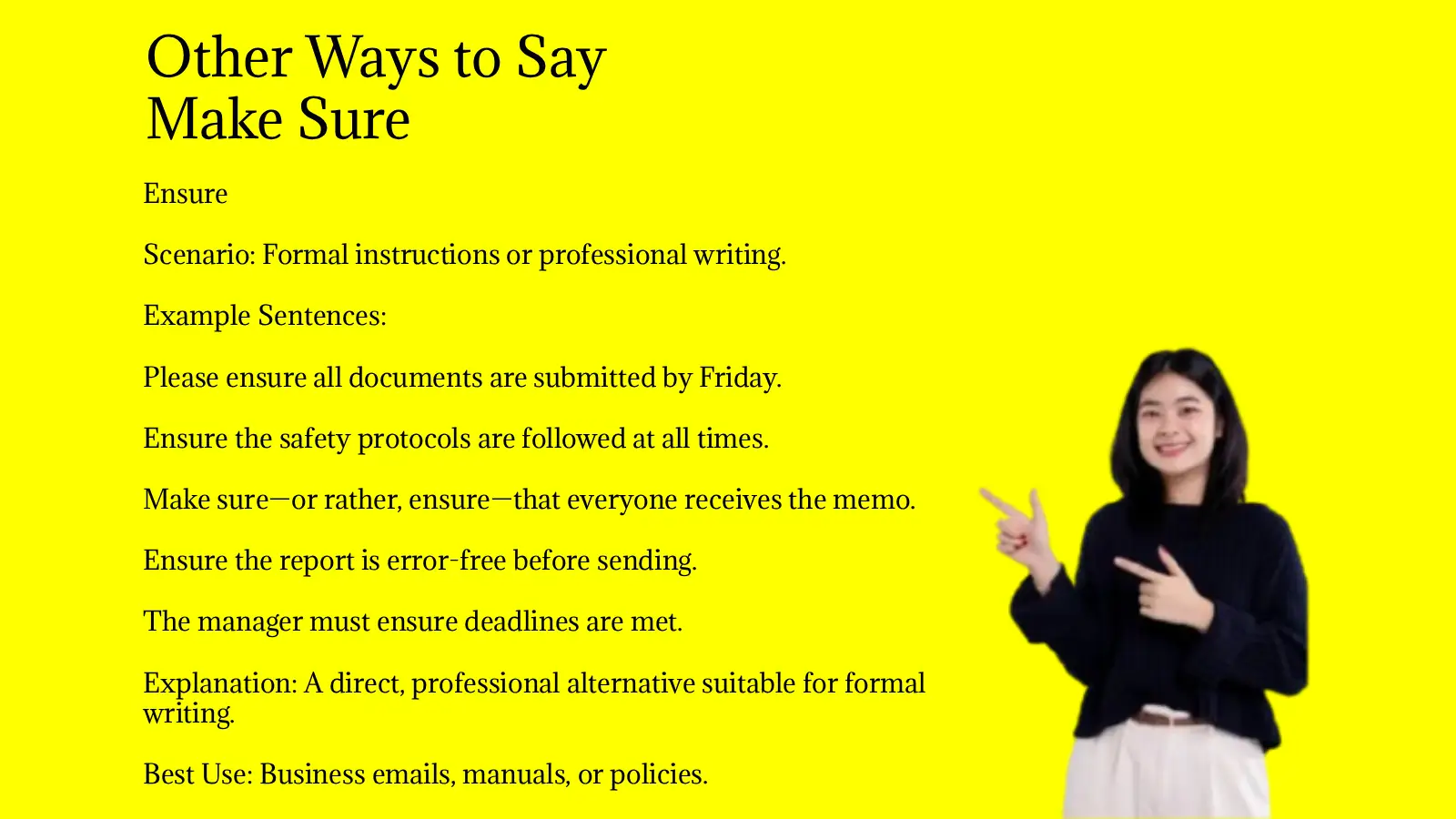
1. Ensure
Scenario: Formal instructions or professional writing.
Example Sentences:
- Please ensure all documents are submitted by Friday.
- Ensure the safety protocols are followed at all times.
- Make sure—or rather, ensure—that everyone receives the memo.
- Ensure the report is error-free before sending.
- The manager must ensure deadlines are met.
Explanation: A direct, professional alternative suitable for formal writing.
Best Use: Business emails, manuals, or policies.
2. Verify
Scenario: Checking accuracy or compliance.
Example Sentences:
- Verify that the data matches the source files.
- Before sending, verify all attachments are included.
- Verify your schedule to avoid conflicts.
- The technician must verify the system settings.
- Always verify facts before publishing.
Explanation: Emphasizes confirmation or correctness.
Best Use: Technical instructions, reports, or professional contexts.
3. Confirm
Scenario: Double-checking details or arrangements.
Example Sentences:
- Confirm the meeting time with the client.
- Please confirm your attendance by tomorrow.
- Confirm that the payment was received.
- Always confirm the booking before travel.
- Confirm all details to avoid mistakes.
Explanation: A polite, professional way to ensure something is finalized.
Best Use: Emails, appointments, reservations.
4. Double-Check
Scenario: Casual or slightly formal, emphasizing careful review.
Example Sentences:
- Double-check your answers before submitting.
- Double-check that the doors are locked.
- Always double-check your calculations.
- Double-check the address to avoid delays.
- I double-checked the schedule just in case.
Explanation: Friendly, approachable way to stress caution.
Best Use: Emails, casual instructions, reminders.
5. Make Certain
Scenario: Slightly formal alternative to “make sure.”
Example Sentences:
- Make certain the files are backed up.
- Make certain everyone receives the update.
- Please make certain all safety equipment is available.
- Make certain your documents are signed.
- Make certain you understand the instructions.
Explanation: Polished, slightly formal phrasing.
Best Use: Workplace instructions or formal reminders.
6. Be Certain
Scenario: Emphasizing personal responsibility or attention.
Example Sentences:
- Be certain you lock the doors before leaving.
- Be certain the lights are off.
- Be certain all team members are informed.
- Be certain you follow the protocol.
- Be certain the report is accurate.
Explanation: Encourages mindfulness and responsibility.
Best Use: Professional or personal instructions.
7. Make It a Point
Scenario: Emphasizes deliberate attention or priority.
Example Sentences:
- Make it a point to greet all clients personally.
- Make it a point to review the schedule each morning.
- Make it a point to double-check your work.
- Make it a point to finish the project on time.
- Make it a point to read the guidelines thoroughly.
Explanation: Suggests conscious effort and attention.
Best Use: Professional or motivational contexts.
8. Take Care That
Scenario: Polite, formal alternative.
Example Sentences:
- Take care that all windows are closed.
- Take care that the files are properly labeled.
- Take care that everyone receives their assignments.
- Take care that the instructions are followed.
- Take care that deadlines are met.
Explanation: Softens the directive, making it courteous.
Best Use: Letters, emails, or polite instructions.
9. Ensure That
Scenario: Formal or authoritative, often in writing.
Example Sentences:
- Ensure that all participants sign the form.
- Ensure that the package is delivered safely.
- Ensure that the software is updated regularly.
- Ensure that all safety checks are completed.
- Ensure that instructions are clear and understood.
Explanation: Very formal and precise.
Best Use: Business manuals, policies, or formal instructions.
10. See To It
Scenario: Slightly informal, emphasizes responsibility.
Example Sentences:
- See to it that the room is cleaned before the meeting.
- See to it that everyone receives their payment.
- Please see to it that the equipment is working properly.
- See to it that the documents are filed correctly.
- See to it that the guests are welcomed.
Explanation: Adds a sense of accountability or personal responsibility.
Best Use: Workplace, casual leadership instructions.
11. Watch Out That
Scenario: Casual or warning context.
Example Sentences:
- Watch out that the paint doesn’t spill.
- Watch out that the kids don’t wander off.
- Watch out that the oven doesn’t overheat.
- Watch out that you don’t miss the deadline.
- Watch out that no files are lost.
Explanation: Emphasizes caution and attention.
Best Use: Friendly reminders or casual advice.
12. Be Sure
Scenario: Direct and casual alternative.
Example Sentences:
- Be sure to bring your ID.
- Be sure to read the instructions carefully.
- Be sure to check your schedule.
- Be sure to lock the door.
- Be sure to submit the form on time.
Explanation: Simple, versatile, and widely understood.
Best Use: Texts, casual emails, reminders.
13. Take Steps to
Scenario: Professional or action-oriented phrasing.
Example Sentences:
- Take steps to confirm the reservation.
- Take steps to ensure quality control.
- Take steps to verify all data is accurate.
- Take steps to protect sensitive information.
- Take steps to avoid delays in the project.
Explanation: Suggests proactive effort and planning.
Best Use: Professional or formal instructions.
14. Guarantee
Scenario: Strong assurance of action or result.
Example Sentences:
- Guarantee that the files are secure.
- Guarantee the project meets quality standards.
- Guarantee the package arrives on time.
- Guarantee customer satisfaction with proper follow-up.
- Guarantee all steps are completed properly.
Explanation: Strong, confident alternative.
Best Use: Business communication, formal instructions.
15. Make Certain That
Scenario: Formal and precise.
Example Sentences:
- Make certain that the forms are signed.
- Make certain that all details are correct.
- Make certain that the team is informed.
- Make certain that deadlines are met.
- Make certain that the system is working properly.
Explanation: Adds emphasis and formality over “make sure.”
Best Use: Emails, instructions, or professional guidance.
16. Keep in Mind That
Scenario: Reminder or gentle guidance.
Example Sentences:
- Keep in mind that the meeting starts at 9 a.m.
- Keep in mind that safety comes first.
- Keep in mind that all documents must be approved.
- Keep in mind that deadlines are strict.
- Keep in mind that the client expects timely updates.
Explanation: Soft reminder alternative.
Best Use: Friendly or professional reminders.
17. Pay Attention To
Scenario: Emphasizing focus and awareness.
Example Sentences:
- Pay attention to the instructions provided.
- Pay attention to the deadlines.
- Pay attention to the small details in your work.
- Pay attention to the safety guidelines.
- Pay attention to how the forms are filled.
Explanation: Focuses on mindfulness and careful action.
Best Use: Training, instructions, guidance.
18. Make It Your Responsibility To
Scenario: Emphasizes personal accountability.
Example Sentences:
- Make it your responsibility to complete the checklist.
- Make it your responsibility to review the contract.
- Make it your responsibility to update the files.
- Make it your responsibility to ensure the event runs smoothly.
- Make it your responsibility to double-check all figures.
Explanation: Highlights ownership and accountability.
Best Use: Workplace or team instructions.
19. Don’t Forget To
Scenario: Casual, friendly reminder.
Example Sentences:
- Don’t forget to check the lights.
- Don’t forget to submit your report.
- Don’t forget to lock the doors.
- Don’t forget to call the client.
- Don’t forget to backup your work.
Explanation: Polite, conversational, and easy to use.
Best Use: Casual messages, texts, or emails.
20. Look Over
Scenario: Focus on review or inspection.
Example Sentences:
- Look over the report before submitting.
- Look over the schedule for mistakes.
- Look over the instructions carefully.
- Look over your notes before the meeting.
- Look over the checklist once more.
Explanation: Emphasizes careful review.
Best Use: Professional or academic contexts.
21. Make Certain That Everything Is Done
Scenario: Full formal instruction.
Example Sentences:
- Make certain that everything is done according to plan.
- Make certain that everything is reviewed before submission.
- Make certain that everything is ready for the meeting.
- Make certain that everything meets the requirements.
- Make certain that everything is in order.
Explanation: Adds thoroughness and completeness.
Best Use: Formal instructions or manuals.
22. See That
Scenario: Directive, slightly formal.
Example Sentences:
- See that the documents are delivered.
- See that the team follows the guidelines.
- See that the equipment is in working order.
- See that the office is cleaned properly.
- See that all files are backed up.
Explanation: Strong but polite directive.
Best Use: Workplace or authority-driven instructions.
23. Take Care to
Scenario: Professional or careful guidance.
Example Sentences:
- Take care to read all instructions carefully.
- Take care to avoid errors in your report.
- Take care to submit your forms on time.
- Take care to follow the safety rules.
- Take care to check everything before leaving.
Explanation: Polite, emphasizes attention and responsibility.
Best Use: Professional communication.
24. Make Certain Everything Is in Place
Scenario: Emphasizes readiness or preparation.
Example Sentences:
- Make certain everything is in place for the event.
- Make certain everything is in place before sending.
- Make certain everything is in place for the meeting.
- Make certain everything is in place before departure.
- Make certain everything is in place to avoid mistakes.
Explanation: Focuses on thorough preparation.
Best Use: Workplace, events, or formal instructions.
25. Assure
Scenario: Formal and professional alternative.
Example Sentences:
- Assure that the project meets all quality standards.
- Assure the client that the service is on schedule.
- Assure that the system functions correctly.
- Assure compliance with all regulations.
- Assure that the reports are accurate.
Explanation: Professional and authoritative.
Best Use: Business or legal contexts.
26. Make It a Priority To
Scenario: Emphasizes importance.
Example Sentences:
- Make it a priority to review the contract.
- Make it a priority to finish the report today.
- Make it a priority to address client concerns.
- Make it a priority to ensure everything is organized.
- Make it a priority to check the inventory.
Explanation: Highlights importance and focus.
Best Use: Workplace or leadership guidance.
27. Be Mindful Of
Scenario: Encourages awareness and care.
Example Sentences:
- Be mindful of deadlines when submitting work.
- Be mindful of details in your presentation.
- Be mindful of safety precautions.
- Be mindful of instructions provided.
- Be mindful of time constraints.
Explanation: Polite, emphasizes awareness.
Best Use: Professional or personal guidance.
28. Check That
Scenario: Simple and clear alternative.
Example Sentences:
- Check that all files are attached.
- Check that the schedule is correct.
- Check that the equipment is functioning.
- Check that the doors are locked.
- Check that all approvals are completed.
Explanation: Direct and easy to use.
Best Use: Emails, instructions, or casual reminders.
29. Be Certain That
Scenario: Emphasizes confidence and correctness.
Example Sentences:
- Be certain that all tasks are finished.
- Be certain that the report is accurate.
- Be certain that the package is ready.
- Be certain that everyone is informed.
- Be certain that the checklist is complete.
Explanation: Slightly formal, polite, and strong.
Best Use: Professional or careful instructions.
30. Mind That
Scenario: Friendly reminder or caution.
Example Sentences:
- Mind that the door is locked.
- Mind that your files are saved.
- Mind that the deadline is today.
- Mind that the instructions are followed.
- Mind that the equipment is off before leaving.
Explanation: Casual, polite caution.
Best Use: Friendly reminders or casual guidance.
31. Guarantee That
Scenario: Strong, authoritative instruction.
Example Sentences:
- Guarantee that the safety measures are implemented.
- Guarantee that the files are backed up.
- Guarantee that the project meets all standards.
- Guarantee that all participants are informed.
- Guarantee that the steps are followed carefully.
Explanation: Emphasizes assurance and certainty.
Best Use: Professional and formal contexts.
32. Ensure Proper
Scenario: Adds specification to “ensure.”
Example Sentences:
- Ensure proper labeling of all packages.
- Ensure proper installation of the software.
- Ensure proper documentation is submitted.
- Ensure proper coordination with the team.
- Ensure proper maintenance of equipment.
Explanation: Highlights correctness and precision.
Best Use: Technical, workplace, or formal instructions.
33. Take Responsibility To
Scenario: Encourages ownership of the task.
Example Sentences:
- Take responsibility to confirm all bookings.
- Take responsibility to follow the procedure.
- Take responsibility to complete your tasks accurately.
- Take responsibility to check all documents.
- Take responsibility to ensure deadlines are met.
Explanation: Emphasizes accountability.
Best Use: Workplace or leadership contexts.
34. Make Certain All Is Ready
Scenario: Emphasizes preparation.
Example Sentences:
- Make certain all is ready for the conference.
- Make certain all is ready before the shipment.
- Make certain all is ready for the team meeting.
- Make certain all is ready for the event.
- Make certain all is ready to avoid last-minute issues.
Explanation: Focuses on readiness and completeness.
Best Use: Formal instructions or planning.
35. Watch That
Scenario: Casual warning or attention.
Example Sentences:
- Watch that you don’t forget your keys.
- Watch that you don’t miss the deadline.
- Watch that the files are saved properly.
- Watch that the oven doesn’t overheat.
- Watch that the instructions are followed.
Explanation: Friendly and cautionary.
Best Use: Casual reminders.
36. Confirm That Everything Is Set
Scenario: Emphasizes checking readiness.
Example Sentences:
- Confirm that everything is set for the meeting.
- Confirm that everything is set for delivery.
- Confirm that everything is set before leaving.
- Confirm that everything is set for the event.
- Confirm that everything is set according to the plan.
Explanation: Focuses on final verification.
Best Use: Professional or event planning contexts.
37. Assure Yourself That
Scenario: Encourages personal verification.
Example Sentences:
- Assure yourself that all documents are signed.
- Assure yourself that the system is functioning.
- Assure yourself that the schedule is accurate.
- Assure yourself that instructions are clear.
- Assure yourself that everything is complete.
Explanation: Personal, reflective alternative that stresses self-verification.
Best Use: Professional guidance or personal reminders.
Conclusion
Using other ways to say “make sure” enhances clarity, professionalism, and tone in your communication. From casual reminders to formal instructions, these 37 alternatives give you flexibility to choose the right phrase for every situation.
Instead of repeating “make sure,” pick a phrase that fits your context—whether it’s ensure, verify, be certain, or double-check—to make your instructions, messages, and guidance more effective, polished, and engaging.