Ever found yourself typing an email and wondering if there’s a better way to ask for input? While the phrase “please provide feedback” is clear, repeating it constantly can make your written communication sound repetitive, overly direct, or robotic.
Whether you are requesting client feedback, seeking employee input, gathering customer reviews, or asking for constructive feedback on a project, your choice of words matters. The way you frame an email call-to-action directly influences the quality and speed of the responses you receive. Using a mix of formal phrases and informal expressions shows respect for the reader’s time while maintaining an engaging, human tone.
This practical guide explores 37 professional alternatives to help you gather opinions, suggestions, and valuable insights across different workplace and social contexts. Whether you want to polish your professional communication or keep your team chats friendly, these variations will improve your email etiquette and encourage meaningful responses.
What Does “Please Provide Feedback” Mean?
“Please provide feedback” is a polite request asking someone to share their thoughts, opinions, or suggestions. It shows that you value their input and are open to improvement.
When to Use “Please Provide Feedback”
This phrase is commonly used in professional settings, such as emails, meetings, or project reviews. It’s helpful when you want constructive criticism, suggestions, or confirmation on work.
Is It Professional/Polite to Say “Please Provide Feedback”?
Yes, it is both professional and polite. However, in some situations, softer or more conversational alternatives can sound more natural and encourage a better response.
1. I’d Appreciate Your Feedback
Scenario: Professional email or request.
Examples:
- I’d appreciate your feedback on this report.
- Could you review this? I’d appreciate your feedback.
- I’d appreciate your feedback when you have time.
- Please take a look—I’d appreciate your feedback.
- I’d appreciate your feedback on the final draft.
Tone: Polite and respectful. Best Use: Formal emails and workplace communication.
2. Let Me Know What You Think
Scenario: Casual or semi-formal communication.
Examples:
- I’ve shared the document—let me know what you think.
- Let me know what you think about this idea.
- Can you review this and let me know what you think?
- Let me know what you think when you get a chance.
- I’d love it if you let me know what you think.
Tone: Friendly and conversational. Best Use: Colleagues, friends, or informal work chats.
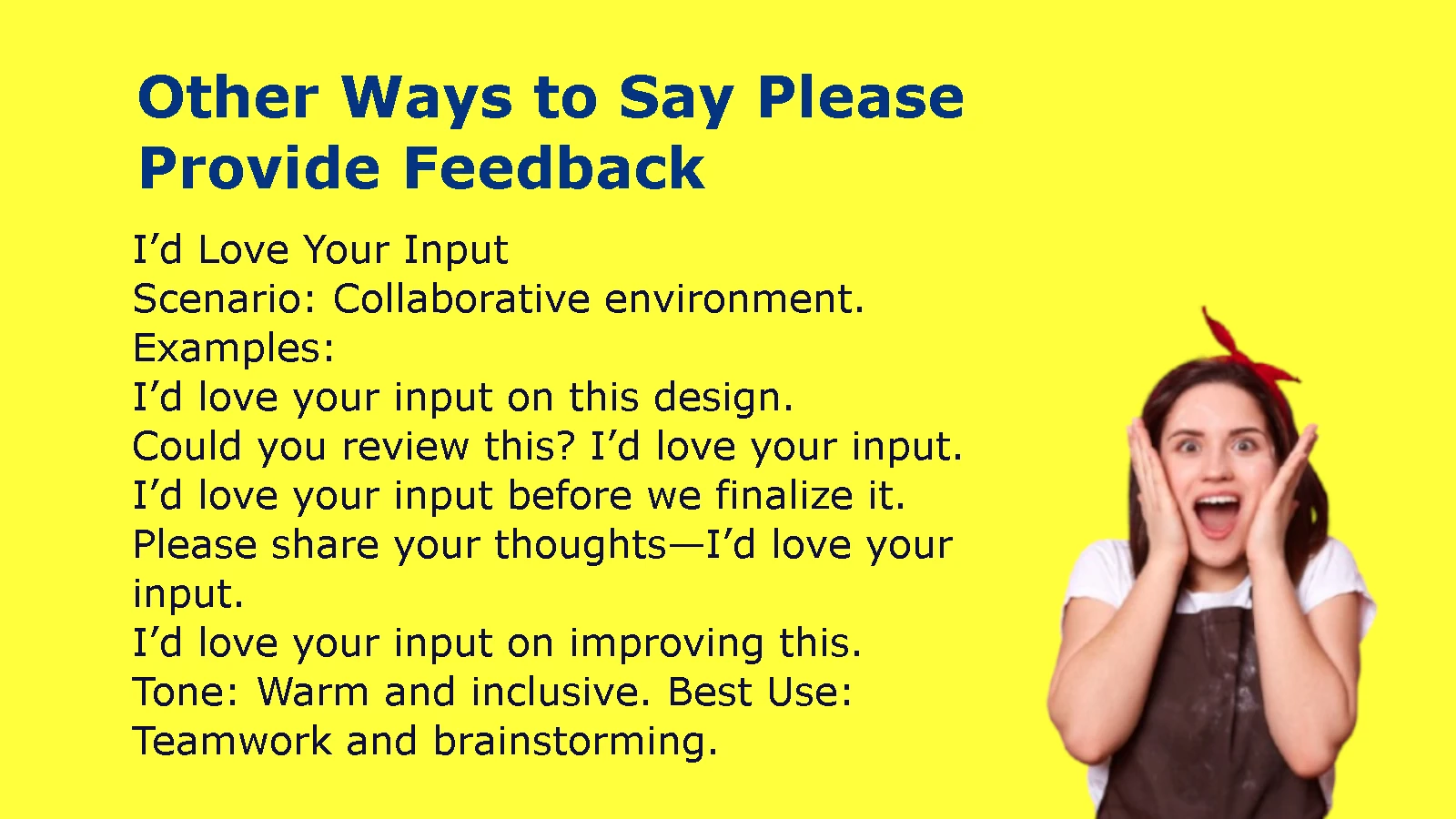
3. I’d Love Your Input
Scenario: Collaborative environment.
Examples:
- I’d love your input on this design.
- Could you review this? I’d love your input.
- I’d love your input before we finalize it.
- Please share your thoughts—I’d love your input.
- I’d love your input on improving this.
Tone: Warm and inclusive. Best Use: Teamwork and brainstorming.
4. Could You Share Your Thoughts?
Scenario: Polite inquiry.
Examples:
- Could you share your thoughts on this proposal?
- I’d value it if you could share your thoughts.
- Could you share your thoughts when convenient?
- Please review and share your thoughts.
- Could you share your thoughts on the approach?
Tone: Respectful and thoughtful. Best Use: Professional communication.
5. Any Feedback Would Be Helpful
Scenario: Open request for suggestions.
Examples:
- Any feedback would be helpful at this stage.
- Please review—any feedback would be helpful.
- Any feedback would be greatly appreciated.
- I’m open to suggestions—any feedback would help.
- Any feedback would be valuable here.
Tone: Open and receptive. Best Use: Early drafts or work in progress.
6. I’d Value Your Opinion
Scenario: Seeking expert advice.
Examples:
- I’d value your opinion on this matter.
- Could you review this? I’d value your opinion.
- I’d value your opinion before we proceed.
- Please share—I’d value your opinion.
- I’d value your opinion on this strategy.
Tone: Respectful and appreciative. Best Use: When asking senior or experienced individuals.
7. Please Share Your Feedback
Scenario: Direct but polite request.
Examples:
- Please share your feedback on the draft.
- Kindly review and share your feedback.
- Please share your feedback at your convenience.
- Please share your feedback with the team.
- Please share your feedback before Friday.
Tone: Professional and clear. Best Use: Emails and formal requests.
8. What Are Your Thoughts on This?
Scenario: Conversational inquiry.
Examples:
- What are your thoughts on this idea?
- I’d like to know—what are your thoughts on this?
- What are your thoughts on the proposal?
- Please review—what are your thoughts on this?
- What are your thoughts on these changes?
Tone: Friendly and engaging. Best Use: Meetings or informal discussions.
9. I’m Open to Your Suggestions
Scenario: Encouraging improvement.
Examples:
- I’m open to your suggestions on this.
- Please review—I’m open to your suggestions.
- I’m open to your suggestions for improvement.
- I’d appreciate it—I’m open to your suggestions.
- I’m open to your suggestions before finalizing.
Tone: Open-minded and collaborative. Best Use: Draft reviews or brainstorming.
10. Could You Review This?
Scenario: Simple and direct request.
Examples:
- Could you review this document?
- Could you review this and share your thoughts?
- Please check—could you review this?
- Could you review this when available?
- Could you review this draft?
Tone: Direct and professional. Best Use: Quick requests in workplace settings.
11. Let Me Know If You Have Any Suggestions
Scenario: Flexible request.
Examples:
- Let me know if you have any suggestions.
- Please review and let me know if you have suggestions.
- Let me know if you have any suggestions for improvement.
- I’d appreciate it—let me know if you have suggestions.
- Let me know if you have any suggestions here.
Tone: Polite and open. Best Use: General feedback requests.
12. I’d Appreciate Your Thoughts
Scenario: Respectful request.
Examples:
- I’d appreciate your thoughts on this.
- Could you review this? I’d appreciate your thoughts.
- I’d appreciate your thoughts before we proceed.
- Please share—I’d appreciate your thoughts.
- I’d appreciate your thoughts on the draft.
Tone: Polite and appreciative. Best Use: Professional communication.
13. Feel Free to Share Your Feedback
Scenario: Encouraging response.
Examples:
- Feel free to share your feedback anytime.
- Please review—feel free to share your feedback.
- Feel free to share your feedback on this.
- Feel free to share your feedback with me.
- Feel free to share your feedback when ready.
Tone: Relaxed and inviting. Best Use: Informal or friendly settings.
14. Your Feedback Would Be Greatly Appreciated
Scenario: Formal request.
Examples:
- Your feedback would be greatly appreciated.
- Please review—your feedback would be appreciated.
- Your feedback would be greatly appreciated on this.
- I’d be grateful—your feedback would be appreciated.
- Your feedback would be appreciated before submission.
Tone: Formal and respectful. Best Use: Formal emails and reports.
15. I’d Like to Hear Your Feedback
Scenario: Personal and direct request.
Examples:
- I’d like to hear your feedback on this.
- Could you review this? I’d like to hear your feedback.
- I’d like to hear your feedback before finalizing.
- Please share—I’d like to hear your feedback.
- I’d like to hear your feedback on the design.
Tone: Friendly and direct. Best Use: Team discussions or one-on-one chats.
16. Can You Give Me Your Input?
Scenario: Casual request.
Examples:
- Can you give me your input on this?
- I’d appreciate it—can you give me your input?
- Can you give me your input before we proceed?
- Please review—can you give me your input?
- Can you give me your input on this idea?
Tone: Casual and conversational. Best Use: Informal workplace chats.
17. I Welcome Your Feedback
Scenario: Open invitation.
Examples:
- I welcome your feedback on this project.
- Please review—I welcome your feedback.
- I welcome your feedback at any time.
- I welcome your feedback before submission.
- I welcome your feedback on improvements.
Tone: Professional and open. Best Use: Formal communication.
18. Any Thoughts?
Scenario: Very casual request.
Examples:
- Any thoughts on this?
- I’ve shared the file—any thoughts?
- Any thoughts before we proceed?
- Take a look—any thoughts?
- Any thoughts on these changes?
Tone: Casual and brief. Best Use: Quick chats or messaging apps.
19. I’d Appreciate Any Suggestions
Scenario: Improvement-focused request.
Examples:
- I’d appreciate any suggestions you have.
- Please review—I’d appreciate any suggestions.
- I’d appreciate any suggestions for improvement.
- I’d appreciate any suggestions on this.
- I’d appreciate any suggestions before finalizing.
Tone: Polite and open. Best Use: Draft reviews.
20. Please Let Me Know Your Feedback
Scenario: Clear and polite.
Examples:
- Please let me know your feedback on this.
- Kindly review and let me know your feedback.
- Please let me know your feedback soon.
- Please let me know your feedback when ready.
- Please let me know your feedback on the report.
Tone: Professional and direct. Best Use: Emails and reports.
21. Could You Take a Look and Share Your Thoughts?
Scenario: Requesting a review with feedback.
Examples:
- Could you take a look and share your thoughts on this document?
- I’ve made some changes—could you take a look and share your thoughts?
- When you have time, could you take a look and share your thoughts?
- Could you take a look and share your thoughts before we finalize?
- Please review—could you take a look and share your thoughts?
Tone: Polite and collaborative. Best Use: Work reviews and team collaboration.
22. I’d Be Grateful for Your Feedback
Scenario: Formal and respectful request.
Examples:
- I’d be grateful for your feedback on this proposal.
- Could you review this? I’d be grateful for your feedback.
- I’d be grateful for your feedback when you have time.
- Please share—I’d be grateful for your feedback.
- I’d be grateful for your feedback before submission.
Tone: Formal and appreciative. Best Use: Professional emails or senior communication.
23. Let Me Know Your Honest Opinion
Scenario: Encouraging transparency.
Examples:
- Let me know your honest opinion on this.
- I value your view—let me know your honest opinion.
- Please review and let me know your honest opinion.
- Let me know your honest opinion before we proceed.
- I’d really like it—let me know your honest opinion.
Tone: Open and sincere. Best Use: When you want genuine, detailed feedback.
24. What Do You Think About This?
Scenario: Simple and conversational.
Examples:
- What do you think about this idea?
- I’ve shared the draft—what do you think about this?
- What do you think about this approach?
- Please review—what do you think about this?
- What do you think about this version?
Tone: Friendly and direct. Best Use: Informal or semi-formal discussions.
25. I’d Appreciate Your Review
Scenario: Requesting both review and feedback.
Examples:
- I’d appreciate your review of this document.
- Could you review this? I’d appreciate your review.
- I’d appreciate your review before final approval.
- Please share—I’d appreciate your review.
- I’d appreciate your review on this draft.
Tone: Professional and polite. Best Use: Workplace and document reviews.
26. Any Input from Your Side?
Scenario: Casual workplace conversation.
Examples:
- Any input from your side on this?
- I’ve updated the file—any input from your side?
- Any input from your side before we move forward?
- Please check—any input from your side?
- Any input from your side on these changes?
Tone: Casual and collaborative. Best Use: Team chats and informal discussions.
27. I’d Love to Hear Your Perspective
Scenario: Seeking thoughtful insight.
Examples:
- I’d love to hear your perspective on this matter.
- Could you review this? I’d love to hear your perspective.
- I’d love to hear your perspective before finalizing.
- Please share—I’d love to hear your perspective.
- I’d love to hear your perspective on this idea.
Tone: Respectful and engaging. Best Use: Strategic discussions or expert input.
28. Please Share Any Suggestions You May Have
Scenario: Formal suggestion request.
Examples:
- Please share any suggestions you may have.
- Kindly review and share any suggestions you may have.
- Please share any suggestions you may have for improvement.
- I’d appreciate it—please share any suggestions you may have.
- Please share any suggestions you may have before approval.
Tone: Formal and polite. Best Use: Professional documents and reports.
29. I’m Interested in Your Feedback
Scenario: Showing genuine curiosity.
Examples:
- I’m interested in your feedback on this.
- Could you review this? I’m interested in your feedback.
- I’m interested in your feedback before we proceed.
- Please share—I’m interested in your feedback.
- I’m interested in your feedback on the draft.
Tone: Professional and engaging. Best Use: Workplace and collaborative settings.
30. Do You Have Any Feedback?
Scenario: Direct and simple request.
Examples:
- Do you have any feedback on this?
- I’ve shared the file—do you have any feedback?
- Do you have any feedback before we finalize?
- Please review—do you have any feedback?
- Do you have any feedback on these changes?
Tone: Direct and neutral. Best Use: Quick check-ins and general use.
31. I’d Appreciate Your Insights
Scenario: Seeking deeper understanding.
Examples:
- I’d appreciate your insights on this topic.
- Could you review this? I’d appreciate your insights.
- I’d appreciate your insights before making a decision.
- Please share—I’d appreciate your insights.
- I’d appreciate your insights on this strategy.
Tone: Thoughtful and respectful. Best Use: Strategic or high-level discussions.
32. Please Let Me Know Your Thoughts
Scenario: Polite and flexible request.
Examples:
- Please let me know your thoughts on this.
- Kindly review and let me know your thoughts.
- Please let me know your thoughts when convenient.
- Please let me know your thoughts on the draft.
- Please let me know your thoughts before finalizing.
Tone: Professional and friendly. Best Use: Emails and general communication.
33. I’d Value Your Feedback
Scenario: Respectful request for input.
Examples:
- I’d value your feedback on this report.
- Could you review this? I’d value your feedback.
- I’d value your feedback before submission.
- Please share—I’d value your feedback.
- I’d value your feedback on these changes.
Tone: Appreciative and professional. Best Use: Workplace or formal communication.
34. Can You Share Your Feedback?
Scenario: Simple and polite request.
Examples:
- Can you share your feedback on this?
- I’d appreciate it—can you share your feedback?
- Can you share your feedback before we proceed?
- Please review—can you share your feedback?
- Can you share your feedback on this draft?
Tone: Friendly and straightforward. Best Use: General use in both formal and informal settings.
35. I’d Appreciate Your Comments
Scenario: Document or content review.
Examples:
- I’d appreciate your comments on this document.
- Could you review this? I’d appreciate your comments.
- I’d appreciate your comments before final approval.
- Please share—I’d appreciate your comments.
- I’d appreciate your comments on the report.
Tone: Professional and respectful. Best Use: Written work or reports.
36. Please Review and Advise
Scenario: Formal or directive request.
Examples:
- Please review and advise on the next steps.
- Kindly review and advise on this document.
- Please review and advise when possible.
- Please review and advise before approval.
- Please review and advise on improvements.
Tone: Formal and authoritative. Best Use: Corporate or formal communication.
37. I’d Love Your Feedback on This
Scenario: Friendly yet clear request.
Examples:
- I’d love your feedback on this idea.
- Could you review this? I’d love your feedback.
- I’d love your feedback before finalizing.
- Please share—I’d love your feedback.
- I’d love your feedback on these changes.
Tone: Warm and engaging. Best Use: Casual or semi-formal conversations.
Conclusion
While “please provide feedback” is clear and professional, using varied alternatives can make your communication more engaging and effective. Whether you’re writing a formal email, collaborating with a team, or having a casual conversation, these 37 alternatives help you ask for input in a more thoughtful and natural way. Choosing the right tone can encourage better responses, build stronger relationships, and create more meaningful communication.