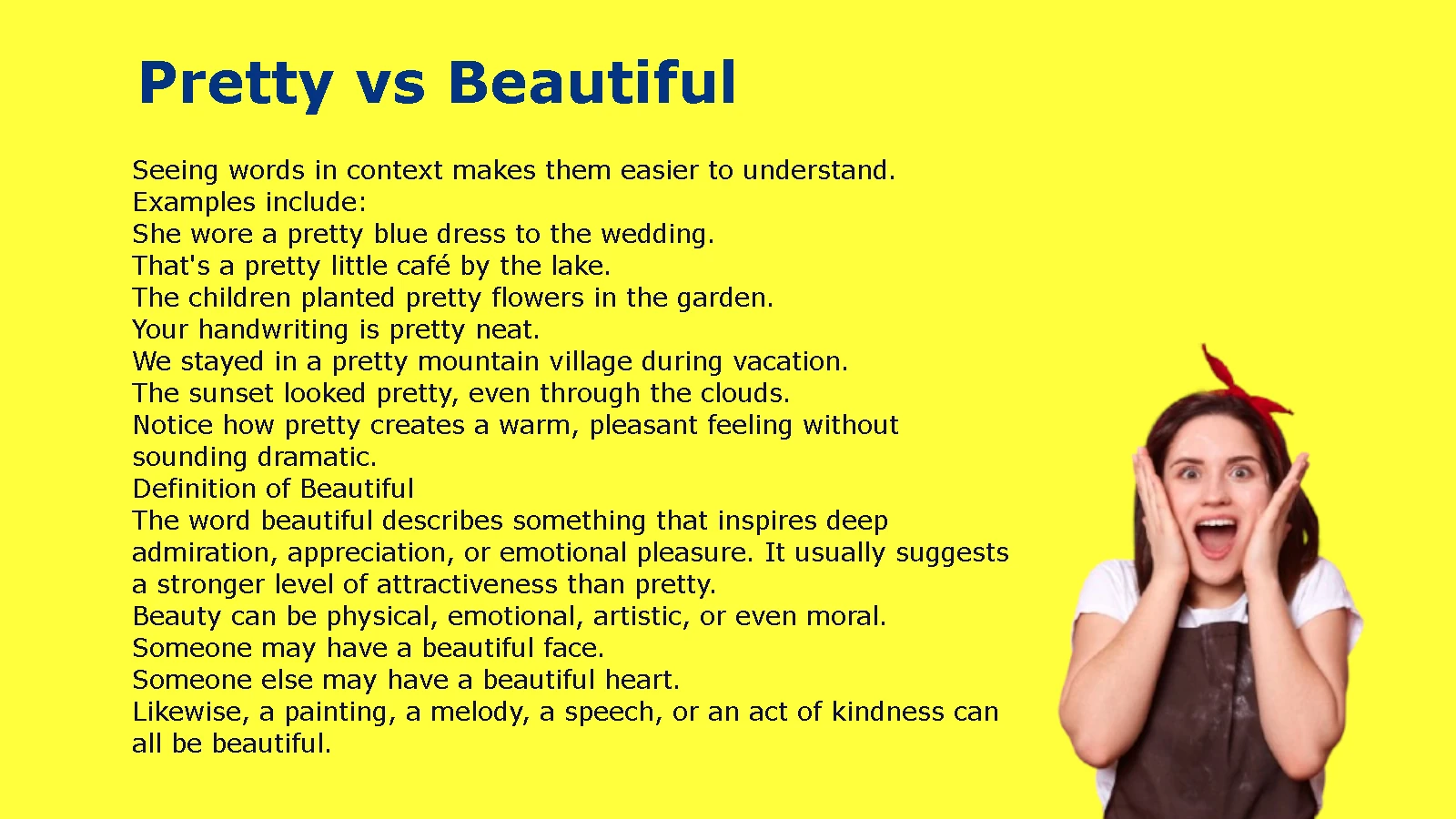
Pretty and beautiful are both correct adjectives used to describe attractiveness, but they convey different levels of admiration. Pretty usually refers to delicate, pleasant, or charming beauty, while beautiful expresses a stronger sense of elegance, attractiveness, or admiration. When comparing Pretty vs. Beautiful, the best choice depends on the intensity and context of the compliment.
Many people find it difficult to know the difference between pretty and beautiful, especially when giving compliments or writing in English. Here’s the good news: understanding when to use each word can help you sound more natural, thoughtful, and confident in everyday conversations.
In this guide, you’ll learn Pretty vs Beautiful in simple terms, including pretty meaning, beautiful meaning, pretty vs beautiful difference, when to use pretty, and when to use beautiful. You’ll also discover pretty and beautiful examples, common usage mistakes, and tips for choosing the most appropriate word in different situations.
By the end, you’ll know exactly how to use both words correctly and give compliments that match the context perfectly.
What Does “Pretty” Mean?
Definition of Pretty
The adjective pretty describes someone or something that is pleasantly attractive, charming, or appealing. It often suggests beauty that is delicate, graceful, or easy on the eyes rather than dramatic or overwhelming.
Unlike stronger adjectives, pretty usually carries a lighter, softer tone. It expresses admiration without implying extraordinary beauty.
Dictionary-style definition
Pretty (adjective): Attractive in a delicate, pleasing, or charming way.
Origin and Etymology
The word pretty has a surprisingly interesting history.
It comes from the Old English word prættig, which originally meant clever, crafty, or skillful. Over several centuries, its meaning shifted. By the Middle English period, people began using it to describe things that were elegant, attractive, or pleasing.
Today, English speakers almost always associate pretty with physical appearance or visual appeal.
Common Characteristics of Something Described as Pretty
When native speakers use pretty, they often emphasize qualities like these.
Pleasant appearance
Pretty usually refers to something visually pleasing without suggesting perfection.
Examples include:
- A pretty garden
- A pretty painting
- A pretty necklace
Delicate or charming qualities
Pretty often implies softness or gentleness.
For example:
- Small flowers
- Graceful architecture
- Light colors
- Gentle smiles
Instead of commanding attention, these things quietly attract it.
Often associated with smaller or softer features
Although this isn’t a strict rule, people commonly describe delicate features as pretty.
Examples include:
- Soft facial expressions
- Bright eyes
- Gentle laughter
- Elegant details
That doesn’t mean only small or delicate things can be pretty. A colorful mountain village or a cozy cabin can also earn the description.
Can describe people, places, objects, and experiences
Many learners believe pretty only describes women. That’s incorrect.
You can use it for countless things.
| Pretty Can Describe | Example |
| Person | She has a pretty smile. |
| Flower | Those roses are pretty. |
| Town | It’s a pretty little village. |
| Dress | That’s a pretty dress. |
| View | What a pretty landscape. |
| Decoration | The room looks pretty. |
Examples of Pretty in Sentences
Seeing words in context makes them easier to understand.
Examples include:
- She wore a pretty blue dress to the wedding.
- That’s a pretty little café by the lake.
- The children planted pretty flowers in the garden.
- Your handwriting is pretty neat.
- We stayed in a pretty mountain village during vacation.
- The sunset looked pretty, even through the clouds.
Notice how pretty creates a warm, pleasant feeling without sounding dramatic.
What Does “Beautiful” Mean?
Definition of Beautiful
The word beautiful describes something that inspires deep admiration, appreciation, or emotional pleasure. It usually suggests a stronger level of attractiveness than pretty.
Beauty can be physical, emotional, artistic, or even moral.
Someone may have a beautiful face.
Someone else may have a beautiful heart.
Likewise, a painting, a melody, a speech, or an act of kindness can all be beautiful.
Dictionary-style definition
Beautiful (adjective): Possessing qualities that delight the senses or deeply move the mind and emotions.
Origin and Etymology
The word beautiful comes from the Old French word beaute, meaning beauty.
Its root ultimately traces back to the Latin word bellus, meaning fine, handsome, or pleasing.
English has used beautiful since the fifteenth century. While its meaning has expanded over time, the central idea has remained the same: something that inspires admiration.
Common Characteristics of Something Described as Beautiful
Exceptional attractiveness
Beautiful often suggests attractiveness beyond the ordinary.
Examples include:
- A breathtaking waterfall
- A masterpiece painting
- An unforgettable smile
- Elegant architecture
Emotional impact
Beauty often reaches beyond appearance.
For example:
- A beautiful memory
- A beautiful friendship
- A beautiful gesture
- A beautiful life story
These examples have nothing to do with physical appearance.
Instead, they focus on emotional value.
Inner and outer beauty
One important difference between pretty and beautiful is that beautiful frequently describes character.
People often say:
- She has a beautiful soul.
- He’s a beautiful person inside and out.
- They shared a beautiful friendship.
These compliments praise personality rather than appearance.
Can describe nearly anything positive
Beautiful is remarkably versatile.
People commonly use it for:
- Nature
- Music
- Literature
- Architecture
- Emotions
- Ideas
- Relationships
- Achievements
- Acts of kindness
Examples of Beautiful in Sentences
Here are some natural examples.
- The mountains looked beautiful after the snowfall.
- She has a beautiful singing voice.
- That was a beautiful speech.
- They enjoyed a beautiful evening together.
- His grandmother told beautiful stories.
- The painting is absolutely beautiful.
Each example expresses admiration that goes beyond simple attractiveness.
Pretty vs Beautiful: The Main Difference
At first glance, these adjectives appear similar. Yet native English speakers often choose one over the other based on feeling rather than strict grammar.
The biggest difference lies in depth.
Pretty usually focuses on pleasant appearance.
Beautiful often includes emotional admiration or exceptional appeal.
Quick Comparison Table
| Feature | Pretty | Beautiful |
| Basic Meaning | Pleasantly attractive | Deeply attractive or inspiring |
| Strength | Moderate | Strong |
| Emotional Impact | Usually light | Often deep |
| Common Tone | Casual | Sincere or expressive |
| Focus | Appearance | Appearance, emotion, or character |
| Typical Usage | Everyday compliments | Meaningful admiration |
| Common Examples | Pretty flowers | Beautiful sunset |
| Formality | Informal to neutral | Neutral to formal |
The Difference in Intensity
Think of attractiveness as a scale.
Nice
│
Pretty
│
Lovely
│
Beautiful
│
Gorgeous
│
Stunning
This isn’t a strict ranking because context always matters.
Still, beautiful generally communicates stronger admiration than pretty.
Appearance vs Overall Impression
Imagine two different gardens.
The first has colorful flowers arranged neatly beside a white fence.
You might call it pretty.
Now imagine standing at the edge of a valley during sunrise. Mist rises from the river while mountains glow in golden light.
Most people would naturally describe that view as beautiful.
The second scene creates an emotional response, not just visual pleasure.
Surface Attraction vs Lasting Impact
Pretty often describes something that catches your eye.
Beautiful often describes something that stays in your mind.
For example:
- A pretty bracelet looks attractive.
- A beautiful family heirloom may carry generations of memories.
The object hasn’t changed.
Its meaning has.
Can Someone Be Both Pretty and Beautiful?
Absolutely.
Many people use both words for the same person, but they emphasize different qualities.
For example:
“She looked pretty at the picnic.”
This focuses on appearance.
Now compare it with:
“She looked beautiful on her wedding day.”
The second compliment feels deeper because it reflects both appearance and the emotional importance of the occasion.
Likewise, someone might be described as:
- Pretty at first glance.
- Beautiful after getting to know them.
In everyday conversation, context shapes the meaning more than dictionary definitions.
When to Use “Pretty”
Choosing the right adjective depends on the situation.
Pretty works best when you want a compliment that feels friendly, casual, and natural.
Everyday Conversations
Native speakers frequently use pretty during ordinary conversations.
Examples include:
- That’s a pretty scarf.
- Your backyard looks pretty.
- The restaurant was pretty nice inside.
- She has pretty eyes.
These compliments sound warm without becoming overly emotional.
Casual Compliments
Pretty fits situations where you want to praise appearance without sounding overly formal.
Examples:
- Pretty smile
- Pretty hairstyle
- Pretty earrings
- Pretty shoes
- Pretty handwriting
Because the word feels relaxed, people often use it among friends and family.
Describing Objects and Places
Pretty works especially well for smaller, charming, or decorative things.
Examples include:
| Object | Natural Expression |
| Garden | Pretty garden |
| Cottage | Pretty cottage |
| Vase | Pretty vase |
| Beach town | Pretty seaside town |
| Bouquet | Pretty bouquet |
Fashion and Personal Style
Fashion magazines and lifestyle blogs frequently use pretty.
Examples:
- Pretty summer dresses
- Pretty floral prints
- Pretty accessories
- Pretty hairstyles
- Pretty makeup looks
The word suggests elegance without exaggeration.
Common Expressions Using Pretty
You’ll hear these phrases regularly in everyday English.
- Pretty smile
- Pretty eyes
- Pretty flowers
- Pretty dress
- Pretty little town
- Pretty colors
- Pretty necklace
- Pretty face
- Pretty garden
- Pretty view
Notice that most examples relate to visual charm.
When to Use “Beautiful”
While pretty suits everyday compliments, beautiful often fits moments that deserve stronger appreciation.
It expresses admiration that feels sincere and memorable.
Meaningful Compliments
People often choose beautiful when emotions matter.
Examples include:
- You look beautiful today.
- Your daughter has a beautiful smile.
- That was a beautiful performance.
- What a beautiful family.
The compliment feels heartfelt rather than casual.
Describing Nature
Nature inspires some of the most common uses of beautiful.
Examples:
- Beautiful mountains
- Beautiful beaches
- Beautiful forests
- Beautiful sunsets
- Beautiful waterfalls
- Beautiful northern lights
Many landscapes are attractive.
Only some leave you speechless.
That’s where beautiful feels right.
Art, Music, and Literature
Beauty isn’t limited to appearance.
Creative works often move people emotionally.
For example:
- A beautiful symphony
- A beautiful novel
- A beautiful painting
- A beautiful poem
- A beautiful film score
Here, beauty comes from the emotional experience rather than the object itself.
Emotional Experiences
Some moments deserve stronger language because they carry lasting meaning.
People often say:
- A beautiful memory
- A beautiful wedding
- A beautiful surprise
- A beautiful reunion
- A beautiful ending
- A beautiful act of kindness
These examples highlight feelings rather than appearance alone.
Character and Inner Beauty
One of the most meaningful uses of beautiful involves personality.
Someone can be physically attractive without being beautiful in character.
Common compliments include:
- She has a beautiful heart.
- He’s a beautiful human being.
- They showed beautiful generosity.
- Her kindness is beautiful.
In these cases, beauty reflects compassion, empathy, honesty, or selflessness.
Common Expressions Using Beautiful
Native speakers frequently use these combinations:
- Beautiful woman
- Beautiful person
- Beautiful soul
- Beautiful voice
- Beautiful sunset
- Beautiful landscape
- Beautiful music
- Beautiful memories
- Beautiful artwork
- Beautiful life
These expressions appear in everyday conversations, books, films, and speeches because they communicate admiration that reaches beyond appearance alone.
Pretty vs Beautiful for a Person
Choosing between pretty and beautiful isn’t just about vocabulary. It also depends on the message you want to send. Both words are compliments, yet they emphasize different qualities.
Native English speakers often select one word over the other based on the situation, the relationship, and the emotional weight of the moment.
Complimenting Physical Appearance
When you describe someone’s appearance, pretty usually highlights features that are pleasant, delicate, or charming.
For example:
- She has pretty blue eyes.
- That’s a pretty hairstyle.
- Your daughter looks pretty in that dress.
- Those are pretty earrings.
These compliments focus on visible features.
By contrast, beautiful often suggests that someone’s overall appearance leaves a stronger impression.
Examples include:
- You look beautiful tonight.
- She looked beautiful in her wedding gown.
- The actress looked beautiful on the red carpet.
- He thought she was beautiful the moment they met.
The compliment feels more heartfelt and memorable.
Complimenting Personality
One of the biggest differences between the two words appears when discussing someone’s character.
People rarely describe kindness, generosity, or compassion as pretty.
Instead, they naturally choose beautiful.
Examples include:
- She has a beautiful heart.
- He has a beautiful spirit.
- Their friendship is beautiful.
- That was a beautiful act of kindness.
In these examples, appearance doesn’t matter at all.
The focus shifts to values, emotions, and behavior.
Cultural and Social Differences
The interpretation of pretty and beautiful varies across cultures.
In many English-speaking countries:
- Pretty often sounds casual and friendly.
- Beautiful feels stronger and more emotional.
- Close family members frequently use beautiful as a term of affection.
- Friends may use pretty more often in everyday conversation.
Some cultures also place different emphasis on compliments.
For instance, one culture may reserve beautiful for special occasions, while another uses it regularly.
Because language evolves constantly, context always matters more than rigid rules.
How Native English Speakers Often Interpret Each Word
Although every person has their own preferences, many native speakers recognize subtle differences.
| Compliment | Common Interpretation |
| You’re pretty. | You’re attractive and pleasant to look at. |
| You’re beautiful. | You’re exceptionally attractive or deeply admired. |
| You have pretty eyes. | Your eyes are attractive. |
| You have beautiful eyes. | Your eyes are striking or unforgettable. |
| You’re a beautiful person. | Your character is admirable. |
Notice how beautiful often carries greater emotional depth.
Pretty vs Beautiful for Women
Historically, English speakers used both adjectives to compliment women. Modern English still follows this pattern, although the meanings have become more flexible.
Traditional Usage
Traditionally:
- Pretty described youthful, delicate attractiveness.
- Beautiful described exceptional beauty.
Classic literature often follows this distinction.
For example, an author might describe a young village girl as pretty while calling a queen beautiful.
Modern Usage
Today’s English speakers don’t always follow traditional distinctions.
Many people freely switch between the two words depending on the moment.
Examples include:
- You look pretty today.
- You look beautiful today.
- That’s a pretty picture of you.
- You looked beautiful at graduation.
Neither expression is wrong.
The occasion influences the choice.
Why Context Matters More Than Gender
Although these words frequently describe women, they aren’t limited by gender.
The setting changes everything.
Someone might say:
- She looks pretty in casual clothes.
- She looks beautiful walking down the wedding aisle.
The second statement reflects not only appearance but also emotion, celebration, and significance.
Respectful Ways to Give Compliments
Compliments usually feel more genuine when they mention something specific.
Instead of saying:
You’re beautiful.
You might say:
- You have a beautiful smile.
- Your confidence is beautiful.
- You have beautiful energy.
- That color looks beautiful on you.
Specific compliments often feel more sincere because they show genuine attention.
Can Men Be Called Pretty or Beautiful?
Yes.
Although many learners believe these words only describe women, native speakers sometimes use both for men.
The meaning simply changes with context.
Pretty for Men
Calling a man pretty is uncommon but not incorrect.
People often use it to describe someone with softer or more delicate features.
Examples include:
- He has pretty eyes.
- The model has a pretty face.
- His curls are pretty.
Sometimes the word appears playfully or humorously.
Beautiful for Men
Calling a man beautiful has become increasingly common.
The compliment may refer to:
- Appearance
- Character
- Voice
- Talent
- Personality
Examples:
- He’s a beautiful person.
- He has a beautiful singing voice.
- Their son is absolutely beautiful.
- That’s a beautiful photograph of him.
The compliment often feels respectful rather than romantic.
Alternative Words Native Speakers Use
Depending on context, English offers many alternatives.
| Word | Meaning | Typical Context |
| Handsome | Attractive, especially for men | Formal and everyday speech |
| Attractive | Generally appealing | Neutral |
| Good-looking | Pleasant appearance | Casual conversation |
| Striking | Memorable appearance | Descriptive writing |
| Gorgeous | Extremely beautiful | Strong compliment |
| Stunning | Impressively beautiful | Fashion, photography |
| Elegant | Graceful and refined | Clothing, appearance |
| Charming | Pleasant personality | Social situations |
Each word carries a slightly different tone.
Choosing the right adjective helps communicate exactly what you mean.
Pretty vs Beautiful for Objects and Places
People don’t reserve these adjectives for human appearance.
They regularly use both words for everyday objects, landscapes, architecture, and works of art.
The difference remains surprisingly consistent.
Pretty describes pleasant visual appeal.
Beautiful expresses admiration that creates a stronger emotional response.
Flowers
Both adjectives work naturally.
Examples:
- Pretty wildflowers
- Pretty roses
- Beautiful orchids
- Beautiful cherry blossoms
A small bouquet on your kitchen table may look pretty.
A hillside covered in blooming tulips may look beautiful.
Houses
English speakers often choose based on scale and emotional impact.
Examples:
- A pretty cottage
- A pretty beach house
- A beautiful mansion
- A beautiful historic home
Neither adjective depends on size alone.
Even a tiny cabin can be beautiful if it creates a lasting impression.
Landscapes
Nature often inspires stronger language.
Examples include:
- Beautiful mountains
- Beautiful lakes
- Beautiful waterfalls
- Beautiful forests
Smaller natural scenes may feel better suited to pretty.
For example:
- Pretty garden
- Pretty walking trail
- Pretty pond
Paintings
Artwork demonstrates the difference well.
A decorative watercolor hanging in a café might seem pretty.
A painting that deeply moves viewers is more likely to be described as beautiful.
Art critics often reserve beautiful for works that combine technical skill with emotional impact.
Jewelry
Jewelry provides another useful comparison.
Examples:
- Pretty bracelet
- Pretty earrings
- Beautiful diamond necklace
- Beautiful antique ring
Again, emotional value influences word choice.
An engagement ring often becomes beautiful because of what it represents.
Cities
Travel writers frequently alternate between the two adjectives.
Examples:
- A pretty coastal town
- A pretty European village
- Beautiful Paris skyline
- Beautiful Kyoto temples
- Beautiful mountain city
The difference usually depends on the overall impression rather than population or size.
Interior Design
Design magazines commonly use both words.
Pretty often describes decorative details.
Beautiful usually refers to an entire space.
Examples:
- Pretty wallpaper
- Pretty curtains
- Beautiful living room
- Beautiful architecture
- Beautiful open-concept kitchen
Pretty vs Beautiful in Literature and Poetry
Writers rarely choose adjectives by accident.
Every word shapes emotion.
Emotional Connotations
Literary authors often use beautiful to express admiration that reaches beyond appearance.
For example, a novelist may describe:
- A beautiful sacrifice
- A beautiful dream
- A beautiful silence
These phrases evoke emotion rather than physical beauty.
Symbolic Meaning
Beauty often symbolizes ideas like:
- Hope
- Love
- Peace
- Innocence
- Transformation
- Grace
Meanwhile, pretty usually symbolizes lightness, youthfulness, or simple visual pleasure.
Why Authors Choose One Word Over the Other
Professional writers carefully match adjectives to emotional intensity.
Compare these examples.
She wore a pretty ribbon.
The sentence paints a pleasant picture.
Now compare it with:
She carried the beautiful memories of her childhood.
Here, beauty exists in memory rather than appearance.
One adjective describes what people see.
The other describes what people feel.
Synonyms of Pretty
Expanding your vocabulary helps your writing sound more natural.
Each synonym carries its own nuance.
| Word | Meaning Difference | Example |
| Cute | Endearing or adorable | Cute puppy |
| Lovely | Warm and pleasant | Lovely garden |
| Charming | Delightfully attractive | Charming village |
| Attractive | Generally pleasing | Attractive design |
| Delicate | Fine and graceful | Delicate flowers |
| Elegant | Stylish and refined | Elegant dress |
| Appealing | Pleasant or inviting | Appealing colors |
When to choose these synonyms
Use cute for playful charm.
Choose lovely for warmth.
Select elegant when sophistication matters.
Use appealing when discussing design, marketing, or aesthetics.
Each word highlights a different aspect of attractiveness.
Synonyms of Beautiful
English also offers many stronger alternatives.
| Word | Meaning Difference | Example |
| Gorgeous | Extremely beautiful | Gorgeous sunset |
| Stunning | Impressively attractive | Stunning architecture |
| Exquisite | Exceptionally refined | Exquisite craftsmanship |
| Magnificent | Grand and impressive | Magnificent cathedral |
| Breathtaking | Awe-inspiring | Breathtaking canyon |
| Radiant | Brightly beautiful | Radiant smile |
| Lovely | Beautiful in a gentle way | Lovely melody |
| Elegant | Graceful and stylish | Elegant ballroom |
Choosing precise vocabulary makes your writing richer without sounding repetitive.
Pretty vs Beautiful vs Cute
These three adjectives overlap, yet each creates a different impression.
| Feature | Cute | Pretty | Beautiful |
| Emotional Strength | Low | Medium | High |
| Typical Focus | Adorableness | Pleasant appearance | Deep admiration |
| Common Uses | Babies, pets | People, flowers, clothes | People, nature, art |
| Formality | Casual | Casual to neutral | Neutral to formal |
Which Compliment Feels Stronger?
Most native speakers would rank them like this:
Cute
│
Pretty
│
Beautiful
Remember, context always outweighs the chart.
Calling someone’s newborn cute feels more natural than calling the baby beautiful, although both are acceptable.
Likewise, describing a mountain range as cute would sound unusual.
Pretty vs Beautiful vs Gorgeous
Another adjective frequently appears in conversations about attractiveness.
Gorgeous.
It expresses even greater intensity than beautiful.
| Word | Typical Strength | Common Context |
| Pretty | Moderate | Everyday compliments |
| Beautiful | Strong | Meaningful admiration |
| Gorgeous | Very strong | Fashion, appearance, scenery |
Examples:
- She looks pretty today.
- She looks beautiful tonight.
- She looks absolutely gorgeous at the awards ceremony.
Notice how each sentence raises the level of admiration.
Pretty vs Beautiful vs Attractive
The word attractive often enters the conversation because it overlaps with both pretty and beautiful. However, it has a broader and more neutral meaning.
Unlike pretty, which often suggests delicate charm, or beautiful, which conveys deep admiration, attractive simply means someone or something appeals to others.
What Each Word Emphasizes
| Word | Primary Focus | Emotional Tone | Common Uses |
| Pretty | Pleasant appearance | Light and friendly | People, flowers, clothing, homes |
| Beautiful | Exceptional beauty or emotional impact | Warm, sincere, expressive | People, nature, art, experiences |
| Attractive | General appeal | Neutral | People, products, places, ideas |
For example:
- She has a pretty smile.
- She looked beautiful on her wedding day.
- She’s an attractive candidate for the position.
Notice how the last example isn’t about physical appearance at all. It refers to suitability.
Which Is More Neutral?
If you’re unsure which adjective to use, attractive is usually the safest option.
People commonly use it in:
- Professional writing
- Academic discussions
- Marketing
- Psychology
- Sociology
- General descriptions
Unlike beautiful, it doesn’t necessarily express strong emotion. Unlike pretty, it doesn’t imply delicacy.
Examples in Everyday Conversation
Here are a few examples that show the subtle differences.
Pretty
That’s a pretty little café.
Beautiful
That beach was beautiful at sunrise.
Attractive
The neighborhood is attractive because it’s quiet and walkable.
Each sentence feels natural, yet each creates a slightly different impression.
How Native English Speakers Use Pretty and Beautiful
One of the best ways to master these words is to understand how native speakers actually use them.
Although dictionaries define the words clearly, everyday conversations often depend on context, tone, and emotion.
In American English
In the United States:
- Pretty appears frequently in casual conversation.
- Beautiful often emphasizes sincerity or admiration.
- Parents regularly call their children beautiful.
- Friends may compliment clothing by saying it’s pretty.
- Advertisements often use beautiful to create emotional appeal.
You’ll hear expressions like:
- What a pretty neighborhood.
- You look beautiful.
- That’s a beautiful idea.
- This is a pretty good restaurant.
Interestingly, pretty also functions as an adverb in informal American English.
For example:
I’m pretty sure.
Here, pretty means fairly or quite, not attractive.
In British English
British English follows similar patterns, although some everyday expressions differ slightly.
British speakers frequently use:
- Lovely
- Gorgeous
- Beautiful
- Pretty
For instance:
- That’s a lovely garden.
- What a beautiful village.
- She’s wearing a pretty dress.
The meanings remain largely the same.
Everyday Speech vs Formal Writing
Formal writing often avoids vague compliments.
Instead of writing:
It was a beautiful report.
Professional writers usually explain why.
For example:
The report presented complex data clearly and offered thoughtful recommendations.
Likewise, travel articles rarely repeat beautiful in every paragraph. Instead, they vary their vocabulary with words such as:
- Scenic
- Spectacular
- Picturesque
- Majestic
- Elegant
- Charming
Variety improves readability and strengthens your writing.
Social Media and Modern Usage
Social media has expanded the use of both words.
People commonly post captions such as:
- Beautiful memories.
- Beautiful people.
- Beautiful sunset.
- Pretty aesthetic.
- Pretty vibes.
- Pretty flowers.
- Beautiful soul.
These expressions often emphasize emotion as much as appearance.
Common Mistakes to Avoid
Even advanced English learners occasionally misuse these adjectives.
Fortunately, the mistakes are easy to avoid once you understand the differences.
Assuming They Mean Exactly the Same Thing
Although they’re similar, they aren’t identical.
Consider these examples.
- Pretty makeup
- Beautiful performance
The first describes appearance.
The second describes an experience.
Using “Pretty” for Every Compliment
Repeating the same adjective makes your writing sound repetitive.
Instead of writing:
- Pretty flowers
- Pretty house
- Pretty lake
- Pretty painting
- Pretty mountains
Mix your vocabulary.
For example:
- Charming cottage
- Beautiful mountains
- Elegant home
- Scenic lake
- Stunning artwork
Ignoring Context
Context determines the best adjective.
A casual picnic photo might be pretty.
A wedding portrait may feel beautiful.
A breathtaking canyon may deserve magnificent.
Always think about the feeling you want your reader to experience.
Confusing Attractiveness with Beauty
Someone can be attractive without creating a deep emotional impression.
Likewise, something can be beautiful because of its meaning rather than its appearance.
Examples include:
- A beautiful friendship
- A beautiful act of courage
- A beautiful farewell speech
These examples highlight emotional value.
Overusing Strong Adjectives
Words like gorgeous, stunning, and beautiful lose their impact if every sentence uses them.
Strong writing mixes vocabulary naturally.
Compare these examples.
Less effective
The beautiful beach had beautiful water beside beautiful cliffs under a beautiful sky.
Better
The beach featured crystal-clear water, dramatic cliffs, and a breathtaking sunset.
The second version creates a stronger image without repeating the same adjective.
Examples in Everyday Conversations
Learning through dialogue helps you understand how native speakers naturally choose between pretty and beautiful.
Casual Conversation
Emma: That’s a pretty sweater.
Sarah: Thanks. I bought it last weekend.
Romantic Conversation
Alex: You look beautiful tonight.
Mia: That’s so sweet. Thank you.
Family Conversation
Grandmother: Look at those pretty flowers.
Grandson: They’re my favorite ones.
Workplace Conversation
Manager: That presentation was beautiful. It explained a difficult topic clearly.
Employee: I appreciate that. I spent a lot of time refining it.
Travel Conversation
Traveler: The village was pretty during the afternoon.
Friend: Wait until you see it at sunset. It’s absolutely beautiful.
Grammar Notes
Besides functioning as adjectives, these words have a few interesting grammatical features.
Understanding them helps you write more naturally.
Parts of Speech
Both words primarily function as adjectives.
Examples:
- Pretty flowers
- Beautiful artwork
However, pretty also functions as an adverb.
Examples:
- I’m pretty tired.
- That’s pretty interesting.
- She’s pretty confident.
In these cases, it means fairly, quite, or rather.
Beautiful does not function as an adverb.
Instead, English uses beautifully.
Examples:
- She sings beautifully.
- The orchestra performed beautifully.
Comparative and Superlative Forms
English normally forms comparisons differently for these adjectives.
| Adjective | Comparative | Superlative |
| Pretty | Prettier | Prettiest |
| Beautiful | More beautiful | Most beautiful |
Examples:
- This garden is prettier than ours.
- That lake is the prettiest in the park.
- This painting is more beautiful than the previous one.
- It was the most beautiful sunset I’ve ever seen.
Common Collocations
Native speakers regularly pair these adjectives with certain nouns.
Pretty
- Pretty smile
- Pretty face
- Pretty dress
- Pretty garden
- Pretty village
- Pretty colors
- Pretty decoration
- Pretty flowers
Beautiful
- Beautiful person
- Beautiful landscape
- Beautiful music
- Beautiful artwork
- Beautiful soul
- Beautiful voice
- Beautiful day
- Beautiful memory
- Beautiful experience
Learning collocations makes your English sound much more natural.
Frequently Asked Questions
Is beautiful a stronger compliment than pretty?
Yes. In most situations, beautiful expresses stronger admiration than pretty. It often carries emotional weight and can describe both appearance and inner qualities.
Is pretty only used for women?
No.
Although people frequently use pretty to describe women and girls, it can also describe children, men (in specific contexts), animals, buildings, clothing, flowers, and landscapes.
Can something be both pretty and beautiful?
Absolutely.
A garden may look pretty during the day and become beautiful when golden evening light transforms the entire scene.
Likewise, someone can appear pretty while also possessing beautiful character.
Is beautiful more formal than pretty?
Generally, yes.
Beautiful fits both casual and formal situations, while pretty sounds slightly more conversational.
Can men be described as beautiful?
Yes.
Modern English frequently uses beautiful to describe men, especially when emphasizing character, emotion, artistry, or striking appearance.
Is pretty always about appearance?
Not entirely.
Although pretty usually describes visual attractiveness, it also appears as an adverb.
For example:
- That’s pretty easy.
- I’m pretty sure.
In these examples, it doesn’t describe beauty at all.
Which Word Sounds More Natural in Daily Conversation?
Both.
Use pretty for casual compliments and everyday descriptions.
Choose beautiful when expressing deeper admiration or discussing emotionally meaningful people, places, or experiences.
What Is the Opposite of Pretty and Beautiful?
The opposite depends on the context.
Common antonyms include:
| Word | Typical Opposite |
| Pretty | Plain, unattractive |
| Beautiful | Ugly, unattractive, unsightly |
Remember that appearance is subjective, so these opposites should be used carefully and respectfully.
Key Takeaways
Understanding pretty vs beautiful isn’t about memorizing strict rules. It’s about recognizing the subtle shades of meaning that native speakers naturally hear.
Here’s a quick recap:
- Pretty describes pleasant, charming, or delicate attractiveness.
- Beautiful expresses deeper admiration and often carries emotional significance.
- Pretty commonly appears in casual conversations about appearance.
- Beautiful can describe people, personalities, places, art, music, memories, and experiences.
- Context matters more than rigid definitions.
- Both words can describe the same person or object, but each highlights a different quality.
- Expanding your vocabulary with alternatives like lovely, elegant, gorgeous, stunning, and attractive makes your writing and speech more expressive.
The next time you choose between pretty and beautiful, think about the impression you want to leave. If you’re describing simple visual charm, pretty is often the right choice. If you’re expressing admiration that reaches beyond appearance and into emotion, significance, or character, beautiful communicates that feeling with greater depth.
Mastering these subtle differences won’t just improve your vocabulary. It will also help you sound more natural, write more precisely, and express yourself with confidence in every conversation.