Apostrophe Meaning refers to the punctuation mark (‘) used to show possession, form contractions, and sometimes indicate omitted letters or numbers. Understanding apostrophe usage helps improve grammar, writing accuracy, and overall communication in English.
The confusion starts because apostrophes are often misplaced or left out entirely. Many people struggle with apostrophe rules, apostrophe usage, and knowing the difference between its vs. it’s or plural vs. possessive nouns. But here’s the good news: once you understand the basic rules, using an apostrophe becomes much easier.
In this guide, you’ll learn the Apostrophe Meaning, explore apostrophe examples, discover the correct use of apostrophes, and understand when to use an apostrophe in everyday writing. You’ll also find simple explanations, common mistakes to avoid, and practical examples that make the rules easy to remember.
By the end, you’ll know exactly what an apostrophe means, why it’s important, and how to use it confidently in emails, essays, social media posts, and professional writing.
What Is an Apostrophe?
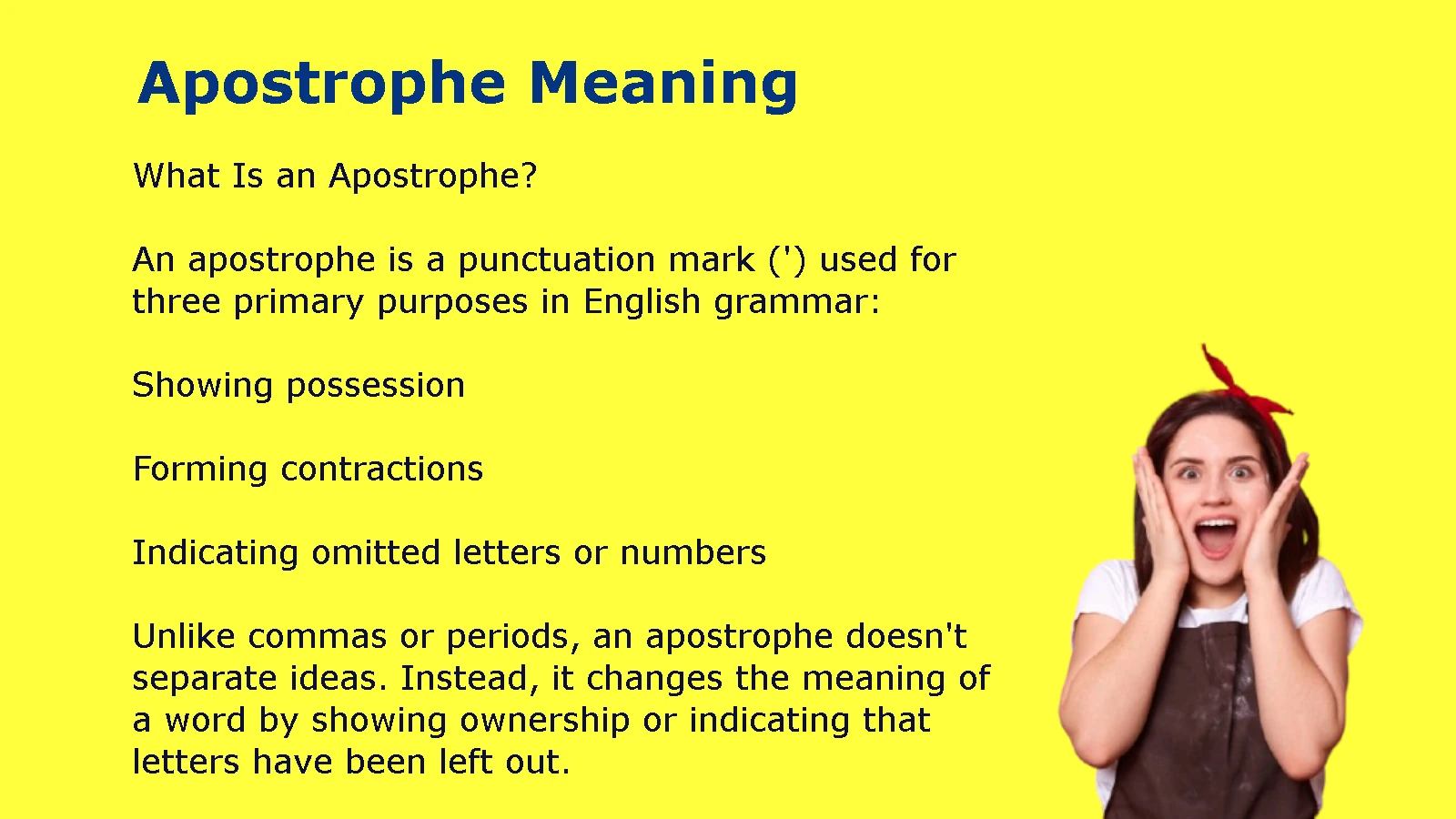
An apostrophe is a punctuation mark (‘) used for three primary purposes in English grammar:
- Showing possession
- Forming contractions
- Indicating omitted letters or numbers
Unlike commas or periods, an apostrophe doesn’t separate ideas. Instead, it changes the meaning of a word by showing ownership or indicating that letters have been left out.
Consider these examples:
| Sentence | Meaning |
| Sarah’s laptop | The laptop belongs to Sarah. |
| Don’t forget your keys. | “Don’t” means do not. |
| Class of ’99 | The first two digits of the year are omitted. |
Without apostrophes, many English sentences become confusing or grammatically incorrect.
For example:
- Its raining outside. ❌
- It’s raining outside. ✅
One missing apostrophe changes a grammatical error into a correct sentence.
A Brief History of the Apostrophe
The apostrophe has existed for centuries, but it wasn’t originally designed to show possession.
The word apostrophe comes from the Greek word apostrophos, meaning “turning away” or “omission.” During the Renaissance, printers and scholars adopted the mark to indicate missing letters in written words. Over time, English writers expanded its purpose to include possession.
Here’s a simplified timeline of its evolution:
| Period | Development |
| Ancient Greek | Symbol associated with omitted sounds. |
| 16th Century | Used to indicate omitted letters in printed English. |
| 17th Century | Began marking possessive nouns consistently. |
| Modern English | Standard punctuation for possession, contractions, and omissions. |
Today, style guides such as The Chicago Manual of Style, AP Stylebook, MLA Handbook, and APA Publication Manual all recognize apostrophes as an essential part of standard English grammar, though they differ slightly in a few specialized cases.
“Punctuation is the traffic signal of language.”
— Adapted from linguistic writing often attributed to grammar educators
That quote captures the role of apostrophes perfectly. They guide readers toward the intended meaning instead of forcing them to guess.
What Does an Apostrophe Mean in Writing?
The meaning of an apostrophe depends entirely on its context. In modern English, it generally communicates one of three ideas.
Showing Ownership
The most common use of an apostrophe is to show that something belongs to someone or something else.
Examples:
- Emma’s backpack
- The teacher’s notes
- The company’s headquarters
- The dog’s collar
Each apostrophe signals ownership.
Replacing Missing Letters
Apostrophes also indicate that letters have been removed from a word.
Examples include:
| Full Form | Contraction |
| do not | don’t |
| cannot | can’t |
| I am | I’m |
| they are | they’re |
| we will | we’ll |
| she is | she’s |
The apostrophe marks where letters have been omitted.
Indicating Omitted Numbers or Characters
Sometimes writers shorten years or informal expressions.
Examples:
- The class of ’08
- The music of the ’80s
- Rock ‘n’ roll
Here, the apostrophe replaces omitted numbers or letters.
Why Context Matters
The same apostrophe can signal entirely different meanings depending on where it appears.
Compare these examples:
| Example | Meaning |
| The girl’s bicycle | Ownership |
| She’s happy. | Contraction |
| Class of ’24 | Omitted numbers |
Recognizing context is the key to understanding apostrophe usage.
The Three Main Uses of an Apostrophe
English grammar relies on three core apostrophe functions. Mastering these rules eliminates the majority of punctuation mistakes.
Showing Possession
Possession tells readers who owns or is connected to something.
Singular Nouns
For most singular nouns, add ‘s.
Examples:
- the student’s notebook
- the artist’s painting
- the baby’s toy
- the author’s manuscript
Even if a noun ends with a consonant or vowel, the rule usually stays the same.
Singular Nouns Ending in S
Many style guides recommend adding ‘s even when a singular noun already ends in s.
Examples:
- James’s notebook
- Chris’s jacket
- Thomas’s presentation
Some publications prefer James’, especially in journalism, but consistency matters more than the chosen style.
Plural Nouns Ending in S
If the plural already ends in s, add only an apostrophe.
Examples:
- the students’ classroom
- the teachers’ lounge
- the players’ uniforms
Notice that another s isn’t added.
Irregular Plural Nouns
Irregular plurals don’t end in s, so they receive ‘s.
Examples:
- children’s books
- men’s clothing
- women’s soccer team
- people’s opinions
Compound Nouns
Place the apostrophe at the end of the compound noun.
Examples:
- my mother-in-law’s advice
- the editor-in-chief’s decision
- someone else’s problem
Joint vs. Separate Ownership
This rule frequently appears in grammar tests.
Joint ownership
- Jack and Emma’s business
Both people own one business together.
Separate ownership
- Jack’s and Emma’s offices
Each person owns a different office.
Proper Nouns
Proper nouns follow the same grammatical rules.
Examples:
- Google’s headquarters
- NASA’s mission
- London’s museums
- America’s economy
Time and Measurement Expressions
Apostrophes often indicate possession in expressions of time and measurement.
Examples:
- one day’s work
- two weeks’ notice
- an hour’s drive
- five years’ experience
Although no physical ownership exists, the relationship is still possessive.
Forming Contractions
Contractions combine two words into one by removing letters.
They’re common in conversation, blogs, emails, and everyday writing because they create a natural tone.
Common Contractions
| Full Form | Contraction |
| I am | I’m |
| you are | you’re |
| they are | they’re |
| we have | we’ve |
| she will | she’ll |
| he would | he’d |
Negative Contractions
English also shortens many negative verbs.
Examples include:
- isn’t
- aren’t
- wasn’t
- weren’t
- don’t
- doesn’t
- didn’t
- won’t
- wouldn’t
- shouldn’t
- couldn’t
- can’t
These forms make writing sound more conversational while remaining grammatically correct.
Pronoun Contractions
Pronouns often pair with helping verbs.
Examples:
- it’s
- who’s
- there’s
- here’s
- what’s
- that’ll
- we’d
However, contractions sometimes create confusion because they resemble possessive forms.
For example:
- it’s = it is
- its = possessive pronoun
That single apostrophe completely changes the meaning.
Formal vs. Informal Writing
Contractions are perfectly acceptable in:
- Blog posts
- Emails
- Social media
- Fiction
- Marketing copy
- Personal letters
Many academic papers, legal documents, technical manuals, and formal contracts avoid contractions to maintain a more formal tone.
Choose the style that best fits your audience.
Showing Omitted Letters or Numbers
Not every apostrophe involves ownership or contractions.
Sometimes writers intentionally remove letters for stylistic reasons.
Examples:
- rock ‘n’ roll
- ma’am
- fo’c’sle (nautical term)
- o’clock
Shortened Years
Apostrophes also replace omitted numbers.
Examples:
- the class of ’26
- music from the ’70s
- fashion of the ’90s
Notice that decades themselves do not require an apostrophe before the s.
Correct:
- the 1990s
- the ’90s
Incorrect:
- 1990’s ❌
Poetry, Dialogue, and Dialect
Authors sometimes omit letters to reproduce natural speech.
Examples:
- lovin’
- fishin’
- sittin’
- ’cause
- ’em
These spellings appear frequently in novels, songs, scripts, and dialogue because they reflect pronunciation rather than formal spelling.
Apostrophe Rules Explained with Examples
Although apostrophe rules seem complicated at first, most follow consistent grammatical patterns. Once you understand the logic behind them, applying the correct form becomes much easier.
Singular Possession
For a singular noun, add ‘s.
| Correct Example | Explanation |
| The doctor’s office | One doctor owns the office. |
| Maria’s notebook | The notebook belongs to Maria. |
| The cat’s food bowl | One cat owns the bowl. |
| The engineer’s blueprint | The blueprint belongs to the engineer. |
More Examples
- The musician’s guitar needed new strings.
- The author’s latest novel became a bestseller.
- The company’s annual report exceeded expectations.
- The neighbor’s garden attracts butterflies every spring.
A simple rule can help: if one person or one thing owns something, add ‘s.
Plural Possession
Plural nouns follow two different patterns depending on how the plural is formed.
Regular Plural Nouns Ending in S
Add only an apostrophe.
| Correct Example | Explanation |
| The teachers’ meeting | Multiple teachers attended one meeting. |
| The players’ locker room | Shared by several players. |
| The students’ projects | Projects belonging to multiple students. |
| The customers’ feedback | Feedback from many customers. |
Irregular Plural Nouns
Add ‘s because these words don’t end in s.
| Correct Example | Explanation |
| Children’s playground | Belongs to children. |
| Women’s conference | Organized for women. |
| Men’s shoes | Shoes for men. |
| People’s opinions | Opinions of many people. |
Understanding whether a noun is singular, a regular plural, or an irregular plural prevents many apostrophe mistakes before they happen.
When Not to Use an Apostrophe
Learning when not to use an apostrophe is just as important as learning when to use one. In fact, many of the most common grammar mistakes happen because writers insert apostrophes where they don’t belong.
A simple rule can help you avoid most errors:
An apostrophe never creates a regular plural. It only shows possession or replaces omitted letters.
If a word is simply becoming plural and nothing belongs to anyone, you usually don’t need an apostrophe.
Plural Nouns
One of the biggest misconceptions in English grammar is that adding an apostrophe makes a word plural. It doesn’t.
Correct Plurals
| Singular | Plural |
| apple | apples |
| book | books |
| computer | computers |
| teacher | teachers |
| student | students |
| house | houses |
Notice that none of these words require an apostrophe.
Incorrect Examples
| Incorrect | Correct |
| Apple’s for sale | Apples for sale |
| Teacher’s are busy | Teachers are busy |
| Dog’s love walks | Dogs love walks |
| Car’s parked outside | Cars parked outside |
These mistakes appear so often that they even have a nickname.
The Greengrocer’s Apostrophe
The greengrocer’s apostrophe refers to the unnecessary use of apostrophes in plural nouns, especially on signs.
Examples include:
- Banana’s
- Potato’s
- Orange’s
- Tomato’s
Although these signs are common, they are grammatically incorrect.
Correct versions are:
- Bananas
- Potatoes
- Oranges
- Tomatoes
Possessive Pronouns
Possessive pronouns never use apostrophes because they already indicate ownership.
Common Possessive Pronouns
- its
- hers
- his
- yours
- ours
- theirs
- whose
Examples:
- The company changed its logo.
- That backpack is hers.
- The victory was theirs.
- This decision is ours.
Adding an apostrophe creates an entirely different word.
Incorrect:
- its’
- her’s
- your’s
- our’s
- their’s
These forms are never correct in standard English.
Plural Acronyms and Abbreviations
Acronyms generally become plural by adding s, not ‘s.
Correct:
- DVDs
- URLs
- CPUs
- PDFs
- FAQs
- NGOs
Incorrect:
- DVD’s
- URL’s
- CPU’s
An exception may appear in highly specialized publications where clarity requires an apostrophe, but this practice is uncommon in modern style guides.
Decades
Writers often misuse apostrophes with decades.
Correct:
- the 1960s
- the 1980s
- the 2000s
- the ’70s
- the ’90s
Incorrect:
- 1960’s
- 1980’s
- 1990’s
Remember:
- Plural decades → no apostrophe
- Shortened decades → apostrophe replaces omitted digits
Family Names
Making a family name plural doesn’t require an apostrophe.
Correct:
- The Smiths
- The Williamses
- The Rodriguezes
- The Murphys
If you’re showing ownership, then use an apostrophe.
Examples:
- The Smiths’ vacation home
- The Williamses’ garden
- The Murphys’ cabin
Signs, Labels, and Headings
Signs rarely require apostrophes.
Correct examples:
- Visitor Entrance
- Employee Parking
- Customer Service
- Teachers Lounge (if used only as a label)
However, many organizations choose possessive forms for stylistic reasons:
- Teacher’s Lounge
- Students’ Union
Both may appear depending on institutional preference.
Apostrophe vs. Possessive Pronouns
Many grammar mistakes happen because contractions resemble possessive pronouns.
| Feature | Apostrophe | Possessive Pronoun |
| Purpose | Shows ownership or omitted letters | Shows ownership only |
| Contains apostrophe | Usually | Never |
| Example | Sarah’s book | Her book |
| Example | It’s raining | Its color changed |
| Common mistake | it’s vs its | your’s instead of yours |
A quick check often solves the problem.
If the word can expand into it is, you are, or who is, you need the apostrophe.
If it simply shows ownership, you usually don’t.
Its vs. It’s: The Most Common Apostrophe Mistake
Few grammar mistakes appear more often than confusing its and it’s.
Although the words look nearly identical, they serve completely different purposes.
What Does “Its” Mean?
Its is a possessive pronoun.
It shows ownership.
Examples:
- The dog wagged its tail.
- The company updated its website.
- Every phone has its own serial number.
- The machine completed its cycle.
Notice that no apostrophe appears.
What Does “It’s” Mean?
It’s is a contraction.
It always means either:
- It is
- It has
Examples:
- It’s raining.
- It’s been a wonderful trip.
- It’s difficult to learn grammar overnight.
- It’s almost time for dinner.
If you can replace it’s with it is, the apostrophe belongs there.
Simple Memory Trick
Try expanding the word.
Example:
It’s a beautiful day.
↓
It is a beautiful day.
The sentence still works.
Now try another:
The cat cleaned it’s paws.
↓
The cat cleaned it is paws.
That doesn’t make sense.
Correct sentence:
The cat cleaned its paws.
Quick Comparison
| Word | Meaning | Example |
| its | belonging to it | The bird spread its wings. |
| it’s | it is / it has | It’s getting cold outside. |
Whose vs. Who’s
These words sound identical but have different meanings.
Whose
Shows possession.
Examples:
- Whose jacket is this?
- Do you know whose notebook disappeared?
- Whose phone keeps ringing?
Who’s
Contraction of:
- who is
- who has
Examples:
- Who’s coming tonight?
- Who’s been using my computer?
- Who’s ready to begin?
Easy Test
Replace who’s with who is.
If the sentence still works, use the apostrophe.
Comparison Table
| Word | Meaning | Example |
| whose | possessive | Whose backpack is this? |
| who’s | who is / who has | Who’s waiting outside? |
Your vs. You’re
Another frequently confused pair.
Your
Shows ownership.
Examples:
- Your assignment is due tomorrow.
- Your shoes are by the door.
- Your opinion matters.
You’re
Contraction of you are.
Examples:
- You’re doing great.
- You’re welcome.
- You’re invited to dinner.
Memory Tip
Replace you’re with you are.
If the sentence still makes sense, you’ve chosen correctly.
Comparison Table
| Word | Meaning | Example |
| your | belonging to you | Your laptop needs charging. |
| you’re | you are | You’re learning quickly. |
There, Their, and They’re
Although apostrophes only affect one of these words, writers frequently confuse all three.
There
Refers to a place or introduces a sentence.
Examples:
- Put the books over there.
- There is a problem.
- There were hundreds of visitors.
Their
Shows ownership.
Examples:
- Their house overlooks the lake.
- Their children love reading.
- Their project won first prize.
They’re
Means they are.
Examples:
- They’re traveling tomorrow.
- They’re building a new office.
- They’re excited about graduation.
Quick Comparison
| Word | Function | Example |
| there | place or introductory word | There is the answer. |
| their | possessive | Their bicycle is new. |
| they’re | they are | They’re leaving soon. |
Common Apostrophe Mistakes
Even experienced writers occasionally misuse apostrophes. Recognizing these patterns makes proofreading much easier.
Using Apostrophes for Plurals
Incorrect:
- Apple’s
- Banana’s
- Computer’s
Correct:
- Apples
- Bananas
- Computers
Leaving Out Apostrophes in Possessives
Incorrect:
- The teachers lounge
- The dogs leash
- The students notebooks
Correct:
- The teacher’s lounge
- The dog’s leash
- The students’ notebooks
Using the Wrong Contraction
Incorrect:
- Your welcome.
- Whose coming?
- Its raining.
Correct:
- You’re welcome.
- Who’s coming?
- It’s raining.
Confusing Possessive Pronouns
Incorrect:
- Our’s
- Your’s
- Their’s
- Her’s
Correct:
- Ours
- Yours
- Theirs
- Hers
Business Name Confusion
Many companies intentionally omit punctuation from their names.
Examples include brands that simplify punctuation for marketing consistency. When writing about a business, always use the company’s official spelling rather than applying grammar rules automatically.
Overusing Apostrophes
Some writers insert apostrophes wherever uncertainty arises.
Instead, ask two questions:
- Is the word showing ownership?
- Is the word shortening another word?
If the answer to both questions is no, you probably don’t need an apostrophe.
Examples of Correct and Incorrect Apostrophe Usage
| Correct | Incorrect | Why It Matters |
| Sarah’s backpack | Sarah backpack | Missing possession |
| The students’ projects | The student’s projects | Ownership belongs to multiple students |
| It’s raining | Its raining | Contraction requires an apostrophe |
| The dog wagged its tail | The dog wagged it’s tail | Possessive pronoun doesn’t take an apostrophe |
| The 1980s | The 1980’s | Plural decades don’t use apostrophes |
| DVDs | DVD’s | Regular plurals don’t need apostrophes |
| The Joneses | The Jones’s | Incorrect plural family name |
| Children’s museum | Childrens’ museum | Irregular plural takes ‘s |
Apostrophe Rules Cheat Sheet
| Situation | Rule | Example |
| Singular possession | Add ‘s | Emma’s book |
| Regular plural possession | Add ‘ | Players’ locker room |
| Irregular plural possession | Add ‘s | Children’s toys |
| Contractions | Replace missing letters | don’t, it’s, they’re |
| Possessive pronouns | No apostrophe | hers, yours, ours |
| Regular plurals | No apostrophe | books, teachers |
| Decades | No apostrophe | 1990s |
| Shortened years | Apostrophe replaces omitted numbers | Class of ’25 |
| Acronym plurals | Add s only | PDFs, URLs |
Quick Decision Guide: Do You Need an Apostrophe?
Start
│
▼
Does the word show ownership?
│
├── Yes
│ │
├── Singular noun → Add ‘s
│
├─ Regular plural ending in s → Add ‘
── Irregular plural → Add ‘s
└── No
│
▼
Is it a contraction?
│
├── Yes → Use an apostrophe
│
└── No
│
▼
Is it simply a plural?
│
├── Yes → No apostrophe
│
└── No → Check the sentence again
By following this decision tree, you can solve most apostrophe questions in seconds and avoid the mistakes that commonly appear in everyday writing.
Apostrophe Examples in Everyday Writing
Understanding grammar rules is only half the battle. The real challenge is applying them consistently in everyday communication. Whether you’re sending a text message, writing a business proposal, or posting on social media, using apostrophes correctly makes your writing look polished and trustworthy.
Let’s explore how apostrophes appear in different types of writing.
Emails
Professional emails benefit from clear punctuation because it reduces confusion and creates a positive impression.
Correct Examples
- I’m following up regarding yesterday’s meeting.
- We’ll send the revised proposal tomorrow.
- Please review the client’s feedback before Friday.
- The manager’s approval is required before publication.
Incorrect Examples
- Im following up regarding yesterdays meeting.
- Well send the revised proposal tomorrow.
- The managers approval is required.
Even small punctuation mistakes can make an otherwise professional email appear rushed or careless.
Academic Writing
Academic writing usually avoids contractions because many universities and publishers prefer a more formal tone. However, apostrophes remain essential for possessive nouns.
Examples
- The researcher’s findings support the hypothesis.
- The participants’ responses were analyzed independently.
- Children’s language development varies considerably during early education.
Although contractions like don’t or can’t are often discouraged in formal papers, possessive apostrophes remain mandatory.
Business Communication
Businesses rely on precise language. Incorrect punctuation may affect contracts, reports, presentations, and marketing materials.
Examples:
- The company’s annual revenue increased by 18%.
- The customers’ feedback influenced the redesign.
- The CEO’s presentation highlighted future expansion plans.
- Employees’ safety remains our highest priority.
Correct punctuation improves clarity and reinforces professionalism.
Social Media
Social media encourages conversational writing, making contractions especially common.
Examples:
- We’re launching something exciting tomorrow!
- It’s finally Friday!
- Don’t miss today’s live event.
- You’re going to love our newest feature.
Despite the informal setting, grammar still matters. Well-written posts build credibility and improve engagement.
Advertising and Marketing
Marketing copy often uses contractions to sound approachable and relatable.
Examples:
- You’re going to love the difference.
- It’s time to upgrade your workspace.
- Don’t wait—limited quantities available.
- We’ll help you every step of the way.
These contractions create a friendly tone while maintaining grammatical accuracy.
News Articles
Journalists generally follow the Associated Press (AP) Stylebook, which has specific punctuation guidelines.
Examples:
- The governor’s office announced new funding.
- Officials said it’s too early to determine the cause.
- The players’ association issued a statement.
News organizations prioritize consistency because readers expect reliable, polished writing.
Creative Writing
Novelists and screenwriters often use apostrophes to reflect natural speech.
Examples:
- “I’m not leaving,” she whispered.
- “They’re already here.”
- “‘Cause I couldn’t wait.”
Writers may also omit letters deliberately to reproduce regional accents or historical dialogue.
Examples:
- fishin’
- ridin’
- singin’
These spellings should remain stylistic choices rather than standard grammar.
Style Guide Differences
Most apostrophe rules remain consistent across major style guides. However, a few situations vary depending on the guide you follow.
Associated Press (AP) Style
The AP Stylebook is widely used by journalists, newspapers, and online news organizations.
Key practices include:
- Favor concise punctuation.
- Use apostrophes for possession.
- Avoid unnecessary punctuation.
- Follow established conventions for names ending in s based on pronunciation and editorial style.
Example:
- James’ bicycle (often accepted in AP style for certain proper names)
The Chicago Manual of Style
The Chicago Manual of Style (CMOS) is common in book publishing and many academic works.
General guidelines include:
- Add ‘s to most singular nouns, even when they end in s.
- Use apostrophes consistently for possessive forms.
Examples:
- James’s notebook
- Charles’s office
- Harris’s presentation
Chicago favors grammatical consistency over visual simplicity.
MLA Style
The Modern Language Association (MLA) style is widely used in the humanities.
MLA generally follows standard English possessive rules:
- Students’ essays
- The author’s argument
- Children’s literature
Contractions are usually acceptable only when appropriate for the writing context or direct quotations.
APA Style
The American Psychological Association (APA) style governs many psychology, education, and social science publications.
APA recommends:
- Clear, consistent punctuation.
- Standard possessive forms.
- Limited use of contractions in formal academic writing unless clarity or readability benefits.
Style Guide Comparison
| Style Guide | Names Ending in S | Contractions | Primary Audience |
| AP | Often James’ | Common in journalism | News media |
| Chicago | Usually James’s | Allowed where appropriate | Books and publishing |
| MLA | Standard possessive rules | Limited in formal writing | Humanities |
| APA | Standard possessive rules | Limited in research writing | Social sciences |
No matter which guide you follow, consistency is more important than switching between different rules within the same document.
British vs. American English Apostrophe Rules
One common question is whether British English and American English use apostrophes differently.
The answer is not very much.
Most apostrophe rules remain identical across both varieties of English.
Shared Rules
Both American and British English use apostrophes to:
- Show possession.
- Form contractions.
- Replace omitted letters.
- Indicate shortened years.
Examples:
- John’s car
- They’re leaving.
- Children’s books.
- Class of ’24.
Minor Style Differences
The primary differences involve editorial preferences rather than grammar.
For example, some British publishers may choose:
- James’
while many American publishers prefer:
- James’s
Both forms are considered correct when used consistently according to the chosen style guide.
Spelling vs. Apostrophes
Many differences between British and American English involve spelling rather than punctuation.
| American English | British English |
| color | colour |
| organize | organise |
| center | centre |
| traveling | travelling |
Notice that the apostrophe rules remain unchanged.
Case Study: How Correct Apostrophe Usage Improved Business Communication
Background
A small software company noticed that customers frequently pointed out grammar mistakes in its website content, promotional emails, and product documentation.
Although the errors were minor, they affected the company’s professional image.
Common mistakes included:
- Its instead of it’s.
- Customer’s instead of customers.
- Incorrect plural apostrophes.
- Missing possessive apostrophes.
The Solution
The company introduced a proofreading checklist that required every piece of content to be reviewed before publication.
Editors focused on:
- Possessive nouns.
- Contractions.
- Pronoun usage.
- Plural nouns.
- Consistency with the organization’s style guide.
The Results
Within a few months:
- Customer complaints about grammar disappeared.
- Internal editing became faster because writers understood the rules.
- Marketing materials appeared more polished and professional.
- The company’s brand credibility improved.
Key Lesson
Small punctuation marks can have a significant impact on how readers perceive quality and attention to detail.
Frequently Asked Questions About Apostrophe Meaning
What is the meaning of an apostrophe?
An apostrophe is a punctuation mark (‘) used to show possession, form contractions, and indicate omitted letters or numbers.
Why is an apostrophe used?
It helps clarify meaning by showing ownership or replacing missing letters.
Examples:
- Emma’s laptop
- Don’t
- It’s
- Class of ’25
Does an apostrophe make a word plural?
No.
Regular plural nouns do not use apostrophes.
Correct:
- books
- computers
- teachers
Incorrect:
- book’s
- computer’s
- teacher’s
When do you add ‘s?
Add ‘s to:
- Most singular nouns.
- Irregular plural nouns.
- Singular proper names in many style guides.
Examples:
- teacher’s desk
- children’s games
- James’s notebook
When do you use only an apostrophe?
Use only ‘ after regular plural nouns ending in s.
Examples:
- students’ projects
- players’ uniforms
- employees’ lounge
Is James’s or James’ correct?
Both forms can be correct.
- James’s follows The Chicago Manual of Style and many grammar authorities.
- James’ appears in some journalistic and editorial styles, including certain AP Style contexts.
Choose one style and use it consistently.
What’s the difference between its and it’s?
- Its shows possession.
- It’s means it is or it has.
Examples:
- The company updated its website.
- It’s ready for launch.
Can a year have an apostrophe?
Yes, but only when digits are omitted.
Correct:
- Class of ’27
Incorrect:
- 2027’s (unless showing possession)
Why don’t possessive pronouns use apostrophes?
Possessive pronouns already express ownership.
Examples:
- yours
- ours
- hers
- theirs
- its
Adding an apostrophe creates an incorrect word.
What is the greengrocer’s apostrophe?
The greengrocer’s apostrophe describes the incorrect use of apostrophes to create plural nouns.
Examples:
Incorrect:
- Apple’s
- Orange’s
- Banana’s
Correct:
- Apples
- Oranges
- Bananas
Key Takeaways About Apostrophe Meaning
The apostrophe may be one of the smallest punctuation marks in English, but its impact is enormous. It helps readers understand ownership, recognize contractions, and interpret shortened words or numbers with ease.
Here are the most important points to remember:
- An apostrophe has three primary functions: showing possession, forming contractions, and indicating omitted letters or numbers.
- Never use an apostrophe to form a regular plural.
- Possessive pronouns such as its, yours, hers, ours, and theirs never take apostrophes.
- Use ‘s for most singular nouns and irregular plural nouns.
- Use only ‘ after regular plural nouns ending in s.
- Contractions always require an apostrophe because letters have been omitted.
- Style guides such as AP, Chicago, MLA, and APA agree on most apostrophe rules, with only a few editorial differences.
- Consistent proofreading helps eliminate common punctuation errors and strengthens the credibility of your writing.
“Good punctuation isn’t about decorating sentences—it’s about communicating ideas clearly.”
Once you understand the meaning and purpose of apostrophes, using them becomes second nature. Whether you’re writing an email, preparing a research paper, publishing a blog post, or drafting a business proposal, correct apostrophe usage ensures your message is accurate, professional, and easy to read. A single punctuation mark may seem small, but it often makes the difference between writing that merely communicates and writing that inspires confidence.