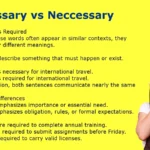
Necessary is the correct spelling, while neccessary is a common misspelling and is not accepted in standard English. Use necessary whenever you mean something that is required, essential, or needed.When comparing necessary vs. neccessary, necessary is the only correct spelling.
The challenge is that many people accidentally add an extra “c” or forget how the word is spelled, especially when writing quickly. But here’s the good news: there’s a simple way to remember the correct spelling, and once you learn it, you’ll be far less likely to make the same mistake again.
In this guide, you’ll learn the difference between Necessary vs Neccessary, discover the correct spelling of necessary, understand why “neccessary” is incorrect, and see necessary meaning, necessary pronunciation, and necessary examples in real sentences. You’ll also find how to spell necessary, memory tricks, and common spelling mistakes to help you write with confidence.
By the end, you’ll know exactly why necessary is the only correct spelling and how to avoid this common writing error in the future.
Necessary vs Neccessary: Which Spelling Is Correct?
The correct spelling is necessary.
The spelling neccessary is incorrect and does not appear in standard English dictionaries. Whether you’re writing an email, an essay, a business report, or a social media post, you should always use necessary.
Quick Comparison
| Word | Correct? | Meaning |
| Necessary | ✅ Yes | Required, essential, or needed |
| Neccessary | ❌ No | Incorrect spelling |
The Correct Spelling Pattern
The word necessary contains:
- One “c”
- Two “s” letters
It follows this pattern:
N-E-C-E-S-S-A-R-Y
Many people accidentally reverse the pattern by writing two c’s and one s, resulting in neccessary. Although it may look believable, it isn’t recognized as a correct English word.
Quick Tip: Remember the phrase “One C, Two S’s.” That single sentence prevents one of the most common spelling mistakes in English.
What Does “Necessary” Mean?
The adjective necessary describes something that is needed, required, or essential to achieve a particular purpose or result.
If something is necessary, you cannot reasonably do without it.
Simple Definition
Necessary means:
- Required
- Essential
- Needed
- Indispensable
- Important for achieving a goal
Dictionary-Style Meaning
Necessary (adjective): Required because something cannot happen correctly or successfully without it.
The word doesn’t always describe something legally required. Often, it simply refers to something that makes a task possible or significantly easier.
When Is Something Necessary?
Many situations involve things that are necessary.
For example:
- Wearing a helmet is necessary when riding a motorcycle.
- Studying is necessary before taking an important exam.
- Clean drinking water is necessary for human survival.
- Accurate financial records are necessary for businesses.
- A passport is necessary for international travel in most countries.
Notice that each example involves something essential rather than merely helpful.
Necessary vs Required
Although people often use these words interchangeably, they don’t always mean exactly the same thing.
| Necessary | Required |
| Means essential or needed | Often means officially demanded |
| May refer to practical necessity | Usually refers to rules or obligations |
| Can be subjective | Usually objective |
Example
Necessary
Drinking plenty of water is necessary during hot weather.
No law requires it, but it helps your body function properly.
Required
Employees are required to wear identification badges.
The employer has established this as a rule.
In many situations, both words fit. However, required often emphasizes obligation, while necessary emphasizes importance.
Common Situations Where “Necessary” Appears
You probably encounter this word more often than you realize.
Everyday Conversation
People frequently say:
- That’s necessary.
- It wasn’t necessary.
- Is this really necessary?
- That’s absolutely necessary.
School and Education
Teachers often write:
- Additional research is necessary.
- Necessary materials should be brought to class.
- Necessary revisions must be completed before submission.
Business Communication
Professionals regularly use phrases like:
- Necessary approvals
- Necessary documentation
- Necessary resources
- Necessary training
- Necessary changes
Healthcare
Medical professionals commonly discuss:
- Necessary treatment
- Necessary medication
- Necessary surgery
- Necessary follow-up appointments
Legal Documents
Legal writing often includes expressions such as:
- Necessary conditions
- Necessary evidence
- Necessary legal procedures
Because the word appears across so many fields, learning its correct spelling pays off in almost every type of writing.
Why Do People Spell “Necessary” as “Neccessary”?
English spelling isn’t always predictable. Many words developed over centuries, borrowing patterns from Latin, French, Germanic languages, and others. As a result, spelling doesn’t always match pronunciation.
The confusion surrounding necessary vs neccessary comes from several different factors.
Double-Letter Confusion
Double letters create problems because people often remember that a word contains repeated letters but forget which ones.
With necessary, many writers remember:
“There’s definitely a double letter somewhere.”
Unfortunately, they often double the wrong letter.
Instead of writing:
necessary
they accidentally write:
neccessary
The mistake happens because the brain remembers repetition but not the exact sequence.
Pronunciation Doesn’t Reveal the Correct Spelling
Another challenge is pronunciation.
When spoken naturally, necessary sounds something like:
NES-uh-ser-ee
Notice that you don’t clearly hear whether the spelling contains one c or two.
Many English words have silent spelling patterns or historical spellings that pronunciation alone cannot explain.
For example:
| Pronunciation | Correct Spelling |
| Necessary | necessary |
| Occasion | occasion |
| Embarrass | embarrass |
| Recommend | recommend |
Each of these words commonly trips up even experienced writers.
English Contains Many Similar Patterns
English includes numerous words with double c, double s, and double m spellings.
Consider these examples:
| Word | Double Letter |
| Success | ss |
| Access | cc |
| Accommodation | cc and mm |
| Occasion | cc |
| Necessary | ss |
Because these patterns vary from word to word, writers sometimes apply the wrong spelling rule.
Fast Typing Creates Muscle Memory Errors
Modern writing happens quickly.
People type on:
- Smartphones
- Tablets
- Laptops
- Desktop computers
When typing rapidly, fingers often follow habit rather than careful spelling.
A writer may know the correct spelling but still produce:
- neccessary
- necesary
- necesarry
- neccesary
Fortunately, proofreading usually catches these errors before publication.
Autocorrect Doesn’t Always Help
Many people rely heavily on spell-check software.
While spell-check is useful, it shouldn’t replace learning correct spelling.
Sometimes:
- autocorrect changes the word unexpectedly,
- the wrong spelling slips into a document,
- or software fails to catch every mistake in specialized writing.
Good spelling remains an important writing skill.
Why Correct Spelling Matters
At first glance, spelling one word incorrectly might not seem important.
However, small mistakes often create larger impressions.
Correct spelling improves:
- Professional credibility
- Academic performance
- Reader confidence
- Search engine optimization
- Business communication
Imagine reading two resumes.
Resume A contains polished writing with correct spelling.
Resume B repeatedly includes errors like neccessary.
Even if both applicants have similar qualifications, many employers will view Resume A more favorably because attention to detail matters.
Real-Life Example
Consider this sentence:
“It is necessary to submit all required documents before Friday.”
Now compare it with:
“It is neccessary to submit all required documents before Friday.”
The second sentence immediately distracts readers.
Instead of focusing on the message, they notice the spelling mistake.
That’s why mastering commonly confused words improves every type of writing.
How to Remember the Correct Spelling of Necessary
Fortunately, you don’t need to memorize complicated grammar rules.
Several simple memory techniques work remarkably well.
Remember: One C, Two S’s
This is by far the easiest method.
Simply repeat:
One C. Two S’s. Necessary.
Many teachers recommend this mnemonic because it’s short, memorable, and accurate.
Think of “One Collar, Two Sleeves”
One of the oldest spelling tricks says:
Necessary has one collar (C) and two sleeves (SS).
Imagine a shirt.
Every shirt has:
- One collar
- Two sleeves
Now connect that picture with the spelling.
Visual memory often lasts much longer than rote memorization.
Break the Word Into Smaller Parts
Instead of viewing the word as one long string of letters, divide it into chunks.
Necessary
Nec + ess + ary
Breaking words into smaller pieces helps your brain recognize familiar patterns instead of memorizing individual letters.
Write It Several Times
Writing strengthens memory.
Try writing:
- necessary
- necessary
- necessary
- necessary
- necessary
Although this seems simple, repetition creates stronger recall over time.
Students preparing for spelling tests often use this method because it works consistently.
Use the Word in Your Own Sentences
Applying a new word in context makes it easier to remember.
Examples:
- It is necessary to save money for emergencies.
- Exercise is necessary for good health.
- Careful planning is necessary before starting construction.
- Patience is necessary when learning a new language.
- A backup copy is necessary before updating software.
Each sentence reinforces both the spelling and the meaning.
Create a Visual Association
Some people remember information better through imagery.
Picture the word like this:
NEC + ESS + ARY
↑↑
Double S
Then remind yourself:
Only one C comes before the double S.
Simple visual cues often stick longer than abstract spelling rules.
Test Yourself Periodically
Learning doesn’t end after reading a spelling rule once.
A better strategy is spaced repetition.
For example:
- Write the word today.
- Spell it again tomorrow.
- Practice again next week.
- Review it next month.
Research in educational psychology consistently shows that revisiting information over increasing intervals improves long-term retention.
“Repetition isn’t about doing the same thing endlessly. It’s about strengthening memory until the correct answer becomes automatic.”
Pronunciation of Necessary
Even though necessary is a common English word, many people hesitate when pronouncing it because its spelling doesn’t perfectly match the way it sounds. The pronunciation is much simpler than the spelling suggests.
American English Pronunciation
Necessary is commonly pronounced as:
/ˈnes.ə.ser.i/
You can think of it as:
NES-uh-ser-ee
The emphasis falls on the first syllable.
British English Pronunciation
The standard British pronunciation is very similar:
/ˈnes.ə.sər.i/
Although the accent differs slightly, the spelling remains exactly the same in both American and British English.
Syllable Breakdown
The word has four syllables.
| Syllable | Sound |
| Nes | NES (stressed) |
| e | uh |
| ssar | ser |
| y | ee |
Breaking the word into syllables makes it easier to pronounce and spell.
Common Pronunciation Mistakes
Many English learners make these mistakes:
- Saying an extra “k” sound after the c
- Stressing the second syllable instead of the first
- Dropping the middle syllable entirely
- Pronouncing every written letter separately
The simplest approach is to say the word naturally:
NES-uh-ser-ee
Once you become comfortable hearing and saying the word, remembering its spelling also becomes easier.
Necessary: Meaning, Origin, and Word History
Many English spelling rules begin to make sense when you understand where a word came from. Necessary is no exception.
The word traces its roots back more than 2,000 years.
Latin Origin
The English word ultimately comes from the Latin word:
necessarius
It meant:
- unavoidable
- indispensable
- unavoidable by circumstance
- essential
The Latin noun necessitas meant necessity or compulsion, which later gave English another familiar word: necessity.
Journey Into English
The word followed this path:
| Language | Word |
| Latin | necessarius |
| Old French | necessaire |
| Middle English | necessary |
| Modern English | necessary |
Although pronunciation changed over the centuries, much of the original spelling remained.
That historical spelling explains why modern English still uses one c followed by two s’s.
Why Didn’t the Spelling Change?
Many English words kept older spellings because dictionaries eventually standardized them.
Once printing became widespread during the fifteenth and sixteenth centuries, publishers needed consistent spelling.
As dictionaries became authoritative references, spellings like necessary became fixed.
That’s why today’s spelling differs slightly from what pronunciation alone might suggest.
Grammar: How to Use Necessary Correctly
Understanding the spelling is only part of mastering this word. You also need to know how it functions in sentences.
Necessary is primarily an adjective.
It describes a noun by showing that something is needed or essential.
Necessary as an Adjective
Examples:
- Water is necessary for life.
- Experience is necessary for this position.
- Regular maintenance is necessary to keep the machine running.
- A permit is necessary before construction begins.
In each example, necessary describes another noun.
Common Sentence Patterns
English speakers frequently use necessary in predictable sentence structures.
It is necessary to…
Examples:
- It is necessary to verify the information.
- It is necessary to wear safety equipment.
- It is necessary to back up important files.
This pattern is especially common in formal writing.
If necessary…
Examples:
- If necessary, we’ll postpone the meeting.
- If necessary, contact customer support.
- Additional testing can be performed if necessary.
This phrase indicates that something may happen depending on the situation.
When necessary…
Examples:
- Employees may work remotely when necessary.
- Doctors prescribe antibiotics only when necessary.
- Emergency services respond immediately when necessary.
As necessary…
Examples:
- Update the software as necessary.
- Make adjustments as necessary.
- Revise the report as necessary.
This expression appears frequently in technical manuals and workplace instructions.
Comparative and Superlative Forms
Like many adjectives, necessary can be compared.
| Form | Example |
| Necessary | Exercise is necessary. |
| More necessary | Water became more necessary during the heat wave. |
| Most necessary | Clean drinking water is the most necessary resource after a disaster. |
Although more necessary sounds unusual, it is grammatically correct.
Necessary in Different Contexts
One reason necessary appears so often is its versatility. It works naturally in casual conversations, professional writing, academic papers, healthcare, engineering, and legal documents.
Let’s explore how different industries use it.
Everyday English
In daily conversation, people often use necessary to describe practical needs.
Examples:
- That’s not necessary.
- Is that really necessary?
- It wasn’t necessary to apologize.
- Bringing an umbrella is necessary today.
The word often expresses whether an action is worth taking.
Academic Writing
Schools and universities frequently use necessary because education involves requirements and expectations.
Examples include:
- Necessary research
- Necessary revisions
- Necessary evidence
- Necessary preparation
Example sentence:
Careful analysis is necessary before drawing conclusions.
Workplace Communication
Businesses use necessary when discussing procedures, planning, compliance, and productivity.
Common workplace phrases include:
- necessary approval
- necessary documentation
- necessary resources
- necessary qualifications
- necessary adjustments
Example:
The finance department completed all necessary paperwork before processing the payment.
Medical Usage
Healthcare professionals often distinguish between treatments that are optional and those that are medically necessary.
Examples include:
- medically necessary surgery
- necessary medication
- necessary testing
- necessary follow-up care
Insurance companies also use the phrase medically necessary when deciding whether a treatment qualifies for coverage.
Legal Language
Law relies heavily on precise wording.
You’ll often encounter phrases such as:
- necessary evidence
- necessary procedures
- necessary legal action
- necessary documentation
Because legal writing values accuracy, necessary appears frequently in contracts, court decisions, and regulations.
Government and Public Administration
Government agencies routinely use necessary when issuing official guidance.
Examples:
- necessary permits
- necessary identification
- necessary qualifications
- necessary public safety measures
Citizens regularly encounter this word while completing applications, renewing licenses, or following official instructions.
Examples of Necessary in Sentences
Learning through examples helps you recognize natural usage.
Basic Examples
- Food is necessary for survival.
- Sleep is necessary for good health.
- Practice is necessary for improvement.
- Honesty is necessary in every relationship.
- Patience is necessary when learning new skills.
Intermediate Examples
- The company made all necessary repairs before reopening the building.
- Careful budgeting is necessary during periods of economic uncertainty.
- Proper maintenance is necessary to extend the life of expensive equipment.
- Regular exercise remains necessary regardless of age.
Professional Examples
- All necessary approvals must be obtained before construction begins.
- The engineering team identified the necessary design modifications.
- Employees received the necessary cybersecurity training before accessing confidential systems.
- Managers reviewed the necessary documentation before signing the agreement.
Academic Examples
- Additional evidence is necessary to support the hypothesis.
- Peer review remains necessary for maintaining research quality.
- The professor explained the necessary statistical methods before the experiment.
- Students completed the necessary laboratory exercises.
Formal Examples
- The committee determined that immediate action was necessary.
- Every necessary precaution was taken before the launch.
- Necessary adjustments were implemented following the inspection.
- The organization allocated the necessary resources to complete the project.
Common Phrases with Necessary
Certain word combinations appear repeatedly in English. These combinations, called collocations, sound natural to native speakers.
Here are some of the most common ones.
| Phrase | Example |
| Necessary precautions | Necessary precautions prevented accidents. |
| Necessary steps | We followed all necessary steps. |
| Necessary information | Please provide the necessary information. |
| Necessary documents | Bring the necessary documents to your appointment. |
| Necessary skills | Candidates should possess the necessary skills. |
| Necessary equipment | The laboratory purchased the necessary equipment. |
| Necessary resources | Schools require the necessary resources. |
| Necessary condition | Trust is a necessary condition for teamwork. |
| Necessary approval | Final necessary approval came yesterday. |
| Necessary action | Officials took the necessary action. |
| Necessary qualifications | Applicants must meet the necessary qualifications. |
| Necessary expense | Repairs became a necessary expense. |
| Necessary repairs | The contractor completed the necessary repairs. |
| Necessary treatment | Doctors recommended the necessary treatment. |
Learning these natural combinations helps your writing sound smoother and more fluent.
“Good writing isn’t just about choosing the right word. It’s about pairing words together the way skilled writers naturally do.”
Words Commonly Confused with Necessary
Many frequently misspelled English words follow similar patterns. Learning them together helps improve overall spelling accuracy.
| Correct Word | Incorrect Form |
| Necessary | Neccessary |
| Occasion | Occassion |
| Accommodation | Accomodation |
| Embarrass | Embarass |
| Recommend | Reccomend |
| Separate | Seperate |
| Calendar | Calender |
| Definitely | Definately |
| Maintenance | Maintainance |
| Judgment (US) | Judgement* (accepted in some UK contexts) |
Notice a pattern?
Most spelling mistakes involve:
- double letters
- silent letters
- unusual historical spellings
- pronunciation differences
Recognizing these patterns makes it easier to catch errors during proofreading.
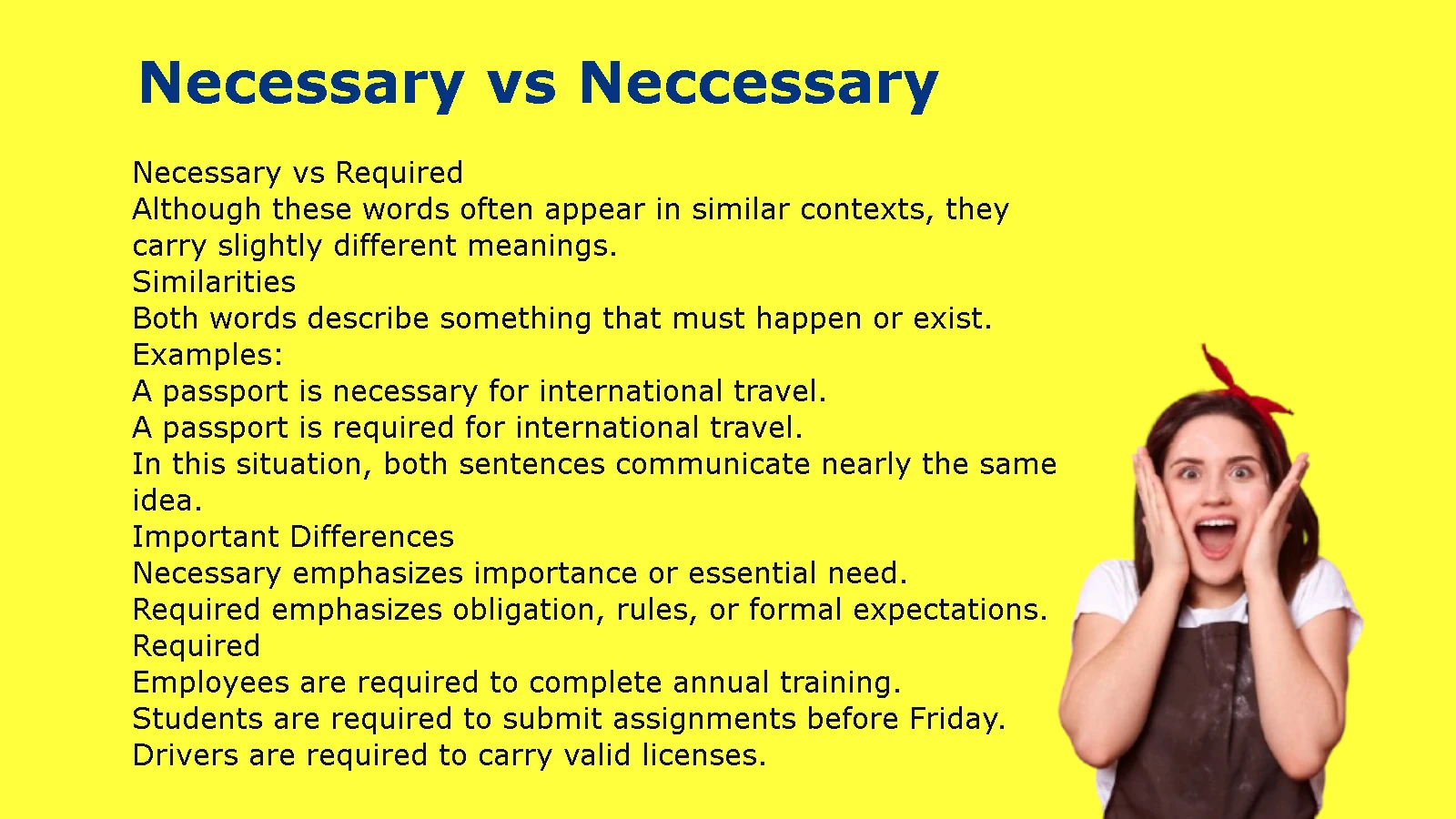
Necessary vs Required
Although these words often appear in similar contexts, they carry slightly different meanings.
Similarities
Both words describe something that must happen or exist.
Examples:
- A passport is necessary for international travel.
- A passport is required for international travel.
In this situation, both sentences communicate nearly the same idea.
Important Differences
Necessary emphasizes importance or essential need.
Required emphasizes obligation, rules, or formal expectations.
| Necessary | Required |
| Focuses on need | Focuses on obligation |
| May be practical | Usually based on rules |
| Often subjective | Usually objective |
| Suggests importance | Suggests compliance |
Examples
Necessary
- Drinking enough water is necessary during a marathon.
- Experience is necessary for success.
- Trust is necessary in strong relationships.
These statements describe genuine needs rather than legal obligations.
Required
- Employees are required to complete annual training.
- Students are required to submit assignments before Friday.
- Drivers are required to carry valid licenses.
These examples involve established rules or policies.
When Can They Be Interchanged?
Sometimes either word works perfectly.
Example:
- Safety equipment is necessary.
- Safety equipment is required.
The surrounding context determines whether the emphasis is on practical importance or official obligation.
Necessary vs Essential
People also confuse necessary and essential because both describe importance. However, they are not always interchangeable.
Similarities
Both words suggest that something is important enough that a task cannot be completed properly without it.
Examples:
- Water is necessary for life.
- Water is essential for life.
Both sentences are correct.
Key Differences
Necessary often refers to something that is needed in a specific situation.
Essential usually implies something fundamental, indispensable, or absolutely critical.
| Necessary | Essential |
| Needed for a purpose | Fundamental or indispensable |
| Can depend on the situation | Usually universally important |
| Practical emphasis | Stronger emphasis on importance |
Examples
Necessary
- A password is necessary to access your account.
- Additional training became necessary after the software update.
Essential
- Oxygen is essential for human life.
- Communication is essential for effective teamwork.
In many contexts, essential carries a stronger sense of absolute importance than necessary.
Necessary vs Mandatory
Although these words overlap in meaning, mandatory has a much narrower use.
What Does Mandatory Mean?
Mandatory means something is required because of a law, regulation, policy, or official rule.
If something is mandatory, people generally don’t have a choice.
Comparison
| Necessary | Mandatory |
| Needed or important | Officially required |
| May be optional depending on context | Not optional |
| Focuses on practical need | Focuses on legal or organizational rules |
Examples
Necessary
- Bringing water is necessary during a long hike.
- Rest is necessary after surgery.
Mandatory
- Seat belts are mandatory in many jurisdictions.
- Cybersecurity training is mandatory for all new employees.
- Tax filings are mandatory under federal law.
Practical Difference
Imagine you’re attending a conference.
- Bringing business cards might be necessary if you plan to network effectively.
- Wearing your attendee badge is mandatory because conference organizers require it.
One improves your experience. The other is a rule you must follow.
Synonyms of Necessary
Using the same word repeatedly can make your writing sound repetitive. Fortunately, necessary has several synonyms. Each one carries a slightly different meaning, so choosing the right alternative depends on the context.
Strong Synonyms of Necessary
These words often replace necessary without changing the overall meaning.
| Synonym | Meaning | Example |
| Essential | Absolutely needed | Water is essential for life. |
| Required | Officially demanded | A passport is required for travel. |
| Needed | Must be available | Extra staff are needed today. |
| Vital | Extremely important | Sleep is vital for recovery. |
| Crucial | Decisive or very important | Communication is crucial during emergencies. |
| Indispensable | Impossible to do without | Trust is indispensable in a partnership. |
| Imperative | Urgently necessary | Immediate action is imperative. |
| Requisite | Officially required or needed | Applicants must have the requisite experience. |
| Obligatory | Required by rules | Wearing safety equipment is obligatory on the site. |
Example Sentences
- Good communication is essential for teamwork.
- Proper planning is crucial before launching a new business.
- Accurate information is vital when making financial decisions.
- Wearing protective equipment is obligatory in hazardous workplaces.
Near Synonyms
These words relate to necessary, but they don’t always mean exactly the same thing.
- Important
- Advisable
- Appropriate
- Helpful
- Beneficial
- Practical
- Worthwhile
- Useful
For example:
Buying travel insurance isn’t always necessary, but it’s often advisable.
That subtle difference matters because advisable suggests a recommendation rather than a requirement.
Antonyms of Necessary
Understanding opposites strengthens your vocabulary and helps you choose words more precisely.
| Antonym | Meaning |
| Unnecessary | Not needed |
| Optional | Left to personal choice |
| Needless | Done without good reason |
| Dispensable | Able to be removed |
| Nonessential | Not critical |
| Voluntary | Done willingly rather than required |
| Extra | More than required |
| Excessive | Beyond what is needed |
Example Sentences
- The meeting turned out to be unnecessary.
- Attendance at the workshop is optional.
- Buying additional accessories would be needless.
- Some decorative features are nonessential.
Knowing these opposites helps you express ideas with greater accuracy.
Common Collocations with Necessary
A collocation is a pair or group of words that naturally appear together in English. Learning these combinations helps your writing sound fluent and natural.
Frequently Used Collocations
| Collocation | Example |
| Absolutely necessary | A backup plan is absolutely necessary. |
| Strictly necessary | Only collect information that is strictly necessary. |
| Barely necessary | The update was barely necessary. |
| Financially necessary | Budget reductions became financially necessary. |
| Medically necessary | The doctor approved medically necessary treatment. |
| Legally necessary | A signed contract is legally necessary in many cases. |
| Practically necessary | Additional storage became practically necessary. |
| Economically necessary | Cost reductions were economically necessary. |
| Necessary measure | The company introduced a necessary measure. |
| Necessary condition | Trust is a necessary condition for cooperation. |
These combinations appear frequently in newspapers, books, research papers, and professional documents.
Idioms and Expressions Featuring Necessary
English includes several fixed expressions built around the word necessary.
If Necessary
This phrase means only if circumstances require it.
Examples:
- We’ll extend the deadline if necessary.
- Contact customer support if necessary.
- Additional testing will be completed if necessary.
As Necessary
This expression means whenever required.
Examples:
- Update the records as necessary.
- Adjust the schedule as necessary.
- Replace damaged parts as necessary.
When Necessary
This phrase refers to actions taken only under certain conditions.
Examples:
- Emergency services respond when necessary.
- Employees may work remotely when necessary.
- Managers intervene only when necessary.
More Than Necessary
People occasionally use this expression to describe something excessive.
Example:
The explanation was more than necessary, but it answered every possible question.
Although less common than the previous phrases, you’ll still encounter it in everyday conversation.
Case Study: How One Misspelled Word Changed a Professional Impression
Imagine two job applicants applying for the same position.
Candidate A
Their resume says:
Strong organizational skills and the ability to complete all necessary tasks independently.
Everything is spelled correctly.
Candidate B
Their resume says:
Strong organizational skills and the ability to complete all neccessary tasks independently.
The qualifications may be identical, yet the spelling mistake immediately catches the recruiter’s attention.
Many hiring managers spend only a few seconds scanning each resume. A simple spelling error can unintentionally suggest a lack of attention to detail, especially for roles involving communication or documentation.
Lesson: Small spelling mistakes can have a big impact. Taking a few moments to proofread can strengthen your credibility.
Common Spelling Mistakes Similar to Necessary
If you often write neccessary, you may also struggle with other commonly misspelled words.
| Correct Spelling | Incorrect Spelling |
| Necessary | Neccessary |
| Separate | Seperate |
| Accommodation | Accomodation |
| Embarrass | Embarass |
| Recommend | Reccomend |
| Occurred | Occured |
| Definitely | Definately |
| Maintenance | Maintainance |
| Conscious | Concious |
| Existence | Existance |
A helpful strategy is to create a personal list of words you frequently misspell and review it regularly.
Tips to Avoid Spelling Necessary Incorrectly
Building strong spelling habits takes practice, but these techniques can make the process much easier.
Remember the Formula
Always think:
One C, Two S’s
This simple phrase solves the most common mistake.
Break the Word into Chunks
Instead of memorizing the entire word, divide it:
Nec + ess + ary
Smaller parts are easier for your brain to process and remember.
Read More
Regular reading naturally reinforces correct spelling. When you repeatedly see necessary written correctly in books, articles, and newspapers, your brain begins to recognize it automatically.
Slow Down While Typing
Many spelling errors happen because people type faster than they think.
Before sending an email or submitting an assignment, pause for a quick review.
Use Spell Check Wisely
Spell-check tools are valuable, but they shouldn’t replace careful proofreading.
Always read your work one final time, especially important documents like resumes, reports, or academic papers.
Quick Quiz: Test Your Knowledge
Choose the correct spelling.
Question 1
Which word is correct?
- A. Neccessary
- B. Necessary
Question 2
Complete the sentence.
It is ________ to wear a helmet while riding a bicycle.
Answer: Necessary
Question 3
Which sentence is correct?
- The repairs were necessary before reopening.
- The repairs were neccessary before reopening.
Correct Answer: The repairs were necessary before reopening.
Question 4
How many c letters appear in necessary?
Answer: One.
Question 5
How many s letters appear in necessary?
Answer: Two.
If you answered all five correctly, you’ve mastered one of the most commonly misspelled words in English.
Frequently Asked Questions
Is neccessary ever correct?
No. Neccessary is always an incorrect spelling. The only accepted spelling in American and British English is necessary.
Why is necessary spelled with one c and two s’s?
The spelling comes from the word’s historical development through Latin and Old French. Modern English standardized the spelling as necessary, and dictionaries recognize no alternative spelling.
What is the easiest way to remember the spelling?
A popular mnemonic is:
One C, Two S’s.
Another helpful memory trick is:
One collar, two sleeves.
Think of a shirt with one collar (C) and two sleeves (SS).
Is necessary an adjective?
Yes. Necessary is primarily an adjective that describes something as required, essential, or needed.
Example:
Regular maintenance is necessary.
Can necessary be used as a noun?
Not by itself.
The related noun is necessity.
Examples:
- Water is a necessity.
- Food is a basic necessity.
What is the plural of necessary?
As an adjective, necessary has no plural form.
However, the noun necessary can occasionally refer to an essential item, though this usage is uncommon today. The plural form is necessaries.
Example:
Travelers packed all the necessaries for the trip.
Can necessary be used as an adverb?
No.
The closest expression is:
necessarily
Example:
Success doesn’t necessarily happen overnight.
What is the opposite of necessary?
The most common antonyms include:
- unnecessary
- optional
- needless
- nonessential
- dispensable
Is necessary formal or informal?
It’s appropriate in both formal and informal English.
You’ll find it in:
- everyday conversations
- academic papers
- business emails
- legal documents
- government publications
- scientific research
Its versatility makes it one of the most useful adjectives in the English language.
Common Takeaways
Here are the key points to remember whenever you’re deciding between necessary vs neccessary:
- Necessary is the only correct spelling.
- Neccessary is always incorrect.
- Necessary means required, essential, or needed.
- Remember the simple rule: one C, two S’s.
- The word functions primarily as an adjective.
- Related words include necessity (noun) and necessarily (adverb).
- Common alternatives include essential, required, vital, and crucial.
- Proofreading important documents helps you catch spelling mistakes before someone else does.
“Clear writing begins with correct spelling. When you consistently choose the right words and spell them accurately, your ideas become easier to understand and more convincing.”