Supersede is the correct spelling, meaning to replace or take the place of something, while supercede is a common misspelling and is not accepted in standard English. Knowing the difference helps you avoid a frequent spelling mistake.When comparing supersede vs. supercede, always use supersede in standard English.
The confusion often comes from the way English words are formed. Many people search for the correct spelling of supersede, how to spell supersede, supersede meaning, or supersede pronunciation, only to find that the unexpected spelling catches them off guard. But here’s the kicker: using the wrong version can make your writing appear less accurate and professional.
In this guide, you’ll learn the difference between Supersede vs Supercede, discover why “supersede” is the correct spelling, explore supersede examples, and understand when to use supersede in everyday and professional writing. You’ll also learn how to pronounce supersede, see it used in sentences, and find a simple memory trick to avoid this common spelling mistake for good.
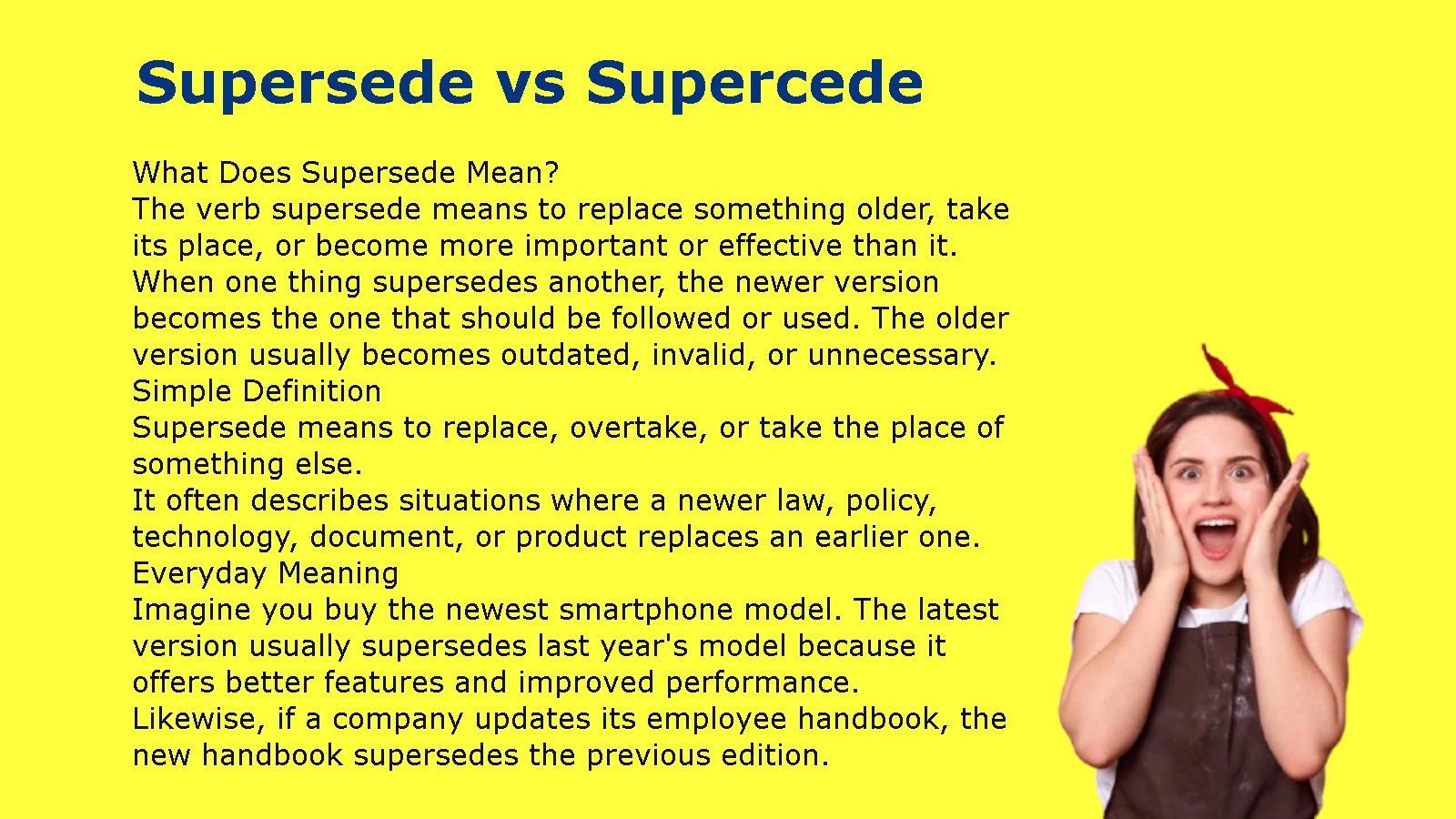
What Does Supersede Mean?
The verb supersede means to replace something older, take its place, or become more important or effective than it.
When one thing supersedes another, the newer version becomes the one that should be followed or used. The older version usually becomes outdated, invalid, or unnecessary.
Simple Definition
Supersede means to replace, overtake, or take the place of something else.
It often describes situations where a newer law, policy, technology, document, or product replaces an earlier one.
Everyday Meaning
Imagine you buy the newest smartphone model. The latest version usually supersedes last year’s model because it offers better features and improved performance.
Likewise, if a company updates its employee handbook, the new handbook supersedes the previous edition.
When Is “Supersede” Used?
You’ll see this word across many industries because replacing outdated information happens everywhere.
Legal Documents
Courts and lawmakers frequently use supersede when newer laws or agreements replace older ones.
Example
This agreement supersedes all previous contracts signed between both parties.
Business Policies
Companies regularly update workplace policies.
Instead of creating confusion, businesses clearly state that the newest policy supersedes earlier versions.
Example
The revised attendance policy supersedes the handbook published last year.
Government Regulations
Governments revise rules as technology, public safety, and society evolve.
Example
The new environmental regulation supersedes the previous standard.
Technology
Software developers release updates that replace older versions.
Example
Version 5.0 supersedes all earlier releases.
Academic Writing
Researchers often publish updated findings that replace outdated theories or data.
Example
Recent evidence supersedes earlier assumptions about the treatment.
Common Situations Where You Can Use “Supersede”
| Situation | Example |
| Software updates | The latest update supersedes version 4.2. |
| Contracts | This agreement supersedes prior agreements. |
| Laws | The amendment supersedes the original act. |
| Company policies | The revised policy supersedes earlier guidelines. |
| Medical research | New clinical evidence supersedes outdated recommendations. |
| School rules | The updated handbook supersedes last year’s edition. |
Does Supersede Always Mean “Replace”?
Not exactly.
Although replace is the closest synonym, supersede usually carries a stronger meaning.
When something replaces another thing, both may still exist.
When something supersedes another, the older version typically loses its authority, usefulness, or relevance.
For example:
- You can replace your office chair without making the old chair invalid.
- A new employment contract supersedes the old contract because the previous agreement no longer applies.
That subtle difference makes supersede especially common in legal, professional, and technical writing.
Is “Supercede” a Real Word?
This is one of the most searched grammar questions online.
The short answer is:
No. “Supercede” is not the standard English spelling.
Modern dictionaries, grammar guides, universities, publishers, and style manuals all recognize supersede as the correct spelling.
If you write supercede in a document, most spell checkers will immediately flag it as incorrect.
Why Do So Many People Spell It “Supercede”?
At first glance, supercede actually looks logical.
Consider these familiar verbs:
- precede
- concede
- recede
- intercede
- secede
- accede
Since these words all end with -cede, it’s easy to assume supersede should follow the same pattern.
English, however, doesn’t always reward logical guesses.
Instead, it preserves many historical spellings that developed hundreds of years ago.
Is “Supercede” Ever Accepted?
You might occasionally find supercede in:
- old handwritten documents
- informal online posts
- personal blogs
- social media comments
- typing mistakes
- historical printing errors
That doesn’t make it correct.
Professional editors treat supercede as a spelling error.
If you’re writing for school, work, publishing, or business, always use supersede.
What Do Dictionaries Say?
Major English dictionaries agree on one spelling.
| Dictionary | Accepted Spelling |
| Merriam-Webster | Supersede |
| Oxford English Dictionary | Supersede |
| Cambridge Dictionary | Supersede |
| Collins Dictionary | Supersede |
| American Heritage Dictionary | Supersede |
Although some dictionaries mention supercede as a common misspelling, they do not list it as the preferred spelling.
Why Spell Check Flags “Supercede”
Modern spell checkers compare words against recognized dictionaries.
Since supercede isn’t standard English, writing software suggests replacing it with supersede.
Programs like Microsoft Word, Google Docs, Grammarly, and many browser spell checkers all recommend the correct form automatically.
Supersede vs Supercede: The Key Difference
Many people believe these spellings represent two different words.
They don’t.
One is correct.
The other is simply a common spelling mistake.
| Feature | Supersede | Supercede |
| Correct spelling | ✅ Yes | ❌ No |
| Standard English | ✅ Yes | ❌ No |
| Accepted by dictionaries | ✅ Yes | ❌ No |
| Used in legal writing | ✅ Yes | ❌ No |
| Appropriate for business writing | ✅ Yes | ❌ No |
| Accepted in academic papers | ✅ Yes | ❌ No |
| Recommended for exams | ✅ Yes | ❌ No |
| Recognized by spell check | ✅ Yes | ❌ Usually flagged |
Which One Should You Use?
Always choose:
✅ Supersede
Never intentionally write:
❌ Supercede
That rule applies to:
- emails
- essays
- resumes
- business reports
- legal documents
- research papers
- blog articles
- books
Using the correct spelling shows professionalism and attention to detail.
Quick Comparison
| Question | Answer |
| Which spelling is correct? | Supersede |
| Is supercede acceptable? | No |
| Why do people misspell it? | They compare it with other -cede verbs. |
| Is supersede used in formal English? | Yes |
| Is supersede commonly used? | Yes, especially in legal and business writing. |
Why Is “Supersede” Spelled with an “S” Instead of a “C”?
This unusual spelling confuses almost everyone at least once.
At first glance, supersede seems like it should follow the same spelling pattern as:
- precede
- concede
- recede
- secede
Yet it doesn’t.
The explanation lies in history rather than modern spelling rules.
The Latin Origin
The English word supersede comes from the Latin verb supersedere.
The Latin word combines two parts:
- super meaning “above” or “over”
- sedere meaning “to sit”
Together, the original meaning was roughly:
to sit above
Over time, the idea evolved into:
- to take someone’s place
- to replace
- to set aside
- to render unnecessary
As English borrowed the word, it preserved the historical spelling with -sede.
Why Doesn’t It End in “-cede”?
Here’s where many people get confused.
Words like precede come from a completely different Latin verb:
cedere
which means:
to go or to move
That’s why these words relate to movement.
| Word | Original Meaning |
| precede | go before |
| recede | go back |
| secede | go away |
| concede | yield or give way |
Supersede doesn’t belong to that family.
Instead, it comes from sedere, not cedere.
Although both endings sound nearly identical in modern English, they developed from different Latin roots.
A Historical Exception
English contains many words that preserve older spellings even after pronunciation changes.
For example:
| Modern Word | Why It Looks Unusual |
| island | Silent s added centuries ago |
| debt | Silent b from Latin influence |
| colonel | Pronounced very differently from its spelling |
| yacht | Keeps its historical Dutch spelling |
| supersede | Retains its original Latin root |
These spellings may seem inconsistent today, but they reflect centuries of language development.
Why People Expect “Supercede”
The human brain naturally looks for familiar patterns.
When you already know:
- concede
- precede
- secede
- recede
your brain predicts:
supercede
That’s pattern recognition at work.
Ironically, your spelling instinct is following a logical rule. English simply refuses to cooperate this time.
Pronunciation Guide
Although people often misspell supersede, most pronounce it correctly.
Standard Pronunciation
sup-er-SEED
IPA
/ˌsuːpərˈsiːd/
Syllable Breakdown
su • per • sede
The final syllable rhymes with:
- seed
- need
- read
- feed
Pronunciation Tips
Stress falls on the last syllable.
Correct:
soo-per-SEED
Not:
- SUPER-seed
- super-said
- super-seed-ee
Easy Way to Remember the Pronunciation
Think of the sentence:
New rules supersede old ones.
Say it naturally a few times.
You’ll notice the stress lands on seed, making the pronunciation easier to remember.
How to Use “Supersede” Correctly
Learning the spelling is only half the battle.
The next step is knowing when the word fits naturally.
In most cases, supersede appears when something new officially replaces something older.
Using Supersede in Business Writing
Businesses frequently update documents, procedures, and internal policies.
Whenever the newest version becomes the official one, supersede is the perfect verb.
Examples
- The revised handbook supersedes the previous edition.
- This policy supersedes all earlier workplace guidelines.
- Our updated pricing structure supersedes last year’s rates.
- The new supplier agreement supersedes every previous contract.
Using Supersede in Legal Writing
Legal professionals rely on precise language.
That’s why contracts often include a clause explaining that the newest agreement replaces every earlier version.
Examples
- This agreement supersedes all prior negotiations.
- The amended contract supersedes the original document.
- The revised statute supersedes previous legislation.
- The court ruling supersedes the earlier administrative order.
Using Supersede in Academic Writing
Research changes constantly.
New discoveries often replace outdated conclusions.
Examples
- Recent findings supersede earlier theories.
- Updated recommendations supersede previous clinical guidelines.
- The revised edition supersedes the original textbook.
- Modern evidence supersedes outdated assumptions.
Using Supersede in Technology
Technology evolves faster than almost any other field.
New hardware, software, and security updates regularly supersede older versions.
Examples
- Version 7.2 supersedes version 6.9.
- The latest operating system supersedes previous releases.
- This update supersedes every earlier security patch.
- The cloud platform supersedes the legacy system.
Using Supersede in Everyday Conversation
Although supersede sounds formal, people still use it in daily life.
Examples include talking about products, rules, or plans.
Examples
- Our new plans supersede yesterday’s schedule.
- This recipe supersedes the one Grandma used years ago.
- My latest phone completely supersedes my old device.
- The new parking rules supersede the temporary signs from last month.
A Simple Rule to Remember
Ask yourself one question:
Has something newer officially replaced something older?
If the answer is yes, supersede is probably the right word.
If you’re simply swapping one object for another without changing authority or validity, words like replace, exchange, or substitute may fit better.
20 Example Sentences Using Supersede
The best way to remember supersede is to see it in context. These examples show how the word works in business, education, law, technology, and everyday conversation.
Workplace Examples
- The updated employee handbook supersedes every previous version.
- Our new vacation policy supersedes the guidelines issued last year.
- The revised pricing agreement supersedes the original contract.
- Management confirmed that the latest memo supersedes all earlier instructions.
School and Academic Examples
- The newest textbook supersedes the edition published in 2020.
- Fresh research often supersedes older scientific theories.
- The revised curriculum supersedes the previous academic plan.
- Updated grading standards supersede the old assessment criteria.
Legal Examples
- This agreement supersedes all prior negotiations between the parties.
- The amended law supersedes the earlier legislation.
- A signed replacement contract supersedes the original agreement.
- The court’s final judgment supersedes the temporary order.
Technology Examples
- Version 6.0 supersedes every earlier software release.
- The security patch supersedes last month’s update.
- The new operating system supersedes legacy software.
- Digital documents often supersede printed copies after approval.
Everyday Examples
- Our weekend plans supersede the schedule we discussed yesterday.
- The latest smartphone model supersedes its predecessor.
- New family rules supersede the temporary arrangements from last month.
- The updated recipe supersedes the original because it produces better results.
Common Mistakes People Make
Misspelling supersede is only one of several errors people make. Understanding these mistakes helps you avoid them in your own writing.
Writing Supercede
This is by far the most common mistake.
❌ Supercede
✅ Supersede
The incorrect spelling appears because many English verbs end in -cede, but supersede does not belong to that group.
Assuming Pronunciation Determines Spelling
Both spellings sound almost identical.
Many people hear the word before they ever write it. Since the pronunciation doesn’t reveal the spelling, they naturally guess.
English contains many words that don’t match their pronunciation perfectly. Supersede is one of them.
Confusing Supersede with Replace
These words overlap, but they aren’t always interchangeable.
Consider the difference:
- I replaced my coffee mug because it broke.
- The revised company policy supersedes the previous version.
In the second sentence, the new policy doesn’t simply replace the old one. It also becomes the official version.
Using It When “Replace” Is Better
Sometimes replace sounds more natural.
Instead of saying:
She superseded her old shoes.
Say:
She replaced her old shoes.
Supersede usually refers to rules, documents, policies, laws, contracts, editions, or systems rather than everyday objects.
Forgetting the Formal Tone
Although ordinary conversations sometimes include supersede, it sounds more formal than replace.
You’ll encounter it more often in:
- contracts
- government publications
- legal writing
- technical manuals
- research papers
- policy documents
Believing “Supercede” Is an Accepted Variant
Some misspellings eventually become accepted over time.
Supercede hasn’t.
Professional editors still treat it as incorrect.
Quick Mistake Checklist
| Mistake | Correct Approach |
| Writing supercede | Always write supersede |
| Using it for ordinary object replacement | Use replace when appropriate |
| Assuming pronunciation explains spelling | Learn the historical spelling |
| Following the -cede pattern | Remember supersede is the exception |
| Ignoring spell check | Accept the correction to supersede |
Why Do So Many People Write Supercede?
The confusion isn’t random.
It happens because the English language encourages your brain to recognize patterns.
Unfortunately, this particular pattern leads you in the wrong direction.
The Influence of Other -cede Words
Many familiar English verbs share the same ending.
- precede
- concede
- recede
- secede
- intercede
- accede
- cede
Since these words all use -cede, writers naturally assume supercede follows the same spelling.
It doesn’t.
Pattern Recognition in the Human Brain
Our brains constantly predict what comes next.
If you’ve learned six words ending in -cede, your brain automatically expects the seventh to match.
That’s one reason intelligent writers misspell supersede so often.
It’s a pattern problem, not a grammar problem.
English Loves Historical Exceptions
English borrowed vocabulary from Latin, French, Germanic languages, Greek, and many others.
As a result, spelling doesn’t always follow neat rules.
Examples include:
| Word | Why It Seems Strange |
| Colonel | Pronunciation differs from spelling. |
| Island | The silent s wasn’t always there. |
| Yacht | Dutch spelling remains. |
| Debt | The b was added later. |
| Supersede | Preserves its historical Latin root. |
These unusual spellings may seem frustrating, yet they reflect the language’s long history.
Frequent Exposure Reinforces the Error
Misspellings spread surprisingly fast online.
A typo in one blog post gets copied into another article. Someone repeats it on social media. Before long, thousands of people have seen the incorrect spelling.
Repeated exposure makes the mistake feel familiar.
Familiar doesn’t mean correct.
Words That People Often Confuse with Supersede
Several verbs share similar meanings, but each has its own nuance.
Understanding the differences makes your writing more precise.
| Word | Meaning | Difference from Supersede |
| Replace | Take the place of something | Doesn’t always imply official authority |
| Override | Cancel the effect of something | Often used for rules or commands |
| Substitute | Use one thing instead of another | Usually temporary or interchangeable |
| Supplant | Displace something through competition | Often emphasizes taking over gradually |
| Repeal | Officially cancel a law | Used only for laws or legislation |
| Amend | Make changes | Doesn’t necessarily replace the whole document |
| Outdate | Make something obsolete | Focuses on becoming old rather than replacing it |
Replace vs Supersede
These words overlap the most.
Replace simply means one thing takes another’s place.
Supersede means the new item also becomes the official or preferred version.
Example:
- I replaced my keyboard.
- The revised employee handbook supersedes the previous edition.
Override vs Supersede
Override usually means to overrule or cancel something.
Example:
The emergency order overrides normal procedures.
Supersede often replaces an entire document or policy rather than temporarily overruling it.
Supplant vs Supersede
Both involve replacement.
However, supplant often suggests competition.
Example:
Streaming services have largely supplanted DVD rentals.
Supersede sounds more official.
Example:
The revised regulations supersede earlier guidelines.
Synonyms of Supersede
No synonym works in every situation.
Choosing the right one depends on context.
| Synonym | Best Used For |
| Replace | General situations |
| Override | Rules and commands |
| Supplant | Competition or gradual replacement |
| Displace | One thing pushing another aside |
| Substitute | Temporary replacement |
| Eclipse | Becoming more important |
| Outmode | Becoming outdated |
| Overtake | Passing something in progress |
Replace
The closest everyday synonym.
Example:
The new machine replaced the old one.
Override
Often appears in technical, legal, and business writing.
Example:
Emergency procedures override standard operating instructions.
Supplant
Suggests replacing through gradual success.
Example:
Electric vehicles may eventually supplant gasoline-powered cars.
Eclipse
Focuses on becoming more significant.
Example:
Smartphones have eclipsed many standalone digital devices.
Displace
Highlights being pushed aside.
Example:
Digital banking has displaced many traditional paper processes.
Antonyms of Supersede
Antonyms describe situations where something remains in effect instead of being replaced.
| Antonym | Meaning |
| Retain | Keep something |
| Preserve | Protect from change |
| Continue | Keep using |
| Maintain | Keep in its current condition |
| Uphold | Support or enforce |
| Keep | Avoid replacing |
Retain
Example:
The company decided to retain its existing policy.
Maintain
Example:
We will maintain the current pricing through next year.
Continue
Example:
Schools will continue using the present curriculum.
Uphold
Frequently used in legal contexts.
Example:
The appellate court upheld the original ruling.
How Supersede Is Used in Different Fields
One reason this word remains common is its versatility.
You’ll encounter it across many professions.
Legal English
Lawyers rely on precise wording.
Instead of saying a contract “replaces” another, they usually write that it supersedes previous agreements.
Common legal examples include:
- contracts
- settlements
- statutes
- amendments
- court orders
- regulations
Example:
This agreement supersedes every prior written and verbal understanding between the parties.
Business and Corporate Communication
Businesses regularly update documents.
Whenever a revised version becomes official, supersede appears.
Examples include:
- employee handbooks
- HR policies
- compliance manuals
- pricing schedules
- supplier agreements
- procurement procedures
Example:
The revised travel policy supersedes all earlier reimbursement guidelines.
Technology
Technology changes rapidly.
Manufacturers constantly release products that outperform previous generations.
Examples include:
- software updates
- operating systems
- hardware revisions
- APIs
- cybersecurity standards
Example:
The latest firmware supersedes every earlier release.
Education
Schools revise teaching materials to reflect new knowledge and standards.
You’ll often see supersede in:
- curriculum updates
- examination guidelines
- textbooks
- research publications
Example:
The updated science curriculum supersedes the version adopted in 2022.
Healthcare
Medical recommendations evolve as researchers gather stronger evidence.
Organizations regularly publish updated guidance that supersedes older advice.
Examples include:
- clinical guidelines
- treatment protocols
- safety recommendations
- vaccination schedules
Example:
The revised clinical guideline supersedes all previous recommendations on patient screening.
Government
Governments frequently amend regulations and policies.
Official notices often include language stating that one regulation supersedes another.
Examples include:
- executive orders
- administrative rules
- environmental regulations
- tax guidance
Example:
This directive supersedes Circular No. 18 issued last year.
Case Study: Why One Word Matters
Imagine a software company releases Version 4.0 with important security fixes.
The release notes state:
Version 4.0 supersedes all previous versions.
That single word tells customers something important. Earlier versions are no longer the recommended choice. They may still function, but the company now recognizes Version 4.0 as the official release.
If the notes simply said:
Version 4.0 replaces Version 3.0.
The message would feel less precise. Readers might wonder if the older version remains supported.
This small distinction explains why legal teams, software developers, government agencies, and businesses consistently choose supersede when they need clear, authoritative language.
Grammar Tips to Remember Supersede
Learning the correct spelling once is good. Remembering it every time you write is even better.
Fortunately, a few simple tricks can make supersede stick in your memory.
Remember the Historical Rule
Many people assume supersede should end with -cede because of words like precede and concede. However, supersede comes from a different Latin root. Its spelling reflects its history rather than a modern spelling pattern.
Once you know that, the unusual spelling makes much more sense.
Memory Trick #1: Think “Standard”
Both supersede and standard contain the letter S.
Supersede starts with the same ending sound as “seed,” not “cede.”
Whenever you’re unsure, remember:
- Supersede
- Standard spelling
Memory Trick #2: Picture a New Rule
Imagine a sign that reads:
New rules supersede old rules.
Visualizing one document replacing another reinforces the meaning and the spelling at the same time.
Memory Trick #3: Learn the Exception
English has many exceptions that don’t follow the usual pattern.
Think about words like:
- island
- colonel
- yacht
- debt
- supersede
Instead of fighting the exception, simply memorize it as one of English’s historical spellings.
Memory Trick #4: Trust Your Spell Checker
Modern writing tools recognize supersede immediately.
If your word processor underlines supercede, don’t ignore it. Accept the correction and move on.
Over time, seeing the correct spelling repeatedly will make it feel natural.
Supersede vs Other -cede Words
One reason supercede looks convincing is that English contains many verbs ending in -cede.
The meanings, however, are quite different.
| Word | Meaning | Example |
| Precede | To come before | Dessert doesn’t precede dinner. |
| Concede | To admit or acknowledge | She conceded the point after reviewing the evidence. |
| Recede | To move back | The floodwaters began to recede overnight. |
| Intercede | To intervene on someone’s behalf | A lawyer may intercede during negotiations. |
| Secede | To withdraw formally | Several regions attempted to secede. |
| Accede | To agree or assume office | The committee acceded to the request. |
| Supersede | To replace or take the place of | The revised policy supersedes the previous one. |
Although these words sound similar, supersede belongs to a different historical word family.
That single fact explains nearly all of the confusion.
Why Doesn’t Supersede Follow the Pattern?
The answer comes back to etymology.
Most -cede verbs originate from the Latin verb cedere, meaning to go or to yield.
Supersede, on the other hand, comes from supersedere, which means to sit above or to refrain from.
English preserved that spelling instead of changing it to match the other words.
Language often values history over consistency.
Is Supercede Ever Acceptable?
Many people ask whether supercede has become acceptable because it’s so common online.
The answer remains straightforward.
No.
Professional editors, publishers, teachers, and style guides continue to recommend only supersede.
Why You Might See “Supercede”
The incorrect spelling appears for several reasons.
- Typing mistakes
- Autocorrect errors in older software
- Informal blog posts
- Social media content
- User-generated websites
- Confusion with other -cede words
Popularity doesn’t make a spelling correct.
What Professional Writers Use
Editors working for newspapers, publishing houses, universities, and businesses consistently use supersede.
You’ll also find it in:
- legal contracts
- government regulations
- academic journals
- dictionaries
- style manuals
- technical documentation
If you’re writing for any professional audience, supersede is the only appropriate choice.
What About Older Documents?
Occasionally, older texts include supercede.
In most cases, it’s simply an outdated spelling mistake that survived in print.
Modern editors generally correct it during revisions or reprints.
Quick Quiz
Test your understanding before moving on.
Question 1
Which spelling is correct?
A. Supercede
B. Supersede
Answer: B. Supersede
Question 2
What does supersede mean?
A. To copy
B. To replace
C. To delay
D. To remove permanently
Answer: B. To replace
Question 3
Choose the correct sentence.
A. The revised contract supercedes the original.
B. The revised contract supersedes the original.
Answer: B
Question 4
Which field commonly uses supersede?
A. Legal writing
B. Business policies
C. Technology
D. All of the above
Answer: D
Question 5
Which word is a synonym for supersede?
A. Replace
B. Dance
C. Whisper
D. Divide
Answer: A
Question 6
Which sentence is correct?
A. Version 5.0 supersedes Version 4.0.
B. Version 5.0 supercedes Version 4.0.
Answer: A
Question 7
Why do people often misspell supersede?
A. It sounds different from how it’s spelled.
B. Many English words end with -cede.
C. English preserves historical spellings.
D. All of the above.
Answer: D
Question 8
Which word is an antonym of supersede?
A. Maintain
B. Replace
C. Override
D. Supplant
Answer: A
Question 9
Complete the sentence.
“The updated handbook ________ the previous edition.”
A. supersedes
B. supercedes
Answer: A
Question 10
Which statement is true?
A. Both spellings are equally correct.
B. Supercede is preferred in American English.
C. Supersede is the only standard spelling.
D. Dictionaries recommend both spellings.
Answer: C
Frequently Asked Questions
Is it supersede or supercede?
The correct spelling is supersede. Although supercede looks similar to words like precede and concede, it is considered a misspelling in standard English.
Why is supersede spelled with an S?
The word comes from the Latin supersedere, not cedere. Because of its different origin, English preserved the spelling with -sede rather than changing it to -cede.
Is supercede in the dictionary?
Some dictionaries mention supercede only as a common misspelling or historical variant. None recommend it as the standard spelling.
Is supersede a formal word?
Yes. It’s common in legal documents, contracts, business policies, government publications, technical manuals, and academic writing.
Can supersede simply mean “replace”?
Yes, although it often implies more than ordinary replacement.
When something supersedes another thing, the older version usually loses its authority, relevance, or official status.
What is the difference between replace and supersede?
Replace is a broad, everyday verb.
Supersede usually refers to an official or authoritative replacement, especially for documents, rules, laws, agreements, or software versions.
Is supersede commonly used in legal writing?
Absolutely.
Lawyers frequently use supersede in contracts, settlements, amendments, and legislation because it clearly states that one document replaces another.
How can I remember the correct spelling?
Remember this simple phrase:
New rules supersede old rules.
Then associate supersede with standard spelling because both begin with S.
Key Takeaways
Here are the most important points to remember.
- Supersede is the only correct spelling in modern English.
- Supercede is a common misspelling caused by confusion with other -cede verbs.
- Supersede means to replace, take the place of, or render something obsolete or unnecessary.
- The word comes from the Latin supersedere, which explains its unusual spelling.
- It appears frequently in legal documents, business communication, government regulations, academic writing, and technology.
- Although replace is a close synonym, supersede often implies that the older version no longer has authority or effect.
- Learning the word’s history makes it much easier to remember its spelling.
Final Comparison Table
| Feature | Supersede | Supercede |
| Correct spelling | ✅ Yes | ❌ No |
| Standard English | ✅ Yes | ❌ No |
| Used in legal documents | ✅ Yes | ❌ No |
| Accepted in business writing | ✅ Yes | ❌ No |
| Found in dictionaries | ✅ Yes | Only as a misspelling or historical variant |
| Recommended for students | ✅ Yes | ❌ No |
| Professional usage | ✅ Yes | ❌ No |
Conclusion
The debate over supersede vs supercede has a simple answer: supersede is the correct spelling, and supercede is not. While the incorrect version looks convincing because it resembles words like precede, concede, and recede, history tells a different story. Supersede comes from a separate Latin root, which explains why its spelling stands apart from the familiar -cede pattern.
Knowing this distinction helps you write with greater confidence in every setting. From legal contracts and business policies to research papers and everyday emails, using supersede shows accuracy and professionalism. The next time you hesitate, remember one simple rule: new versions supersede old ones. Keep that phrase in mind, and you’ll never second-guess the spelling again.