Beginning is the correct spelling, while begining is a common misspelling. The word begin doubles the final n before adding -ing, following standard English spelling rules. When comparing begining vs beginning, beginning is the correct spelling.
The confusion happens when the verb begin changes to its -ing form, leaving many people unsure whether to use one n or double it. But here’s the kicker: a single missing letter can make your writing look less polished in emails, essays, and professional documents.
In this guide, you’ll learn the difference between Begining vs Beginning, discover the correct spelling of beginning, understand why beginning has two n’s, and see the present participle of begin explained with clear examples. You’ll also learn how to spell beginning, beginning pronunciation, and how to use the word correctly in everyday sentences.
By the end, you’ll know exactly why beginning is correct, why begining is a common misspelling, and how to avoid making this mistake in your writing again.
Begining vs Beginning: Which One Is Correct?
The short answer is simple:
- Beginning ✅ is the correct spelling.
- Begining ❌ is a misspelling.
English dictionaries recognize only beginning. If you use begining in school assignments, business emails, blog posts, or professional documents, spell-check software will usually flag it as an error.
Quick Comparison
| Word | Correct? | Meaning |
| Beginning | ✅ Yes | The start or first part of something |
| Begining | ❌ No | Incorrect spelling of beginning |
Whether you’re writing an essay, sending an email, or creating website content, beginning is always the spelling you should use.
Why Do So Many People Write “Begining”?
Several reasons explain this common mistake.
- The word sounds like it could have only one n.
- People often type quickly and accidentally omit a letter.
- English spelling rules can seem inconsistent.
- Many learners don’t know the consonant-doubling rule.
Fortunately, once you understand why beginning contains two n letters, you’ll rarely make the mistake again.
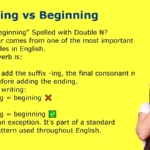
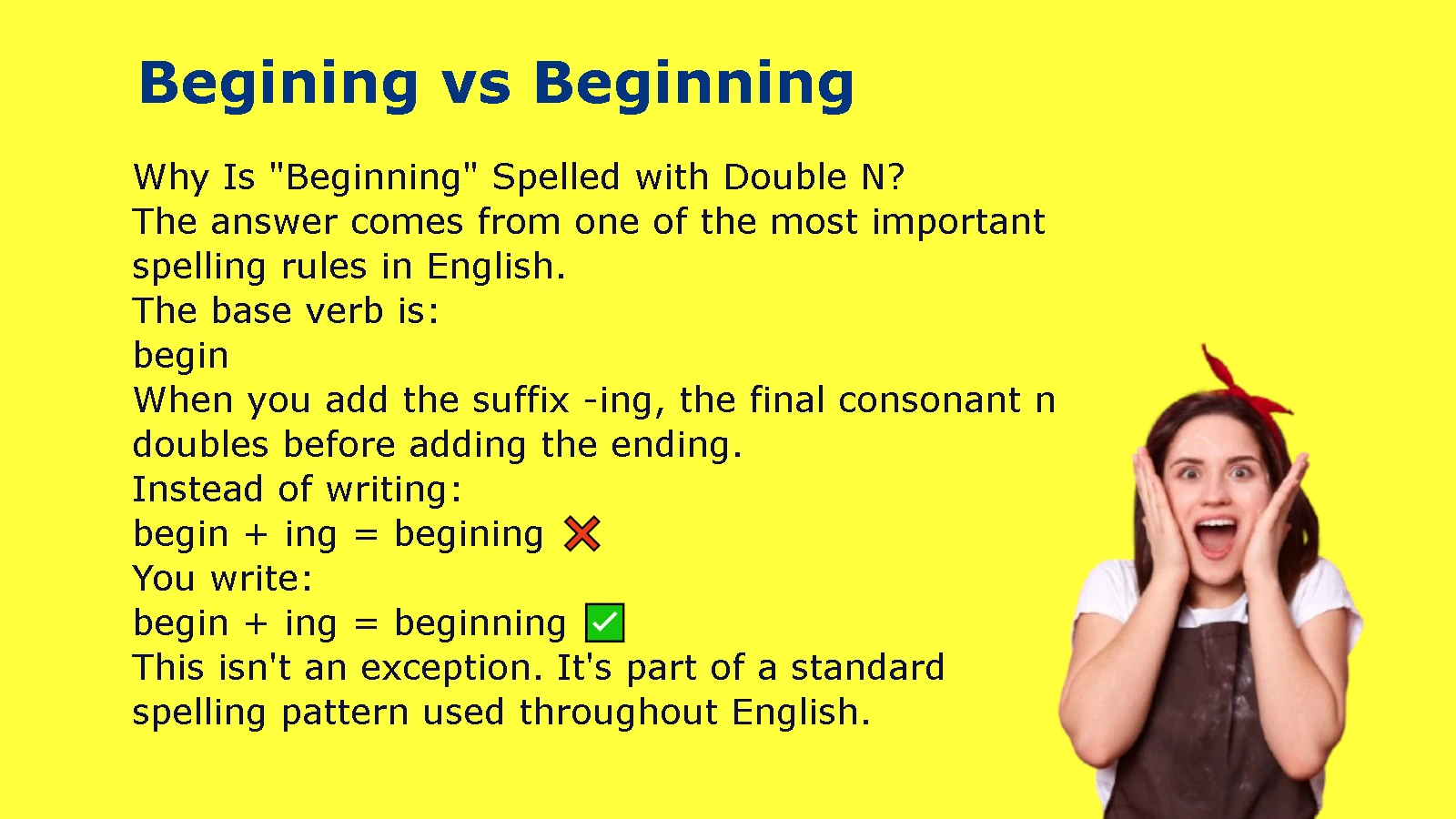
Why Is “Beginning” Spelled with Double N?
The answer comes from one of the most important spelling rules in English.
The base verb is:
begin
When you add the suffix -ing, the final consonant n doubles before adding the ending.
Instead of writing:
begin + ing = begining ❌
You write:
begin + ing = beginning ✅
This isn’t an exception. It’s part of a standard spelling pattern used throughout English.
The Rule Behind the Double N
A final consonant usually doubles before adding -ing when these conditions are true:
- The word ends with one vowel followed by one consonant.
- The final syllable receives the primary stress.
- The suffix begins with a vowel.
The word begin satisfies all three conditions.
| Rule | Does “begin” qualify? |
| Ends with one vowel + one consonant | ✅ Yes |
| Final syllable is stressed | ✅ Yes |
| Adding -ing | ✅ Yes |
Because every condition is met, the final n doubles.
Why Pronunciation Doesn’t Help
English spelling doesn’t always match pronunciation perfectly.
When people say beginning, the double n isn’t strongly pronounced. It sounds almost identical to what many imagine begining would sound like.
That’s why relying only on pronunciation often leads to spelling errors.
Instead, rely on the spelling rule rather than the sound.
A Simple Memory Trick
Here’s an easy way to remember the correct spelling.
If you begin something, you’re already running toward a double N.
Think about these words:
- run → running
- sit → sitting
- begin → beginning
They all follow the same pattern.
Another memory trick is this:
Beginning begins with “begin,” but it finishes with two Ns before “-ing.”
Small mental shortcuts like these make spelling much easier.
Understanding the Consonant-Doubling Rule
The consonant-doubling rule appears throughout English. Once you learn it, you’ll spell hundreds of words more confidently.
Let’s break it down into simple situations.
One-Syllable Words
Many short words double their last consonant before adding -ing.
| Base Word | Correct Form |
| run | running |
| sit | sitting |
| stop | stopping |
| swim | swimming |
| hop | hopping |
| win | winning |
Notice that every word doubles its final consonant.
Incorrect examples include:
- runing ❌
- stoping ❌
- swiming ❌
Words with Stress on the Final Syllable
Some longer words also double the final consonant because the last syllable carries the stress.
Examples include:
| Base Word | Correct Form |
| begin | beginning |
| admit | admitting |
| occur | occurring |
| refer | referring |
| regret | regretting |
| permit | permitting |
Although these words contain more than one syllable, they still follow the same spelling rule.
Words That Do Not Double the Final Consonant
Not every word doubles its last letter.
If the stress falls earlier in the word, you usually don’t double the consonant.
Examples include:
| Base Word | Correct Form |
| open | opening |
| visit | visiting |
| listen | listening |
| happen | happening |
| enter | entering |
| offer | offering |
Notice that opening contains only one n, while beginning contains two.
The difference comes from word stress, not word length.
Why Stress Matters
English spelling often depends on pronunciation patterns.
Consider these examples:
- BE-gin ❌
- be-GIN ✅
The stress falls on the second syllable.
Now compare it with:
- O-pen ✅
Since the stress falls on the first syllable, the consonant doesn’t double.
Understanding stress helps explain dozens of spelling patterns that confuse English learners.
Common Verbs That Follow the Same Rule
Here are several everyday verbs that use consonant doubling.
| Verb | Present Participle |
| begin | beginning |
| admit | admitting |
| occur | occurring |
| refer | referring |
| forget | forgetting |
| regret | regretting |
| control | controlling |
| travel* | traveling (US English) |
Note: In US English, traveling uses one l, while British English usually writes travelling.
This difference doesn’t affect beginning, which is spelled the same in both American and British English.
Meaning of “Beginning”
The word beginning has several closely related meanings.
Although it usually refers to the start of something, its grammatical function changes depending on the sentence.
Understanding these meanings helps you use the word naturally.
Beginning as a Noun
Most often, beginning functions as a noun.
It refers to the starting point of an event, story, journey, process, or period.
Examples
- The beginning of the movie surprised everyone.
- Every great friendship has a beginning.
- The project had a difficult beginning, but it ended successfully.
- We arrived at the beginning of the ceremony.
In each sentence, beginning names the first part of something.
Beginning as Part of a Verb
The word also appears in progressive verb forms.
Examples include:
- The meeting is beginning.
- Winter is beginning earlier this year.
- She was beginning to understand the lesson.
- The flowers are beginning to bloom.
Here, beginning isn’t a noun. Instead, it’s the present participle of the verb begin.
Beginning as an Adjective
Sometimes beginning describes another noun.
Examples include:
- beginning readers
- beginning students
- beginning piano lessons
- beginning stages
In these cases, beginning means introductory, starting, or designed for beginners.
Dictionary Definition
Most major dictionaries define beginning similarly.
Beginning: The point at which something starts or comes into existence.
It may also describe:
- the first part of an event
- the origin of something
- the early stage of development
- the act of starting
These meanings appear consistently in educational, business, scientific, and everyday writing.
Common Situations Where “Beginning” Appears
You’ll encounter beginning in almost every kind of English.
Examples include:
- books
- newspapers
- novels
- emails
- speeches
- academic papers
- contracts
- websites
- advertisements
- conversations
Because it’s such a common word, spelling it correctly leaves a stronger impression on readers.
How to Use “Beginning” in a Sentence
Knowing the correct spelling is only half the battle. You also need to understand how the word works in everyday writing.
Fortunately, beginning is flexible. It can function as a noun, appear in verb phrases, or introduce time-related expressions.
Using “Beginning” as a Noun
This is the most common usage.
Examples
- Every adventure has a beginning.
- The beginning of the novel immediately captured my attention.
- We missed the beginning of the football game.
- She remembered the beginning of their friendship vividly.
- Success often starts with a small beginning.
Notice how the word refers to the first part of something.
Using “Beginning” in Progressive Tenses
When paired with a helping verb, beginning becomes part of the verb phrase.
Examples include:
- The presentation is beginning now.
- The weather was beginning to improve.
- Scientists are beginning to understand the phenomenon better.
- I am beginning to see your point.
- Businesses are beginning to adopt new technologies faster than ever.
This structure is extremely common in spoken and written English.
Using “Beginning” at the Start of a Phrase
Many announcements and formal documents use beginning to introduce a starting date or event.
Examples include:
- Beginning today, all visitors must register.
- Beginning next Monday, the office will open at 8 a.m.
- Beginning in July, the new pricing policy takes effect.
- Beginning immediately, safety procedures will change.
This usage sounds professional and appears frequently in schools, workplaces, government notices, and official announcements.
Common Examples of “Beginning”
Once you understand the spelling rule, the next step is seeing beginning used naturally. The word appears in everyday conversations, books, newspapers, academic writing, and business communication. The more examples you read, the easier it becomes to recognize the correct spelling instantly.
Below are real-world situations where beginning fits naturally.
Beginning in Everyday Conversations
People use beginning constantly in casual speech.
Examples
- I liked the movie from the beginning.
- Let’s go back to the beginning of the story.
- The rain was beginning to fall.
- Our vacation is beginning tomorrow.
- That’s only the beginning of what happened.
- The meeting is beginning, so let’s head inside.
Notice that every sentence uses beginning, never begining.
Beginning in Academic Writing
Teachers, professors, and researchers often use the word when discussing timelines, essays, historical events, or experiments.
Examples include:
- The beginning of the Industrial Revolution transformed manufacturing.
- The article explains the beginning of modern genetics.
- Students should introduce their main argument at the beginning of the essay.
- Data collection was beginning before sunrise.
Academic writing values precise spelling, making beginning the only acceptable choice.
Beginning in Business Communication
Professional emails, reports, and presentations frequently include this word.
Examples:
- The project is beginning next quarter.
- Sales improved from the beginning of the fiscal year.
- Training will be beginning next Monday.
- Please review the instructions at the beginning of the document.
- Our partnership marked the beginning of long-term growth.
Correct spelling helps maintain professionalism and credibility.
Beginning in Literature
Authors often use beginning to establish time, introduce characters, or create suspense.
Examples:
- Every story has a beginning, a middle, and an end.
- The beginning of the novel introduces the main conflict.
- From the very beginning, readers sense that something unusual is about to happen.
A strong beginning often determines whether readers continue reading.
Beginning in News Articles
Journalists frequently refer to the beginning of events, investigations, seasons, or policies.
Examples include:
- The beginning of hurricane season brought heavy rainfall.
- Officials announced changes beginning next month.
- Markets recovered after a slow beginning to the week.
- Construction is beginning ahead of schedule.
Because news writing demands accuracy, you’ll never see reputable publications intentionally use begining.
Examples Across Different Contexts
| Context | Example Sentence |
| School | The semester is beginning next week. |
| Sports | The game had an exciting beginning. |
| Travel | Our journey had a rough beginning. |
| Business | The company is beginning a new expansion plan. |
| Technology | Developers are beginning system testing. |
| Healthcare | Treatment should begin at the beginning of symptoms. |
| Personal Life | Every friendship has a beginning. |
These examples show how versatile the word is.
Examples of the Incorrect Spelling “Begining”
Although millions of people search for begining, it remains incorrect.
The mistake usually appears because someone forgets to double the final n.
Here are some common errors and their corrections.
| Incorrect | Correct |
| begining school | beginning school |
| begining tomorrow | beginning tomorrow |
| at the begining | at the beginning |
| the begining of time | the beginning of time |
| begining a project | beginning a project |
| begining today | beginning today |
Incorrect Sentence Examples
❌ The begining of the movie was exciting.
✅ The beginning of the movie was exciting.
❌ School is begining next week.
✅ School is beginning next week.
❌ The begining of the book confused me.
✅ The beginning of the book confused me.
❌ They are begining construction tomorrow.
✅ They are beginning construction tomorrow.
Will Spell Check Catch It?
Most modern writing tools identify begining as a spelling mistake.
Examples include:
- Microsoft Word
- Google Docs
- Grammarly
- Apple Pages
- Browser spell checkers
However, relying entirely on software isn’t ideal. Understanding the rule helps you write confidently even without automatic correction.
Can “Begining” Ever Be Correct?
No.
Unlike some words that have both American and British spellings, begining has no accepted use in standard English.
Whether you’re writing in:
- US English
- UK English
- Canadian English
- Australian English
…the correct spelling is always:
Beginning
Why People Misspell “Beginning”
Understanding the reason behind the mistake makes it easier to avoid.
Several factors contribute to this common spelling error.
Forgetting the Consonant-Doubling Rule
This is the biggest reason.
Many writers remember to add -ing but forget to double the final consonant first.
Instead of:
begin → beginning
they accidentally write:
begin → begining
Learning the rule eliminates this problem.
Typing Too Quickly
Fast typing often causes missing letters.
Since beginning contains three consecutive n letters if you count the one in -ing, it’s easy to skip one accidentally.
This is especially common on smartphones and tablets.
Pronunciation Doesn’t Reveal the Double Letter
When spoken naturally, beginning doesn’t strongly emphasize both n letters.
As a result, people often spell the word exactly how they hear it.
Many Exceptions
English has countless spelling patterns.
Some words double consonants.
Others don’t.
Examples:
- hoping
- hopping
- filing
- filling
- later
- letter
Because the language contains many exceptions, learners sometimes apply the wrong rule.
Learning English as a Second Language
English learners often memorize vocabulary before studying spelling rules.
That approach can produce mistakes like:
- begining
- stoping
- refering
- occuring
Once learners understand consonant doubling, these mistakes usually disappear.
Visual Memory Plays a Role
People often spell familiar words from memory rather than by applying grammar rules.
If someone has repeatedly seen begining online, they may unconsciously believe it’s correct.
Reading high-quality books and articles strengthens visual spelling memory.
Beginning vs Begining: Side-by-Side Comparison
Here’s an easy reference table.
| Feature | Beginning | Begining |
| Correct spelling | ✅ Yes | ❌ No |
| Found in dictionaries | ✅ Yes | ❌ No |
| Accepted in academic writing | ✅ Yes | ❌ Never |
| Accepted in professional writing | ✅ Yes | ❌ Never |
| Passes spell check | ✅ Yes | ❌ Usually flagged |
| Based on English spelling rules | ✅ Yes | ❌ No |
| Recommended for SEO writing | ✅ Yes | ❌ Never |
The comparison leaves little room for confusion.
Whenever you’re unsure, remember:
Beginning is always correct.
Words That Follow the Same Spelling Rule
One of the easiest ways to remember beginning is to compare it with similar words.
Many English verbs double the final consonant before adding -ing.
| Base Word | Correct Form |
| Begin | Beginning |
| Admit | Admitting |
| Refer | Referring |
| Occur | Occurring |
| Regret | Regretting |
| Forget | Forgetting |
| Permit | Permitting |
| Commit | Committing |
| Transfer | Transferring |
| Propel | Propelling |
These words all follow the same pattern because the stress falls on the final syllable.
Words That Often Confuse Writers
Here are some similar spelling mistakes.
| Incorrect | Correct |
| occuring | occurring |
| refering | referring |
| admiting | admitting |
| regreting | regretting |
| stoping | stopping |
| runing | running |
| writting | writing |
| swiming | swimming |
Notice that not every word doubles the same letter.
For example:
- write → writing
- create → creating
- open → opening
The spelling depends on established English rules, not simply adding another consonant.
Pattern Recognition Makes Spelling Easier
Instead of memorizing every word individually, recognize the pattern.
Words ending in:
- one vowel
- one consonant
- stressed final syllable
often double the last consonant before adding -ing, -ed, or similar suffixes.
For example:
- permit → permitted
- refer → referred
- occur → occurred
Learning patterns is much more effective than memorizing isolated spellings.
Related Word Forms
The word beginning belongs to a family of related words.
Understanding each form improves both writing and speaking.
| Word | Part of Speech | Meaning |
| Begin | Verb | To start something |
| Beginning | Noun / Present participle / Adjective | The start or first stage |
| Began | Verb (Past tense) | Started |
| Begun | Past participle | Started after “has,” “have,” or “had” |
| Beginner | Noun | A person who is learning |
| Beginnings | Plural noun | Multiple starting points |
Begin
Begin is the base verb.
Examples:
- Let’s begin the meeting.
- Please begin when you’re ready.
- They begin work every morning at eight.
Beginning
This word has several grammatical functions.
Examples:
- The beginning of the book was exciting.
- She is beginning to understand.
- Beginning students should practice daily.
Began
This is the simple past tense.
Examples:
- The concert began on time.
- It began raining after lunch.
- Our friendship began years ago.
Begun
This is the past participle.
Examples:
- The meeting has begun.
- Construction had begun before winter.
- The investigation has already begun.
Remember:
❌ has began
✅ has begun
Beginner
A beginner is someone learning a new skill.
Examples:
- She’s a beginner in Spanish.
- This course is designed for beginners.
- Every expert was once a beginner.
Knowing the relationship between these forms makes your writing more precise and helps you avoid tense mistakes.
Beginning in Common Expressions
The word beginning appears in many everyday expressions. Learning these phrases helps you sound more natural in both spoken and written English. Each expression has a specific meaning, even though they all relate to the idea of starting something.
Let’s look at the most common ones.
From the Beginning
Meaning: From the very start of something.
Examples
- I knew the answer from the beginning.
- She supported the project from the beginning.
- We planned the trip carefully from the beginning.
This phrase emphasizes that something existed or happened right from the start.
In the Beginning
Meaning: During the earliest stage of an event, process, or period.
Examples
- In the beginning, the software had several bugs.
- In the beginning, learning a new language can feel overwhelming.
- The company struggled in the beginning but later became successful.
You’ll often see this phrase in history books, literature, and discussions about how something developed over time.
At the Beginning
Meaning: At the starting point of a specific event, document, or timeline.
Examples
- Read the instructions at the beginning of the manual.
- We met at the beginning of the conference.
- The teacher explained the rules at the beginning of class.
Unlike from the beginning, which highlights continuity, at the beginning refers to a specific point in time.
Beginning With
Meaning: Starting with a particular person, item, or event.
Examples
- We’ll review the agenda beginning with today’s announcements.
- The museum tour starts beginning with the oldest exhibits.
- Read the chapters beginning with Chapter Three.
This phrase often appears in instructions and presentations.
Beginning To
Meaning: Starting to do something.
Examples
- I’m beginning to understand algebra.
- The weather is beginning to improve.
- Scientists are beginning to uncover new evidence.
This construction is extremely common in everyday English.
New Beginning
Meaning: A fresh start after a major life change.
Examples
- Moving to a new city gave her a new beginning.
- Graduation marked a new beginning for the students.
- The company viewed the merger as a new beginning.
The phrase often carries a positive and hopeful tone.
Fresh Beginning
Meaning: Another way of saying a new start, usually after setbacks.
Examples
- January feels like a fresh beginning.
- After changing careers, he enjoyed a fresh beginning.
- Every morning offers a fresh beginning.
Since the Beginning
Meaning: From the time something first started until now.
Examples
- She has been involved since the beginning.
- They’ve supported the charity since the beginning.
- The rules have remained the same since the beginning.
Comparison of Common Expressions
| Expression | Meaning | Example |
| From the beginning | From the very start | I trusted her from the beginning. |
| In the beginning | During the early stage | In the beginning, sales were slow. |
| At the beginning | At the starting point | Read the notes at the beginning. |
| Beginning with | Starting with | We’ll begin with introductions. |
| Beginning to | Starting an action | She’s beginning to improve. |
| New beginning | Fresh chapter in life | Retirement was a new beginning. |
| Fresh beginning | Opportunity to start over | Monday feels like a fresh beginning. |
| Since the beginning | From the start until now | He’s been here since the beginning. |
Beginning in Grammar
The word beginning can perform different grammatical functions depending on how it appears in a sentence. Understanding these roles will help you write more naturally and avoid common grammar mistakes.
Beginning as a Gerund
A gerund is a verb ending in -ing that functions as a noun.
Examples
- Beginning early improves your chances of success.
- Beginning a new habit takes discipline.
- Beginning with a clear plan saves time.
In these examples, beginning acts as the subject of the sentence.
Beginning as a Present Participle
A present participle works with helping verbs to form continuous tenses.
Examples
- The concert is beginning now.
- They were beginning to worry.
- We are beginning a new project next week.
- The flowers are beginning to bloom.
Here, beginning is part of the verb phrase rather than functioning as a noun.
Beginning as an Adjective
Sometimes beginning describes another noun.
Examples
- Beginning students should complete the introductory exercises.
- The school offers beginning piano classes.
- This guide is ideal for beginning photographers.
In this role, beginning means introductory or intended for beginners.
Grammar Snapshot
| Function | Example |
| Noun | The beginning of the story was exciting. |
| Gerund | Beginning early makes a difference. |
| Present Participle | The meeting is beginning. |
| Adjective | Beginning students should practice daily. |
Common Mistakes to Avoid
Even experienced writers occasionally make spelling or grammar mistakes with beginning. Fortunately, they’re easy to fix once you know what to watch for.
Writing “Begining” Instead of “Beginning”
This is by far the most common mistake.
❌ begining
✅ beginning
Always remember to double the final n before adding -ing.
Confusing “Begin” with “Beginning”
Use begin when you need the base verb.
Correct:
- Let’s begin the lesson.
Incorrect:
- Let’s beginning the lesson.
Likewise, use beginning when referring to the start of something.
Correct:
- The beginning of the lesson was interesting.
Mixing Up “Began” and “Begun”
These two verb forms often confuse learners.
Correct:
- The meeting began at noon.
- The meeting has begun.
Incorrect:
- The meeting has began.
A simple trick is to remember that begun follows helping verbs such as has, have, and had.
Forgetting Subject-Verb Agreement
Make sure the helping verb matches the subject.
Correct:
- She is beginning.
- They are beginning.
Incorrect:
- They is beginning.
Capitalization Errors
Capitalize Beginning only when grammar requires it.
Examples:
- Beginning today, the office opens at 8 a.m.
- We celebrated the beginning of summer.
In the first sentence, the word starts the sentence, so it’s capitalized. In the second, it appears in the middle of the sentence, so it remains lowercase.
Quick Spelling Tips to Remember
If you’ve struggled with begining vs beginning, these simple tips will help you remember the correct spelling every time.
Remember the Formula
Think of the word like this:
Begin + n + ing = Beginning
The extra n isn’t random. It follows the consonant-doubling rule.
Think of Similar Words
Compare it with words you already know.
- running
- swimming
- stopping
- admitting
- referring
- occurring
Recognizing patterns makes spelling much easier.
Proofread Slowly
Many spelling mistakes happen because people read too quickly.
When proofreading, pause briefly on longer words like:
- beginning
- occurring
- referring
- admitting
A few extra seconds can catch errors before someone else does.
Use Spell Check Wisely
Modern writing tools are helpful, but they shouldn’t replace good spelling habits.
Spell-check software may catch begining, but it won’t always detect every grammar mistake in your writing.
Read More
Strong readers often become strong spellers.
Books, newspapers, and high-quality websites repeatedly expose you to the correct spelling of common words.
The more often you see beginning, the more natural it becomes.
Frequently Asked Questions
Is “begining” ever correct?
No. Begining is always a misspelling. The correct form is beginning.
Why does “beginning” have two Ns?
Because begin follows the English consonant-doubling rule. The final n doubles before adding -ing.
Is “beginning” a noun or a verb?
It can be both.
As a noun:
- The beginning of the story.
As part of a verb:
- The story is beginning.
It can also function as an adjective in phrases like beginning students.
How can I remember the correct spelling?
Remember the pattern:
- run → running
- stop → stopping
- begin → beginning
If similar words double the final consonant, beginning should too.
What is the difference between “begin” and “beginning”?
Begin is the base verb that means “to start.”
Beginning refers to the start of something or serves as the present participle of begin.
Examples:
- Let’s begin.
- The beginning of the book was exciting.
Is “the beginning” grammatically correct?
Yes.
Examples:
- The beginning of the film was emotional.
- I enjoyed the beginning more than the ending.
Can “beginning” start a sentence?
Absolutely.
Examples:
- Beginning tomorrow, parking rules will change.
- Beginning with Chapter Two, the course becomes more advanced.
What are other words that double the final consonant?
Common examples include:
- admitting
- occurring
- referring
- regretting
- forgetting
- permitting
- stopping
- running
Does British English spell “beginning” differently?
No.
Both American English and British English use the spelling beginning.
Why is “beginning” one of the most commonly misspelled words?
The pronunciation doesn’t clearly indicate the double n, and many people forget the consonant-doubling rule when adding -ing.
Key Takeaways
If you’re still wondering about begining vs beginning, here’s the simple answer:
- Beginning is the only correct spelling.
- Begining is always incorrect in standard English.
- The double n follows the English consonant-doubling rule.
- The word beginning can function as a noun, a present participle, a gerund, or an adjective depending on the sentence.
- Learning related forms such as begin, began, begun, and beginner strengthens both your grammar and vocabulary.
- Reading regularly, proofreading carefully, and recognizing spelling patterns will help you avoid this mistake permanently.
Whether you’re writing an academic paper, sending a professional email, publishing a blog post, or simply texting a friend, choosing beginning instead of begining shows attention to detail and a solid understanding of English spelling. Once you understand the rule, you’ll not only spell beginning correctly every time but also recognize the same pattern in dozens of other English words.