Privilege is the correct spelling, while priviledge is a common misspelling. Privilege refers to a special right, advantage, or benefit given to a person or group. Understanding the correct spelling helps you write with confidence.When comparing priviledge vs privilege, privilege is the only correct spelling in standard English.
The confusion usually happens because the extra “d” in priviledge seems natural, even though it isn’t part of the correct spelling. But here’s the kicker: using the wrong version in emails, academic papers, or professional writing can make your work appear less polished and credible.
In this guide, you’ll learn the difference between Priviledge vs Privilege, discover the correct spelling of privilege, understand why “priviledge” is incorrect, and explore the meaning of privilege, privilege pronunciation, privilege examples, and how to use privilege in a sentence. You’ll also find simple memory tricks to help you remember the correct spelling every time.
By the end, you’ll know exactly why privilege is the accepted spelling, why priviledge is a common misspelling, and how to avoid this mistake in your everyday writing.
Privilege vs Priviledge: Which One Is Correct?
The answer is simple.
Privilege is the only correct spelling in English.
Priviledge is an incorrect spelling and should never appear in formal or informal writing.
Quick Comparison
| Word | Correct? | Meaning |
| Privilege | ✅ Yes | A special right, benefit, advantage, or immunity granted to someone or a group |
| Priviledge | ❌ No | Incorrect spelling of privilege |
Whenever you write emails, essays, reports, resumes, or social media posts, always choose privilege.
The Simple Rule
If you’re unsure, remember this:
- Privilege ends with -lege.
- It does not end with -ledge.
That one small difference separates the correct spelling from a mistake.
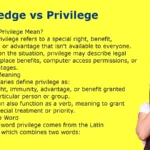
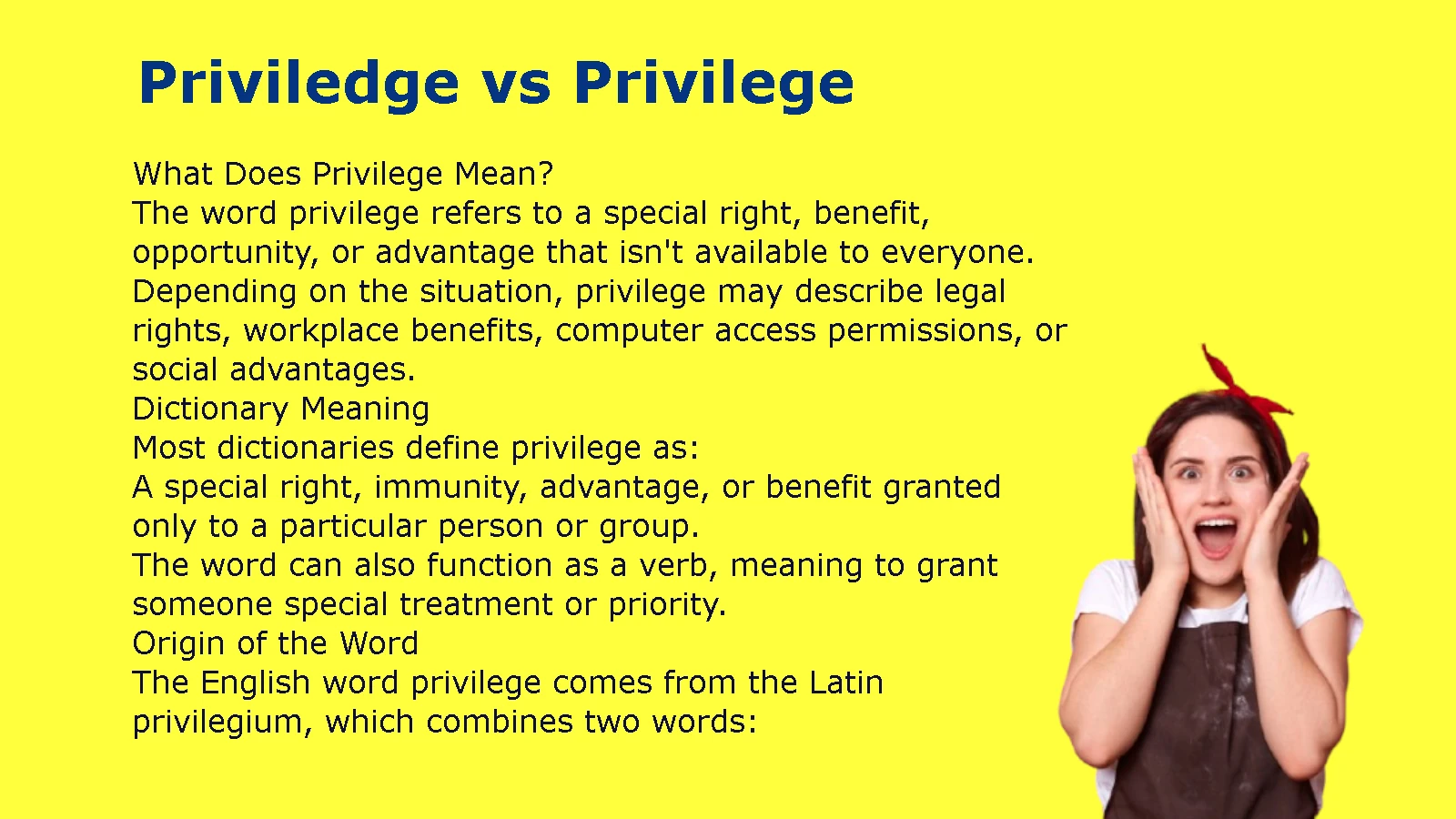
What Does Privilege Mean?
The word privilege refers to a special right, benefit, opportunity, or advantage that isn’t available to everyone.
Depending on the situation, privilege may describe legal rights, workplace benefits, computer access permissions, or social advantages.
Dictionary Meaning
Most dictionaries define privilege as:
A special right, immunity, advantage, or benefit granted only to a particular person or group.
The word can also function as a verb, meaning to grant someone special treatment or priority.
Origin of the Word
The English word privilege comes from the Latin privilegium, which combines two words:
| Latin Word | Meaning |
| privus | Individual or private |
| lex (legis) | Law |
Originally, privilegium referred to a law that applied only to one person or a specific group rather than to everyone.
Over time, the meaning expanded to include exclusive rights, honors, and advantages.
How Privilege Is Used Today
Today, the word appears in many different situations.
Everyday Life
People often use privilege when talking about opportunities or benefits.
Examples include:
- Having the privilege of meeting someone famous
- Receiving early access to an event
- Being allowed into an exclusive area
- Enjoying membership benefits
Workplace
Companies often give employees privileges such as:
- Flexible work schedules
- Reserved parking
- Executive lounges
- Remote work options
- Performance bonuses
Education
Schools may grant privileges like:
- Library access after hours
- Student leadership positions
- Campus parking permits
- Academic honors
Technology
In computing, privilege refers to permissions that allow users to perform certain actions.
Examples include:
- Installing software
- Editing system settings
- Managing user accounts
- Accessing secure files
Law
Legal privilege protects certain communications from being disclosed in court.
Common examples include:
- Attorney-client privilege
- Doctor-patient confidentiality (in many jurisdictions)
- Spousal privilege
- Executive privilege
Although the meaning changes slightly across fields, the central idea remains the same: special access or rights that others may not have.
Why Do People Spell Privilege as “Priviledge”?
At first glance, priviledge looks believable.
That’s exactly why so many people make the same mistake.
Several factors contribute to this spelling error.
Pronunciation Can Be Misleading
When spoken quickly, privilege often sounds similar to words ending in -dge.
Because English pronunciation doesn’t always match spelling, many writers insert an unnecessary d before the g.
For example:
- privilege ❌ → priviledge
- college ❌ → colledge
The pronunciation stays almost the same even though the spelling changes.
English Has Similar-Looking Words
English contains many words ending in -dge.
Examples include:
- bridge
- badge
- judge
- knowledge
- lodge
- fridge
After seeing these patterns repeatedly, many writers assume privilege belongs to the same family.
It doesn’t.
Instead, it follows the -lege spelling pattern.
Typing Too Quickly
Sometimes the mistake isn’t about spelling knowledge.
It’s simply a typing habit.
Since d sits close to g on a keyboard, many writers accidentally insert it without noticing.
Modern spell checkers usually catch the error immediately.
Memory Patterns
People often remember words based on how they sound instead of how they’re written.
Unfortunately, English contains many exceptions.
That’s why visual memory usually works better than pronunciation alone.
How to Spell Privilege Correctly
Learning the correct spelling becomes much easier once you understand its structure.
Letter-by-Letter Breakdown
P R I V I L E G E
Notice what’s missing?
There is no D.
That’s the easiest way to remember it.
Break the Word into Syllables
Priv-i-lege
Thinking about the word in smaller parts helps reinforce the correct spelling.
Memory Tricks That Actually Work**
Trick 1
Think of the word legal.
Both words share the letters leg.
Privilege
↓
leg
Since legal doesn’t contain a d, neither does privilege.
Trick 2
Remember this sentence:
Privilege has a leg, not a ledge.
It’s short, memorable, and surprisingly effective.
Trick 3
Visual repetition works.
Write the correct spelling several times:
- Privilege
- Privilege
- Privilege
- Privilege
Your brain gradually stores the correct letter pattern.
Privilege Pronunciation
Although spelling causes confusion, pronunciation is fairly straightforward.
American English
/ˈprɪvəlɪdʒ/
Approximate pronunciation:
PRIV-uh-lij
British English
The pronunciation is very similar, though some speakers pronounce the middle syllable more clearly.
Syllable Breakdown
| Part | Pronunciation |
| Priv | PRIV |
| i | uh |
| lege | lij |
Common Pronunciation Mistakes
Many learners incorrectly pronounce the word as:
- priv-ledge
- priv-ee-ledge
- pri-vill-edge
The final sound is “lij,” not “ledge.”
Once you hear the correct pronunciation a few times, the spelling becomes easier to remember.
Privilege Meaning in Different Contexts
One reason privilege appears so often is that it carries different meanings depending on the topic.
Understanding each use helps you choose the right definition.
Privilege in General English
In everyday conversation, privilege usually means an honor or special opportunity.
Examples:
- It was a privilege to attend the ceremony.
- Speaking with the author was a privilege.
- She considers teaching children a privilege.
Here, the word expresses gratitude or appreciation.
Privilege in Law
Legal privilege protects confidential communications.
Some well-known examples include:
| Legal Privilege | Purpose |
| Attorney-client privilege | Protects confidential conversations between lawyers and clients |
| Executive privilege | Allows certain executive communications to remain confidential under specific legal principles |
| Parliamentary privilege | Protects legislators while performing official duties |
| Spousal privilege | May protect certain communications between spouses depending on jurisdiction |
These privileges exist because confidential communication supports the legal system and public administration.
Privilege in Society
In social discussions, privilege refers to advantages that some individuals or groups experience because of factors such as economic circumstances, education, family background, or social position.
Examples include:
- Access to better schools
- Greater financial resources
- Professional networking opportunities
- Easier access to healthcare
- Safer neighborhoods
The term doesn’t automatically mean someone avoided hardship. Instead, it often highlights advantages that may not be equally available to everyone.
Privilege in Education
Educational institutions often grant privileges to students who meet specific requirements.
Examples include:
- Honors housing
- Research opportunities
- Leadership positions
- Scholarship benefits
- Early course registration
These privileges are usually earned through academic achievement or participation.
Privilege in the Workplace
Businesses regularly assign privileges based on job roles or responsibilities.
Examples include:
- Company credit cards
- Executive travel benefits
- Management authority
- Flexible scheduling
- Additional vacation days
Many organizations clearly define these privileges in employee handbooks.
Privilege in Technology
In computing, privilege means permission to perform specific system actions.
Common privilege levels include:
- Guest user
- Standard user
- Administrator
- Superuser
- Root access
Without sufficient privileges, users cannot install software, modify system files, or change security settings.
Examples of Privilege in Sentences
Seeing the word in context makes it much easier to remember.
Everyday Conversation
- It was a privilege to meet my favorite author.
- We had the privilege of touring the historic building.
- Thank you for giving me the privilege to speak today.
Academic Writing
- Access to rare manuscripts is a privilege reserved for researchers.
- Academic freedom is both a privilege and a responsibility.
Professional Communication
- Employees receive parking privileges after completing probation.
- Administrative privileges allow managers to approve requests.
Technology
- Only administrators have permission to change system privileges.
- The software checks user privileges before granting access.
Legal Context
- The attorney invoked attorney-client privilege.
- Certain communications remain protected by legal privilege.
Informal Writing
- It’s a privilege to call you my friend.
- We were lucky enough to receive VIP privileges.
Examples of the Incorrect Spelling “Priviledge”
The misspelling priviledge appears frequently online, but it is always incorrect.
Here are common mistakes and their corrections.
| Incorrect | Correct |
| It was a priviledge to meet you. | It was a privilege to meet you. |
| She has admin priviledges. | She has admin privileges. |
| Education is a priviledge. | Education is a privilege. |
| They lost their priviledges. | They lost their privileges. |
| Thank you for this priviledge. | Thank you for this privilege. |
Why Spell Check Flags “Priviledge”
Modern spell checkers identify priviledge as an error because:
- It isn’t recognized in standard English dictionaries.
- No major style guide accepts it.
- Academic institutions treat it as a spelling mistake.
- Professional editors automatically correct it.
If you’re ever uncertain, remember one simple rule:
Privilege is correct. Priviledge is always incorrect.
Privilege as Different Parts of Speech
Most people think of privilege only as a noun. However, the word appears in several grammatical forms. Knowing how each form works helps you write more naturally and avoid common grammar mistakes.
Privilege as a Noun
The most common use of privilege is as a noun. It describes a special right, benefit, honor, or advantage that someone has.
Examples
- It was a privilege to represent my school.
- Voting is a privilege as well as a civic responsibility in many countries.
- Access to confidential information is a privilege, not a right.
Common Noun Phrases
- special privilege
- exclusive privilege
- unique privilege
- voting privilege
- legal privilege
- administrative privilege
- user privilege
- membership privilege
- educational privilege
- constitutional privilege
Privilege as a Verb
Although less common, privilege also functions as a verb. It means to give special treatment, priority, or preference to someone or something.
This usage appears most often in academic writing, legal discussions, sociology, and business communication.
Examples
- The company privileges employee safety over short-term profits.
- The policy privileges transparency and accountability.
- The admissions process should never privilege one applicant unfairly.
Because this form sounds formal, many writers choose alternatives such as favor, prioritize, or give preference to.
Privileged (Adjective)
The adjective privileged describes a person, group, or position that has special advantages or benefits.
Examples
- She grew up in a privileged neighborhood.
- He works in a privileged position with access to confidential records.
- The witness shared privileged information with the attorney.
Notice that privileged can describe both social advantages and legally protected information.
Privileging (Present Participle)
Privileging refers to the act of giving preference or priority.
Although grammatically correct, it appears mainly in academic and professional writing.
Examples
- The organization is privileging long-term growth over quick profits.
- The software is privileging administrator accounts during installation.
Underprivileged
The word underprivileged describes people or communities with limited access to opportunities or resources.
Examples include:
- underprivileged children
- underprivileged communities
- underprivileged schools
The focus is on reduced opportunities rather than personal ability.
Unprivileged
Unprivileged is less common but still correct. It describes someone who lacks special rights or advantages.
Example
- The program provides educational support for unprivileged families.
Common Words Related to Privilege
Learning related vocabulary strengthens your understanding of privilege and improves your writing.
| Word | Meaning |
| Privileged | Having special advantages |
| Privileges | Plural form of privilege |
| Privileging | Giving preference |
| Underprivileged | Lacking opportunities or resources |
| Unprivileged | Without special rights or benefits |
| Advantage | A favorable condition |
| Benefit | Something helpful or valuable |
| Right | A legal or moral entitlement |
| Immunity | Protection from legal action or obligation |
| Access | Permission to enter or use something |
| Authority | Official power or control |
| Exemption | Freedom from a rule or requirement |
| Opportunity | A favorable chance to succeed |
Using these related words helps prevent repetitive writing while preserving meaning.
Privilege Synonyms
Depending on the context, several words can replace privilege. However, each carries a slightly different meaning.
| Synonym | Best Used When | Example |
| Advantage | General benefits | Experience gave her an advantage. |
| Benefit | Helpful gain | Employees receive health benefits. |
| Right | Legal or moral entitlement | Freedom of speech is a right. |
| Honor | Recognition or distinction | It was an honor to participate. |
| Opportunity | Favorable chance | She had the opportunity to study abroad. |
| Permission | Authorization | You need permission to enter. |
| Immunity | Legal protection | Diplomatic immunity protects certain officials. |
| Preference | Priority given | The policy gives preference to veterans. |
Choosing the Right Synonym
Although these words overlap, they are not interchangeable in every situation.
For example:
- It was a privilege to meet the president. ✅
- It was an advantage to meet the president. ❌ (The meaning changes.)
Likewise:
- Administrator privileges ✅
- Administrator advantages ❌
Always choose the word that fits the context rather than replacing privilege automatically.
Privilege Antonyms
Antonyms help clarify meaning by showing the opposite idea.
| Antonym | Meaning |
| Disadvantage | An unfavorable condition |
| Restriction | A limitation on freedom or action |
| Limitation | Reduced ability or access |
| Penalty | A punishment or negative consequence |
| Burden | A difficult responsibility |
| Obligation | A required duty |
| Denial | Refusal of access or permission |
Examples
- Losing administrator access is a significant restriction.
- Financial hardship can place students at a disadvantage.
- Membership privileges may end after repeated policy violations.
Common Collocations with Privilege
Native English speakers often combine privilege with specific words. These natural word pairings are called collocations.
Learning them makes your writing sound more fluent.
Frequently Used Collocations
| Collocation | Example |
| great privilege | It was a great privilege to serve. |
| special privilege | Members receive special privileges. |
| exclusive privilege | VIP guests enjoy exclusive privileges. |
| equal privilege | Every citizen deserves equal privileges under the law. |
| grant a privilege | The organization granted additional privileges. |
| revoke a privilege | The school revoked parking privileges. |
| earn a privilege | Students earn privileges through good behavior. |
| abuse a privilege | He abused his administrative privileges. |
| lose a privilege | Employees may lose remote work privileges. |
| enjoy a privilege | Subscribers enjoy premium privileges. |
Technology Collocations
In information technology and cybersecurity, these phrases appear regularly.
- administrator privilege
- user privilege
- elevated privilege
- privileged account
- privileged access
- least privilege
- privilege escalation
- access privilege
- file privileges
- system privileges
These terms are standard across operating systems, databases, and enterprise security platforms.
Idioms and Common Expressions Using Privilege
Although English doesn’t have many idioms built around privilege, several expressions appear frequently in conversation.
Have the Privilege of
Meaning: To feel honored or fortunate.
Example:
We had the privilege of interviewing the Nobel Prize winner.
Consider It a Privilege
Meaning: To express gratitude or appreciation.
Example:
I consider it a privilege to mentor young professionals.
It’s a Privilege
Often used in speeches or formal settings.
Example:
It’s a privilege to stand before you today.
A Privileged Position
This expression describes someone with exceptional access, influence, or opportunity.
Example:
Financial advisors often work in a privileged position because clients trust them with sensitive information.
Privilege in Computing
One of the most important technical uses of privilege appears in computer science and cybersecurity.
Here, a privilege represents a permission that allows a user or program to perform specific actions.
Without the correct privileges, users cannot complete protected tasks.
Common User Privilege Levels
| User Type | Typical Permissions |
| Guest | View limited content |
| Standard User | Run approved applications |
| Power User | Additional administrative capabilities |
| Administrator | Full system management |
| Root/Superuser | Complete control over the operating system |
Examples of Computer Privileges
A user may receive permission to:
- install software
- modify system files
- create user accounts
- change passwords
- configure networks
- manage databases
- access secure servers
Each privilege reduces or expands what a user can do.
The Principle of Least Privilege
Cybersecurity professionals follow an important security concept called the Principle of Least Privilege (PoLP).
The idea is simple:
Users receive only the permissions necessary to perform their jobs.
Benefits
- Reduces security risks
- Prevents accidental system changes
- Limits malware damage
- Improves regulatory compliance
- Protects sensitive information
Privilege Escalation
A related cybersecurity term is privilege escalation.
It occurs when a user or attacker gains permissions beyond those originally granted.
There are two common forms:
| Type | Description |
| Vertical privilege escalation | Gaining higher-level permissions, such as moving from a standard user to an administrator |
| Horizontal privilege escalation | Accessing another user’s resources while keeping the same permission level |
Preventing privilege escalation is a major goal of modern cybersecurity.
Privilege in Law
Legal professionals use privilege in a very specific way.
In law, privilege protects certain communications from being disclosed without permission.
These protections encourage honest conversations between individuals and professionals.
Attorney-Client Privilege
This is one of the best-known legal privileges.
It protects confidential communications between lawyers and their clients when legal advice is sought.
Without this protection, clients might hesitate to speak openly.
Executive Privilege
Executive privilege refers to the authority claimed by executive branch leaders to keep certain internal communications confidential under specific legal circumstances.
The scope and application vary by jurisdiction and constitutional framework.
Parliamentary Privilege
Many legislatures grant members certain protections while carrying out official duties.
These protections help lawmakers debate freely without fear of legal retaliation for statements made during legislative proceedings.
Spousal Privilege
Some legal systems recognize forms of spousal privilege, allowing spouses to avoid disclosing certain confidential communications in court.
The exact rules differ depending on the country and legal jurisdiction.
Qualified vs. Absolute Privilege
| Type | Description |
| Qualified Privilege | Applies only under certain conditions and may be lost if abused. |
| Absolute Privilege | Provides complete protection in specific legal settings, regardless of intent. |
Understanding these distinctions is essential for anyone studying law or legal ethics.
Privilege in Social Sciences
In sociology and related disciplines, privilege describes advantages that individuals or groups may experience because of social, economic, educational, cultural, or institutional factors.
The concept helps researchers examine how access to opportunities can differ across populations.
Examples of Social Privilege
- Growing up in a financially stable household
- Attending well-funded schools
- Having access to professional networks
- Living in neighborhoods with abundant public services
- Receiving quality healthcare with fewer barriers
It’s important to recognize that discussing privilege in social science focuses on patterns and systems rather than judging individual experiences.
Privilege vs Similar Words
Many English words have meanings that overlap with privilege, but they are not interchangeable. Choosing the right word makes your writing more precise and prevents confusion.
Privilege vs Right
Although these terms are related, they describe different concepts.
A right is something people are legally or morally entitled to. A privilege is a special benefit, opportunity, or advantage that may be granted, earned, or withdrawn.
Quick Comparison
| Feature | Privilege | Right |
| Definition | A special benefit or advantage | A legal or moral entitlement |
| Can Be Taken Away? | Often, yes | Usually only under specific legal circumstances |
| Must Be Earned? | Sometimes | No |
| Applies to Everyone? | Usually no | Often yes |
Examples
- Driving is often considered a privilege because governments can suspend or revoke a driver’s license.
- Freedom of speech is generally recognized as a right in many democratic countries.
Privilege vs Benefit
A benefit is any helpful or positive outcome. A privilege is an exclusive or special advantage.
Examples
- Health insurance is an employee benefit.
- Access to the executive lounge is a workplace privilege.
Think of it this way:
- Every privilege is a benefit.
- Not every benefit is a privilege.
Privilege vs Advantage
An advantage is any favorable condition that improves someone’s chances of success.
A privilege usually exists because of permission, status, role, or access.
| Privilege | Advantage |
| Granted or earned | May occur naturally |
| Often exclusive | Can be available to anyone |
| Usually tied to access or authority | Often tied to circumstances or skills |
Examples
- Administrative access is a privilege.
- Speaking multiple languages can be an advantage.
Privilege vs Entitlement
These words are frequently confused.
A privilege is something granted or earned.
An entitlement is something someone believes or is legally recognized as deserving.
Examples
- Receiving confidential access is a privilege.
- Social Security benefits may be described as legal entitlements in some jurisdictions.
The two words should not be used interchangeably because they carry different meanings.
Privilege vs Permission
Permission means authorization to perform a specific action.
Privilege refers to a broader status or benefit that often includes multiple permissions.
Example
A manager may receive the privilege of approving expenses.
To approve a single expense report, the manager still needs the appropriate permission within the company’s software.
Frequently Confused Spellings Similar to Privilege
The mistake priviledge isn’t unique. English contains many words that people misspell because pronunciation doesn’t always match spelling.
| Incorrect | Correct |
| Priviledge | Privilege |
| Knowlege | Knowledge |
| Acknowlege | Acknowledge |
| Enviroment | Environment |
| Definately | Definitely |
| Occured | Occurred |
| Untill | Until |
| Recieve | Receive |
| Seperate | Separate |
| Accomodate | Accommodate |
Why These Errors Happen
Most spelling mistakes come from one of three causes:
- Writers spell words the way they sound.
- Similar-looking words influence memory.
- Fast typing leads to missing or misplaced letters.
The good news is that regular reading and proofreading quickly reduce these errors.
Common Grammar Mistakes with Privilege
Correct spelling is only one part of using privilege properly. Grammar mistakes can also affect clarity.
Using “Privilege” Instead of “Privileges”
Remember that privilege is singular, while privileges is plural.
Correct
- Employees receive several privileges.
- Voting is an important privilege.
Incorrect
- Employees receive several privilege.
Confusing the Noun and Adjective Forms
Correct
- She has many privileges. (noun)
- She comes from a privileged background. (adjective)
Incorrect
- She has many privileged.
Using the Wrong Verb
The verb privilege is grammatically correct but relatively uncommon in everyday conversation.
Instead of writing:
- The policy privileges experienced applicants.
You could write:
- The policy gives preference to experienced applicants.
- The policy prioritizes experienced applicants.
These alternatives often sound more natural.
Capitalizing the Word Unnecessarily
Unless Privilege begins a sentence or forms part of a proper noun, it should remain lowercase.
Correct
- It was a privilege to attend.
Incorrect
- It was a Privilege to attend.
Misspelling the Word
This remains the most common error.
Incorrect
- priviledge
Correct
- privilege
Whenever you’re unsure, remember this simple phrase:
Privilege has a “leg,” not a “ledge.”
Quick Summary Table
| Topic | Key Takeaway |
| Correct spelling | Privilege |
| Incorrect spelling | Priviledge |
| Part of speech | Noun and verb |
| Adjective form | Privileged |
| Plural form | Privileges |
| Common mistake | Adding an unnecessary d |
| Computing meaning | User permissions or access rights |
| Legal meaning | Protected confidential communications |
| Everyday meaning | A special right, benefit, honor, or advantage |
Case Study: How One Letter Changes Professional Writing
Imagine two job applicants submit nearly identical cover letters.
Applicant A writes:
It has been a privilege to lead cross-functional teams throughout my career.
Applicant B writes:
It has been a priviledge to lead cross-functional teams throughout my career.
The experience may be the same, but the impression isn’t.
Recruiters often scan resumes and cover letters quickly. A simple spelling mistake in a commonly used word can distract from an otherwise strong application. While one typo doesn’t define a candidate, careful proofreading demonstrates attention to detail and professionalism.
Lesson: Small spelling differences can influence how readers perceive your writing, especially in academic and professional settings.
Frequently Asked Questions
Is “priviledge” ever correct?
No. Priviledge is always a misspelling. The correct spelling is privilege.
Why is privilege spelled with “-lege” instead of “-ledge”?
The spelling comes from the word’s historical development through Latin and Old French into English. Although its pronunciation resembles some -dge words, its accepted spelling has always been privilege.
How do you remember the correct spelling of privilege?
A simple memory trick is:
Privilege has a “leg,” not a “ledge.”
You can also remember that the word contains leg, just like legal, which helps reinforce the correct spelling.
What is the plural of privilege?
The plural form is privileges.
Examples
- Employee privileges
- Voting privileges
- User privileges
Can privilege be used as a verb?
Yes.
Although less common, privilege can function as a verb.
Example
- The company privileges innovation over short-term gains.
What does privileged mean?
Privileged is the adjective form of privilege.
It describes someone or something that has special rights, access, opportunities, or advantages.
Example
- Only privileged users can modify server settings.
How is privilege used in computing?
In computing, a privilege is a permission that allows a user or process to perform specific actions.
Examples include:
- installing software
- changing security settings
- managing user accounts
- accessing protected files
- administering servers
Modern operating systems use privilege levels to protect systems from accidental or unauthorized changes.
What is legal privilege?
Legal privilege protects certain confidential communications from disclosure.
Common examples include:
- attorney-client privilege
- parliamentary privilege
- executive privilege
- spousal privilege (where recognized)
These protections encourage honest communication and support the fair administration of justice.
How do you pronounce privilege?
In American English, privilege is commonly pronounced:
PRIV-uh-lij
The ending sounds like “lij,” not “ledge.”
Why do people misspell privilege so often?
Several factors contribute to the mistake:
- The pronunciation resembles words ending in -dge.
- English spelling contains many exceptions.
- Similar words like knowledge and judge influence memory.
- People often spell the word based on sound rather than its actual letter pattern.
Final Thoughts
The comparison between priviledge vs privilege has a clear answer: privilege is the only correct spelling. Whether you’re writing an email, preparing a report, completing schoolwork, or publishing online content, using the correct form strengthens your credibility and helps readers focus on your message rather than your spelling.
Beyond spelling, understanding the meaning of privilege makes your communication more precise. The word appears across everyday conversations, law, education, business, and technology, where it consistently refers to a special right, benefit, access level, or advantage. Recognizing these different contexts allows you to use the term accurately and confidently.
The next time you hesitate between priviledge and privilege, remember one simple rule:
Privilege has a “leg,” not a “ledge.”
That easy reminder can help you avoid one of the most common spelling mistakes in English and ensure your writing remains polished, professional, and correct.