Have you ever wondered whether Consensual and Consentual are two different words or simply a common spelling mistake? This is a frequent confusion in the English language, especially because both terms look similar and are connected to the idea of consent, agreement, and permission. However, only one spelling is considered correct in standard English. Understanding the difference between Consensual vs Consentual helps improve your vocabulary, spelling accuracy, grammar knowledge, and overall communication skills.
The correct word is Consensual, which means something that is done with the mutual agreement, approval, or permission of all people involved. It is commonly used in areas such as relationships, law, medicine, psychology, contracts, and social communication. For example, a consensual agreement is one where everyone involved willingly accepts the decision without pressure or force.
On the other hand, Consentual is generally considered an incorrect spelling and is not commonly accepted in modern standard English. Although it may seem logical because it comes from the word consent, English does not form this adjective by adding “ual” directly to “consent.” The correct adjective form follows the pattern of consensus, creating consensual. Recognizing this spelling difference can help writers avoid common English mistakes and choose the correct word in professional and everyday writing.
This confusion often appears in searches related to consensual meaning, consentual meaning, difference between consensual and consentual, commonly misspelled words, and English spelling rules. Learning these small differences strengthens your understanding of word formation, language usage, and how English vocabulary develops over time.
In this guide, you’ll learn the complete difference between Consensual vs Consentual, their meanings, correct usage, sentence examples, pronunciation, common mistakes, and simple memory tricks to help you remember the correct spelling forever.
Consentual vs Consensual: Quick Answer
Consensual is the correct English adjective. It means based on mutual agreement or consent. Consentual is a nonstandard spelling that isn’t accepted in modern standard English dictionaries or style guides. If you want accurate and professional writing, always choose consensual.
Consentual vs Consensual at a Glance
| Feature | Consentual | Consensual |
| Correct spelling | ❌ No | ✅ Yes |
| Standard English | ❌ No | ✅ Yes |
| Found in major dictionaries | Rare or omitted | Yes |
| Recommended in writing | No | Yes |
| Common in legal writing | No | Yes |
| Used in academic writing | No | Yes |
| Meaning | Intended to mean based on consent | Based on mutual agreement or permission |
The short rule
If you’re describing something that happens because everyone involved agrees, consensual is the only spelling you should use.
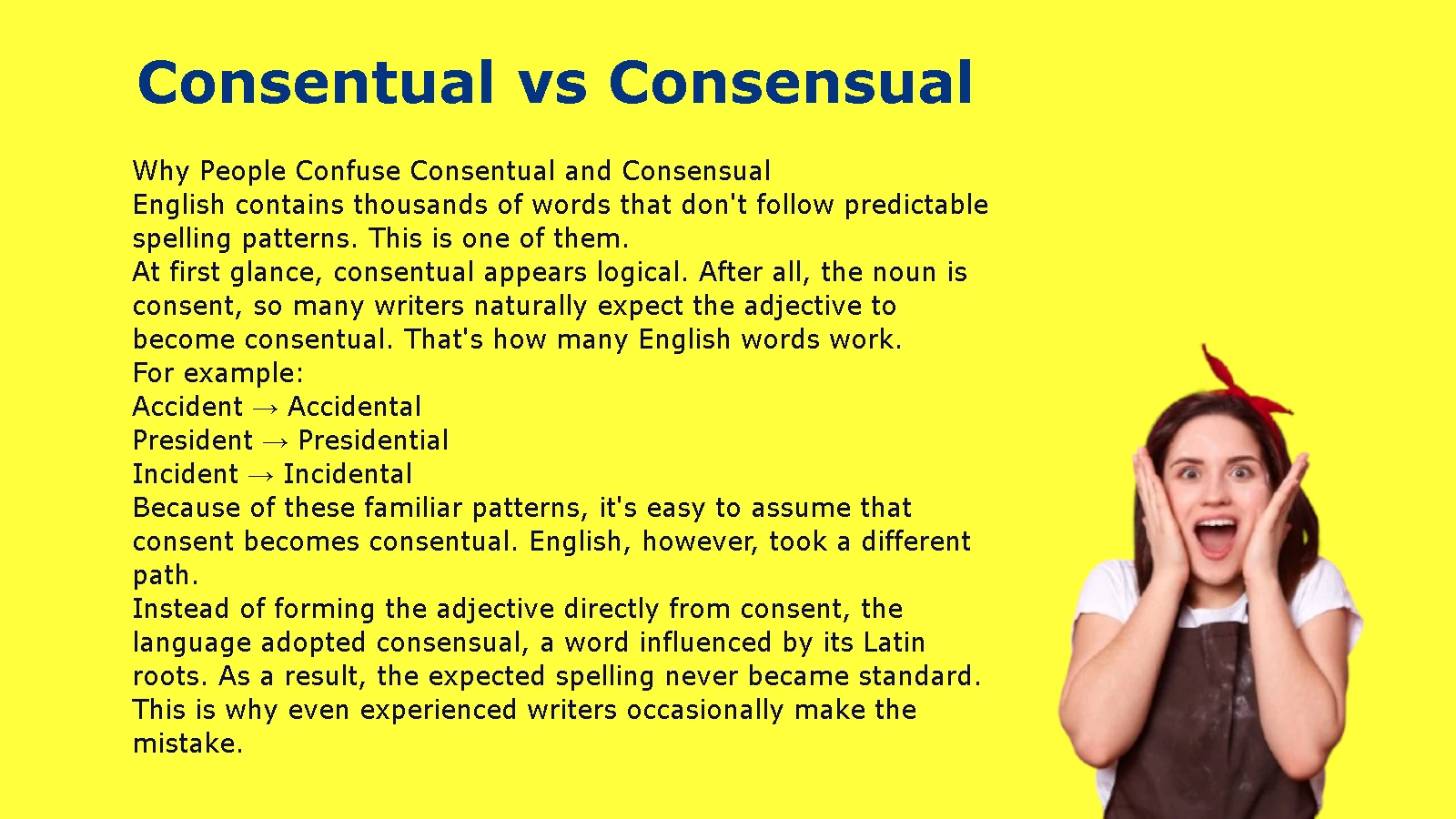
Why People Confuse Consentual and Consensual
English contains thousands of words that don’t follow predictable spelling patterns. This is one of them.
At first glance, consentual appears logical. After all, the noun is consent, so many writers naturally expect the adjective to become consentual. That’s how many English words work.
For example:
- Accident → Accidental
- President → Presidential
- Incident → Incidental
Because of these familiar patterns, it’s easy to assume that consent becomes consentual. English, however, took a different path.
Instead of forming the adjective directly from consent, the language adopted consensual, a word influenced by its Latin roots. As a result, the expected spelling never became standard.
This is why even experienced writers occasionally make the mistake.
The spelling looks logical
One reason the confusion persists is that both words appear believable.
Compare them.
| Word | Looks Correct? | Actually Correct? |
| Consentual | Yes | ❌ No |
| Consensual | Yes | ✅ Yes |
Unlike obvious misspellings, consentual doesn’t immediately look wrong. That’s what makes it tricky.
Pronunciation doesn’t help
Another reason people make this mistake is pronunciation.
When spoken naturally, consensual often sounds very close to consentual. The difference between the middle sounds can be subtle during fast conversation.
Because people often write words the way they hear them, many end up typing consentual without realizing it’s incorrect.
The internet spreads the mistake
Misspellings don’t stay hidden anymore.
Once an incorrect spelling appears in blog posts, forums, social media posts, or online comments, search engines may index it. Other writers then copy the mistake without checking a reliable dictionary.
This creates a cycle where the incorrect spelling becomes surprisingly common even though it isn’t accepted in standard English.
What Does Consensual Mean?
The adjective consensual describes something that happens because everyone involved willingly agrees to it.
The key idea is mutual agreement.
No one is forced. No one is pressured. Every participant gives permission voluntarily.
Dictionary-style definition
Consensual (adjective):
Existing or occurring because all parties willingly agree.
Although many people first encounter this word in legal discussions, it appears in many other fields as well.
Everyday meaning
In daily conversation, consensual simply means that everyone agreed.
Examples include:
- a consensual decision
- a consensual agreement
- a consensual arrangement
- a consensual partnership
- a consensual discussion
The word emphasizes cooperation rather than conflict.
Common situations where “consensual” appears
Relationships
One of the most familiar uses describes relationships in which every participant willingly agrees.
Example
Their relationship was completely consensual.
Legal writing
Law often distinguishes between consensual and non-consensual actions because consent can determine legal responsibility.
Example
The parties entered into a consensual settlement.
Business agreements
Companies frequently negotiate terms before signing contracts.
When both sides agree voluntarily, lawyers may describe the arrangement as consensual.
Example
The merger proceeded through a consensual agreement.
Healthcare
Doctors must obtain informed consent before many medical procedures.
When patients freely agree after receiving enough information, professionals describe the process as consensual.
Example
The treatment followed a consensual decision between the patient and physician.
Academic research
Researchers working with human participants must obtain informed consent.
Ethics committees often discuss whether participation was truly consensual.
Example
Every volunteer joined the study on a consensual basis.
Workplace decisions
Managers and employees sometimes reach agreements without conflict.
These decisions can also be described as consensual.
Example
Both departments reached a consensual solution.
Is Consentual a Real Word?
This question appears frequently because the spelling looks convincing.
The honest answer is nuanced.
Consentual has appeared occasionally in historical writing and scattered publications. However, modern English doesn’t recognize it as the standard adjective.
Today, professional editors almost always replace consentual with consensual.
If you’re writing an essay, business report, legal document, research paper, website article, or email, you should avoid consentual.
Why isn’t it accepted?
Languages evolve over centuries.
Some words become standard because dictionaries adopt them and educated speakers consistently use them.
Others fade away or never gain widespread acceptance.
Consentual falls into the second category.
Even though it seems logical, standard English settled on consensual instead.
What major dictionaries recognize
Leading English dictionaries consistently list consensual as the accepted adjective.
They define it as:
- based on agreement
- involving mutual consent
- voluntarily accepted by all parties
In contrast, consentual is generally absent from modern dictionaries or labeled as a nonstandard variant.
This consistent treatment is why teachers, editors, publishers, and style guides recommend using consensual in every formal context.
Why “Consensual” Is the Correct Form
The answer lies in the history of the English language.
Many English words arrived through Latin and French, bringing spelling patterns that don’t always match modern expectations.
The adjective consensual traces its roots to the Latin word consensus, meaning agreement or shared opinion. Over time, English developed consensual to describe actions or relationships based on mutual agreement.
Although consent and consensual are closely related in meaning, they didn’t evolve through the simple noun-plus-suffix pattern that many people expect.
That’s why English uses:
- Consent (noun and verb)
- Consensual (adjective)
—not consentual.
Understanding the word family
Looking at related words makes the pattern easier to understand.
| Word | Part of Speech | Meaning |
| Consent | Noun / Verb | Permission or agreement |
| Consensual | Adjective | Based on mutual agreement |
| Consensus | Noun | General agreement among a group |
| Consensually | Adverb | In a way based on mutual agreement |
Notice that consensual and consensus share the consens- pattern. Recognizing this connection makes the correct spelling easier to remember.
Why editors always choose “consensual”
Professional editors value consistency, clarity, and adherence to established language standards. Since consensual is the accepted form in dictionaries, legal documents, academic journals, and respected publications, using it helps your writing appear polished and credible.
Choosing consensual also prevents confusion. Readers instantly recognize the standard spelling, while consentual may distract them or make them question the accuracy of the text.
As a simple rule, if you’re unsure which spelling to use, remember this:
When mutual agreement is the meaning, “consensual” is always the correct choice.
Examples of Consensual in Sentences
The easiest way to remember a word is to see it in context. Below are examples from everyday life, business, law, healthcare, and education. Notice that consensual always describes something based on mutual agreement.
Everyday Examples
- They reached a consensual decision after discussing every option.
- The roommates made a consensual agreement about household chores.
- Their business partnership remained consensual from beginning to end.
- Everyone supported the change through a consensual process.
- The neighbors found a consensual solution to the parking issue.
- Both friends agreed to end the partnership on consensual terms.
- The family made a consensual choice about the vacation destination.
- The committee approved the proposal through consensual discussion.
- Their arrangement remained completely consensual throughout the project.
- The volunteers joined the event on a consensual basis.
Professional Examples
- The companies reached a consensual settlement without going to court.
- Management introduced the policy after a consensual agreement with employee representatives.
- The contract reflected a consensual understanding between both organizations.
- The negotiation ended with a consensual resolution.
- The partners dissolved the company through a consensual agreement.
Legal Examples
Legal writing frequently uses consensual because agreement often determines legal rights and responsibilities.
Examples include:
- The dispute concluded through a consensual settlement.
- Both parties signed the consensual agreement voluntarily.
- The judge reviewed whether the transaction was truly consensual.
- Lawyers confirmed that the contract resulted from consensual negotiations.
- The property transfer occurred through a consensual arrangement.
Academic Examples
You’ll often encounter consensual in research papers, psychology, sociology, and ethics.
Examples:
- Every participant provided consensual permission before joining the study.
- Researchers documented the consensual nature of participation.
- The ethics committee verified that recruitment remained consensual.
- Students completed the interview through consensual participation.
- The study emphasized informed and consensual decision-making.
Incorrect Uses of Consentual
Many writers accidentally replace consensual with consentual because it seems logical. Unfortunately, it’s still incorrect in standard English.
Here are some common mistakes and their corrections.
| Incorrect | Correct |
| consentual agreement | consensual agreement |
| consentual relationship | consensual relationship |
| consentual discussion | consensual discussion |
| consentual arrangement | consensual arrangement |
| consentual contract | consensual contract |
| consentual negotiation | consensual negotiation |
| consentual participation | consensual participation |
| consentual process | consensual process |
| consentual settlement | consensual settlement |
| consentual decision | consensual decision |
A simple spell-check may catch the error, but proofreading with intention is always the safer approach.
Common Phrases That Use Consensual
Some combinations appear so often that they’re considered standard expressions.
Consensual agreement
A decision accepted willingly by everyone involved.
Example
The two businesses signed a consensual agreement after several meetings.
Consensual relationship
A relationship entered into freely by all participants.
Example
Their relationship was entirely consensual.
Consensual decision
A choice reached through mutual agreement.
Example
The board made a consensual decision to expand internationally.
Consensual arrangement
An arrangement accepted voluntarily.
Example
The neighbors reached a consensual arrangement regarding property access.
Consensual settlement
A dispute resolved through agreement instead of prolonged conflict.
Example
The lawsuit ended with a consensual settlement.
Consensual negotiation
A negotiation in which both sides willingly participate.
Example
Months of consensual negotiation helped avoid litigation.
Consensual process
A procedure based on cooperation rather than force.
Example
The organization adopted a consensual process for making policy changes.
Consensual participation
Participation that occurs voluntarily.
Example
Survey responses were collected through consensual participation.
Consent vs Consensual
Many people confuse these related words because they share the same root. However, they serve different grammatical functions.
| Feature | Consent | Consensual |
| Part of speech | Noun and verb | Adjective |
| Meaning | Permission or agreement | Based on mutual agreement |
| Function | Names or expresses agreement | Describes something |
| Example | She gave consent. | It was a consensual agreement. |
Using Consent
As a noun:
Everyone gave consent before the interview began.
As a verb:
Parents must consent to the school trip.
Using Consensual
As an adjective:
The project moved forward through a consensual process.
Notice that consensual cannot replace consent, and consent cannot replace consensual.
Consensus vs Consensual
This is another common source of confusion.
Although the words look similar, they describe different ideas.
| Consensus | Consensual |
| General agreement among a group | Based on mutual agreement between parties |
| Noun | Adjective |
| Refers to shared opinion | Describes something agreed upon |
Consensus examples
- The committee reached a consensus.
- Scientists formed a consensus after reviewing the evidence.
- There wasn’t enough consensus to approve the proposal.
Consensual examples
- The agreement was consensual.
- They reached a consensual settlement.
- The arrangement remained consensual throughout the project.
Easy way to remember
Think of it this way:
- Consensus is the agreement itself.
- Consensual describes something based on agreement.
Other Words Commonly Confused with Consensual
English contains several similar-looking words that writers often mix together.
| Word | Meaning | Example |
| Consent | Permission | She gave her consent. |
| Consensus | General agreement | The group reached a consensus. |
| Mutual | Shared by both sides | They had mutual respect. |
| Voluntary | Done willingly | Participation was voluntary. |
| Agreed | Accepted by everyone | The agreed schedule worked well. |
| Cooperative | Working together | They maintained a cooperative relationship. |
Although these words overlap in meaning, they aren’t interchangeable.
For example:
- A meeting may be voluntary without being consensual.
- Two people can have mutual respect without reaching a consensus.
- Someone may give consent, resulting in a consensual agreement.
Understanding these subtle differences improves both speaking and writing.
Grammar Rule to Remember
Here’s the simplest rule.
If you’re describing something based on mutual agreement or permission, always use “consensual.”
Never write consentual in formal English.
Quick checklist
Ask yourself:
- Am I describing an agreement?
- Did everyone willingly agree?
- Am I using an adjective?
If the answer is yes, write consensual.
Memory Tricks That Actually Work
Remembering unusual spellings becomes much easier when you connect them to familiar words.
Trick One: Think of “Consensus”
Both words begin with consens-.
- Consensus
- Consensual
Since both relate to agreement, keeping the same spelling pattern makes sense.
Trick Two: Remember the “S”
Many people accidentally type a T because they think about consent.
Instead, remember this phrase:
Agreement starts with an S in consensual.
That tiny reminder often prevents the mistake.
Trick Three: Learn the Pair
Instead of memorizing one word, memorize two together.
- Consensus
- Consensual
Your brain naturally recognizes repeated spelling patterns.
Trick Four: Read It Aloud
Say the word slowly.
Con-sen-su-al
Breaking it into syllables makes the spelling easier to visualize.
Case Study: A Small Spelling Error With Big Consequences
Imagine a human resources manager drafting a company policy.
The document states:
“All workplace interactions must remain consentual.”
The policy then goes through proofreading, legal review, and publication.
Although readers understand the intended meaning, the incorrect spelling raises questions about the document’s professionalism. Employees may wonder whether other mistakes exist, and legal reviewers might request revisions before approving the policy.
Now compare it with the corrected sentence:
“All workplace interactions must remain consensual.”
The second version reflects standard English, aligns with legal and professional writing conventions, and inspires greater confidence in the document.
Lesson from the case study
Even a single spelling mistake can affect how readers perceive your credibility. Using consensual consistently helps your writing appear polished, accurate, and trustworthy.
“Good writing isn’t only about being understood. It’s also about earning the reader’s confidence.”
Mini Quiz: Test Your Understanding of Consentual vs Consensual
Now it’s your turn. Fill in each blank with the correct word or phrase before checking the answers.
Questions
- The contract was completely __________ because both companies agreed to every term.
- Is consentual or consensual the correct spelling?
- Every volunteer gave their __________ before participating in the study.
- The neighbors reached a __________ agreement without involving a lawyer.
- The committee finally reached a __________ after hours of discussion.
- Professional editors usually replace __________ with consensual.
- A relationship entered into willingly by everyone involved is called a __________ relationship.
- Which word is an adjective: consent or consensual?
- Which word means “general agreement among a group”: consensus or consensual?
- Which spelling should you use in academic and legal writing?
Answers
| Question | Correct Answer |
| 1 | consensual |
| 2 | consensual |
| 3 | consent |
| 4 | consensual |
| 5 | consensus |
| 6 | consentual |
| 7 | consensual |
| 8 | consensual |
| 9 | consensus |
| 10 | consensual |
If you answered most of these correctly, you’ve already mastered one of the most commonly confused spelling pairs in English.
Frequently Asked Questions About Consentual vs Consensual
Is consentual a real word?
Not in standard modern English. While the spelling has appeared occasionally in older publications and online writing, major dictionaries and style guides recognize consensual as the accepted adjective.
If you’re writing for school, work, publishing, or professional communication, always choose consensual.
Is consensual the correct spelling?
Yes.
Consensual is the standard spelling used in:
- Legal documents
- Academic papers
- Newspapers
- Books
- Government publications
- Business writing
- Professional websites
It’s the only spelling recommended in formal English.
Why do people write consentual?
Most people assume the adjective comes directly from the noun consent.
That seems logical because English often forms adjectives by adding a suffix to a noun. However, consensual developed differently, so the expected spelling never became standard.
Is consensual an adjective?
Yes.
It describes something that exists because everyone involved willingly agrees.
Examples
- a consensual agreement
- a consensual partnership
- a consensual arrangement
- a consensual decision
What is the noun form of consensual?
The closest noun is consent.
For example:
- They gave their consent before the project began.
- The agreement became consensual after everyone approved it.
Although consensus is also related, it has a different meaning. It refers to general agreement among a group rather than individual permission.
Is consensual used in both American and British English?
Yes.
Both American English and British English use consensual as the standard spelling.
There is no regional difference between the two.
Can consentual ever be correct?
In modern English, no.
You may occasionally encounter the spelling in historical texts, archived documents, or unedited online content. However, contemporary dictionaries, publishers, and editors recommend consensual instead.
Is consensual only used in legal contexts?
No.
Although legal writing uses the word frequently, consensual appears in many other settings, including:
- Business negotiations
- Healthcare
- Research ethics
- Education
- Psychology
- Sociology
- Everyday conversations about mutual agreement
Whenever something happens because everyone agrees willingly, consensual is an appropriate adjective.
Common Mistakes to Avoid
Even experienced writers sometimes make these errors. Fortunately, they’re easy to fix once you know what to watch for.
Using consentual because it “looks right”
This is by far the most common mistake.
❌ Incorrect
They reached a consentual agreement.
✅ Correct
They reached a consensual agreement.
Confusing consent with consensual
Remember:
- Consent is a noun or verb.
- Consensual is an adjective.
Compare these examples:
- She gave consent.
- The decision was consensual.
Mixing up consensus and consensual
Although the words share similar roots, they have different meanings.
Consensus
- A shared opinion among a group.
Consensual
- Based on mutual agreement.
Keep the distinction clear to avoid awkward or inaccurate sentences.
Assuming spell-check catches every mistake
Spell-check tools have improved, but they aren’t perfect.
Some programs recognize unusual spellings or fail to flag words used in the wrong context. A careful proofread is still one of the best ways to improve your writing.
Copying unreliable online sources
Not every website follows professional editing standards.
Before adopting a spelling, compare it with trusted dictionaries or reputable publications. This simple habit helps you avoid repeating common internet mistakes.
Quick Recap: Consentual vs Consensual
Here’s everything you need to remember at a glance.
| Question | Answer |
| Which spelling is correct? | Consensual |
| Is consentual standard English? | No |
| Which word should you use in formal writing? | Consensual |
| What does consensual mean? | Based on mutual agreement or consent |
| Part of speech | Adjective |
| Related noun | Consent |
| Similar word | Consensus |
Key Takeaways
Before you finish, remember these simple rules:
- Consensual is the accepted spelling in modern English.
- Consentual is a nonstandard spelling and should be avoided.
- Use consensual whenever something happens through mutual agreement.
- Don’t confuse consensual, consent, and consensus because each has a different grammatical role.
- Learning the connection between consensus and consensual makes the correct spelling much easier to remember.
- In professional writing, accurate spelling strengthens your credibility and helps readers trust your work.
Final Thoughts on Consentual vs Consensual
At first glance, consentual seems like it should be the correct adjective because it appears to grow naturally from the word consent. English, however, doesn’t always follow predictable spelling patterns. In this case, the language settled on consensual, and that’s the form recognized by dictionaries, publishers, educators, and legal professionals.
The good news is that this mistake is easy to avoid. Once you understand that consensual belongs to the same word family as consensus, the spelling becomes much easier to remember. Every time you write about an agreement, partnership, decision, or arrangement based on the willing approval of everyone involved, consensual is the word you should choose.
Small grammar improvements often have a big impact. Using the correct spelling not only makes your writing more accurate but also shows readers that you pay attention to detail. Whether you’re preparing an academic paper, writing a business document, editing a blog post, or simply improving your English, choosing consensual will always keep your writing clear, professional, and correct.