
Have you ever come across the term Yaoi and wondered what it means or why it appears so often in discussions about Japanese media, manga, and anime culture? The word Yaoi is a unique term that has gained worldwide recognition, but its meaning and cultural background can sometimes be confusing for new readers. Understanding the Yaoi meaning helps people explore its connection with fiction, storytelling, fandom communities, and Japanese entertainment while avoiding misunderstandings about its usage.
In simple terms, Yaoi refers to a genre of Japanese fictional works that focuses on romantic and emotional relationships between male characters. The term is commonly associated with manga, anime, novels, and other forms of creative media that explore themes of love, relationships, character development, and human emotions. Although Yaoi originated within Japanese fan culture, the genre has developed an international audience and is discussed widely among fans of Japanese pop culture and BL (Boys’ Love) media.
The meaning of Yaoi is closely connected to the history of Japanese fandom, where fans created and shared stories featuring male characters in romantic situations. Over time, the term became recognized globally, with different communities using it to describe specific types of fictional relationships and storytelling styles. Because Yaoi has cultural, historical, and social contexts, understanding the term requires looking beyond a simple definition.
Many people search for questions like “What does Yaoi mean?”, “Is Yaoi the same as BL?”, and “Where did Yaoi come from?” because the terminology around Japanese media can be complex. Learning the difference between related terms improves understanding of anime vocabulary, manga genres, and online fandom discussions.
In this guide, you will learn the complete Yaoi meaning, its origin, history, common uses, differences from related terms, and important cultural context. By the end, you will have a clearer understanding of how Yaoi is used in Japanese media and global fan communities.
What Does Yaoi Mean?
In its simplest form, Yaoi refers to fictional stories that focus on romantic or sexual relationships between male characters. These stories appear in manga, anime, novels, games, and fan-created works.
Outside Japan, many people use Yaoi as a general label for male-male romance in Japanese media. However, the original meaning was much narrower.
Simple Definition
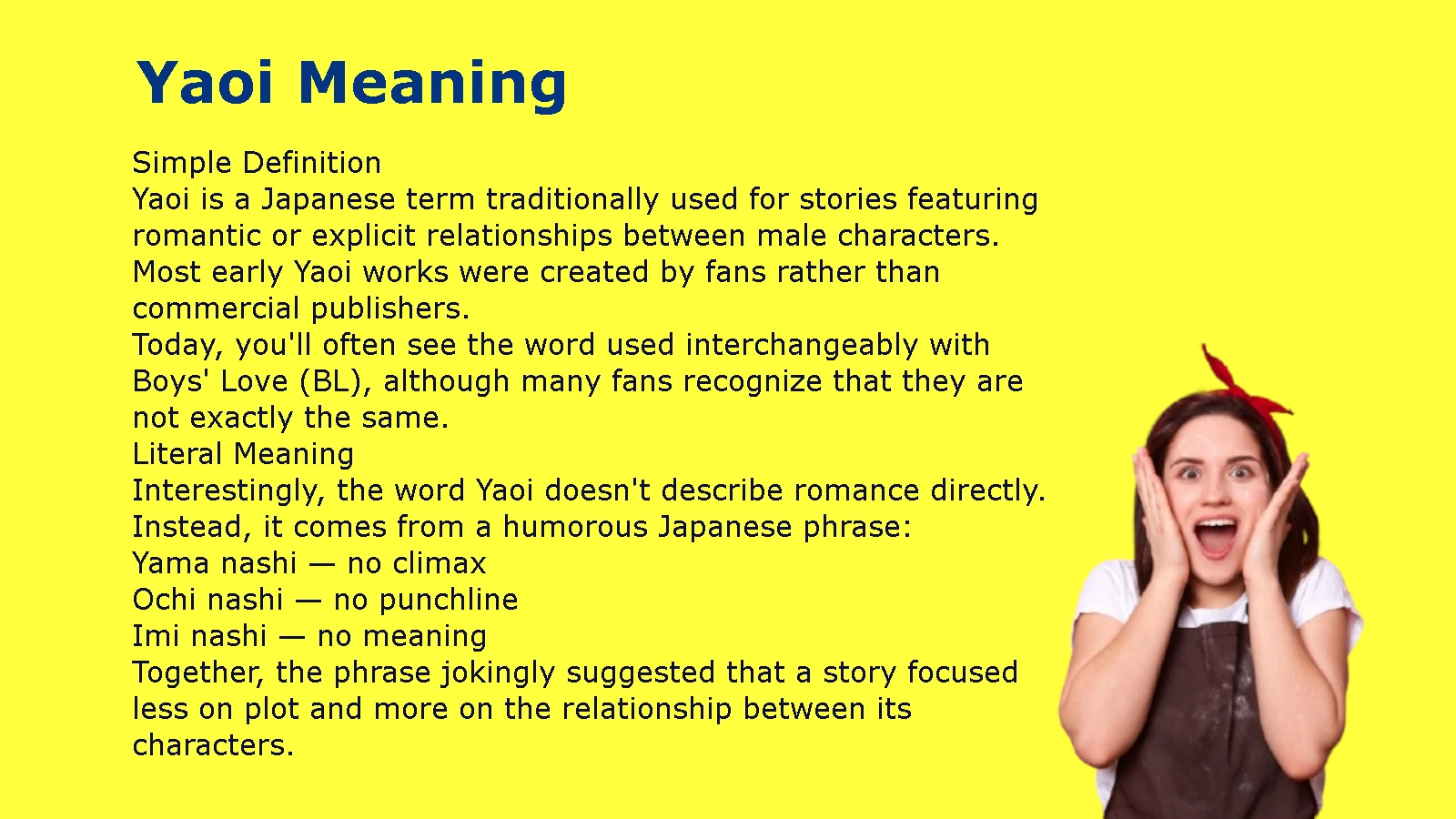
Yaoi is a Japanese term traditionally used for stories featuring romantic or explicit relationships between male characters. Most early Yaoi works were created by fans rather than commercial publishers.
Today, you’ll often see the word used interchangeably with Boys’ Love (BL), although many fans recognize that they are not exactly the same.
Literal Meaning
Interestingly, the word Yaoi doesn’t describe romance directly.
Instead, it comes from a humorous Japanese phrase:
- Yama nashi — no climax
- Ochi nashi — no punchline
- Imi nashi — no meaning
Together, the phrase jokingly suggested that a story focused less on plot and more on the relationship between its characters.
Modern Meaning
Today, many English-speaking anime fans use Yaoi to describe:
- Manga
- Anime
- Webtoons
- Visual novels
- Fan fiction
- Fan art
that feature male romantic relationships.
However, Japanese publishers now use Boys’ Love (BL) far more often than Yaoi.
How Do You Pronounce Yaoi?
The pronunciation is simple once you hear it.
Yaoi is pronounced:
YAH-oh-ee
or written phonetically as:
yah-oh-ee
Many beginners accidentally pronounce it as:
- Yay-oy
- Yow-ee
- Yah-why
These pronunciations are incorrect.
Pronunciation Tips
Break the word into three sounds:
Ya + O + I
Say each vowel clearly without blending them together.
Where Did the Word Yaoi Come From?
The history of Yaoi is closely connected to Japanese fan culture.
Unlike many manga genres that began with publishers, Yaoi developed through independent creators who wanted to tell stories outside mainstream publishing.
Japanese Origins
During the late 1970s and early 1980s, fans began creating doujinshi, which are self-published comics.
Many artists used popular male characters from existing manga or anime and imagined romantic relationships between them.
These fan works eventually became known as Yaoi.
The Phrase Behind the Name
The expression:
Yama nashi, ochi nashi, imi nashi
was originally a joke among creators.
It implied that the stories skipped complicated plots and focused mainly on emotional or romantic interactions.
Over time, the shortened word Yaoi became the accepted label.
How the Meaning Changed
As the genre gained popularity, commercial publishers began producing similar stories.
Eventually, publishers preferred the term Boys’ Love (BL) because it sounded more professional and covered a wider variety of romance stories.
Today, Japanese bookstores usually organize these works under BL, not Yaoi.
What Does the Acronym Yaoi Stand For?
Many people don’t realize that Yaoi is actually an abbreviation.
| Japanese Phrase | English Meaning |
| Yama nashi | No climax |
| Ochi nashi | No punchline |
| Imi nashi | No meaning |
Although the phrase sounds negative in English, it wasn’t intended as criticism.
Instead, creators used it playfully to describe stories where romance mattered more than traditional storytelling.
Today, very few readers think about this original phrase when using the word.
The History of Yaoi
The history of Yaoi reflects the growth of manga fandom itself.
What started as a small creative movement eventually became a worldwide cultural phenomenon.
Early Fan-Created Manga
In the late 1970s, many amateur artists created their own comics.
Rather than inventing new characters, they often reimagined heroes from famous manga series.
These stories circulated through comic markets and fan events.
Because they weren’t limited by publishers, creators experimented with themes that commercial magazines rarely explored.
Growth During the 1980s
By the 1980s, Yaoi had become an established part of Japanese fan culture.
Comic conventions provided spaces where artists could sell self-published books directly to readers.
This period also saw more original stories instead of only fan works.
Many artists who later became professional manga creators first built audiences through Yaoi doujinshi.
International Popularity
During the 1990s and early 2000s, anime became more accessible outside Japan.
Fans discovered Yaoi through:
- Fan translations
- Internet forums
- Anime conventions
- Online communities
- Scanlation groups
Interest spread rapidly across North America, Europe, Latin America, and Southeast Asia.
As official English translations became more common, publishers began licensing many BL titles.
The Digital Era
Streaming services, digital manga platforms, and social media transformed how fans discovered Yaoi and BL.
Today, readers can access licensed titles legally through digital publishers instead of relying on unofficial translations.
Online communities also encourage discussions about:
- Character relationships
- Story recommendations
- Fan art
- Cosplay
- Cultural differences
- Translation accuracy
The internet helped turn what was once a niche hobby into a global fandom.
Is Yaoi the Same as Boys’ Love (BL)?
This question causes more confusion than almost any other.
The short answer is:
Not exactly.
Although many people use the words interchangeably, there are important differences.
Quick Comparison
| Feature | Yaoi | Boys’ Love (BL) |
| Original use | Fan-created works | Commercial genre |
| Modern usage | Less common in Japan | Standard publishing term |
| Content | Often more explicit | Wide range from sweet romance to mature stories |
| Popularity today | Mostly overseas fandom | Worldwide publishing industry |
Why People Mix Them Up
Outside Japan, many anime fans learned the word Yaoi before they ever heard of BL.
As a result, they continued using Yaoi for nearly every story involving male romance.
Inside Japan, however, bookstores, publishers, and magazines now overwhelmingly use BL instead.
Which Term Is More Common Today?
If you browse modern manga publishers, you’ll notice that Boys’ Love appears much more frequently.
Reasons include:
- It sounds more inclusive.
- It covers many storytelling styles.
- It avoids the historical baggage attached to Yaoi.
- Publishers consider it a broader marketing term.
Because of this shift, many newer fans naturally encounter BL first.
Yaoi vs. Boys’ Love vs. Shounen-ai
These three terms often overlap, yet they describe different ideas.
| Term | Meaning | Romance | Explicit Content | Common Today |
| Yaoi | Male romance, originally fan-created | Yes | Often | Mostly outside Japan |
| Boys’ Love (BL) | Broad publishing genre | Yes | Sometimes | Yes |
| Shounen-ai | Older term emphasizing emotional romance | Yes | Usually little or none | Rarely used in Japan |
Understanding Shounen-ai
Outside Japan, many fans use Shounen-ai to describe stories that focus on emotional relationships rather than explicit scenes.
However, the word isn’t widely used by modern Japanese publishers.
Instead, they simply classify these works as BL, regardless of whether they contain mature content.
This difference explains why online discussions sometimes become confusing.
What Makes a Story Yaoi?
Not every story featuring two male characters qualifies as Yaoi or BL.
The relationship must play a central role in the narrative.
Common characteristics include:
- Romantic attraction between male characters
- Emotional relationship development
- Personal conflict
- Character growth
- Relationship-focused storytelling
- Strong emotional themes
Some stories include explicit scenes.
Others focus almost entirely on romance, trust, and emotional connection.
Because the genre has expanded over the years, there’s now tremendous variety.
A lighthearted college romance and a dramatic historical fantasy can both fall under the broader BL category even though they tell completely different stories.
Common Features of Yaoi Stories
While every title is unique, many Yaoi stories share certain storytelling elements.
Emotional Relationships
Relationships usually drive the story forward.
Readers often follow the characters as they build trust, overcome misunderstandings, and grow together.
Character Development
Many stories spend considerable time exploring each character’s fears, ambitions, strengths, and emotional struggles.
Rather than relying only on romance, successful titles create believable personalities that readers can connect with.
Conflict and Resolution
Conflict may involve:
- Family expectations
- Career choices
- Friendship
- Personal identity
- Long-distance relationships
- Fantasy adventures
- Social pressure
These challenges help the relationship evolve naturally instead of progressing too quickly.
Wide Variety of Genres
One common misconception is that Yaoi or BL is a genre by itself.
In reality, it often overlaps with many other genres, including:
- Fantasy
- Mystery
- Horror
- Historical fiction
- Science fiction
- Slice of life
- Comedy
- Action
- Supernatural
- Drama
The romantic relationship serves as the emotional center, while the surrounding story can belong to almost any genre.
Popular Themes in Yaoi and Boys’ Love Stories
One reason Yaoi and Boys’ Love (BL) remain popular is their variety. While romance stays at the center of most stories, the setting, tone, and conflict can change dramatically from one title to another.
Here are some of the most common themes you’ll find.
School Romance
Many BL stories take place in high schools or universities. These settings allow writers to explore:
- First love
- Friendship turning into romance
- Coming-of-age experiences
- Academic pressure
- School festivals and club activities
School settings appeal to readers because they capture the excitement and uncertainty of young relationships.
Workplace Romance
Office romances have become increasingly popular.
Stories may involve:
- Coworkers
- Business partners
- Teachers
- Doctors
- Lawyers
- Designers
- Writers
These stories often focus on balancing professional responsibilities with personal feelings.
Fantasy Worlds
Fantasy BL combines romance with imaginative storytelling.
Popular fantasy settings include:
- Magical kingdoms
- Dempires and royal courts
- Dragons and mythical creatures
- Witches and wizards
- Ancient prophecies
Fantasy allows creators to build unique worlds while developing emotional relationships.
- Feudal Japan
- Ancient China
- Medieval Europe
- Victorian England
Historical settings introduce cultural traditions, political conflicts, and social expectations that shape each relationship.
Supernatural Stories
Many titles include paranormal elements like:
- Vampires
- Werewolves
- Ghosts
- Spirits
- Angels
- Demons
- Time travel
These supernatural twists often create exciting conflicts that wouldn’t exist in ordinary settings.
Slice-of-Life Stories
Not every BL story includes dramatic action.
Slice-of-life stories focus on everyday experiences, including:
- Cooking together
- Moving into a new apartment
- Raising pets
- Traveling
- Building careers
- Spending time with friends
These quieter stories often emphasize emotional realism over action.
Who Reads Yaoi?
A common misconception is that Yaoi appeals to only one group of readers.
In reality, the audience has grown significantly over the past few decades.
A Diverse Global Community
Today, readers include:
- Teenagers (where age-appropriate)
- College students
- Adults
- Manga collectors
- Anime fans
- Novel readers
- Artists
- Writers
People from many countries enjoy BL and Yaoi stories for different reasons, including the artwork, character development, emotional storytelling, and unique settings.
Traditional Audience
Historically, many Yaoi works targeted women.
The Japanese term fujoshi, which literally means “rotten girl,” became a humorous self-description used by many female fans.
Similarly, fudanshi refers to male fans of BL.
These labels are optional, and many readers simply describe themselves as anime or manga fans.
Growing International Interest
Digital publishing has introduced BL to readers around the world.
Official translations now appear in dozens of languages, making the genre more accessible than ever before.
Common Yaoi Terms You Should Know
If you’re new to anime or manga, you’ll encounter several related terms.
| Term | Meaning |
| BL (Boys’ Love) | The modern publishing term for male romance stories. |
| Shounen-ai | An older label sometimes used outside Japan for romance-focused stories with little or no explicit content. |
| Doujinshi | Self-published comics created by fans or independent artists. |
| Seme | Traditionally refers to the more assertive partner in some BL stories. |
| Uke | Traditionally refers to the more reserved or receptive partner. |
| Fujoshi | A female fan of BL. |
| Fudanshi | A male fan of BL. |
| Tankōbon | A collected volume of manga chapters. |
| Omegaverse | A fictional setting with its own social and biological rules. It appears across many fandoms, including some BL works. |
Understanding these terms makes it easier to follow conversations within anime communities.
How Yaoi Differs From LGBTQ+ Representation
This topic often causes confusion.
Although Yaoi features relationships between male characters, it isn’t automatically intended to represent real-life LGBTQ+ experiences.
Fiction Versus Reality
Many BL stories are fictional romances designed for entertainment.
Some explore realistic relationships and identity, while others rely on fantasy, exaggerated drama, or fictional settings.
That means they shouldn’t automatically be viewed as accurate portrayals of gay relationships or LGBTQ+ communities.
Modern Storytelling
Over time, many creators have written more nuanced stories with realistic characters, healthier relationships, and broader perspectives.
At the same time, other works continue to embrace fantasy or melodrama.
As with any genre, quality and representation vary from one title to another.
Is Yaoi an Outdated Term?
The answer depends on where you are and who you’re talking to.
In Japan
Most publishers now use Boys’ Love (BL) instead of Yaoi.
You’ll see BL on:
- Book covers
- Magazine categories
- Online stores
- Publisher websites
Outside Japan
International fans still use Yaoi, especially when discussing older anime, fan fiction, or classic manga.
Because both terms remain common online, understanding each one helps avoid confusion.
Which Word Should You Use?
For modern discussions, BL is usually the safest and most current choice.
When referring to older fandom culture or historical fan works, Yaoi remains accurate.
Well-Known Yaoi and BL Titles
The following works are widely recognized within the Boys’ Love genre.
| Title | Format | Genre | Beginner Friendly |
| Given | Manga / Anime | Music, Drama | Yes |
| Sasaki and Miyano | Manga / Anime | School Romance | Yes |
| Cherry Magic! Thirty Years of Virginity Can Make You a Wizard?! | Manga / Live Action / Anime | Romantic Comedy | Yes |
| Junjo Romantica | Manga / Anime | Romance | Moderate |
| Sekaiichi Hatsukoi | Manga / Anime | Workplace Romance | Moderate |
| Twittering Birds Never Fly | Manga / Film | Crime, Drama | Mature readers |
Note: These titles vary in tone, themes, and intended audience. Always check age ratings before reading or watching.
How to Use “Yaoi” in a Sentence
Learning the meaning is one thing.
Using the word naturally is another.
Everyday Examples
- I recently learned the meaning of Yaoi while exploring manga genres.
- She enjoys reading Yaoi and BL manga.
- That online discussion explained the history of Yaoi very clearly.
Anime Discussions
- Many fans now prefer the term BL instead of Yaoi.
- The series contains elements commonly associated with Yaoi storytelling.
- Older forums often used Yaoi as the primary label.
Writing Examples
- The article explains the origin and modern meaning of Yaoi.
- Understanding Yaoi helps readers explore Japanese pop culture more confidently.
Synonyms and Related Terms
Although no word is a perfect synonym, several related terms often appear alongside Yaoi.
| Term | Relationship to Yaoi | When to Use |
| Boys’ Love (BL) | Modern publishing term | Most current discussions |
| Male-Male Romance | General English description | Broad audiences |
| BL Manga | Specific format | Manga discussions |
| BL Anime | Animated works | Anime conversations |
| Shounen-ai | Older fandom label | Historical or fan discussions |
| Queer Romance Fiction | Broader literary category | General fiction discussions |
Common Misconceptions About Yaoi
Many myths continue to circulate online.
Here’s what you should know.
| Myth | Fact |
| Yaoi and BL are exactly the same. | They overlap, but BL is the broader modern publishing term. |
| Every Yaoi story contains explicit content. | Many focus primarily on romance and emotional development. |
| Only women read BL. | Readers come from many backgrounds and age groups. |
| Yaoi exists only in manga. | The genre also includes novels, anime, games, and fan works. |
| Yaoi accurately represents every LGBTQ+ experience. | Some works do, while others use fictional or stylized storytelling. |
Frequently Asked Questions About Yaoi Meaning
Is Yaoi a Japanese word?
Yes. The word originated in Japan and began as a humorous abbreviation used by fan creators before becoming associated with a broader category of male-male romance stories.
What does Yaoi literally mean?
The word comes from the phrase:
- Yama nashi
- Ochi nashi
- Imi nashi
It loosely translates to “no climax, no punchline, no meaning.” The phrase jokingly described stories that focused more on relationships than traditional plot structure.
Is Yaoi different from BL?
Yes.
Although people often use the terms interchangeably, BL is now the standard publishing term in Japan. Yaoi is more closely associated with older fan culture and remains more common in international fandom.
Is Yaoi only found in manga?
No.
You’ll also find Yaoi or BL stories in:
- Anime
- Light novels
- Visual novels
- Drama CDs
- Live-action adaptations
- Fan fiction
- Webtoons
Can anime be considered Yaoi?
Yes.
Some anime adaptations are based on BL manga or novels. Whether viewers describe them as Yaoi or BL often depends on the community and the specific title.
Is Yaoi appropriate for teenagers?
It depends on the individual work.
Some BL titles focus on wholesome romance and are suitable for younger readers, while others contain mature themes or explicit content intended only for adults. Always check the publisher’s age rating before reading or watching.
Why do many fans prefer the term BL today?
BL has become the preferred label because it covers a wider range of stories and is the term most commonly used by Japanese publishers.
What is the opposite of Yaoi?
There isn’t a direct opposite.
However, the closest comparable genre is Yuri, which focuses on romantic relationships between female characters.
Key Takeaways
Here are the most important points to remember.
- Yaoi originated as a humorous term used by Japanese fan creators.
- The name comes from “Yama nashi, ochi nashi, imi nashi.”
- Today, Boys’ Love (BL) is the preferred publishing term in Japan.
- Yaoi stories center on romantic relationships between male characters.
- The genre includes manga, anime, novels, games, and fan-created works.
- Not every BL story contains explicit content.
- Readers around the world enjoy the genre for its emotional storytelling, memorable characters, and diverse settings.
- Understanding the history of the word helps you use it accurately in conversations and writing.
Final Thoughts on the Meaning of Yaoi
The Yaoi meaning has evolved considerably since the term first appeared in Japanese fan circles decades ago. What began as a playful description of self-published comics has grown into a globally recognized part of anime and manga culture.
While many international fans still use Yaoi, the publishing industry now favors Boys’ Love (BL) because it better reflects the wide range of stories available today. Knowing the distinction between these terms makes it easier to understand discussions within the anime community and appreciate how the genre has changed over time.
Whether you’re exploring manga for the first time, researching Japanese pop culture, or simply expanding your vocabulary, understanding the history, origin, and modern usage of Yaoi gives you valuable context. Language evolves alongside culture, and Yaoi is a clear example of how a niche fan term became part of a worldwide conversation.