Boss’s vs Bosses: Boss’s is the singular possessive form, meaning something belongs to one boss (e.g., the boss’s office). Bosses is the plural form of boss, referring to more than one boss (e.g., The bosses held a meeting). Use bosses’ when something belongs to multiple bosses.
The confusion gets even bigger when people search for the boss’s meaning, bosses meaning, boss’s pronunciation, or wonder how to spell boss’s correctly. And here’s the kicker: using the wrong form in an email, report, or workplace message can change the meaning of your sentence and make your writing look less professional.
The good news? The difference is easier than it seems.
In this guide, you’ll learn the difference between Boss’s vs Bosses, discover the correct spelling of boss’s, understand when to use boss’s or bosses, and see plenty of boss’s examples and bosses examples in real sentences. You’ll also learn Boss’s vs Bosses grammar rules, common mistakes to avoid, and simple memory tricks that make choosing the right word effortless.
By the end, you’ll know exactly how to use boss’s and bosses correctly, so you can write with confidence every time.
The quick rule is simple:
| Word | Meaning | Example |
| Boss’s | Something belongs to one boss | The boss’s office is large. |
| Bosses | More than one boss | The company hired new bosses. |
| Bosses’ | Something belongs to multiple bosses | The bosses’ meeting lasted three hours. |
In this guide, you’ll learn exactly when to use each word, why the apostrophe changes the meaning, common mistakes to avoid, and practical examples that make the difference easy to remember.
Boss’s vs Bosses vs Bosses’: Quick Difference Explained
The main difference between boss’s and bosses depends on two things:
- How many bosses are you talking about?
- Are you showing ownership?
The word boss is a singular noun. When you talk about more than one boss, you make it plural by adding -es, creating bosses.
However, when you want to show possession, you add an apostrophe.
Here is the basic breakdown:
| Form | Number of People | Shows Ownership? | Example |
| Boss | One person | No | My boss works nearby. |
| Boss’s | One person | Yes | My boss’s computer is new. |
| Bosses | Multiple people | No | The bosses attended the event. |
| Bosses’ | Multiple people | Yes | The bosses’ decisions affected employees. |
A simple way to remember:
- Boss = one leader
- Bosses = multiple leaders
- Boss’s = belonging to one leader
- Bosses’ = belonging to multiple leaders
The apostrophe does not make a word plural. Instead, it shows ownership.
For example:
The boss’s car is parked outside.
This means one boss owns the car.
The bosses’ cars are parked outside.
This means several bosses own cars.
What Does Boss’s Mean?
Definition of Boss’s
Boss’s is the singular possessive form of the noun boss. It shows that something belongs to, relates to, or comes from one specific boss.
The apostrophe and s tell the reader that only one boss is involved.
The word structure looks like this:
Boss + ’s = Boss’s
Examples:
- My boss’s office has a large window.
- I followed my boss’s instructions carefully.
- The boss’s decision changed the project timeline.
- We discussed the boss’s expectations during the meeting.
In each example, the sentence refers to one boss.
How to Recognize When to Use Boss’s
Use boss’s when you can replace the phrase with:
“The office of one boss”
or
“Something belonging to one boss.”
For example:
The boss’s computer needs repair.
You can rewrite it as:
The computer of one boss needs repair.
The meaning stays the same.
Here are more examples:
| Sentence | Meaning |
| The boss’s phone rang during lunch. | One boss owns the phone. |
| I emailed my boss’s assistant. | One boss has an assistant. |
| The boss’s opinion matters. | One boss has an opinion. |
| The boss’s schedule changed. | One boss has a schedule. |
What Does Bosses Mean?
Definition of Bosses
Bosses is the plural form of boss. It refers to two or more people who manage, supervise, or lead others.
Unlike boss’s, the word bosses does not show ownership. It simply tells the reader that multiple bosses exist.
The word structure is:
Boss + es = Bosses
Examples:
- Many bosses struggle with communication problems.
- The company has several bosses in different departments.
- Good bosses recognize employee achievements.
- The bosses met to discuss future plans.
In these examples, the focus is on multiple leaders rather than something they own.
When to Use Bosses Instead of Boss’s
Use bosses when:
- You are talking about more than one boss.
- You are describing a group of managers or leaders.
- No ownership relationship exists.
Examples:
Incorrect:
The boss’s attended the conference.
Why is it wrong?
The apostrophe does not create a plural word.
Correct:
The bosses attended the conference.
Another example:
Incorrect:
Many company boss’s prefer teamwork.
Correct:
Many company bosses prefer teamwork.
The first sentence suggests ownership. The second sentence correctly describes multiple leaders.
What Does Bosses’ Mean?
Definition of Bosses’
Bosses’ is the plural possessive form of bosses. It shows that something belongs to or is connected with multiple bosses.
The apostrophe comes after the s because the noun is already plural.
The formula is:
Bosses + ’ = Bosses’
Examples:
- The bosses’ meeting lasted all afternoon.
- The bosses’ offices are located upstairs.
- The employees followed the bosses’ instructions.
- The bosses’ decisions affected the entire company.
In these examples, more than one boss owns or controls something.
Difference Between Boss’s and Bosses’
Many writers confuse these two forms because both show possession. The difference is the number of owners.
| Sentence | Meaning |
| The boss’s office is clean. | One boss owns the office. |
| The bosses’ offices are clean. | Multiple bosses own offices. |
| The boss’s decision was final. | One boss made the decision. |
| The bosses’ decisions were different. | Multiple bosses made decisions. |
A quick trick:
Ask yourself:
“How many bosses are involved?”
If the answer is one:
→ Use boss’s
If the answer is more than one:
→ Use bosses’
Boss’s vs Bosses vs Bosses’: Grammar Rules Explained
Understanding the grammar behind these words makes the difference much easier.
English uses apostrophes mainly for two reasons:
- Showing possession
- Showing missing letters in contractions
In boss’s and bosses’, the apostrophe shows possession.
Singular Possessive Rule
For most singular nouns, add:
’s
Examples:
- teacher → teacher’s
- employee → employee’s
- manager → manager’s
- boss → boss’s
Examples:
- The teacher’s lesson was helpful.
- The employee’s report was detailed.
- The manager’s office is nearby.
- The boss’s message arrived this morning.
Even though boss ends with the letter s, the standard modern English form is still usually boss’s.
Plural Rule for Regular Nouns Ending in S
When a plural noun already ends in s, add only an apostrophe.
Formula:
Plural noun + ’ = Possession
Examples:
- employees → employees’
- managers → managers’
- teachers → teachers’
- bosses → bosses’
Examples:
- The employees’ benefits improved.
- The managers’ meeting started early.
- The teachers’ lounge was renovated.
- The bosses’ agreement was announced.
Plural Formation Rule for Boss
The word boss ends with two s letters. To make it plural, English adds -es.
Examples:
| Singular | Plural |
| boss | bosses |
| class | classes |
| glass | glasses |
| dress | dresses |
This happens because adding only s would make pronunciation awkward.
Incorrect:
- bosss
Correct:
- bosses
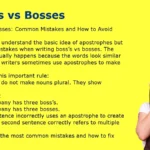
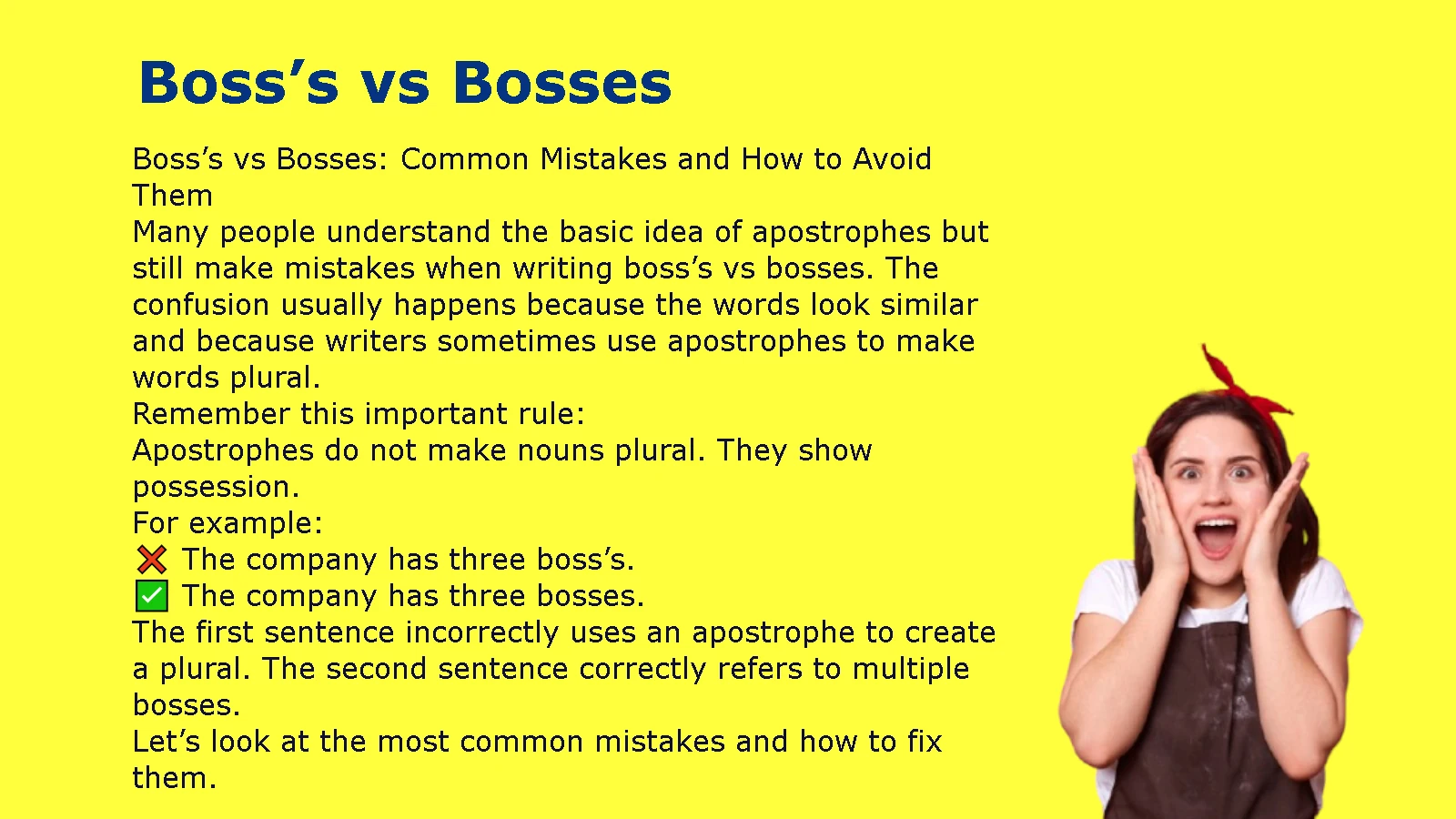
Boss’s vs Bosses: Common Mistakes and How to Avoid Them
Many people understand the basic idea of apostrophes but still make mistakes when writing boss’s vs bosses. The confusion usually happens because the words look similar and because writers sometimes use apostrophes to make words plural.
Remember this important rule:
Apostrophes do not make nouns plural. They show possession.
For example:
❌ The company has three boss’s.
✅ The company has three bosses.
The first sentence incorrectly uses an apostrophe to create a plural. The second sentence correctly refers to multiple bosses.
Let’s look at the most common mistakes and how to fix them.
Mistake 1: Using Boss’s When You Mean Multiple Bosses
One of the most frequent errors is adding an apostrophe when talking about more than one boss.
Incorrect:
The boss’s attended the annual meeting.
Why is it wrong?
The sentence talks about multiple people. The apostrophe changes the word into a possessive form instead of a plural noun.
Correct:
The bosses attended the annual meeting.
Here, bosses simply means more than one boss.
More examples:
| Incorrect | Correct |
| Several boss’s joined the discussion. | Several bosses joined the discussion. |
| The company hired two new boss’s. | The company hired two new bosses. |
| Many boss’s prefer different leadership styles. | Many bosses prefer different leadership styles. |
Mistake 2: Forgetting the Apostrophe When Showing Ownership
Another common mistake happens when writers want to show ownership but leave out the apostrophe.
Incorrect:
I need my boss approval before leaving.
Correct:
I need my boss’s approval before leaving.
Why?
The approval belongs to one boss, so boss’s is the correct form.
More examples:
Incorrect:
The boss office is on the third floor.
Correct:
The boss’s office is on the third floor.
Incorrect:
I followed the boss instructions.
Correct:
I followed the boss’s instructions.
The apostrophe acts like a small ownership marker. It tells the reader who something belongs to.
Mistake 3: Confusing Boss’s With Bosses’
This mistake happens when writers understand possession but forget to check the number of owners.
Compare these examples:
One boss:
The boss’s computer is broken.
Meaning:
- One boss owns the computer.
Multiple bosses:
The bosses’ computers are broken.
Meaning:
- Multiple bosses own computers.
The location of the apostrophe changes the meaning.
| Word | Owner Count | Example |
| Boss’s | One boss | The boss’s car |
| Bosses’ | Multiple bosses | The bosses’ cars |
Mistake 4: Writing Bosses’ When You Only Mean Plural
Some writers add an apostrophe because they think every ending needs one.
Incorrect:
The bosses’ are discussing the project.
Correct:
The bosses are discussing the project.
Why?
The sentence does not show ownership. It only describes what multiple bosses are doing.
The apostrophe is unnecessary.
Case Study: How One Apostrophe Changes Workplace Communication
Imagine an employee writes this email:
I need the bosses approval before submitting the report.
A reader may understand the meaning, but the grammar is incorrect.
The corrected sentence depends on the situation:
Situation 1: One supervisor
I need my boss’s approval before submitting the report.
Only one person needs to approve the report.
Situation 2: Several supervisors
I need my bosses’ approval before submitting the report.
Multiple supervisors must approve it.
A tiny punctuation mark changes the entire meaning.
This matters in professional writing because unclear grammar can create confusion, especially in contracts, policies, reports, and official messages.
How to Remember the Difference Between Boss’s and Bosses
Grammar rules become easier when you use simple memory tricks.
Trick 1: Count the Number of Bosses First
Before writing, ask:
How many bosses am I talking about?
One boss:
Use:
Boss’s
Examples:
- My boss’s office
- The boss’s decision
- The boss’s computer
More than one boss:
Use:
Bosses or Bosses’
Examples:
- Several bosses
- The bosses’ meeting
Trick 2: Look at the Apostrophe Position
The apostrophe position gives you a helpful clue.
Apostrophe before the “s”
Boss’s
Usually means:
- One owner
Example:
The boss’s desk
One boss owns the desk.
Apostrophe after the “s”
Bosses’
Usually means:
- Multiple owners
Example:
The bosses’ desks
Multiple bosses own the desks.
Trick 3: Remove the Apostrophe and Read the Sentence
Sometimes removing the apostrophe helps reveal the meaning.
Example:
The boss’s office
Remove the apostrophe:
The boss office
You can see that the sentence needs ownership.
Another example:
The bosses’ offices
Remove the apostrophe:
The bosses offices
The plural word bosses remains, showing that multiple people are involved.
Boss’s vs Bosses Examples in Everyday Sentences
The easiest way to understand these words is to see them in real situations.
Workplace Examples
| Sentence | Correct Form | Explanation |
| My ___ asked me to finish the report. | boss | One manager, no ownership |
| I completed my ___ request. | boss’s | One boss owns the request |
| Several ___ attended the leadership event. | bosses | Multiple leaders |
| The ___ meeting lasted four hours. | bosses’ | Meeting belongs to multiple bosses |
School Examples
Although boss is mostly used in workplaces, the same grammar rules apply in other situations.
Examples:
- The club leader followed the boss’s instructions.
- The company invited several bosses to speak.
- The bosses’ presentations were recorded.
Casual Conversation Examples
People use these words in everyday speech too.
Examples:
- “My boss’s birthday is next week.”
- “The company has new bosses.”
- “The bosses’ opinions were different.”
Boss’s vs Bosses in Business and Workplace Writing
Professional writing requires accuracy because small mistakes can affect credibility.
A report, email, or presentation with incorrect apostrophe usage may look careless even if the message is understandable.
Common Workplace Situations
Writing Emails
Incorrect:
I need my bosses approval today.
The sentence is unclear.
Possible corrections:
One boss:
I need my boss’s approval today.
Multiple bosses:
I need my bosses’ approval today.
Writing Reports
Incorrect:
The bosses decision affected employee performance.
Correct:
The boss’s decision affected employee performance.
The decision belongs to one boss.
Creating Policies
Incorrect:
All bosses’ must follow the company rules.
Correct:
All bosses must follow the company rules.
No ownership exists, so no apostrophe is needed.
Is Boss’s Ever Considered Incorrect?
A common question is whether boss’s is grammatically correct because the word already ends with s.
The answer is yes. In standard modern English, boss’s is widely accepted as the singular possessive form.
Examples:
- The boss’s office
- The boss’s instructions
- The boss’s schedule
Some writers follow style preferences that remove the extra s after certain names ending in s.
For example:
- James’ book
- James’s book
Both forms appear in writing depending on the style guide being followed.
However, for the common noun boss, most modern grammar references recommend:
✅ The boss’s office
rather than:
⚠️ The boss’ office
For everyday writing, boss’s is the safest and most widely recognized choice.
Boss’s vs Bosses Pronunciation Differences
Interestingly, boss’s and bosses often sound the same when spoken.
Both are usually pronounced:
BOSS-iz
Examples:
- The boss’s car
- The bosses arrived
Because pronunciation can be identical, context becomes important.
When speaking, listeners rely on the surrounding words.
Compare:
The boss’s car is outside.
The word car shows possession.
The bosses are outside.
The verb are shows that bosses is the subject.
Writing creates a clearer distinction because the apostrophe becomes visible.
Practice Exercise: Choose Boss’s, Bosses, or Bosses’
Test your understanding by completing these sentences.
Fill in the Blanks
- My _______ office is located near the entrance.
- The company invited several _______ to the conference.
- The _______ decision surprised everyone.
- The employees discussed the _______ new policy.
- Three _______ attended the meeting.
- The _______ offices are on different floors.
- I asked my _______ assistant for help.
- Many successful _______ value communication.
Answers
- boss’s
- bosses
- boss’s
- boss’s
- bosses
- bosses’
- boss’s
- bosses
Frequently Asked Questions About Boss’s and Bosses
Is Boss’s the Same as Bosses?
No, boss’s and bosses have different meanings.
- Boss’s shows ownership by one boss.
- Bosses means more than one boss.
Examples:
- The boss’s phone → one boss owns the phone.
- The bosses arrived → multiple bosses arrived.
Is Bosses’ a Real Word?
Yes, bosses’ is correct.
It is the plural possessive form of bosses.
Example:
The bosses’ meeting started at noon.
This means the meeting belongs to or involves multiple bosses.
Which Is Correct: My Boss’s Name or My Bosses Name?
The correct form depends on the meaning.
One boss:
✅ My boss’s name
Example:
My boss’s name is Sarah.
Multiple bosses:
✅ My bosses’ names
Example:
My bosses’ names are listed on the document.
The apostrophe tells the reader how many people own something.
Should I Write Boss’s or Boss’?
Both forms may appear, but boss’s is the standard choice in most modern English writing.
Examples:
Preferred:
The boss’s office is upstairs.
Less common:
The boss’ office is upstairs.
For professional and academic writing, boss’s is usually the better option.
Final Thoughts: Mastering Boss’s vs Bosses
The difference between boss’s vs bosses becomes simple once you focus on meaning.
Remember these three rules:
- Boss’s = one boss owns something.
- Bosses = more than one boss.
- Bosses’ = multiple bosses own something.
The apostrophe is not decoration. It carries meaning.
Before writing, ask yourself one question:
“Am I talking about one boss, multiple bosses, or something they own?”
Once you answer that, choosing the correct form becomes easy.
Whether you are writing a workplace email, preparing a report, or improving your English grammar, using boss’s, bosses, and bosses’ correctly helps your writing sound clear, professional, and confident.