Columbian vs Colombian: Colombian is the correct word for anything related to the country of Colombia, including its people, culture, and products. Columbian usually refers to things associated with Christopher Columbus, places named Columbia, or historical organizations. For modern nationality, always use Colombian.
The confusion often leads people to search for Colombian meaning, Colombian spelling, Colombian pronunciation, and Columbian vs Colombian difference before using the word in writing. And here’s the kicker: choosing the wrong spelling can make your writing appear inaccurate, especially in academic papers, travel content, business communication, or everyday conversations.
The good news? The distinction is simple once you know the rule.
In this guide, you’ll learn the difference between Columbian vs Colombian, discover the correct spelling of Colombian, understand when to use Colombian, and find out whether Columbian is ever correct. You’ll also see Colombian examples, learn how to pronounce Colombian, and explore easy memory tricks to avoid this common spelling mistake.
By the end, you’ll know exactly which spelling to use and feel confident whenever you write about Colombia, Colombian people, Colombian culture, or anything related to the South American country.
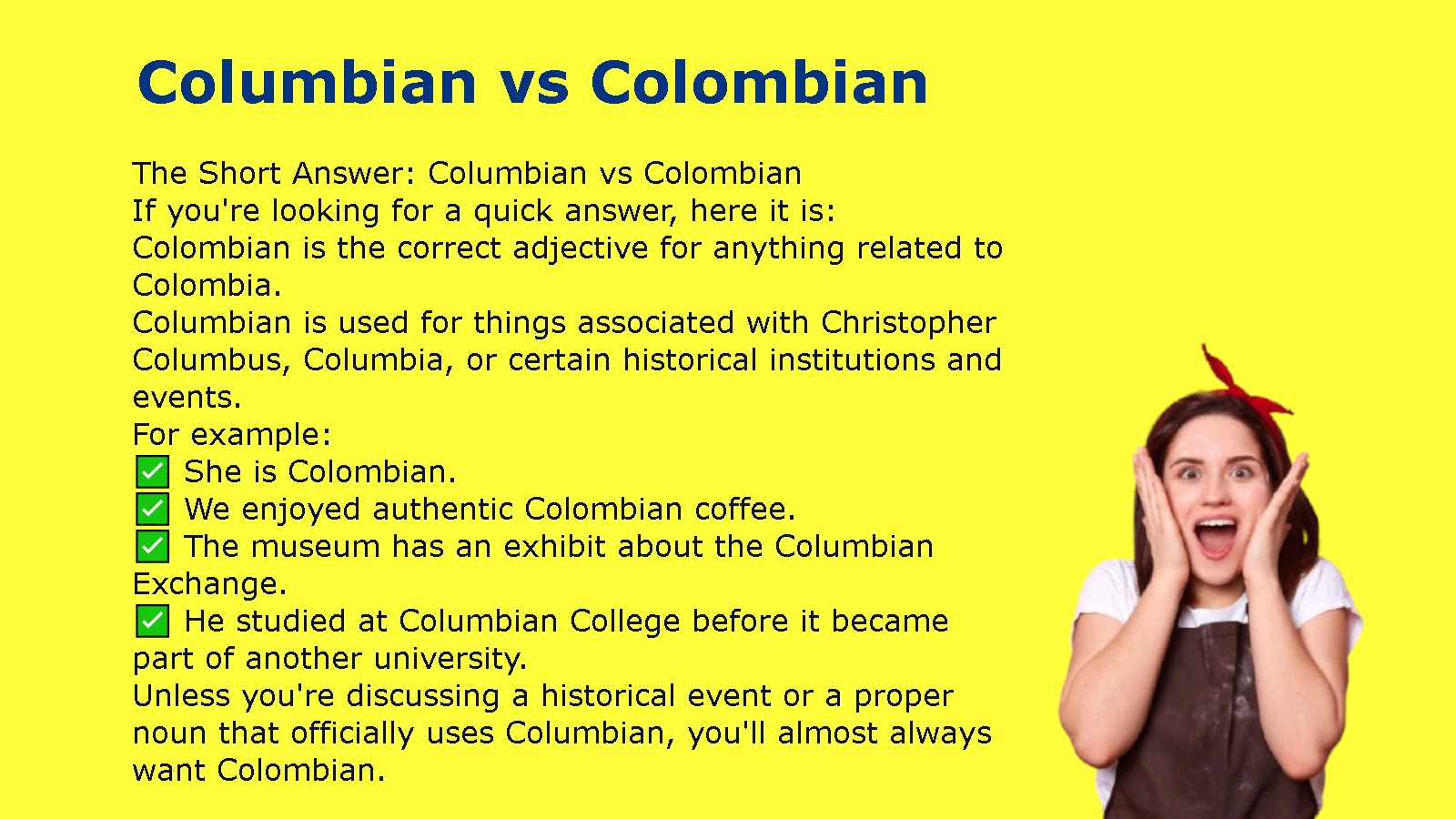
The Short Answer: Columbian vs Colombian
If you’re looking for a quick answer, here it is:
- Colombian is the correct adjective for anything related to Colombia.
- Columbian is used for things associated with Christopher Columbus, Columbia, or certain historical institutions and events.
For example:
✅ She is Colombian.
✅ We enjoyed authentic Colombian coffee.
✅ The museum has an exhibit about the Columbian Exchange.
✅ He studied at Columbian College before it became part of another university.
Unless you’re discussing a historical event or a proper noun that officially uses Columbian, you’ll almost always want Colombian.
Columbian vs Colombian at a Glance
| Feature | Colombian | Columbian |
| Refers to | Colombia | Columbus or Columbia |
| Connected to a country | ✅ Yes | ❌ No |
| Nationality | ✅ Yes | ❌ No |
| Culture | ✅ Yes | Rarely |
| Coffee | ✅ Colombian coffee | ❌ Incorrect in modern usage |
| Historical events | Rarely | ✅ Yes |
| Universities and institutions | Rarely | ✅ Sometimes |
| Common in everyday English | Very common | Limited |
Quick takeaway
Think of it this way:
- Colombia → Colombian
- Columbus → Columbian
That one-letter difference changes the meaning entirely.
What Does Colombian Mean?
Definition of Colombian
Colombian is the adjective and demonym used for anything connected with the country of Colombia.
It describes:
- People
- Language
- Food
- Music
- Geography
- Culture
- Government
- Businesses
- Sports
- Products
If something comes from Colombia or belongs to its people or culture, Colombian is the correct spelling.
Where Does the Word Colombian Come From?
The word Colombian comes directly from Colombia, a country located in the northwestern part of South America.
Interestingly, the country itself was named after Christopher Columbus. However, the English adjective formed from the country’s official name is Colombian, not Columbian.
That distinction often surprises English learners because the country and the explorer share the same historical origin.
When Should You Use Colombian?
You’ll use Colombian in many everyday situations.
Talking About People
Someone born in Colombia or holding Colombian citizenship is Colombian.
Examples:
- She’s Colombian.
- My coworker moved here from Bogotá and is Colombian.
- Many Colombian athletes compete internationally.
Talking About Food
Colombia has a rich culinary tradition.
Examples include:
- Colombian arepas
- Colombian empanadas
- Colombian tamales
- Colombian hot chocolate
- Colombian ajiaco
Example sentence:
We tried authentic Colombian cuisine during our vacation.
Talking About Coffee
One of the most common phrases in English is Colombian coffee.
The country is famous for producing high-quality Arabica beans that are exported worldwide.
Examples:
- Colombian coffee beans
- Colombian roast
- Colombian espresso
- Colombian coffee farms
Notice that the spelling is always Colombian, never Columbian.
Talking About Culture
Examples include:
- Colombian music
- Colombian festivals
- Colombian traditions
- Colombian literature
- Colombian fashion
- Colombian art
Sentence:
Colombian culture blends Indigenous, African, and European influences.
Talking About Geography
Use Colombian when referring to places within Colombia.
Examples:
- Colombian Andes
- Colombian Amazon
- Colombian Caribbean coast
- Colombian Pacific region
Talking About Sports
Many internationally recognized athletes are Colombian.
Examples:
- Colombian soccer team
- Colombian cyclist
- Colombian tennis player
- Colombian Olympic athlete
Examples of Colombian Used Correctly
Here are real-world examples.
People
- My roommate is Colombian.
- She’s proud of her Colombian heritage.
- Several Colombian artists exhibited their work.
Travel
- We explored several Colombian cities.
- Cartagena is a popular Colombian destination.
- Many travelers love the Colombian Caribbean coast.
Business
- The company imports Colombian coffee.
- They signed agreements with Colombian suppliers.
- Several Colombian startups attracted international investors.
Education
- She studies Colombian history.
- The professor specializes in Colombian politics.
- Students researched Colombian biodiversity.
Culture
- We watched a Colombian film.
- He enjoys Colombian music.
- The museum displayed Colombian textiles.
Common Collocations with Colombian
These combinations appear frequently in books, newspapers, and conversations.
| Phrase | Correct? |
| Colombian coffee | ✅ |
| Colombian food | ✅ |
| Colombian citizen | ✅ |
| Colombian passport | ✅ |
| Colombian culture | ✅ |
| Colombian Spanish | ✅ |
| Colombian cuisine | ✅ |
| Colombian artist | ✅ |
| Colombian mountains | ✅ |
| Colombian exports | ✅ |
Whenever you’re talking about the country, these are the correct expressions.
What Does Columbian Mean?
Unlike Colombian, the word Columbian appears much less often in modern English. However, it is still a legitimate word when used in the right context.
Understanding those contexts will help you avoid mistakes while recognizing when Columbian is actually correct.
Definition of Columbian
Columbian generally refers to:
- Christopher Columbus
- Historical events connected to Columbus
- Institutions using the word “Columbian”
- Places or organizations named “Columbia”
It does not describe modern Colombia or its people.
Historical Background
For centuries, the name Columbia served as a poetic or symbolic name for the United States. During the eighteenth and nineteenth centuries, many schools, newspapers, organizations, and civic groups adopted the word Columbian in their official names.
Because those names are proper nouns, their spelling remains unchanged today.
When Is Columbian Correct?
Although uncommon, Columbian is correct in several situations.
Historical Events
One famous example is the Columbian Exchange.
This term describes the exchange of plants, animals, diseases, cultures, technologies, and ideas between Europe, Africa, and the Americas after Christopher Columbus’s voyages.
Example:
The Columbian Exchange changed agriculture around the world.
Historical Exhibitions
The World’s Columbian Exposition took place in Chicago in 1893.
It celebrated the 400th anniversary of Christopher Columbus’s arrival in the Americas.
Example:
Millions visited the World’s Columbian Exposition.
Institutional Names
Some organizations still use Columbian because it is part of their official name.
Examples include:
- Columbian College
- Columbian museums
- Columbian historical societies
- Columbian publications
When referring to these organizations, changing the spelling would be incorrect.
References to Columbus
Some books and historical writings describe Columbus-related subjects using Columbian.
Example:
Scholars debated the long-term effects of Columbian exploration.
Examples of Columbian Used Correctly
- The Columbian Exchange reshaped world history.
- Historians continue studying Columbian exploration.
- The exhibition highlighted artifacts from the World’s Columbian Exposition.
- The archive preserves several Columbian documents.
- Researchers analyzed maps from the early Columbian era.
Notice that none of these examples refer to modern Colombia.
Common Collocations with Columbian
| Phrase | Correct? |
| Columbian Exchange | ✅ |
| World’s Columbian Exposition | ✅ |
| Columbian College | ✅ |
| Columbian historical society | ✅ |
| Columbian publications | ✅ |
| Columbian explorer | Sometimes |
| Columbian coffee | ❌ |
| Columbian citizen | ❌ |
| Columbian culture (meaning Colombia) | ❌ |
Why Do People Confuse Columbian and Colombian?
Even experienced writers occasionally mix these words up. The confusion comes from several factors rather than a single cause.
Let’s look at the most common reasons.
They Sound Nearly Identical
In everyday speech, Columbian and Colombian often sound almost the same.
Many people hear the word before they ever write it, so they guess the spelling based on pronunciation.
That guess isn’t always correct.
Only One Letter Changes
Compare them carefully.
| Word | Difference |
| Colombian | o after “Col” |
| Columbian | u after “Col” |
A single vowel separates the two words.
When typing quickly, it’s easy to hit the wrong key without noticing.
Autocorrect Doesn’t Always Help
Spell-check programs verify whether a word exists.
Both Colombian and Columbian are legitimate English words.
As a result, your software may not flag the mistake because the word itself is spelled correctly. The problem lies in the context.
For example:
❌ Columbian coffee
The spelling is valid, yet the phrase is incorrect because coffee comes from Colombia, not Columbia.
The Historical Connection Creates Confusion
Both words ultimately trace their roots to Christopher Columbus.
- The country Colombia was named in his honor.
- The adjective became Colombian.
- Historical references connected with Columbus often use Columbian.
Because they share a common origin, many writers assume the spellings are interchangeable.
They aren’t.
Many People Rarely Encounter Columbian
Most modern writing discusses countries, travel, food, sports, or culture.
That means readers see Colombian far more often than Columbian.
Ironically, unfamiliarity with the historical term causes some people to misuse it in everyday writing.
Key Differences Between Columbian and Colombian
Although the words look similar, their meanings belong to different contexts.
| Aspect | Colombian | Columbian |
| Refers to | Colombia | Columbus or Columbia |
| Modern nationality | ✅ Yes | ❌ No |
| Country | Colombia | Not a country |
| Food | Colombian cuisine | Usually incorrect |
| Coffee | Colombian coffee | Incorrect |
| History | Sometimes | Frequently |
| Proper nouns | Occasionally | Often |
| Common everyday usage | Very high | Limited |
| Travel writing | Correct | Usually incorrect |
| Academic history | Occasionally | Often |
A Simple Way to Remember
Imagine you’re writing about a vacation.
If the topic is:
- Bogotá
- Medellín
- Cartagena
- Coffee
- Food
- Soccer
- Culture
- Music
The correct spelling is Colombian.
If the topic involves:
- Christopher Columbus
- Historical exhibitions
- The Columbian Exchange
- Institutions officially named Columbian
Then Columbian is the right choice.
“One letter can change the entire meaning of a word. Good writing often comes down to noticing small details.”
When to Use Colombian
If you’re writing about Colombia, its people, places, products, or culture, always use Colombian. This is the standard adjective recognized in dictionaries, style guides, and everyday English.
Whether you’re writing a travel article, a news story, or a social media post, Colombian is almost always the correct choice.
Use Colombian for People
A person from Colombia is Colombian.
Examples:
- She’s a Colombian engineer who recently moved to Texas.
- My neighbors are Colombian.
- Several Colombian scientists presented their research.
- He’s proud of his Colombian heritage.
- The author interviewed Colombian entrepreneurs.
Use Colombian for Cities and Places
When referring to locations within the country, use Colombian.
Examples:
- Colombian cities
- Colombian mountains
- Colombian beaches
- Colombian rainforests
- Colombian national parks
Example sentences:
- The Colombian Andes stretch across much of the country.
- We spent two weeks exploring Colombian towns.
Use Colombian for Food and Drinks
Colombia has a rich culinary tradition. Every dish, beverage, or ingredient from the country takes the adjective Colombian.
Common phrases include:
- Colombian coffee
- Colombian chocolate
- Colombian arepas
- Colombian empanadas
- Colombian cuisine
- Colombian desserts
Example:
Fresh Colombian coffee has a smooth flavor with balanced acidity.
Use Colombian for Culture
Use Colombian whenever you describe traditions, music, literature, or art.
Examples:
- Colombian music
- Colombian festivals
- Colombian dance
- Colombian painters
- Colombian writers
- Colombian traditions
Example sentence:
The festival celebrated Colombian music and folklore.
Use Colombian for Business
Many international companies work with suppliers and businesses in Colombia.
Examples:
- Colombian exports
- Colombian companies
- Colombian manufacturers
- Colombian farmers
- Colombian startups
Example:
The retailer sources premium beans from Colombian coffee growers.
Use Colombian for Government and Sports
Examples:
- Colombian government
- Colombian president
- Colombian passport
- Colombian soccer team
- Colombian Olympic athletes
Example:
The Colombian national team qualified for the tournament.
Quick Checklist: Is Colombian Correct?
Ask yourself these questions.
| Question | If Yes… |
| Am I talking about Colombia? | ✅ Use Colombian |
| Am I describing a person from Colombia? | ✅ Use Colombian |
| Is it food, coffee, or culture from Colombia? | ✅ Use Colombian |
| Is it a city or region in Colombia? | ✅ Use Colombian |
If you answered yes to any of these, Colombian is the correct spelling.
When to Use Columbian
Although much less common, Columbian still has legitimate uses.
The key is understanding that Columbian usually appears in historical or official names rather than modern descriptions of Colombia.
Use Columbian for Historical Events
The best-known example is the Columbian Exchange.
This historical term describes the transfer of crops, animals, diseases, technologies, and ideas between the Americas and the Eastern Hemisphere after Christopher Columbus’s voyages.
Examples:
- The Columbian Exchange transformed agriculture.
- Historians continue to study the Columbian Exchange.
Use Columbian for Official Names
Some institutions still use Columbian because it forms part of their official title.
Examples include:
- Columbian College
- World’s Columbian Exposition
- Columbian historical societies
Never change the spelling of an official name.
Use Columbian in Historical Discussions
When discussing Columbus or early exploration, Columbian may be appropriate.
Example:
Scholars examined Columbian navigation techniques.
Examples of Colombian Used Correctly
Reading examples is one of the fastest ways to remember the correct spelling.
People
- Maria is Colombian.
- He’s a talented Colombian musician.
- Our guide was Colombian.
- Several Colombian students joined the exchange program.
- She’s the first Colombian architect hired by the firm.
Travel
- We visited several Colombian cities.
- The Colombian coastline was breathtaking.
- Their itinerary included famous Colombian landmarks.
- Every Colombian village had its own charm.
- The Colombian countryside looked beautiful.
Food
- We ordered authentic Colombian food.
- Their restaurant specializes in Colombian cuisine.
- Fresh Colombian coffee tastes incredible.
- I learned how to cook Colombian dishes.
- The bakery sells traditional Colombian desserts.
Culture
- The museum displayed Colombian artwork.
- We listened to Colombian folk music.
- She studies Colombian history.
- The library hosted a Colombian literature event.
- Children performed traditional Colombian dances.
Business
- The company imports Colombian flowers.
- Investors partnered with Colombian businesses.
- The brand supports Colombian farmers.
- The report highlighted Colombian exports.
- Several Colombian startups gained global attention.
Examples of Columbian Used Correctly
Here are situations where Columbian is genuinely correct.
- The Columbian Exchange reshaped global trade.
- Students studied the Columbian Exchange in history class.
- The World’s Columbian Exposition opened in Chicago in 1893.
- Researchers analyzed Columbian exploration routes.
- Historians debated the effects of Columbian voyages.
- The museum displayed artifacts from the Columbian era.
- Several Columbian organizations preserved historical records.
- The archive contains Columbian manuscripts.
- The exhibition featured Columbian maps.
- The lecture focused on Columbian exploration.
- Scholars translated Columbian documents.
- Visitors toured a Columbian historical collection.
- The university preserved Columbian archives.
- Experts discussed Columbian navigation.
- The conference explored Columbian history.
Notice how every example relates to history or an official name rather than the modern country of Colombia.
Common Mistakes People Make
Many spelling mistakes happen because writers assume the two words mean the same thing.
They don’t.
Here are the most common errors.
| Incorrect | Correct |
| Columbian coffee | Colombian coffee |
| Columbian food | Colombian food |
| Columbian citizen | Colombian citizen |
| Columbian culture | Colombian culture |
| Columbian passport | Colombian passport |
| Columbian music | Colombian music |
| Columbian government | Colombian government |
| Columbian athlete | Colombian athlete |
Mistake: Misspelling Coffee
Incorrect:
Columbian coffee is famous worldwide.
Correct:
Colombian coffee is famous worldwide.
Mistake: Using Columbian for Nationality
Incorrect:
She’s Columbian.
Correct:
She’s Colombian.
Mistake: Confusing Colombia and Columbia
These names look similar but refer to different things.
| Word | Meaning |
| Colombia | South American country |
| Columbia | Name used for various places and institutions |
| Colombian | Related to Colombia |
| Columbian | Related to Columbia or Columbus |
Understanding this distinction eliminates most spelling mistakes.
Memory Tricks to Remember the Difference
Simple memory aids can make the correct spelling stick.
Trick One: Match the Country Name
Look carefully.
Colombia → Colombian
The spelling stays almost identical.
Trick Two: Think About Columbus
Columbus → Columbian
Both words contain the letter u after “Col.”
Trick Three: Picture a Map
If you imagine South America, you’ll naturally think of Colombia.
That makes Colombian the obvious choice.
Trick Four: Coffee Test
Ask yourself:
Am I talking about coffee?
If the answer is yes, it’s almost certainly Colombian coffee.
Trick Five: History Test
Ask:
Am I discussing Christopher Columbus or a historical event?
If yes, Columbian might be correct.
Columbian vs Colombian in Everyday English
Different types of writing use these words in different ways.
Travel Writing
Travel articles almost always use Colombian.
Examples:
- Colombian beaches
- Colombian hotels
- Colombian culture
- Colombian cuisine
Journalism
News organizations consistently use Colombian when covering:
- Elections
- Sports
- Business
- Tourism
- Crime
- Economics
Academic Writing
History papers may use both words.
For example:
- Colombian politics
- Colombian biodiversity
- Columbian Exchange
- World’s Columbian Exposition
The correct choice depends entirely on the topic.
Business Writing
Companies should always use the correct spelling.
Examples:
- Colombian supplier
- Colombian manufacturer
- Colombian exports
- Colombian distributor
Using Columbian instead may appear careless and reduce credibility.
Social Media
People frequently misspell Colombian, especially in captions and comments.
Examples of incorrect posts include:
- Love Columbian coffee!
- Met amazing Columbian people today.
Both should use Colombian instead.
Related Words People Often Misspell
Because the spellings look so similar, these phrases often appear incorrectly online.
| Wrong | Right |
| Columbian coffee | Colombian coffee |
| Columbian restaurant | Colombian restaurant |
| Columbian cuisine | Colombian cuisine |
| Columbian soccer player | Colombian soccer player |
| Columbian passport | Colombian passport |
| Columbian music | Colombian music |
| Columbian government | Colombian government |
| Columbian artist | Colombian artist |
| Columbian literature | Colombian literature |
| Columbian history (modern country) | Colombian history |
Exception: If you’re referring to the Columbian Exchange, the World’s Columbian Exposition, or another official historical name, Columbian remains correct.
Colombian in Popular Phrases and Collocations
Some word combinations appear so often that they’re worth memorizing.
| Common Phrase | Correct Spelling |
| Colombian coffee | ✅ |
| Colombian cuisine | ✅ |
| Colombian food | ✅ |
| Colombian culture | ✅ |
| Colombian music | ✅ |
| Colombian artist | ✅ |
| Colombian writer | ✅ |
| Colombian citizen | ✅ |
| Colombian government | ✅ |
| Colombian exports | ✅ |
| Colombian peso | ✅ |
| Colombian Spanish | ✅ |
| Colombian Amazon | ✅ |
| Colombian Andes | ✅ |
| Colombian flowers | ✅ |
Learning these common collocations helps you write naturally and confidently.
Historical and Institutional Uses of Columbian
Although Columbian is much less common than Colombian, it still appears in important historical terms and official names. The word has a long connection with Christopher Columbus and the name Columbia, which was once used as a poetic name for places and ideas connected with the Americas.
Understanding these uses helps you recognize when Columbian is correct instead of automatically assuming it is a spelling mistake.
The Columbian Exchange
One of the most famous uses of Columbian is the term Columbian Exchange.
The Columbian Exchange refers to the widespread transfer of plants, animals, diseases, people, technologies, and ideas between the Americas and other parts of the world after Christopher Columbus’s voyages in the late 15th century.
The exchange dramatically changed global history.
Examples of things involved in the Columbian Exchange
| From the Americas | From Europe, Africa, and Asia |
| Potatoes | Wheat |
| Tomatoes | Sugar |
| Corn (maize) | Horses |
| Cocoa | Cattle |
| Tobacco | Coffee |
| Peppers | Various diseases |
Why the Columbian Exchange Matters
The effects of this exchange can still be seen today.
For example:
- Potatoes became an important food source in Europe.
- Tomatoes transformed Italian cuisine.
- Horses changed transportation and farming in many parts of the Americas.
- New diseases caused devastating population losses among Indigenous communities.
Example sentence:
The Columbian Exchange changed diets, economies, and societies across the globe.
The World’s Columbian Exposition
Another famous use of Columbian appears in the World’s Columbian Exposition, also called the Chicago World’s Fair of 1893.
The event took place in Chicago, Illinois, to celebrate the 400th anniversary of Christopher Columbus’s arrival in the Americas.
The fair became one of the most influential exhibitions in American history.
Important facts about the World’s Columbian Exposition
| Fact | Detail |
| Year | 1893 |
| Location | Chicago, Illinois |
| Purpose | Celebration of Columbus’s 1492 voyage |
| Attendance | Around 27 million visitors |
| Famous features | White City architecture, Ferris wheel |
The event introduced millions of visitors to new inventions, cultural displays, and architectural ideas.
Example:
The World’s Columbian Exposition influenced American architecture and urban planning.
Columbian in Educational Institutions
Some schools and organizations use Columbian as part of their official name.
When a word appears in a proper name, you should preserve the original spelling.
For example:
- Columbian College
- Columbian historical societies
- Columbian publications
Changing these names to Colombian would create an incorrect reference.
Columbian in Historical Writing
Historians sometimes use Columbian when discussing topics connected to Columbus or the period following his voyages.
Examples:
- Columbian exploration
- Columbian voyages
- Columbian era
- Columbian discoveries
However, writers must use this term carefully.
For example:
✅ Correct:
The book examines Columbian exploration during the Age of Discovery.
❌ Incorrect:
The restaurant serves authentic Columbian food.
The second sentence should say Colombian food because it refers to Colombia.
Frequently Asked Questions About Columbian vs Colombian
Is Columbian ever correct?
Yes. Columbian is a correct English word, but it has specific uses.
Use it when referring to:
- Christopher Columbus
- The Columbian Exchange
- The World’s Columbian Exposition
- Organizations or institutions with Columbian in their official name
Do not use it when describing modern Colombia.
Is Colombian the correct spelling for people from Colombia?
Yes.
A person from Colombia is Colombian.
Examples:
✅ She is Colombian.
✅ He is a Colombian athlete.
✅ They are Colombian citizens.
The word Columbian does not describe nationality.
Why do people write Columbian instead of Colombian?
People often confuse the two because:
- The words look almost identical.
- They sound similar when spoken.
- Both words have historical connections to Columbus.
- The letter difference is easy to overlook.
The mistake usually comes from visual similarity rather than meaning.
Is Colombian coffee spelled with an “o” or a “u”?
The correct spelling is:
✅ Colombian coffee
Example:
Colombian coffee is known around the world for its quality.
Columbian coffee is incorrect because coffee comes from Colombia, not from a place or concept related to Columbus.
Can Columbian and Colombian be used interchangeably?
No.
They may look similar, but they have different meanings.
| Sentence | Correct? |
| I bought Colombian coffee. | ✅ |
| I studied the Columbian Exchange. | ✅ |
| She is Colombian. | ✅ |
| She is Columbian. | ❌ |
| Columbian cuisine is popular. | ❌ |
| Colombian history is fascinating. | ✅ |
Is Columbia the same as Colombia?
No.
These names refer to different things.
Colombia
Colombia is a country in South America.
Examples:
- Colombian citizens
- Colombian culture
- Colombian coffee
Columbia
Columbia is used in several names, including:
- Places
- Universities
- Organizations
- Historical references
Examples:
- Columbia University
- District of Columbia
- British Columbia
The similarity between the names causes many spelling mistakes.
Why is the country spelled Colombia instead of Columbia?
The country chose the spelling Colombia in Spanish and English.
Although both names come from Christopher Columbus, they developed differently over time.
Today:
- Colombia = the South American country
- Columbia = a name used for various places and institutions
Which spelling do dictionaries recommend?
Dictionaries recognize both words, but they define them differently.
- Colombian = relating to Colombia
- Columbian = relating to Columbus, Columbia, or historical terms
The correct spelling depends on the context.
Quick Quiz: Columbian or Colombian?
Test your knowledge.
Choose the correct word.
Question 1
She loves drinking ______ coffee every morning.
A) Columbian
B) Colombian
Answer: B) Colombian
Coffee comes from Colombia.
Question 2
The students learned about the ______ Exchange in history class.
A) Columbian
B) Colombian
Answer: A) Columbian
The term refers to Christopher Columbus.
Question 3
He is a famous ______ soccer player.
A) Columbian
B) Colombian
Answer: B) Colombian
The player comes from Colombia.
Question 4
The museum displayed artifacts from the World’s ______ Exposition.
A) Colombian
B) Columbian
Answer: B) Columbian
The official historical name uses Columbian.
Question 5
They opened a restaurant serving traditional ______ cuisine.
A) Colombian
B) Columbian
Answer: A) Colombian
Cuisine from Colombia is Colombian.
Case Study: How One Letter Creates a Meaning Problem
Imagine a travel company publishing this sentence:
“Experience the best Columbian coffee farms during your South American adventure.”
At first glance, the sentence looks fine. However, it contains an important mistake.
The correct sentence should be:
“Experience the best Colombian coffee farms during your South American adventure.”
Why?
Because the farms are located in Colombia, the country famous for coffee production. The word Columbian changes the meaning and incorrectly connects the coffee with Columbus or Columbia.
This small spelling error could affect:
- Search engine rankings
- Brand credibility
- Reader trust
- Professional image
A single letter may seem tiny, but language works through details.
Expert Tip: Context Matters More Than Spelling
The biggest lesson in the Columbian vs Colombian debate is that spelling alone does not tell the whole story.
Both words are correctly spelled. The challenge is choosing the word that matches your meaning.
A useful rule:
If it comes from Colombia, use Colombian. If it connects to Columbus or Columbia, use Columbian.
This simple habit prevents most mistakes.
Final Verdict: Columbian or Colombian?
The difference between Columbian vs Colombian comes down to one important question:
What are you talking about?
If you’re describing the country of Colombia, its people, products, culture, food, coffee, or traditions, use:
✅ Colombian
Examples:
- Colombian coffee
- Colombian food
- Colombian culture
- Colombian citizen
- Colombian athlete
If you’re discussing Christopher Columbus, historical events, or official names containing the word, use:
✅ Columbian
Examples:
- Columbian Exchange
- World’s Columbian Exposition
- Columbian College
Key Takeaways
- Colombian refers to the country Colombia.
- Columbian usually refers to Christopher Columbus, Columbia, or historical terms.
- A person from Colombia is always Colombian.
- Coffee from Colombia is always Colombian coffee.
- The Columbian Exchange is correctly spelled with u.
- Both words are correct, but they belong in different situations.
Remember this quick formula:
Colombia → Colombian
Columbus → Columbian
Once you connect the spelling with the meaning, choosing the right word becomes easy.