Based On vs Based Off Of: Based on is the correct and preferred phrase in standard English. It means “derived from” or “supported by.” Based off of is an informal variation, mainly used in American English, but based on is recommended for formal, academic, and professional writing.
The phrase Based On is the standard and widely accepted expression in American English and British English. It means that something is developed, created, or formed using information, evidence, ideas, or a real situation as its foundation. For example, a movie can be based on a true story, a report can be based on research, or a decision can be based on facts. This phrase is commonly used in formal writing, professional settings, education, and everyday speech.
On the other hand, Based Off Of is a more informal expression that is commonly used in spoken American English. It usually carries the same meaning as Based On, but many grammar experts consider it less formal or unnecessary because the word “off” does not add extra meaning. You may hear people say a character is based off of a real person or a design is based off of an original idea, but in formal writing, Based On is usually the preferred choice.
Understanding the difference between Based On and Based Off Of helps you choose the right phrase depending on the situation. Whether you are writing an essay, creating professional content, sending an email, or improving your language skills, knowing when to use each expression will make your communication more precise and confident.
In this guide, you will learn the clear difference between Based On vs Based Off Of, their meanings, grammar rules, examples, common mistakes, and simple memory tips to help you use these phrases correctly in writing and conversation.
Quick Answer: Based On or Based Off Of?
If you’re in a hurry, here’s the answer.
| Phrase | Grammatically Acceptable? | Formal Writing | Everyday Conversation | Recommended Choice |
| Based on | Yes | ✅ Yes | ✅ Yes | Best choice |
| Based off | Informal | ❌ Usually avoid | ✅ Common | Acceptable in casual speech |
| Based off of | Informal | ❌ Avoid | ✅ Common | Use sparingly |
The Bottom Line
If you’re writing an essay, email, report, article, or professional document, choose based on. It sounds natural, follows standard English conventions, and won’t raise eyebrows with editors.
What Does “Based On” Mean?
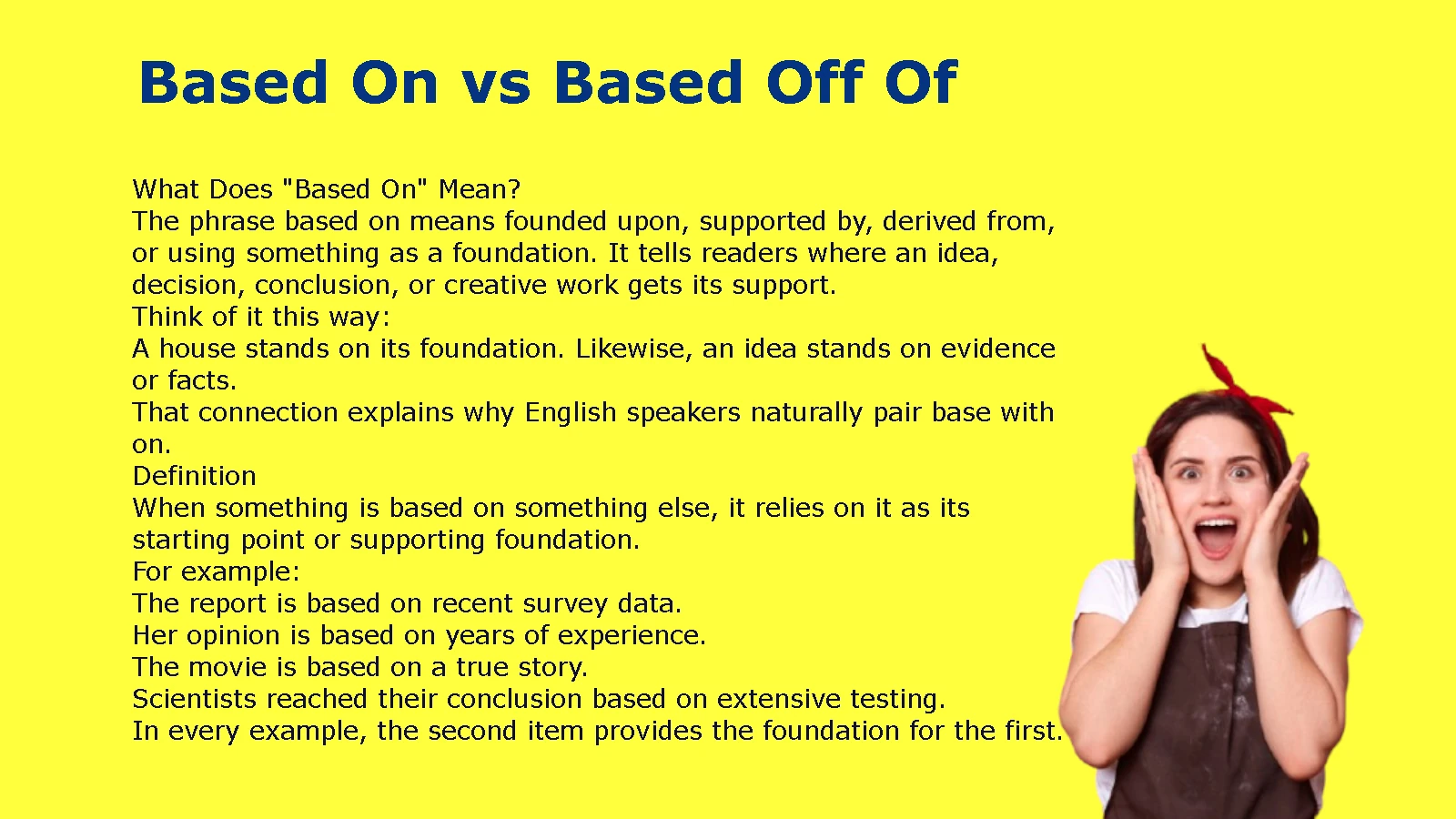
The phrase based on means founded upon, supported by, derived from, or using something as a foundation. It tells readers where an idea, decision, conclusion, or creative work gets its support.
Think of it this way:
A house stands on its foundation. Likewise, an idea stands on evidence or facts.
That connection explains why English speakers naturally pair base with on.
Definition
When something is based on something else, it relies on it as its starting point or supporting foundation.
For example:
- The report is based on recent survey data.
- Her opinion is based on years of experience.
- The movie is based on a true story.
- Scientists reached their conclusion based on extensive testing.
In every example, the second item provides the foundation for the first.
Why “Based On” Is Standard English
English has used based on for generations because the preposition on naturally expresses support.
Consider these familiar expressions:
- Built on trust
- Founded on evidence
- Depends on facts
- Relies on research
Each phrase describes something resting upon another thing.
The same principle applies to based on.
Imagine placing a book on a table.
The table supports the book.
Likewise, evidence supports an argument.
That mental picture makes the expression easy to remember.
The Grammar Behind the Phrase
The adjective based comes from the verb base, which means:
- establish
- found
- place upon a foundation
When you say:
The decision is based on customer feedback.
you’re saying customer feedback forms the foundation of that decision.
Nothing in the sentence suggests movement or separation. That’s one reason many grammar experts prefer on instead of off.
Examples of Correct Usage
Academic Writing
- The research is based on interviews conducted over two years.
- The conclusion is based on measurable evidence.
Business
- Our pricing strategy is based on market demand.
- Bonuses are based on employee performance.
Everyday Conversation
- My opinion is based on personal experience.
- The recommendation is based on what worked before.
Journalism
- The article is based on court documents.
- The report is based on eyewitness accounts.
Science
- The theory is based on decades of observation.
- Climate models are based on historical data.
Notice how natural every sentence sounds. That’s one reason professional writers overwhelmingly choose based on.
What Does “Based Off Of” Mean?
Now let’s examine the phrase that creates confusion.
You’ll hear based off of regularly in conversations, podcasts, television interviews, and social media posts.
Examples include:
- It’s based off of a comic book.
- This recipe is based off of my grandmother’s cooking.
- The design was based off of an older model.
Most listeners understand exactly what the speaker means.
However, grammar discussions begin when writers ask whether it’s the best choice.
Definition
In modern English, based off of generally means:
- inspired by
- adapted from
- developed from
- influenced by
Many speakers use it exactly the same way they use based on.
For example:
The TV series is based off of a bestselling novel.
Most readers interpret that sentence correctly.
Even so, professional editors often revise it to:
The TV series is based on a bestselling novel.
The meaning stays the same, yet the sentence aligns with standard written English.
Why People Say “Based Off Of”
Language changes because people speak more than they write.
In casual conversation, phrases often blend together or shift over time.
Several factors helped popularize based off of.
Everyday Speech
People frequently combine expressions without thinking about grammar.
Examples include:
- coming off of
- working off of
- feeding off of
- building off of
Since these combinations sound familiar, many speakers naturally extend the pattern to based off of.
Influence of Spoken American English
American English often embraces expressions that develop through everyday conversation.
Over time, millions of speakers repeat a phrase until it becomes common.
That doesn’t always mean style guides approve of it.
Instead, it shows how language evolves through use.
Influence from Similar Expressions
Consider these phrases:
- Build off an idea.
- Work off a draft.
- Expand off an existing plan.
Each suggests continuing from an earlier starting point.
Some speakers unconsciously replace build off with base off, even though the verbs describe different relationships.
Is “Based Off Of” Grammatically Wrong?
The answer requires a little nuance.
Many people assume it’s either completely correct or completely incorrect.
Reality sits somewhere in the middle.
Everyday English
In casual conversation, based off of isn’t likely to confuse anyone.
Friends, coworkers, and family members hear it every day.
For example:
This video game is based off of an old arcade classic.
Most listeners won’t notice anything unusual.
Formal English
Professional writing follows different expectations.
Editors typically replace:
- based off
- based off of
with
- based on
That revision creates a cleaner, more traditional sentence.
Why Editors Prefer “Based On”
Editors value three things:
- clarity
- consistency
- tradition
Since based on has served as the standard form for decades, publishers continue recommending it.
Replacing one phrase with another also helps maintain consistency across books, newspapers, journals, and business documents.
Does “Based Off Of” Ever Change the Meaning?
Sometimes.
Many speakers use both phrases interchangeably.
Others notice a subtle distinction.
For example:
Based on often emphasizes a foundation.
The report is based on government statistics.
The statistics directly support the report.
Meanwhile, based off of may suggest adaptation or inspiration.
The sculpture was based off of a childhood drawing.
The drawing inspired the sculpture rather than serving as factual evidence.
This distinction isn’t universal, but you’ll occasionally encounter it in creative fields.
Based On vs Based Off Of: The Key Differences
Although these phrases often communicate similar ideas, they aren’t viewed the same way in every context.
The biggest difference lies in formality, editorial preference, and usage expectations.
Comparison Table
| Feature | Based On | Based Off Of |
| Standard English | ✅ Yes | ❌ Informal |
| Accepted in academic writing | ✅ Yes | Rarely |
| Appropriate for business writing | ✅ Yes | Usually avoided |
| Common in conversation | ✅ Yes | ✅ Yes |
| Preferred by editors | ✅ Yes | ❌ No |
| Suggests foundation | Strongly | Sometimes |
| Suggests inspiration or adaptation | Sometimes | More commonly |
Meaning
Based on highlights support or foundation.
Example:
The findings are based on years of research.
The research provides evidence.
Based off of often sounds more conversational.
Example:
The artwork is based off of photographs from the 1940s.
Here, the photographs inspired the artwork.
Formality
If you’re writing:
- a resume
- a research paper
- a business proposal
- a legal document
- a professional email
choose based on every time.
It reflects the conventions expected in edited English and helps your writing appear polished and authoritative.
Readability
Readers rarely stop to question based on because it feels familiar.
By contrast, based off of can distract readers who expect formal grammar, especially in academic or professional settings.
Strong writing removes unnecessary distractions. Choosing the standard phrase keeps the focus on your message instead of your wording.
Which One Should You Remember?
A simple memory trick can help.
Imagine constructing a building.
Every building stands on its foundation.
It doesn’t stand off its foundation.
Likewise, ideas, decisions, reports, and stories are typically based on facts, evidence, research, or inspiration.
Whenever you’re unsure, based on is the safest and strongest choice. It works in virtually every situation, from casual conversations to scholarly articles, making it the preferred option for clear and effective communication.
Is “Based Off” Different from “Based Off Of”?
At first glance, “based off” and “based off of” look like two different expressions. In practice, they mean the same thing. The only difference is that one includes the extra preposition of.
For example:
- The game is based off an old board game.
- The game is based off of an old board game.
Most people understand both sentences without any confusion. However, neither form is the preferred choice in formal writing.
Which One Sounds More Natural?
In everyday American English, you’ll hear both versions.
Some speakers drop of because it makes the sentence shorter:
The design is based off an earlier prototype.
Others keep of because it feels more natural in conversation:
The design is based off of an earlier prototype.
Neither version has a grammatical advantage over the other. If you’re editing formal writing, the best revision is still:
The design is based on an earlier prototype.
Regional Differences
Language varies from place to place.
Many American speakers use based off or based off of in casual conversations. In contrast, British English strongly favors based on, especially in newspapers, books, and academic writing.
That doesn’t mean you’ll never hear based off of outside the United States. It simply appears less often.
Should You Use Either One?
Ask yourself one question:
Who will read this?
If the audience includes:
- Teachers
- Professors
- Employers
- Clients
- Editors
- Publishers
Choose based on.
If you’re chatting with friends or posting on social media, either phrase is unlikely to cause confusion.
When You Can Use “Based Off Of”
Although based on remains the standard expression, there are situations where based off of doesn’t sound out of place.
The key is understanding your audience and the level of formality.
Casual Conversations
People naturally use informal expressions when speaking.
For example:
My costume was based off of a superhero I liked as a kid.
No one is likely to stop the conversation to correct that wording.
Entertainment Discussions
Movies, television, and video games often inspire informal speech.
Examples:
- The series is based off of a bestselling novel.
- The game is based off an older franchise.
- That character is based off a real athlete.
You’ll hear sentences like these in interviews and podcasts.
Creative Industries
Artists, designers, musicians, and photographers often describe inspiration rather than factual evidence.
For example:
This painting is based off of memories from childhood.
Here, the speaker emphasizes inspiration instead of documentation.
Even so, many publishers would still edit the sentence to based on before printing it.
Social Media
Platforms like Instagram, TikTok, Reddit, and X encourage conversational language.
A caption might read:
This recipe is based off my grandma’s cooking.
That’s perfectly understandable in an informal setting.
Dialogue in Fiction
Writers often let characters speak naturally.
For example:
“It’s based off of something my grandfather told me,” she whispered.
Dialogue reflects real speech, not strict grammar rules.
When You Should Always Use “Based On”
Certain types of writing demand precision and consistency.
That’s where based on shines.
Academic Writing
Teachers expect standard English.
Examples include:
- Essays
- Research papers
- Theses
- Dissertations
- Journal articles
Correct:
The hypothesis is based on previous studies.
Business Communication
Professional writing reflects credibility.
Examples include:
- Reports
- Presentations
- Client proposals
- Annual reviews
- Marketing research
Correct:
Our forecast is based on current market trends.
Professional Emails
A polished email creates a better impression.
Instead of writing:
Based off of our conversation…
Write:
Based on our conversation…
It’s shorter, cleaner, and more professional.
Journalism
News organizations strive for consistency.
Reporters typically write:
- based on police records
- based on interviews
- based on court filings
Rarely will you see based off of in a professionally edited newspaper.
Technical Documentation
Instruction manuals, engineering documents, and software documentation rely on precise wording.
Example:
Recommendations are based on laboratory testing.
That wording leaves little room for interpretation.
Legal Writing
Legal documents depend on exact language.
Courts prefer wording that has long-established usage.
Example:
The decision is based on the evidence presented.
Replacing it with based off of could sound less formal without adding any benefit.
Common Mistakes to Avoid
Many grammar mistakes happen because writers imitate spoken English.
Here are some of the most common errors.
Using “Based Off Of” in Formal Writing
❌ The proposal is based off of last year’s report.
✅ The proposal is based on last year’s report.
Mixing Similar Expressions
Some people confuse build off with base on.
Correct:
We can build on this idea.
Also correct:
We can build off this idea.
But:
The idea is based on customer feedback.
Notice that build and base don’t always follow the same pattern.
Assuming Longer Means Better
Adding extra words doesn’t improve clarity.
Compare these sentences.
❌ The movie is based off of a novel.
✅ The movie is based on a novel.
The second version is shorter and stronger.
Forgetting Your Audience
An informal phrase may work perfectly in a text message.
It may not belong in:
- College essays
- Job applications
- Business proposals
- Professional websites
Good writing always considers the reader.
Real-World Example Sentences
Looking at real examples makes the difference much easier to remember.
Business
Correct:
- Our strategy is based on customer feedback.
- The budget is based on projected revenue.
- Decisions are based on measurable results.
Informal:
- Our campaign is based off last year’s launch.
Education
Correct:
- The conclusion is based on experimental data.
- The essay is based on historical evidence.
- Grades are based on classroom performance.
Movies and Television
Correct:
- The film is based on a bestselling novel.
- The documentary is based on real events.
Informal:
- The show is based off of a comic series.
Research
Correct:
- Scientists developed the model based on years of observation.
- The report is based on verified statistics.
Everyday Conversation
Natural speech often includes both versions.
Examples:
- My opinion is based on experience.
- The recipe is based off my mother’s cooking.
- That painting is based off of a dream.
- Their decision was based on what happened yesterday.
Mini Case Study: One Sentence, Three Different Audiences
Imagine you’re describing the same movie.
Casual Text Message
It’s based off of a true story.
Perfectly acceptable.
College Essay
The film is based on historical events.
Better choice.
Newspaper Review
The screenplay is based on real court records.
Best choice for formal publication.
The meaning hardly changes.
The audience does.
That’s why choosing the appropriate expression matters.
Why “Based On” Sounds More Natural
Some grammar choices feel right because English speakers have heard them for centuries.
Based on belongs to that category.
It Matches Related Expressions
English already uses many expressions built around on.
Examples include:
- depends on
- relies on
- founded on
- built on
- centered on
- focused on
Adding based on to that list feels consistent.
It Creates a Strong Foundation Image
Imagine a bridge resting on concrete supports.
Without those supports, the bridge collapses.
Likewise:
- A theory rests on evidence.
- An opinion rests on experience.
- A decision rests on facts.
That visual connection makes based on intuitive.
It Improves Clarity
Professional writing favors expressions readers recognize immediately.
Since based on appears in textbooks, newspapers, research journals, and business documents, readers process it without hesitation.
Even small improvements in readability can strengthen an article.
Is “Based Off Of” Becoming More Acceptable?
Language never stays still.
Words evolve.
Grammar changes.
Expressions appear, disappear, and sometimes become standard.
So what about based off of?
The answer is yes—but with important limits.
Spoken English Changes Faster Than Written English
People experiment with language every day.
If enough speakers repeat a phrase, it often becomes common.
That’s exactly what happened with based off of.
Today, you’ll hear it in:
- Podcasts
- Interviews
- Sports broadcasts
- YouTube videos
- Everyday conversations
Its popularity reflects spoken usage rather than formal grammar.
Descriptive vs. Prescriptive Grammar
This debate often comes down to two approaches to language.
| Approach | Focus | View of “Based Off Of” |
| Descriptive grammar | Describes how people actually speak | Accepts that many speakers use it |
| Prescriptive grammar | Recommends standard usage | Prefers based on |
Neither approach is inherently wrong.
One observes language.
The other provides guidance for formal communication.
Why Style Guides Still Recommend “Based On”
Professional editors value consistency.
When thousands of writers contribute to newspapers, magazines, and academic journals, using one standard expression prevents unnecessary variation.
That’s why based on remains the safer choice.
Even writers who personally say based off of in conversation often change it during editing.
What Major Dictionaries and Style Authorities Say
Leading dictionaries and style authorities recognize that based off of appears in modern English. However, they consistently identify based on as the standard and preferred form for formal writing.
Here’s how major references generally approach the issue.
| Authority | General Guidance |
| Merriam-Webster | Records both usage and recognizes that based off appears in modern English, especially in speech. |
| Cambridge Dictionary | Uses based on in definitions and examples as the standard expression. |
| Oxford Learner’s Dictionaries | Lists based on as the conventional phrase for meaning “using something as a foundation.” |
| The Chicago Manual of Style | Favors standard, widely accepted forms in edited writing, making based on the preferred choice. |
| AP Style | Professional news writing overwhelmingly uses based on for clarity and consistency. |
What This Means for You
Dictionaries describe how people use language.
Style guides recommend how writers should use language in professional settings.
That’s an important distinction.
A phrase can be common in conversation without becoming the best choice for formal writing.
A Simple Rule to Remember
When you’re uncertain, ask yourself:
Does this sentence describe something resting on a foundation?
If the answer is yes, based on is almost always the right choice.
It is clear, familiar, and accepted in virtually every type of writing—from classroom essays to published books and professional reports.
Frequently Asked Questions About Based On vs Based Off Of Grammar
Is based off of grammatically correct?
Yes, based off of is grammatically acceptable in informal spoken English. Many native speakers use it in everyday conversations without causing confusion.
However, if you’re writing an essay, research paper, business document, or professional email, based on is the better choice. Most editors and style guides consider it the standard expression.
Is based off incorrect?
Not necessarily.
Based off is simply a shorter version of based off of. It’s common in casual American English, especially in speech.
For example:
- Informal: This design is based off an older version.
- Formal: This design is based on an older version.
While based off isn’t usually treated as a grammar mistake in conversation, it may sound too informal in professional writing.
Why do many Americans say based off of?
Language naturally changes over time.
Many speakers use based off of because it sounds similar to familiar expressions like:
- build off an idea
- work off a draft
- feed off each other
As these phrases became more common, some people began using based off of in the same way.
That shift reflects spoken language rather than a formal grammar rule.
Which phrase should students use?
Students should almost always use based on.
Teachers, professors, and academic editors expect standard English. Using based on keeps your writing clear and professional.
Correct:
The conclusion is based on the evidence collected.
Can based off of appear in books?
Yes, but context matters.
You’ll often find based off of in:
- Fiction dialogue
- Memoirs
- Interviews
- Informal nonfiction
- Personal essays
Characters in novels don’t always speak formally. Authors often choose realistic dialogue over textbook grammar.
Outside of dialogue, most published books still favor based on.
Is based on more professional?
Absolutely.
Whether you’re writing:
- a resume
- a cover letter
- a business proposal
- a report
- an academic paper
- a legal document
Based on is the safer and more professional option.
Which phrase should researchers use?
Researchers should consistently use based on.
Scientific writing values precision and consistency.
Examples include:
- The model is based on observed data.
- The analysis is based on laboratory results.
- Recommendations are based on statistical evidence.
Is “based on true events” correct?
Yes.
In fact, based on true events is the standard wording used in books, films, documentaries, and news articles.
Examples:
- The movie is based on true events.
- The novel is based on a true story.
- The documentary is based on historical records.
Is “based off a true story” acceptable?
You’ll hear it in conversations and interviews, but it’s generally considered informal.
For formal writing, choose:
The film is based on a true story.
That version is widely accepted and reads more smoothly.
Quick Decision Guide
When you’re unsure which phrase to use, this table provides a quick answer.
| If You’re Writing… | Best Choice | Why? |
| School essay | Based on | Standard academic English |
| Research paper | Based on | Preferred by journals and universities |
| Business report | Based on | Professional and clear |
| Resume | Based on | Formal writing |
| Professional email | Based on | Creates a polished impression |
| Legal document | Based on | Traditional legal usage |
| Newspaper article | Based on | Consistent editorial style |
| Blog post | Based on | More authoritative |
| Marketing copy | Based on | Builds credibility |
| Casual text message | Either | Informal conversation allows flexibility |
| Social media caption | Either | Depends on your preferred style |
| Fiction dialogue | Either | Reflects natural speech |
A Handy Memory Trick
Picture a building.
Every building stands on a foundation.
It doesn’t stand off its foundation.
The same idea applies to writing.
A report is based on facts.
A theory is based on research.
A decision is based on evidence.
That simple image makes the correct phrase much easier to remember.
Common Grammar Myths
The debate surrounding based on vs based off of grammar has led to several misconceptions. Let’s clear up the most common ones.
| Myth | Reality |
| Based off of is always wrong. | No. It’s common in informal speech but usually avoided in formal writing. |
| Based on is old-fashioned. | False. It remains the standard expression across professional writing. |
| Both phrases are interchangeable everywhere. | Not always. Audience and context matter. |
| Editors don’t care which one you use. | Most editors consistently prefer based on. |
| Using based off of makes writing sound more natural. | It may sound conversational, but it can weaken formal writing. |
Understanding these myths helps you make informed choices instead of relying on assumptions.
Side-by-Side Comparison
Here’s a quick comparison you can revisit whenever you’re uncertain.
| Feature | Based On | Based Off Of |
| Standard English | ✅ Yes | ❌ Informal |
| Formal writing | ✅ Recommended | ❌ Usually avoided |
| Academic papers | ✅ Yes | Rarely used |
| Business communication | ✅ Yes | Usually avoided |
| Journalism | ✅ Yes | Rarely used |
| Legal writing | ✅ Yes | Not recommended |
| Casual conversation | ✅ Yes | ✅ Yes |
| Fiction dialogue | ✅ Yes | ✅ Yes |
| Preferred by editors | ✅ Yes | ❌ No |
| Safest choice | ✅ Always | Only in informal contexts |
Key Takeaways
Before wrapping up, here are the most important points to remember.
- Based on is the standard and preferred expression in English.
- It works well in both formal and informal writing.
- Based off of is common in everyday American speech.
- Most editors replace based off of with based on during the editing process.
- Academic, professional, legal, and technical writing should almost always use based on.
- Creative dialogue and casual conversations allow more flexibility.
- When in doubt, choose based on because it fits nearly every situation.
Final Verdict: Based On vs Based Off Of Grammar
If the goal is to write clear, polished, and professional English, based on is the phrase to remember.
Although based off of has become increasingly common in spoken American English, it hasn’t replaced based on as the accepted standard for formal writing. Universities, publishers, businesses, and news organizations continue to favor based on because it clearly conveys that something rests upon evidence, facts, experience, or another supporting foundation.
That doesn’t mean based off of is meaningless or unusable. In casual conversations, interviews, social media posts, and fictional dialogue, it often sounds natural because it reflects how many people actually speak. Context, audience, and purpose all influence whether it’s an appropriate choice.
A simple rule can guide almost every decision:
- Writing for school or work? Use based on.
- Writing professionally? Use based on.
- Talking with friends or writing dialogue? Either phrase may work, though based on is still perfectly natural.
By choosing the phrase that matches your audience, you’ll write with greater confidence, improve readability, and avoid one of the most common grammar questions in modern English.
Conclusion
The discussion around based on vs based off of grammar isn’t about proving one phrase is absolutely right and the other completely wrong. Instead, it’s about understanding usage, context, and audience.
Based on remains the trusted standard because it expresses a clear relationship between an idea and its foundation. It’s the wording you’ll see in academic papers, business reports, professional emails, news articles, and published books. Choosing it helps your writing sound polished and authoritative without adding unnecessary complexity.
Meanwhile, based off of has earned a place in informal conversation. Native speakers use it every day, especially when talking about inspiration, adaptations, or creative works. While it’s unlikely to confuse your audience, it doesn’t offer any advantage in formal writing.
Whenever you’re unsure, keep one image in mind: ideas stand on a foundation, just as buildings stand on one. That simple mental picture points you toward based on every time.
Making that small choice can strengthen your writing, improve clarity, and help your message connect with readers—whether you’re drafting a research paper, preparing a presentation, or simply trying to express yourself with confidence.