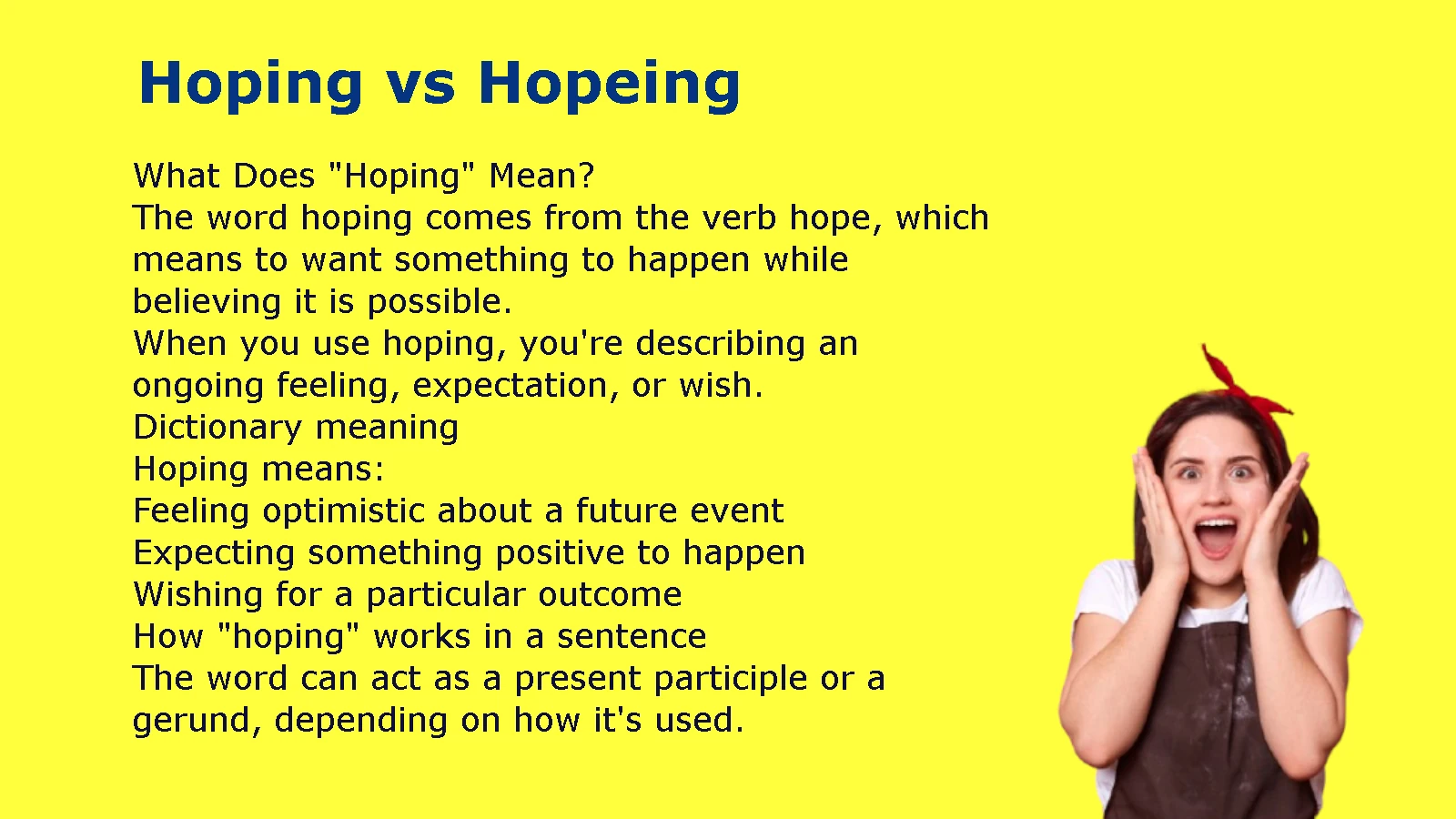
Have you ever wondered whether “Hoping vs Hopeing” is simply a spelling difference or if both words have different meanings? This is a common confusion in English spelling because many learners add extra letters when forming words with verb endings. However, only one spelling is correct in standard English, and understanding the difference can help improve your grammar accuracy, writing skills, and overall vocabulary development.
In simple terms, hoping is the correct spelling and refers to having a feeling of expectation, desire, or confidence that something will happen. It is the present participle form of the verb hope, used in sentences such as “I am hoping for good news” or “She is hoping to achieve her goals.” On the other hand, hopeing is an incorrect spelling because English spelling rules require the final silent “e” in hope to be removed before adding “ing.”
The confusion between hoping and hopeing happens because many English words keep their final e when adding suffixes, while others follow different spelling patterns. Learning this rule helps writers avoid common mistakes and use words correctly in emails, essays, conversations, and professional communication.
If you have ever paused while writing a sentence like “I am hoping things improve” and wondered whether hopeing might also be correct, you are not alone. Many learners struggle with similar spelling pairs, but a simple rule makes the difference easy to remember.
In this guide, you will learn the clear difference between hoping vs hopeing, their meanings, spelling rules, sentence examples, pronunciation, and easy memory tips so you can use the correct form confidently in everyday English writing.
Hoping vs. Hopeing: The Quick Answer
If you’re in a hurry, here’s the answer.
| Word | Correct? | Meaning |
| Hoping | ✅ Yes | The present participle or gerund of hope |
| Hopeing | ❌ No | Incorrect spelling |
The verb hope becomes hoping, not hopeing.
Correct examples
- I’m hoping the weather improves tomorrow.
- She’s hoping for good news.
- We’re hoping to finish early.
Incorrect examples
- ❌ I’m hopeing the weather improves tomorrow.
- ❌ She’s hopeing for good news.
- ❌ We’re hopeing to finish early.
Quick tip: If you’re adding -ing to a verb that ends with a silent e, remove the e first.
What Does “Hoping” Mean?
The word hoping comes from the verb hope, which means to want something to happen while believing it is possible.
When you use hoping, you’re describing an ongoing feeling, expectation, or wish.
Dictionary meaning
Hoping means:
- Feeling optimistic about a future event
- Expecting something positive to happen
- Wishing for a particular outcome
How “hoping” works in a sentence
The word can act as a present participle or a gerund, depending on how it’s used.
| Usage | Example |
| Present participle | She is hoping for a promotion. |
| Gerund | Hoping keeps people motivated during difficult times. |
Although both forms look the same, they play different grammatical roles.
Present participle
A present participle works with helping verbs to create continuous verb tenses.
Examples:
- I am hoping you’ll join us.
- They were hoping to catch the last train.
- We have been hoping for better results.
In these sentences, hoping describes an action or state that continues over time.
Gerund
A gerund is a verb ending in -ing that functions as a noun.
Examples:
- Hoping gives people strength.
- Hoping without taking action rarely changes the outcome.
- Hoping can make difficult situations easier to handle.
Here, hoping acts as the subject of the sentence.
Why “Hopeing” Is Incorrect
The spelling hopeing looks logical at first glance. After all, the base word is hope, so why not simply add -ing?
English spelling doesn’t work that way.
Instead, it follows a standard rule that removes the silent e before adding -ing.
The silent “e” rule
When a verb ends with a silent e, the e usually disappears before adding -ing.
Here’s what happens:
- hope → hoping
- smile → smiling
- write → writing
- arrive → arriving
Notice the pattern.
The silent e isn’t needed because the -ing ending already keeps the pronunciation clear.
Why people write “hopeing”
Many English learners—and even native speakers—make this mistake for several reasons.
They spell words the way they sound
Since hope clearly ends with e, it’s natural to assume the letter should remain.
However, English spelling often follows historical patterns instead of pronunciation.
They confuse “hope” with nouns
When adding endings like -ful, -less, or -fully, the e often stays.
Examples:
- hopeful
- hopeless
- hopefully
Because of these words, some writers assume hopeing should also be correct.
It isn’t.
They overgeneralize spelling patterns
Some verbs keep the final e before adding -ing, but those are genuine exceptions rather than the rule.
You’ll learn those exceptions later in this guide.
The Grammar Rule Behind “Hoping”
Understanding one spelling rule can save you from making dozens of mistakes.
Drop the silent “e” before adding “-ing”
Most English verbs ending in a silent e lose that letter when -ing is added.
The purpose is to make spelling simpler while keeping pronunciation the same.
Here’s the pattern
| Base Verb | Add “-ing” | Correct Form |
| hope | + ing | hoping |
| make | + ing | making |
| write | + ing | writing |
| smile | + ing | smiling |
| arrive | + ing | arriving |
| dance | + ing | dancing |
| love | + ing | loving |
| remove | + ing | removing |
| save | + ing | saving |
| achieve | + ing | achieving |
Once you recognize this rule, you’ll naturally spell hundreds of verbs correctly.
Why English drops the silent “e”
The final e in many English verbs doesn’t affect pronunciation once another vowel follows.
Take these examples:
- make → making
- love → loving
- move → moving
The sound stays almost identical even after removing the silent e.
That makes the extra letter unnecessary.
Think of it as removing a spare piece that no longer serves a purpose.
Compare correct and incorrect spellings
| Correct | Incorrect |
| hoping | hopeing |
| making | makeing |
| writing | writeing |
| smiling | smileing |
| living | liveing |
| arriving | arriveing |
You’ll notice the incorrect forms all keep the silent e, which standard English spelling rules don’t allow.
Why This Rule Matters
Spelling might seem like a small detail, yet it shapes how readers perceive your writing.
Whether you’re sending an email, writing a report, publishing a blog post, or submitting schoolwork, correct spelling helps your ideas look polished and trustworthy.
Better readability
Readers move through correctly spelled text without stopping to question individual words.
A misspelling like hopeing interrupts that flow.
Stronger first impressions
Recruiters, teachers, clients, and editors often notice spelling errors immediately.
One small mistake may not ruin your message. Still, several mistakes can distract readers from your ideas.
More accurate communication
Correct spelling removes doubt.
When you write hoping, everyone recognizes the word instantly.
Real-Life Examples of “Hoping”
Seeing words in context makes them much easier to remember.
Everyday conversations
- I’m hoping we can meet this weekend.
- She’s hoping her package arrives today.
- They’re hoping the traffic isn’t too bad.
- We’re hoping for sunshine tomorrow.
Workplace communication
- I’m hoping we can finalize the proposal today.
- Our team is hoping to complete the project before Friday.
- We’re hoping the client approves the revised budget.
- Everyone is hoping for positive feedback after the presentation.
Academic writing
- Researchers are hoping the study provides new insights.
- Students are hoping to improve their exam scores.
- Scientists are hoping their findings encourage further research.
Personal messages
- I’m hoping you’re feeling better today.
- We’re hoping you can celebrate with us.
- I’m hoping everything goes smoothly during your trip.
Notice that every example follows the same spelling rule.
A Simple Way to Remember It
Imagine the silent e as training wheels on a bicycle.
When the word stands alone, the e helps guide pronunciation.
Once -ing joins the word, those training wheels aren’t needed anymore.
So they come off.
hope
│
Remove the silent “e”
│
hop + ing
│
hoping ✅
This simple mental picture makes the rule much easier to recall when you’re writing quickly.
Mini Case Study: A Common Workplace Mistake
Sarah was preparing an important email to a potential client. She wrote:
“We are hopeing to schedule a meeting next week.”
Before sending the email, she used a grammar checker, which flagged hopeing as a spelling error.
She corrected the sentence to:
“We are hoping to schedule a meeting next week.”
The revised version looked more professional and prevented a simple spelling mistake from distracting the reader.
Lesson: Even experienced writers occasionally make this error. Knowing the silent e rule helps you catch it before pressing Send.
Quote to Remember
“Good spelling doesn’t just make writing correct. It makes ideas easier to trust.”
That principle applies whether you’re writing a text message, a college essay, or a business proposal.
When You Keep the E Before Adding -ing
By now, you know that most verbs ending in a silent e drop that e before adding -ing. However, English has a few genuine exceptions.
These exceptions aren’t random. Most of them keep the e to preserve pronunciation or prevent confusion with another word.
Here’s a closer look.
Verbs Ending in -ee
If a verb ends with -ee, you usually keep both e’s when adding -ing.
| Base Verb | Correct Form | Why the e Stays |
| agree | agreeing | Ends in -ee |
| see | seeing | Ends in -ee |
| flee | fleeing | Ends in -ee |
| free | freeing | Ends in -ee |
| disagree | disagreeing | Ends in -ee |
If you removed one e, the spelling would look unusual and could affect readability.
Words That Keep the E to Avoid Confusion
Some verbs keep the e because dropping it would create another valid English word with a different meaning.
| Base Verb | Correct Form | Without the e |
| dye | dyeing | dying (different meaning) |
| singe | singeing | singing (different meaning) |
Consider these examples:
- She is dyeing her hair blue.
- The firefighter avoided singeing his gloves.
Now compare them:
- The leaves are dying.
- The choir is singing.
One missing letter completely changes the meaning.
Verbs Ending in Double E
Some words naturally end in ee, so no letter is removed.
Examples include:
- canoe → canoeing
- shoe → shoeing
- tiptoe → tiptoeing
These words follow their own spelling pattern.
Don’t Let the Exceptions Confuse You
The exceptions are few.
The rule applies to the vast majority of everyday verbs.
If you’re unsure, remember this simple guideline:
Drop the silent e unless keeping it prevents confusion or the verb ends in -ee.
Hoping vs. Hopeing Side by Side
Sometimes a direct comparison makes everything clear.
| Feature | Hoping | Hopeing |
| Correct English spelling | ✅ Yes | ❌ No |
| Found in dictionaries | Yes | No |
| Accepted in school assignments | Yes | No |
| Appropriate for business writing | Yes | No |
| Used in published books | Yes | No |
| Recognized by spell check | Yes | No |
There isn’t a situation where hopeing is considered the correct spelling in modern English.
Pronunciation of “Hoping”
One reason people write hopeing is that they assume the spelling should match the spoken word.
Interestingly, pronunciation doesn’t change after removing the silent e.
Pronunciation
Hoping
/ˈhoʊ.pɪŋ/
The word has two syllables:
HOPE + ing
The silent e isn’t pronounced in the original verb either, so removing it doesn’t affect how the word sounds.
Examples of “Hoping” in Everyday Sentences
Reading words in context is one of the fastest ways to remember them.
Everyday Conversation
- I’m hoping we get some rain this evening.
- She’s hoping her parents visit this summer.
- We’re hoping the movie starts on time.
- They’re hoping to adopt a puppy next month.
- Everyone is hoping for better weather.
At Work
- I’m hoping to hear back from the hiring manager today.
- Our department is hoping to reduce costs this quarter.
- The sales team is hoping to exceed its targets.
- We’re hoping the software update solves the issue.
- The client is hoping for a quicker delivery.
In School
- Students are hoping for easier exam questions.
- The teacher is hoping everyone completes the project.
- I’m hoping to improve my writing skills.
- She’s hoping to earn a scholarship.
Personal Life
- We’re hoping to buy our first home next year.
- I’m hoping everything works out.
- They’re hoping their vacation goes smoothly.
- He’s hoping his favorite team wins.
- We’re hoping for good health and happiness.
Formal Writing
- Researchers are hoping the results contribute to future studies.
- Investors are hoping market conditions improve.
- Officials are hoping the new policy benefits local communities.
Common Mistakes People Make
Although the rule is straightforward, writers still make the same errors again and again.
Keeping the Silent E
This is the most common mistake.
❌ Hopeing
✅ Hoping
Many people simply attach -ing without considering the silent e rule.
Confusing Related Words
These words all keep the e:
- hopeful
- hopeless
- hopefully
Because they retain the e, some writers mistakenly assume hopeing should too.
The endings are different, so the spelling rule changes.
Typing Too Quickly
Fast typing often causes people to write words automatically instead of thinking about spelling rules.
Fortunately, most spell-check tools catch hopeing immediately.
Still, proofreading remains important.
Memorizing Instead of Understanding
Some learners try to memorize every word individually.
A better approach is to learn the rule.
Once you understand why hoping is correct, you’ll naturally spell similar words correctly.
Other Verbs That Follow the Same Rule
The same spelling pattern appears throughout English.
Learning these examples reinforces the rule.
| Base Verb | Correct -ing Form |
| hope | hoping |
| love | loving |
| move | moving |
| arrive | arriving |
| smile | smiling |
| dance | dancing |
| close | closing |
| use | using |
| save | saving |
| believe | believing |
| improve | improving |
| remove | removing |
| create | creating |
| achieve | achieving |
| imagine | imagining |
| graduate | graduating |
| celebrate | celebrating |
| operate | operating |
| motivate | motivating |
| appreciate | appreciating |
Notice how each verb drops the final silent e.
Once you recognize this pattern, spelling becomes much easier.
Comparing Similar Spelling Rules
English contains several common spelling patterns.
Understanding how they differ helps avoid confusion.
| Rule | Example |
| Drop silent e before -ing | hope → hoping |
| Double the final consonant | run → running |
| Change ie to y before -ing | lie → lying |
| Keep ee endings | agree → agreeing |
Each rule applies under different circumstances.
That’s why learning patterns works better than memorizing isolated words.
Memory Tricks That Actually Work
Simple tricks often stick better than long grammar explanations.
Picture the Word Changing
Imagine removing the silent e before opening a door.
The -ing ending can’t enter until the unnecessary e steps aside.
hope
↓
remove e
↓
hop
↓
hop + ing
↓
hoping
Think of Other Familiar Words
Ask yourself:
- make → making
- smile → smiling
- write → writing
If those words lose the e, hope should too.
Remember the Phrase
Silent e takes a break before -ing.
This short sentence summarizes the rule perfectly.
Mini Case Study: A Student’s Essay
Emma submitted an English essay with this sentence:
“I am hopeing to study biology in college.”
Her teacher circled hopeing and wrote:
Drop the silent e before adding -ing.
Emma revised the sentence:
“I am hoping to study biology in college.”
From then on, she applied the same rule to dozens of other verbs, including making, writing, smiling, and saving.
Instead of memorizing individual spellings, she learned one rule that improved her writing across the board.
Takeaway: Understanding grammar patterns saves time and reduces spelling mistakes.
Quick Comparison: Correct vs. Incorrect Usage
| Sentence | Correct? |
| I’m hoping for the best. | ✅ |
| She’s hoping to travel next year. | ✅ |
| We are hoping the package arrives today. | ✅ |
| I’m hopeing for the best. | ❌ |
| They’re hopeing to finish soon. | ❌ |
| Everyone was hopeing it would snow. | ❌ |
One missing rule leads to every incorrect example.
The good news is that it’s easy to fix once you know why the silent e disappears.
Did You Know?
- The -ing ending has been part of English for centuries.
- Modern English spelling preserves many historical patterns, even when pronunciation changes.
- Most spelling errors involving -ing happen because writers apply the wrong rule rather than because they don’t know the word.
- Learning a handful of spelling patterns can help you spell hundreds of English verbs correctly without memorizing each one separately.
Simple Trick to Remember the Correct Spelling
English spelling can seem unpredictable at times. Fortunately, hoping follows a straightforward rule that becomes easy to remember once you practice it.
Here are a few memory tricks that work well.
Remember the Silent E Rule
If a verb ends with a silent e, remove it before adding -ing.
Think of it like this:
Silent e steps aside so -ing can take its place.
Examples:
| Base Verb | Correct Form |
| hope | hoping |
| make | making |
| smile | smiling |
| write | writing |
| arrive | arriving |
Whenever you see a verb ending in a silent e, ask yourself:
“Would I remove the e before adding -ing?”
In most cases, the answer is yes.
Compare It to Familiar Words
You probably never write:
- ❌ makeing
- ❌ smileing
- ❌ writeing
Instead, you naturally write:
- ✅ making
- ✅ smiling
- ✅ writing
The same rule applies to hope.
- hope → hoping
Once you make that connection, the correct spelling becomes much easier to remember.
Watch Out for the Exceptions
Although the rule applies to most verbs, don’t forget these exceptions.
| Base Verb | Correct Form | Reason |
| dye | dyeing | Prevents confusion with dying |
| singe | singeing | Keeps the pronunciation clear |
| agree | agreeing | Ends in -ee |
| see | seeing | Ends in -ee |
| flee | fleeing | Ends in -ee |
| canoe | canoeing | Ends with a double e sound |
The list of exceptions is small compared to the large number of verbs that follow the standard rule.
Quick Cheat Sheet
Need a fast reminder? Use this table.
| Question | Answer |
| Is hoping correct? | ✅ Yes |
| Is hopeing correct? | ❌ No |
| Why? | Drop the silent e before adding -ing |
| Is there any exception for hope? | ❌ No |
| Should I ever write hopeing? | ❌ Never |
Bookmark this table if you often second-guess your spelling.
Frequently Asked Questions
Is hopeing ever correct?
No. Hopeing is always a misspelling in modern English.
Whether you’re writing an email, essay, text message, or blog post, the correct spelling is hoping.
Why do we remove the e in hoping?
The e at the end of hope is silent.
According to standard English spelling rules, most verbs ending in a silent e drop that letter before adding -ing.
That’s why:
- hope → hoping
- move → moving
- smile → smiling
Is hoping a verb?
Yes.
It is the present participle of the verb hope.
Example:
We are hoping for good weather.
It can also function as a gerund.
Example:
Hoping gives people a reason to keep going.
Is hoping used in formal writing?
Absolutely.
You’ll find hoping in:
- Business emails
- Academic papers
- Newspapers
- Books
- Government documents
- Professional reports
It is the standard spelling in every type of writing.
Why does dye become dyeing instead of dying?
If the e were removed, dyeing would become dying, which already means losing life.
Keeping the e prevents confusion.
Compare:
- She is dyeing her shirt blue.
- The flowers are dying because they need water.
One letter changes the meaning completely.
Does spell check recognize hopeing?
Most modern spell-check tools identify hopeing as incorrect and suggest hoping instead.
However, it’s still worth learning the rule instead of relying only on software.
Is hoping a common English word?
Yes.
It’s widely used in both spoken and written English.
Examples include:
- I’m hoping everything goes well.
- We’re hoping to visit next month.
- Scientists are hoping for positive results.
How do you pronounce hoping?
Hoping is pronounced:
HOPE-ing
Phonetically:
/ˈhoʊ.pɪŋ/
Removing the silent e does not change its pronunciation.
Practice Quiz
Test your understanding with these quick questions.
Choose the correct spelling.
Questions
- I am ______ you’ll join us tomorrow.
- hoping
- hopeing
- She is ______ for good news.
- hoping
- hopeing
- We were ______ the rain would stop.
- hoping
- hopeing
- They are ______ to finish before sunset.
- hoping
- hopeing
- The students are ______ for higher grades.
- hoping
- hopeing
- Researchers are ______ the experiment succeeds.
- hoping
- hopeing
- Which follows the correct spelling rule?
- hopeing
- hoping
- Which sentence is correct?
- I am hopeing you understand.
- I am hoping you understand.
- Which word is found in English dictionaries?
- hoping
- hopeing
- Which spelling should you use in professional writing?
- hoping
- hopeing
Answers
| Question | Correct Answer |
| 1 | hoping |
| 2 | hoping |
| 3 | hoping |
| 4 | hoping |
| 5 | hoping |
| 6 | hoping |
| 7 | hoping |
| 8 | I am hoping you understand. |
| 9 | hoping |
| 10 | hoping |
If you answered all ten correctly, you’ve mastered this spelling rule.
Key Takeaways
Before you go, here’s a quick recap.
- Hoping is the only correct spelling.
- Hopeing is always incorrect.
- Most verbs ending in a silent e drop the e before adding -ing.
- A few exceptions, such as dyeing and singeing, keep the e to avoid confusion or preserve pronunciation.
- Learning spelling patterns is more effective than memorizing individual words.
- The same rule applies to many common verbs, including making, smiling, writing, saving, and arriving.
- Correct spelling improves clarity, professionalism, and credibility in every type of writing.
Final Thoughts on Hoping vs. Hopeing
The difference between hoping and hopeing comes down to one simple spelling rule. Because hope ends with a silent e, that e is dropped before adding -ing, making hoping the only correct form.
While hopeing may look reasonable at first glance, it isn’t recognized in standard English. Understanding this rule helps you avoid the same mistake with many other verbs, from making and writing to smiling and arriving.
The next time you’re unsure, remember this simple phrase:
Drop the silent e before adding -ing.
It’s an easy rule to learn, simple to apply, and one that will make your writing more accurate and polished every time.