Ever wondered why Least vs. Lest causes so much confusion even for confident writers? One small letter changes everything—one word talks about the minimum amount, while the other is used to prevent something undesirable from happening in formal or literary English.
That’s the tricky part. You’re not alone if you’ve mixed them up in writing, exams, or everyday sentences. And here’s the kicker: using the wrong one can make your sentence sound incorrect or completely change its meaning.
But don’t worry—this is easier to fix than it looks.
In this guide, you’ll clearly understand Least vs. Lest, along with their meanings, grammar usage, and real-life examples that make the difference easy to remember. You’ll also learn related LSI entities like grammar rules, English usage, sentence structure, formal writing, and language clarity, helping you use both words correctly in any context.
So, if you want to stop second-guessing your grammar and write with more confidence, let’s break it down step by step.
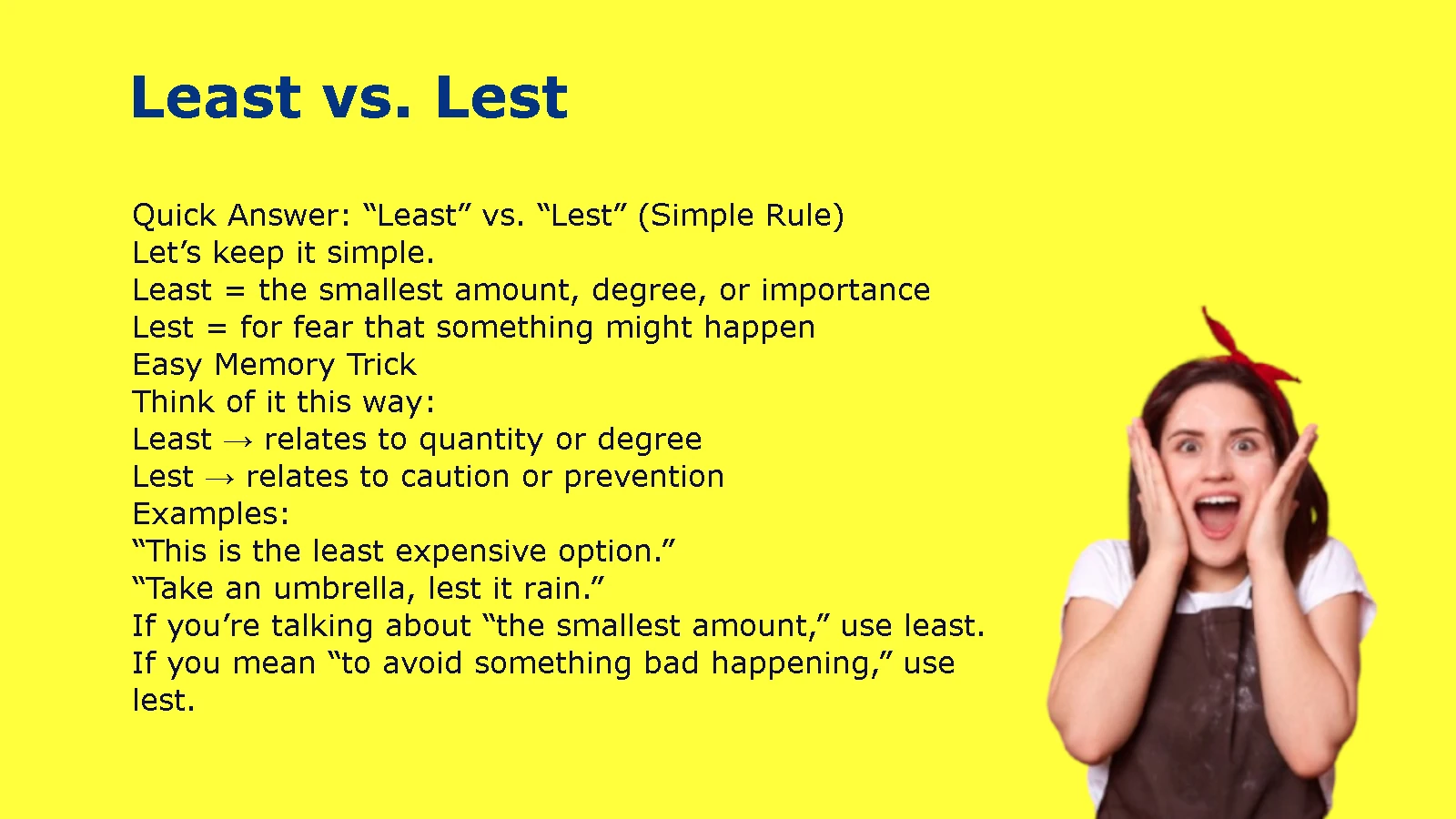
Quick Answer: “Least” vs. “Lest” (Simple Rule)
Let’s keep it simple.
Least = the smallest amount, degree, or importance
Lest = for fear that something might happen
Easy Memory Trick
Think of it this way:
- Least → relates to quantity or degree
- Lest → relates to caution or prevention
Examples:
- “This is the least expensive option.”
- “Take an umbrella, lest it rain.”
If you’re talking about “the smallest amount,” use least.
If you mean “to avoid something bad happening,” use lest.
How People Actually Use “Least” and “Lest”
This is where confusion begins.
Most English speakers use least regularly in everyday conversation.
However, lest is much less common and often appears in formal writing, literature, speeches, or traditional expressions.
In Everyday Conversation
You’ll hear:
- “I like this the least.”
- “That’s the least of my worries.”
You’ll rarely hear:
- “Lest we forget.”
- “Take care lest you fall.”
In Writing
Writers often encounter lest in books, articles, and historical texts.
Because it sounds formal, many people misunderstand its meaning or avoid using it altogether.
Why This Happens
- The words look similar
- They sound somewhat alike
- One is common while the other is relatively rare
- They serve completely different grammatical functions
The Core Difference Between “Least” and “Lest”
The easiest way to understand the distinction is to focus on meaning.
| Word | Meaning | Function |
| Least | Smallest amount or degree | Adjective, adverb, noun |
| Lest | To prevent or avoid something | Conjunction |
Key Insight
Least compares things.
Lest introduces a possible negative outcome.
Examples:
- “She has the least experience.”
- “Speak quietly, lest you wake the baby.”
One measures.
The other warns.
“Least” Explained Clearly (With Examples)
At its core, least means the smallest amount, degree, or importance.
Common Uses of “Least”
Comparing Quantities
- “This route requires the least effort.”
- “He spends the least money.”
Expressing Importance
- “That is the least important issue.”
- “My health is the least of my concerns right now.”
Showing Preference
- “Blue is my least favorite color.”
- “I enjoyed that movie the least.”
Key Takeaway
Whenever you’re talking about something being smaller, lower, fewer, or less important than others, use least.
“Lest” Explained Clearly (With Examples)
Now let’s look at lest.
This word means:
“For fear that” or “to prevent something from happening.”
Common Uses of “Lest”
Expressing Caution
- “Drive carefully, lest you cause an accident.”
- “Speak softly, lest you disturb others.”
Avoiding Negative Outcomes
- “Take notes, lest you forget.”
- “Lock the door, lest someone enter.”
Formal Writing
- “The warning was repeated lest anyone misunderstand.”
- “He remained silent lest he reveal too much.”
Key Takeaway
Lest almost always introduces a potential problem that someone wants to avoid.
The Biggest Mistake People Make
The most common mistake is using least when they actually mean lest.
Incorrect
“Take an umbrella, least it rains.”
Correct
“Take an umbrella, lest it rains.”
Another mistake is trying to use lest as a comparison word.
Incorrect
“She has the lest experience.”
Correct
“She has the least experience.”
Lesson
Ask yourself:
Am I comparing amounts?
→ Use least
Am I preventing a possible problem?
→ Use lest
Side-by-Side Comparison Table
Here’s a quick reference you can use anytime.
| Phrase | Correct Word | Why |
| The least expensive option | Least | Comparing cost |
| My least favorite food | Least | Comparing preference |
| Hurry, lest we miss the train | Lest | Preventing a bad outcome |
| Be careful lest you fall | Lest | Warning or caution |
| The least amount of work | Least | Comparing quantity |
| Study hard lest you fail | Lest | Avoiding failure |
Real-Life Examples of “Least”
Let’s see how least appears naturally.
Common Situations
- “This project requires the least effort.”
- “She is the least experienced employee.”
- “That was the least exciting game I’ve ever watched.”
- “We chose the option with the least risk.”
Mini Scenario
You’re choosing a phone plan.
You compare prices and say:
“This package costs the least.”
No confusion here because you’re comparing options.
Real-Life Examples of “Lest”
Now compare that with lest.
Common Situations
- “Bring your ID, lest they deny entry.”
- “Save your work often, lest the computer crash.”
- “Leave early, lest traffic delay you.”
- “Wear a jacket, lest you get cold.”
Mini Scenario
A teacher tells students:
“Study tonight, lest you struggle during the exam.”
The teacher isn’t comparing anything.
They’re warning about a possible consequence.
Why “Lest” Sounds More Formal
One reason people avoid lest is that it sounds old-fashioned.
Modern Alternatives
Instead of:
“Take notes, lest you forget.”
Many people say:
- “Take notes so you don’t forget.”
- “Take notes in case you forget.”
- “Take notes to avoid forgetting.”
Is “Lest” Wrong?
Not at all.
It’s perfectly correct English.
It’s simply more formal than many modern alternatives.
Common Expressions Using “Lest”
Some phrases keep lest alive in modern English.
Popular Examples
- “Lest we forget”
- “Lest anyone think otherwise”
- “Lest there be confusion”
- “Lest you wonder”
These expressions are especially common in speeches, writing, and public statements.
Key Tip
If you encounter lest in literature or formal documents, remember that it usually signals caution or prevention.
How to Avoid Confusion Every Time
Want a foolproof strategy?
Use This Checklist
If the sentence involves comparison:
Use least
Examples:
- least expensive
- least important
- least likely
If the sentence involves prevention:
Use lest
Examples:
- lest we forget
- lest it happen again
- lest they arrive early
Why This Works
The meanings never overlap.
Once you identify the purpose of the sentence, the correct choice becomes obvious.
What to Say Instead
If you’re unsure about lest, use a clearer modern alternative.
Alternatives to “Lest”
Instead of:
“Leave now, lest you miss the bus.”
Try:
- “Leave now so you don’t miss the bus.”
- “Leave now to avoid missing the bus.”
- “Leave now in case traffic slows you down.”
Alternatives to “Least”
There are fewer substitutes, but you can sometimes say:
- smallest
- lowest
- fewest
depending on the context.
Quick Decision Guide (Use This Instantly)
When you’re unsure, follow this simple rule:
Smallest amount or degree?
→ Least
Avoiding a possible problem?
→ Lest
Still unsure?
Try replacing lest with “so that something bad doesn’t happen.”
If the sentence still makes sense, lest is probably correct.
FAQ: “Least” vs. “Lest”
Is “lest” an old-fashioned word?
Not exactly. It’s still correct and widely understood, but it appears more often in formal writing than casual conversation.
Can “least” and “lest” ever mean the same thing?
No. Their meanings are completely different.
Which word is more common?
Least is far more common in everyday English.
Is “lest” grammatically correct today?
Yes. It remains a standard English word and is commonly used in formal contexts.
How can I remember the difference?
Think:
- Least = lowest amount
- Lest = avoid trouble
Case Study: A Writing Mistake That Changed the Meaning
A student wrote:
“Bring your notes, least you forget the lesson.”
The teacher immediately noticed the problem.
What Happened
The student meant:
“Bring your notes, lest you forget the lesson.”
Why It Was Wrong
Least refers to quantity.
The sentence required a warning about forgetting.
Correct Version
“Bring your notes, lest you forget the lesson.”
One missing letter completely changed the meaning.
Key Facts You Should Remember
- Least means the smallest amount or degree
- Lest means for fear that or to avoid something
- Least is extremely common in daily speech
- Lest is more formal and less common
- The two words are never interchangeable
- Comparing things requires least
- Preventing problems requires lest
Final Takeaway: The One Rule That Never Fails
Here’s the simplest way to remember “least” vs. “lest.”
If you’re comparing amounts, importance, preference, or degree, use least.
If you’re warning about a possible negative outcome or trying to prevent something from happening, use lest.
Think of it this way:
Least measures. Lest warns.
That single distinction solves almost every situation you’ll encounter.
So the next time you’re writing and hesitate between these two similar-looking words, remember:
Smallest amount → Least
Avoiding trouble → Lest
Simple. Clear. No confusion.