
Have you ever wondered what Maundy Thursday really means and why it holds such an important place in the Christian calendar? Many people recognize the name during Holy Week, yet they are often unsure of its origin, significance, or the events it commemorates. Understanding the Maundy Thursday meaning provides valuable insight into one of the most meaningful days leading up to Easter Sunday and helps deepen your appreciation of Christian traditions, Biblical history, and the message of humility and service.
In simple terms, Maundy Thursday is the Thursday before Easter that commemorates the Last Supper of Jesus Christ with His disciples. During this sacred meal, Jesus instituted Holy Communion (also known as the Eucharist) and demonstrated the importance of humility by washing His disciples’ feet. The word “Maundy” comes from the Latin word mandatum, meaning “commandment,” referring to Jesus’ instruction to His followers to love one another as He had loved them.
Because of its rich spiritual significance, many people search for topics such as Maundy Thursday meaning, what happened on Maundy Thursday, why is it called Maundy Thursday, Maundy Thursday traditions, and Maundy Thursday Bible verses. Learning about this day also helps clarify its connection to Good Friday, Holy Week, the Passion of Christ, and the celebration of Easter.
In this guide, you’ll discover the complete Maundy Thursday meaning, its Biblical background, historical origin, symbolism, traditions observed around the world, and practical examples that explain why this sacred day continues to be remembered by millions of Christians each year.
Maundy Thursday Meaning
What Is Maundy Thursday?
Maundy Thursday is the Thursday before Good Friday and three days before Easter Sunday. It falls during Holy Week, the final week of Lent, and commemorates several defining moments in the life of Jesus Christ before His crucifixion.
For Christians, Maundy Thursday is much more than a historical remembrance. It celebrates the beginning of the Easter Triduum, the three sacred days that include:
- Maundy Thursday
- Good Friday
- Holy Saturday, leading into Easter Sunday
These days tell the story of Jesus’ final hours, His death on the cross, and His resurrection.
Why Christians Observe Maundy Thursday
Christians remember Maundy Thursday because several foundational events happened on this day.
These include:
- The Last Supper with the Twelve Apostles
- The first celebration of Holy Communion (Eucharist)
- Jesus washing His disciples’ feet
- The new commandment to love one another
- Jesus praying in the Garden of Gethsemane
- The betrayal of Jesus by Judas Iscariot
Together, these events reveal Jesus’ humility, love, obedience, and willingness to sacrifice Himself for humanity.
“A new command I give you: Love one another. As I have loved you, so you must love one another.”
— John 13:34 (NIV)
Where Does Maundy Thursday Fit in Holy Week?
The days of Holy Week follow the final journey of Jesus before His resurrection.
| Day | Main Event |
| Palm Sunday | Jesus enters Jerusalem |
| Holy Monday | Cleansing of the Temple |
| Holy Tuesday | Jesus teaches in Jerusalem |
| Holy Wednesday | Judas agrees to betray Jesus |
| Maundy Thursday | Last Supper and Foot Washing |
| Good Friday | Crucifixion of Jesus |
| Holy Saturday | Jesus rests in the tomb |
| Easter Sunday | Resurrection of Jesus |
Each day builds upon the previous one. Maundy Thursday serves as the bridge between Jesus’ public ministry and His Passion.
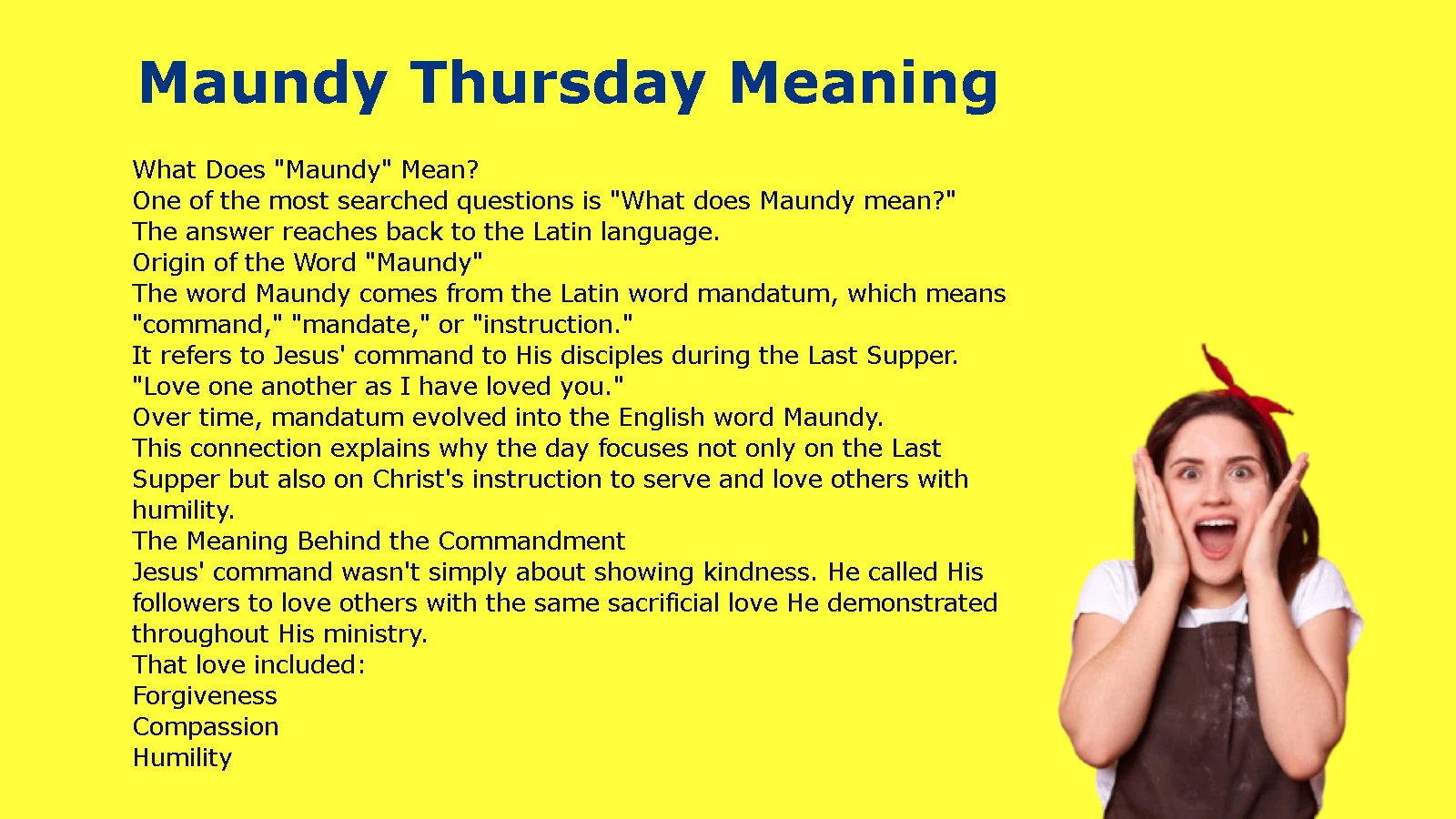
What Does “Maundy” Mean?
One of the most searched questions is “What does Maundy mean?”
The answer reaches back to the Latin language.
Origin of the Word “Maundy”
The word Maundy comes from the Latin word mandatum, which means “command,” “mandate,” or “instruction.”
It refers to Jesus’ command to His disciples during the Last Supper.
“Love one another as I have loved you.”
Over time, mandatum evolved into the English word Maundy.
This connection explains why the day focuses not only on the Last Supper but also on Christ’s instruction to serve and love others with humility.
The Meaning Behind the Commandment
Jesus’ command wasn’t simply about showing kindness. He called His followers to love others with the same sacrificial love He demonstrated throughout His ministry.
That love included:
- Forgiveness
- Compassion
- Humility
- Selfless service
- Putting others before yourself
These values remain central to Christian teaching today.
Why Is It Called Maundy Thursday?
The name Maundy Thursday highlights Jesus’ new commandment rather than the meal itself.
Although many people associate the day primarily with the Last Supper, early Christian traditions also emphasized Jesus washing His disciples’ feet.
The foot washing illustrated what His command looked like in action.
Instead of seeking honor, Jesus chose the role of a servant.
Instead of demanding respect, He showed humility.
That example became one of Christianity’s strongest lessons about leadership.
Today, many churches continue the tradition by holding foot-washing ceremonies during Maundy Thursday services.
When Is Maundy Thursday?
Unlike fixed holidays such as Christmas, Maundy Thursday changes each year because its date depends on Easter Sunday.
It always falls:
- On a Thursday
- During Holy Week
- Three days before Easter Sunday
- One day before Good Friday
How the Date Is Determined
The Christian calendar calculates Easter as the first Sunday after the first full moon following the spring equinox.
Because Easter changes each year, Maundy Thursday changes as well.
Upcoming Maundy Thursday Dates
| Year | Date |
| 2026 | April 2 |
| 2027 | March 25 |
| 2028 | April 13 |
| 2029 | March 29 |
| 2030 | April 18 |
This movable date has been part of Christian tradition for centuries.
What Happened on Maundy Thursday?
Several of the most important events in the New Testament happened on Maundy Thursday. Together, they form the beginning of Jesus’ Passion—the final chapter of His earthly ministry before the crucifixion.
Each event carries deep spiritual meaning and continues to shape Christian worship today.
The Last Supper
The Last Supper stands at the heart of Maundy Thursday.
Jesus gathered with His twelve disciples in Jerusalem to celebrate the Jewish Passover meal.
During this meal, He prepared His followers for what would happen next.
Instead of focusing only on the Passover tradition, Jesus gave the meal new meaning.
He took bread and said:
“This is my body given for you; do this in remembrance of me.”
He then took the cup of wine and declared:
“This cup is the new covenant in my blood.”
These words established what Christians now celebrate as Holy Communion, also called the Eucharist or the Lord’s Supper.
Why the Last Supper Matters
The Last Supper represents several key beliefs.
It symbolizes:
- Christ’s sacrifice
- God’s new covenant with humanity
- Forgiveness through Jesus
- Unity among believers
- Hope through the resurrection
Millions of Christians around the world continue to celebrate Communion because of what happened that evening.
Key Events During the Last Supper
| Event | Meaning |
| Jesus breaks bread | His body given for humanity |
| Jesus shares the cup | His blood establishes the new covenant |
| Institution of Communion | Foundation of Christian worship |
| Prediction of betrayal | Jesus knows what lies ahead |
| New commandment | Love one another |
Jesus Washed His Disciples’ Feet
One of the most remarkable moments on Maundy Thursday appears in John 13.
Before the meal ended, Jesus performed a task usually reserved for household servants.
He washed His disciples’ feet.
In the ancient Middle East, people traveled dusty roads while wearing sandals. Washing someone’s feet offered comfort and hospitality.
Yet Jesus, their teacher and master, chose to perform this humble act Himself.
Peter initially resisted.
He couldn’t understand why Jesus would lower Himself in this way.
Jesus explained that His followers should serve others just as He had served them.
What Foot Washing Symbolizes
The act teaches several timeless lessons.
It represents:
- Humility
- Equality
- Compassion
- Servant leadership
- Love expressed through action
Many churches still include a foot-washing ceremony during Maundy Thursday services to remember this example.
Lessons Modern Readers Can Learn
The foot washing remains surprisingly relevant today.
Whether someone leads a family, a business, a church, or a community, the lesson stays the same.
True leadership begins with service.
Rather than asking, “How can others serve me?” Jesus challenges people to ask, “How can I serve others?”
That shift in perspective has inspired countless charitable organizations, missionaries, hospitals, schools, and volunteer ministries throughout history.
The New Commandment
Perhaps the defining moment behind the Maundy Thursday meaning comes from Jesus’ words to His disciples.
He gave them a new command:
“Love one another. As I have loved you, so you must love one another.”
John 13:34
At first glance, the instruction may seem simple.
Yet Jesus raised the standard.
He didn’t tell His followers merely to love their neighbors.
He told them to love as He loved—with patience, forgiveness, humility, sacrifice, and grace.
This became one of the defining characteristics of Christian discipleship.
Why This Command Was Different
Earlier Jewish law already taught people to love their neighbors.
Jesus expanded that teaching by making His own life the example.
His love included:
- Loving enemies
- Forgiving those who caused harm
- Serving without expecting recognition
- Remaining faithful during suffering
- Putting others before personal comfort
That message continues to shape Christian ethics across cultures and generations.
Prayer in the Garden of Gethsemane
After the Last Supper, Jesus and His disciples left Jerusalem and crossed the Kidron Valley to the Garden of Gethsemane, located on the Mount of Olives. This quiet garden became the setting for one of the most moving moments in the New Testament.
Knowing that His arrest and crucifixion were only hours away, Jesus prayed with deep sorrow while His disciples struggled to stay awake.
“Father, if you are willing, take this cup from me; yet not my will, but yours be done.”
— Luke 22:42 (NIV)
This prayer reveals both Jesus’ humanity and His complete obedience to God’s plan. Christians often reflect on this passage because it demonstrates courage, faith, and surrender in the face of suffering.
Lessons From Gethsemane
The events in Gethsemane continue to inspire believers today.
They remind Christians to:
- Trust God during difficult seasons.
- Pray honestly in times of fear.
- Remain faithful even when the future feels uncertain.
- Place God’s will above personal desires.
- Find strength through prayer.
The Garden of Gethsemane also marks the transition from Jesus’ ministry to His Passion, leading directly to His arrest and trial.
Judas Betrays Jesus
One of the saddest events of Maundy Thursday is the betrayal of Jesus by Judas Iscariot, one of His twelve disciples.
Earlier that week, Judas agreed to hand Jesus over to the religious authorities in exchange for thirty pieces of silver. Later that night, he led a group of soldiers to Gethsemane.
To identify Jesus, Judas greeted Him with a kiss.
This act fulfilled earlier prophecies and began the chain of events that led to the crucifixion on Good Friday.
Although the betrayal carries deep sadness, Christians also see it as part of God’s plan of salvation through Jesus Christ.
Timeline of Maundy Thursday Events
| Time | Event | Biblical References |
| Evening | Jesus celebrates the Last Supper | Matthew 26, Mark 14, Luke 22 |
| During the meal | Jesus institutes Holy Communion | Matthew 26:26–29 |
| During the meal | Jesus washes the disciples’ feet | John 13:1–17 |
| After supper | Jesus gives the New Commandment | John 13:34–35 |
| Late evening | Jesus and disciples go to Gethsemane | Matthew 26:36 |
| Night | Jesus prays in the garden | Luke 22:39–46 |
| Night | Judas betrays Jesus | John 18:1–12 |
| Late night | Jesus is arrested | Matthew 26:47–56 |
Why Is Maundy Thursday Important?
The Maundy Thursday meaning extends far beyond remembering historical events. It represents the heart of the Christian message: love, humility, sacrifice, and service.
Without Maundy Thursday, the story of Easter would be incomplete.
The day marks the beginning of the Easter Triduum, the most sacred period in the Christian year. It prepares believers for the sorrow of Good Friday and the joy of Easter Sunday.
Maundy Thursday Matters Because It:
- Introduces Holy Communion.
- Demonstrates servant leadership.
- Reveals Christ’s unconditional love.
- Shows complete obedience to God’s will.
- Begins the events leading to the resurrection.
- Calls believers to love others through action.
These themes remain central to Christian worship across denominations.
The Last Supper Established Holy Communion
One of Maundy Thursday’s greatest contributions to Christianity is the institution of the Eucharist, also known as Holy Communion or the Lord’s Supper.
During Communion, Christians remember Jesus’ sacrifice through bread and wine (or grape juice in some churches).
Different Christian traditions understand Communion differently. However, nearly all agree that it serves as a powerful reminder of Christ’s death and resurrection.
Common Names for Communion
| Term | Commonly Used By |
| Eucharist | Catholic, Orthodox, Anglican |
| Holy Communion | Most Christian denominations |
| Lord’s Supper | Many Protestant churches |
| Blessed Sacrament | Roman Catholic Church |
Regardless of the name, the practice traces directly back to Maundy Thursday.
Jesus Redefined Leadership
In many cultures, leaders expect others to serve them.
Jesus reversed that idea.
By washing His disciples’ feet, He demonstrated that true greatness comes through serving others.
His example continues to influence:
- Churches
- Charitable organizations
- Hospitals
- Schools
- Community outreach programs
- Humanitarian missions
Many Christian leaders intentionally perform acts of service because they see servant leadership as one of Christ’s greatest teachings.
A Lesson in Humility
Humility sits at the center of Maundy Thursday.
Jesus possessed authority, yet He chose service.
He deserved honor, yet He knelt before His followers.
This contrast makes the foot washing one of the Bible’s strongest illustrations of humility.
Modern readers can apply this lesson in everyday life by:
- Listening before speaking.
- Helping without expecting praise.
- Treating everyone with dignity.
- Forgiving others quickly.
- Leading through actions instead of titles.
Maundy Thursday in the Bible
The events of Maundy Thursday appear across all four Gospels, although each writer emphasizes different details.
Key Bible Passages
| Event | Bible References | Significance |
| The Last Supper | Matthew 26:17–30 | Institution of Communion |
| Mark 14:12–26 | Passover meal | |
| Luke 22:7–38 | New covenant | |
| Washing the Feet | John 13:1–17 | Humility and service |
| New Commandment | John 13:34–35 | Love one another |
| Prayer in Gethsemane | Matthew 26:36–46 | Obedience and prayer |
| Betrayal of Jesus | John 18:1–12 | Beginning of the Passion |
Together, these passages provide a complete picture of the events Christians remember on Maundy Thursday.
Bible Verses That Capture the Meaning of Maundy Thursday
Several verses summarize the day’s spiritual message.
John 13:14–15
“Now that I, your Lord and Teacher, have washed your feet, you also should wash one another’s feet.”
Meaning: Leadership begins with humble service.
John 13:34
“Love one another. As I have loved you, so you must love one another.”
Meaning: Love should define every follower of Christ.
Luke 22:19
“Do this in remembrance of me.”
Meaning: Communion keeps Christ’s sacrifice at the center of Christian worship.
Matthew 26:39
“Yet not as I will, but as you will.”
Meaning: Trusting God often requires surrender.
How Christians Observe Maundy Thursday
Although traditions vary around the world, most Christian churches observe Maundy Thursday through worship, Scripture, prayer, and Communion.
The atmosphere is usually quiet and reflective because the celebration leads directly into the solemn remembrance of Good Friday.
Evening Worship Services
Many churches hold special evening services because the Last Supper took place after sunset.
These services often include:
- Bible readings from the Gospels.
- Hymns centered on the cross.
- Sermons about humility and service.
- Holy Communion.
- Silent prayer.
Some congregations dim the sanctuary lights near the end of the service to symbolize the approaching suffering of Christ.
Holy Communion
Communion remains the central focus of Maundy Thursday worship.
During the service, believers remember Christ’s sacrifice by sharing bread and wine or grape juice.
Although theological interpretations differ among Christian traditions, Communion always points back to the events of the Last Supper.
Foot-Washing Ceremonies
Many churches practice ceremonial foot washing in remembrance of John 13.
Participants wash one another’s feet as a visible expression of:
- Humility
- Equality
- Forgiveness
- Christian love
- Service
While not every denomination includes this practice, it remains especially common among:
- Roman Catholics
- Mennonites
- Seventh-day Adventists
- Some Baptist churches
- Anglican churches
- Eastern Orthodox communities
- Pentecostal congregations in certain regions
Prayer and Reflection
Maundy Thursday encourages believers to slow down before the events of Good Friday.
Many Christians spend extra time:
- Reading Scripture.
- Reflecting on Jesus’ final teachings.
- Confessing sins.
- Praying for others.
- Expressing gratitude.
Some churches also hold extended prayer vigils that continue late into the evening, recalling Jesus asking His disciples to remain awake and pray in Gethsemane.
Maundy Thursday Traditions Around the World
Although the central message stays the same, different countries express Maundy Thursday through unique customs shaped by history and culture.
United States
Many churches hold evening Communion services followed by Scripture readings about the Passion of Christ.
Some congregations include:
- Foot washing
- Choir performances
- Candlelight worship
- Silent reflection
The service often ends quietly without a formal dismissal, symbolizing the unfinished story that continues on Good Friday.
United Kingdom
Churches across England, Scotland, Wales, and Northern Ireland observe Maundy Thursday with Communion services.
One of the country’s best-known traditions is the Royal Maundy Service, where the British monarch distributes specially minted Maundy Money to selected recipients in recognition of Christian service and community contributions.
Spain
In Spain, Semana Santa (Holy Week) includes elaborate religious processions.
While Good Friday draws the largest crowds, Maundy Thursday features:
- Candlelit ceremonies
- Historic church services
- Public processions
- Traditional music
- Prayer gatherings
Many cities preserve customs that date back several centuries.
Philippines
The Philippines observes Maundy Thursday as part of Semana Santa, one of the country’s most important religious seasons.
Families commonly:
- Attend church.
- Participate in processions.
- Visit several churches in one evening, a tradition known as Visita Iglesia.
- Spend time in prayer and reflection.
The day is also recognized as a public holiday, allowing many people to take part in religious observances.
Latin America
Across countries such as Mexico, Guatemala, Colombia, and Peru, Maundy Thursday blends worship with local customs.
Common traditions include:
- Community processions
- Passion plays
- Evening Mass
- Family gatherings
- Public prayers
Many towns decorate churches and streets with flowers, candles, and religious artwork.
Eastern Orthodox Traditions
Eastern Orthodox churches also commemorate the Last Supper, although they often follow a different liturgical calendar because many use the Revised Julian or Julian calendar for calculating Easter.
Special services emphasize:
- The Mystical Supper
- Christ’s humility
- Preparation for the Passion
- Holy Communion
While the calendar date may differ from Western churches, the spiritual focus remains remarkably similar.
Royal Maundy Service
One of the most distinctive Maundy Thursday traditions takes place in the United Kingdom through the Royal Maundy Service. This centuries-old ceremony reflects the biblical theme of humble service and generosity.
During the service, the British monarch presents specially minted Maundy Money to people of all genders who have demonstrated exceptional Christian service or made significant contributions to their local communities.
Although the ceremony has changed over time, its purpose remains the same: honoring lives marked by faith, compassion, and service to others.
The History of Royal Maundy
The tradition dates back to the Middle Ages.
In earlier centuries, English monarchs often washed the feet of people experiencing poverty, following Jesus’ example from John 13. They also distributed food, clothing, and money.
By the 18th century, the foot-washing practice had ended, but the custom of giving specially minted coins continued.
Today, the monarch distributes Maundy Money during a church service held in a different cathedral or abbey each year.
What Is Maundy Money?
Maundy Money consists of specially minted silver coins that are not intended for everyday circulation.
Recipients receive:
- A white purse containing silver Maundy coins.
- A red purse containing commemorative coins.
The number of recipients usually matches the monarch’s age. For example, if the monarch is 78 years old, 78 men and 78 women receive Maundy Money that year.
The tradition reflects Christ’s teaching that true greatness comes through serving others.
Maundy Thursday Symbols and Their Meanings
Symbols help Christians remember the events and spiritual lessons of Maundy Thursday.
| Symbol | Meaning |
| Bread | Represents the body of Christ given for humanity. |
| Wine | Symbolizes Christ’s blood and the new covenant. |
| Basin and Towel | Remind believers of humility and servant leadership. |
| Cross | Points to Jesus’ coming sacrifice on Good Friday. |
| Olive Trees | Represent the Garden of Gethsemane and Jesus’ prayer. |
| Candles | Symbolize Christ as the Light of the World and the solemnity of Holy Week. |
These symbols appear in churches, artwork, and Christian education throughout Holy Week.
Is Maundy Thursday a Public Holiday?
Whether Maundy Thursday is a public holiday depends on the country.
Some nations officially recognize it, while others observe it primarily through church services without closing businesses or schools.
Countries Where Maundy Thursday Is Commonly a Public Holiday
| Country | Public Holiday |
| Philippines | Yes |
| Colombia | Yes |
| Peru | Yes |
| Paraguay | Yes |
| El Salvador | Yes |
| Costa Rica | Yes |
| Denmark | Yes |
| Norway | Yes |
| Iceland | Yes |
In these countries, many government offices, banks, and schools close so people can participate in religious observances or spend time with family.
Countries Where It Is Primarily a Religious Observance
In several countries, Maundy Thursday is widely observed in churches but is not a nationwide public holiday.
Examples include:
- United States
- United Kingdom
- Canada
- Australia
- New Zealand
Although businesses typically remain open, many churches hold special evening services.
Maundy Thursday vs. Good Friday
People sometimes confuse these two important days of Holy Week.
While they are closely connected, each commemorates different events.
| Maundy Thursday | Good Friday |
| Commemorates the Last Supper | Commemorates the crucifixion of Jesus |
| Jesus washes the disciples’ feet | Jesus dies on the cross |
| Institution of Holy Communion | Reflection on Christ’s sacrifice |
| Focus on service and love | Focus on redemption and atonement |
| Beginning of the Easter Triduum | Second day of the Easter Triduum |
Together, these days tell the story of Christ’s final hours before His resurrection.
Key Differences at a Glance
Maundy Thursday Focuses On
- The Last Supper
- Holy Communion
- Humble service
- The New Commandment
- Prayer in Gethsemane
Good Friday Focuses On
- Jesus’ trial
- Crucifixion
- Death on the cross
- Forgiveness of sins
- Redemption
Both observances prepare Christians for the celebration of Easter Sunday.
Maundy Thursday vs. Holy Thursday
Another common question is whether Maundy Thursday and Holy Thursday are different holidays.
The answer is no.
They refer to the same day.
The difference lies only in the name used by different Christian traditions.
| Name | Commonly Used By |
| Maundy Thursday | Anglican, Lutheran, Methodist, many Protestant churches |
| Holy Thursday | Roman Catholic Church and many liturgical traditions |
Regardless of the name, both commemorate:
- The Last Supper
- Jesus washing the disciples’ feet
- The institution of the Eucharist
- Christ’s command to love one another
Common Misunderstandings About Maundy Thursday
Several myths continue to circulate about Maundy Thursday.
Let’s clear up the most common ones.
Maundy Means “Mourning”
False.
The word comes from the Latin mandatum, meaning “command” or “mandate.”
It refers to Jesus’ command to love one another.
Maundy Thursday Is the Day Jesus Was Crucified
False.
Jesus was crucified on Good Friday.
Maundy Thursday remembers the events that took place the evening before the crucifixion.
The Last Supper Is the Only Event Remembered
False.
Christians also remember:
- The washing of the disciples’ feet.
- The institution of Holy Communion.
- Jesus’ prayer in Gethsemane.
- Judas’ betrayal.
- The New Commandment.
Each event contributes to the meaning of the day.
Every Christian Church Observes Maundy Thursday the Same Way
False.
While nearly all major Christian traditions recognize the significance of the day, practices vary.
Some churches include:
- Foot washing.
- Holy Communion.
- Prayer vigils.
- Processions.
- Scripture readings.
Others hold simpler worship services focused on reflection and prayer.
Frequently Asked Questions About Maundy Thursday Meaning
What does Maundy Thursday mean in simple words?
Maundy Thursday is the Thursday before Good Friday. It remembers the Last Supper, Jesus washing His disciples’ feet, and His command to love one another. It also marks the beginning of the Easter Triduum.
Why is it called Maundy Thursday?
The name comes from the Latin word mandatum, meaning “command.” It refers to Jesus’ new commandment in John 13:34:
“Love one another. As I have loved you.”
What happened on Maundy Thursday?
According to the Gospels, several important events occurred:
- Jesus celebrated the Last Supper.
- He instituted Holy Communion.
- He washed the disciples’ feet.
- He gave the New Commandment.
- He prayed in the Garden of Gethsemane.
- Judas betrayed Him.
- Jesus was arrested.
Why did Jesus wash His disciples’ feet?
Jesus washed their feet to demonstrate humility, servant leadership, and unconditional love.
He wanted His followers to serve one another instead of seeking status or power.
Why is Holy Communion connected to Maundy Thursday?
During the Last Supper, Jesus shared bread and wine with His disciples and instructed them to continue this practice in remembrance of Him.
That event became the foundation for Christian Communion services around the world.
Is Maundy Thursday the same as Holy Thursday?
Yes.
Both names refer to the same day. Different Christian traditions simply use different terms.
Is Maundy Thursday a holy day of obligation?
For Roman Catholics, Maundy Thursday (Holy Thursday) is highly significant because it begins the Sacred Triduum. However, it is not classified as a universal holy day of obligation. Catholics are strongly encouraged to attend the Evening Mass of the Lord’s Supper, but attendance is not universally required under canon law.
Why does the date change every year?
Maundy Thursday depends on the date of Easter Sunday.
Since Easter is calculated using the ecclesiastical lunar calendar, Maundy Thursday also changes each year.
How do Christians celebrate Maundy Thursday today?
Many Christians observe the day by:
- Attending church services.
- Receiving Holy Communion.
- Participating in foot-washing ceremonies.
- Reading Bible passages about the Last Supper.
- Spending time in prayer and reflection.
- Preparing spiritually for Good Friday and Easter Sunday.
Key Facts About Maundy Thursday
| Fact | Details |
| Meaning of “Maundy” | Derived from the Latin mandatum, meaning “command.” |
| Observed During | Holy Week |
| Occurs | Thursday before Good Friday |
| Main Biblical Events | Last Supper, Foot Washing, Gethsemane, Betrayal of Jesus |
| Main Theme | Love, humility, service, and obedience |
| Primary Bible Passage | John 13 |
| Beginning of | Easter Triduum |
Case Study: How One Act of Humility Became a Lasting Christian Tradition
The foot washing described in John 13 has shaped Christian worship for nearly two thousand years.
Each Maundy Thursday, churches across the world reenact this moment. In some congregations, pastors wash the feet of church members. In others, members wash one another’s feet as a sign of equality and mutual service.
The tradition is especially meaningful because it reverses normal expectations of leadership. Instead of receiving honor, the leader serves others first.
This practice has also inspired countless Christian hospitals, charities, disaster relief organizations, and community outreach ministries. Many of these groups view compassionate service as a practical expression of Jesus’ command to “love one another.”
The lesson remains just as relevant today as it was in the first century: genuine leadership begins with humility.
Conclusion
The Maundy Thursday meaning reaches far beyond a single event in the Bible. It brings together the Last Supper, the institution of Holy Communion, Jesus washing His disciples’ feet, His prayer in the Garden of Gethsemane, and His new commandment to love one another.
These moments reveal the heart of the Christian faith. They show a Savior who chose humility over status, service over power, and sacrificial love over self-interest. They also prepare believers for the sorrow of Good Friday and the hope of Easter Sunday, completing the story of Christ’s death and resurrection.
Whether your interest is historical, biblical, or spiritual, Maundy Thursday offers a timeless reminder that love is demonstrated through action, leadership begins with service, and faith often grows strongest through humility. Those enduring lessons continue to shape Christian worship and inspire millions of people around the world every Holy Week.