Have you ever wondered whether Genuinity vs Sincerity describe the same quality or express two different ideas in the English language? Although these words are closely related and often appear in similar situations, they are not interchangeable. Many English learners, writers, and even native speakers confuse genuinity and sincerity because both are associated with honesty, authenticity, and truthful behavior. However, understanding the subtle distinction between these terms can improve your vocabulary, grammar accuracy, communication skills, and overall English fluency.
In simple terms, genuinity refers to the quality of being genuine, authentic, or real, while sincerity describes the quality of being honest, heartfelt, and free from pretense. A person may show genuinity by being true to their identity and values, whereas sincerity is demonstrated through honest words, emotions, and intentions. Although the two concepts often overlap, they emphasize different aspects of character, communication, and personal integrity.
This confusion frequently appears in searches such as genuinity meaning, sincerity meaning, difference between genuinity and sincerity, genuinity vs sincerity, and commonly confused English words. It also relates to broader topics like English vocabulary, grammar usage, word choice, writing clarity, and professional communication. Learning when to use each word correctly helps you express ideas more precisely and avoid common vocabulary mistakes.
If you’ve ever paused while writing a sentence like “Her genuinity impressed everyone” or “His sincerity earned their trust,” you’re not alone. These words may seem similar, but choosing the right one can make your writing and speech more accurate and natural.
In this guide, you’ll learn the difference between genuinity and sincerity, their definitions, real-life examples, grammar tips, key differences, and easy memory tricks so you can confidently use both words in everyday writing and conversation.
Genuinity vs. Sincerity at a Glance
Before exploring each word in detail, here’s a quick comparison.
| Feature | Genuinity | Sincerity |
| Meaning | The quality of being genuine or authentic | The quality of being honest in thoughts, feelings, or intentions |
| Focus | Authenticity | Honest emotion |
| Describes | A person, object, experience, or identity | A person’s feelings, words, or actions |
| Common Contexts | Authentic products, personalities, relationships | Apologies, gratitude, promises, compliments |
| Part of Speech | Noun | Noun |
| Related Adjective | Genuine | Sincere |
| Can Describe Objects? | Yes | Rarely |
| Emotional Emphasis | Low to moderate | High |
Quick takeaway
- Genuinity = Being authentic.
- Sincerity = Being honest about your feelings.
Although they often overlap, they are not interchangeable in every situation.
What Does Genuinity Mean?
Definition of Genuinity
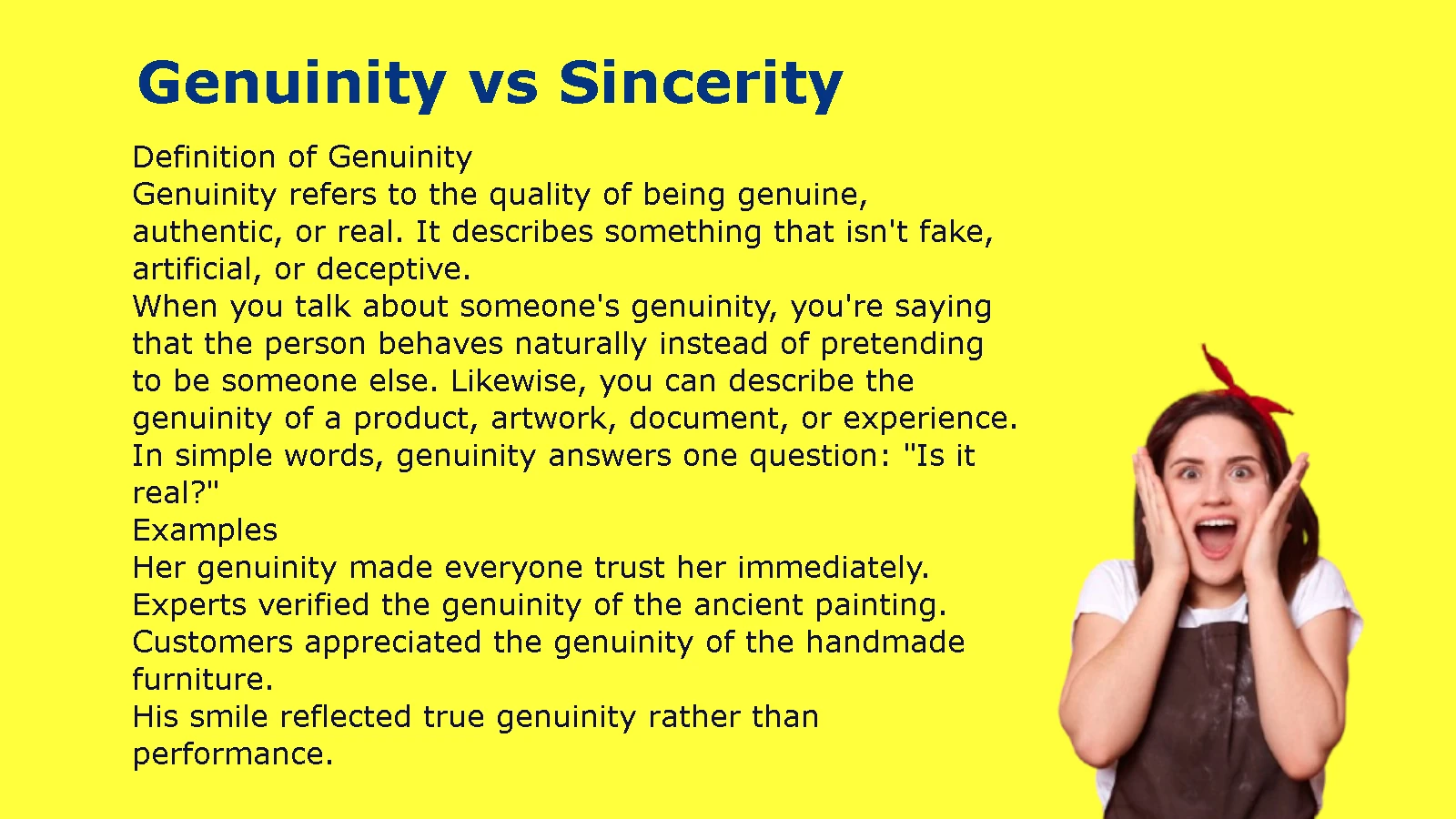
Genuinity refers to the quality of being genuine, authentic, or real. It describes something that isn’t fake, artificial, or deceptive.
When you talk about someone’s genuinity, you’re saying that the person behaves naturally instead of pretending to be someone else. Likewise, you can describe the genuinity of a product, artwork, document, or experience.
In simple words, genuinity answers one question: “Is it real?”
Examples
- Her genuinity made everyone trust her immediately.
- Experts verified the genuinity of the ancient painting.
- Customers appreciated the genuinity of the handmade furniture.
- His smile reflected true genuinity rather than performance.
Origin of the Word
The word genuinity comes from the adjective genuine, which traces its roots to the Latin word genuinus, meaning “natural,” “authentic,” or “native.”
Although genuinity is a legitimate English noun, many writers prefer genuineness, which has become much more common in modern English.
That doesn’t make genuinity incorrect. It simply means you’ll encounter genuineness more often in books, newspapers, and professional writing.
What Genuinity Really Describes
Genuinity focuses on authenticity rather than emotion.
It often refers to whether something truly represents its original nature.
For example, you might discuss:
- authentic personalities
- original artwork
- natural behavior
- genuine friendships
- legitimate documents
- handcrafted products
- truthful character
Notice that none of these examples necessarily involve feelings. Instead, they involve authenticity.
Common Situations Where Genuinity Is Used
You’ll often find the word in situations involving trust and authenticity.
Personal Character
People admire genuinity because authentic individuals don’t pretend to impress others.
Example
Everyone appreciated her genuinity because she always spoke honestly without trying to impress anyone.
Authentic Products
Businesses frequently highlight the genuinity of luxury goods, antiques, jewelry, and collectibles.
Examples include:
- designer handbags
- rare coins
- signed memorabilia
- artwork
- gemstones
Relationships
Healthy relationships often depend on genuinity.
Instead of pretending to share interests or hiding your personality, you build stronger connections by being yourself.
Professional Leadership
Employees usually trust leaders who demonstrate genuinity through consistent actions rather than polished speeches.
Authentic leadership builds credibility over time.
What Does Sincerity Mean?
Definition of Sincerity
Sincerity is the quality of being honest, truthful, and heartfelt in your thoughts, feelings, or intentions.
Unlike genuinity, sincerity focuses on emotion rather than authenticity.
It answers the question:
“Does this person truly mean what they’re saying?”
Someone who apologizes sincerely genuinely regrets what happened.
Someone who thanks you sincerely expresses real gratitude.
Origin of the Word
The word sincerity comes from the adjective sincere, which entered English through French and ultimately derives from the Latin word sincerus, meaning clean, pure, or genuine.
Over time, English speakers began using sincere primarily to describe honest emotions and truthful intentions.
What Sincerity Really Means
Sincerity isn’t about whether something is authentic.
Instead, it describes whether someone’s feelings are honest.
Consider these examples.
A politician may deliver a speech with complete sincerity because they genuinely believe every word.
Whether those claims are objectively true is a different question.
Likewise, someone may sincerely apologize even if their actions later prove inconsistent.
Sincerity concerns intention, not necessarily accuracy.
Common Situations Where Sincerity Is Used
Apologies
One of the most common uses.
Example
I appreciated the sincerity of her apology.
Gratitude
People often recognize heartfelt appreciation through sincere words.
Examples:
- sincere thanks
- sincere appreciation
- sincere gratitude
Condolences
Expressions of sympathy rely heavily on sincerity.
People value heartfelt support more than perfectly chosen words.
Promises
Trust grows when promises come from sincere intentions.
Even when circumstances change, sincerity reflects honest commitment.
Compliments
A sincere compliment feels authentic because the speaker genuinely believes what they’re saying.
The Main Difference Between Genuinity and Sincerity
Although these words sometimes overlap, they describe different qualities.
| Genuinity | Sincerity |
| Focuses on authenticity | Focuses on honest feelings |
| Describes whether something is real | Describes whether emotions are genuine |
| Can describe people and objects | Mostly describes people and communication |
| Answers “Is it authentic?” | Answers “Do they truly mean it?” |
Think of it this way.
Imagine a handcrafted wooden table.
You might question its genuinity.
Is it really handcrafted?
Is it made from solid wood?
Now imagine someone apologizing after hurting your feelings.
You wouldn’t question the apology’s genuinity.
Instead, you’d ask whether it showed sincerity.
That’s because apologies involve emotions rather than authenticity.
Identity vs. Emotion
Another helpful way to separate the words is by considering what each one emphasizes.
Genuinity relates to identity.
It reflects who or what something truly is.
Examples include:
- authentic personalities
- original artwork
- genuine friendships
- legitimate products
Sincerity relates to emotion.
It reflects honest feelings and intentions.
Examples include:
- heartfelt apologies
- genuine gratitude
- honest promises
- compassionate condolences
Why People Confuse Them
The confusion happens because authentic people often behave sincerely.
Likewise, sincere people often appear genuine.
Even so, the concepts remain different.
Consider this example.
A salesperson may sound completely sincere while promoting a product because they truly believe it’s excellent.
However, if the product turns out to be counterfeit, it lacks genuinity.
The person’s sincerity doesn’t change the product’s authenticity.
That simple example shows why these words shouldn’t always replace each other.
Genuinity vs. Sincerity Comparison Table
| Category | Genuinity | Sincerity |
| Primary Meaning | Authenticity | Honest intention |
| Describes | Identity, originality | Feelings and communication |
| Common Subjects | People, products, experiences | People, speech, emotions |
| Related Words | Genuine, authentic | Honest, heartfelt |
| Typical Contexts | Identity, craftsmanship, originality | Apologies, thanks, promises |
| Emotional Focus | Low | High |
| Object Usage | Common | Rare |
| Everyday Frequency | Less common | Very common |
| Preferred Alternative | Genuineness | Sincerity |
“Authenticity tells you what something is. Sincerity tells you what someone truly feels.”
When to Use Genuinity
You should use genuinity when you want to emphasize that someone or something is authentic, original, or real. The word highlights authenticity rather than emotion. Although genuineness is more common in modern English, genuinity is still a valid noun and works well in formal and literary writing.
A simple way to remember it is this:
If you’re asking whether something is real or authentic, “genuinity” is usually the better choice.
Use Genuinity When Talking About Personal Character
Some people never pretend to be someone they’re not. They express their thoughts honestly, stay true to their values, and behave consistently regardless of who’s watching. Their genuinity helps build trust because people know what to expect.
Examples
- Everyone admired her genuinity because she never changed her personality to fit in.
- His genuinity made him a respected leader.
- Friends appreciated the genuinity of his kindness.
- The interview revealed her genuinity, not a carefully rehearsed image.
Use Genuinity for Products and Objects
Businesses often talk about the authenticity of expensive or collectible items. In these situations, genuinity refers to whether an item is original rather than fake.
Common examples include:
- Luxury watches
- Designer handbags
- Paintings
- Jewelry
- Rare coins
- Historical documents
- Signed sports memorabilia
Examples
- Experts confirmed the genuinity of the diamond.
- The museum tested the genuinity of the ancient manuscript.
- Buyers should verify the genuinity of collectible items before making a purchase.
Use Genuinity for Relationships
Strong relationships depend on authenticity. When people stop pretending and show their true personalities, trust grows naturally.
Examples
- Their friendship was built on genuinity instead of convenience.
- She valued his genuinity more than his achievements.
- Their conversations reflected complete genuinity.
Use Genuinity in Creative Work
Artists, writers, musicians, and designers often strive to create authentic work that reflects their unique voice.
Examples
- Critics praised the novel’s genuinity.
- The documentary captured the genuinity of everyday life.
- The photographer’s work stood out because of its genuinity.
Examples of Genuinity in Sentences
- Her genuinity inspired everyone around her.
- Customers trusted the brand because of its genuinity.
- The company’s success came from the genuinity of its mission.
- His genuinity was impossible to fake.
- Visitors appreciated the genuinity of the cultural experience.
- Experts questioned the genuinity of the signature.
- The actor’s performance showed remarkable genuinity.
- We admired the genuinity of their friendship.
- The painting’s genuinity increased its value.
- Nothing could replace the genuinity of face-to-face conversations.
When to Use Sincerity
Unlike genuinity, sincerity focuses on honest emotions and truthful intentions. Whenever you want to describe someone’s feelings, promises, gratitude, or apologies, sincerity is almost always the better choice.
Think of sincerity as the emotional side of honesty.
Use Sincerity for Apologies
People don’t judge an apology by how elegant it sounds. They judge it by whether it feels sincere.
Examples
- She accepted his apology because it showed real sincerity.
- His sincerity helped rebuild the relationship.
- The manager apologized with complete sincerity.
Use Sincerity for Gratitude
A heartfelt thank-you carries much more meaning than polite words spoken out of habit.
Examples
- We appreciated her sincerity during the award speech.
- His letter expressed deep sincerity.
- They thanked every volunteer with genuine sincerity.
Use Sincerity for Promises
Promises become meaningful when people truly intend to keep them.
Examples
- She spoke with absolute sincerity.
- His promise reflected genuine sincerity.
- Everyone believed her because of her obvious sincerity.
Use Sincerity in Professional Communication
Business communication often values sincerity because it strengthens trust.
You’ll frequently see phrases such as:
- sincere appreciation
- sincere thanks
- sincere apologies
- sincere congratulations
- sincere condolences
These expressions sound professional while communicating honest emotion.
Examples of Sincerity in Sentences
- I admired the sincerity of her apology.
- His sincerity won everyone’s respect.
- The teacher thanked the students with genuine sincerity.
- Her sincerity comforted the grieving family.
- They appreciated his sincerity during the interview.
- The speech reflected remarkable sincerity.
- She answered every question with complete sincerity.
- His sincerity made the compliment unforgettable.
- We recognized the sincerity behind her words.
- Their sincerity strengthened the partnership.
Can Genuinity and Sincerity Be Used Interchangeably?
This is one of the most common questions about genuinity vs. sincerity.
The short answer is not always.
While both words involve honesty, they describe different aspects of it. Substituting one for the other can change your meaning or make your sentence sound unnatural.
Situations Where They Overlap
Sometimes a person’s authentic character naturally leads to sincere behavior.
For example:
Her genuinity made her compliments feel sincere.
Here, both qualities exist together.
Likewise:
His sincerity reflected the kind of genuine person he was.
Although both words appear in the same context, they describe different qualities.
Situations Where They Cannot Replace Each Other
Consider these examples.
❌ The sincerity of the diamond was verified.
Diamonds don’t have feelings, so sincerity doesn’t fit.
✅ The genuinity of the diamond was verified.
❌ We appreciated the genuinity of her apology.
The sentence sounds awkward because an apology expresses emotion.
✅ We appreciated the sincerity of her apology.
A Helpful Rule
Ask yourself one question before choosing the word.
| Question | Correct Word |
| Is it authentic or original? | Genuinity |
| Is it heartfelt or honest? | Sincerity |
That simple test works in almost every situation.
Side-by-Side Sentence Examples
The easiest way to understand the difference is by comparing similar sentences.
| Genuinity | Sincerity |
| Everyone admired her genuinity. | Everyone admired her sincerity during the speech. |
| Experts confirmed the genuinity of the painting. | We appreciated the sincerity of his apology. |
| The necklace’s genuinity was verified. | Her sincerity earned everyone’s trust. |
| Customers valued the genuinity of the handmade products. | The letter expressed genuine sincerity. |
| His genuinity attracted loyal friends. | His sincerity strengthened the friendship. |
| The certificate proved the genuinity of the artwork. | She thanked everyone with heartfelt sincerity. |
| The company’s genuinity impressed customers. | The manager spoke with complete sincerity. |
| Their relationship reflected true genuinity. | His sincerity comforted the family. |
| Researchers tested the genuinity of the fossils. | We respected her sincerity. |
| Her genuinity inspired confidence. | His sincerity inspired forgiveness. |
Common Collocations
Some words naturally appear together in English. Learning these combinations helps your writing sound more fluent.
Common Genuinity Collocations
- genuinity of character
- genuinity of emotions
- genuinity of personality
- genuinity of intentions
- genuinity of craftsmanship
- genuinity of products
- genuinity of artwork
- genuinity of experience
- genuinity of relationships
- genuinity of identity
Example Sentences
- We admired the genuinity of his character.
- Experts verified the genuinity of the artifact.
- The company guarantees the genuinity of every product.
Common Sincerity Collocations
These combinations appear much more frequently in everyday English.
- sincere apology
- sincere gratitude
- sincere thanks
- sincere appreciation
- sincere congratulations
- sincere condolences
- with sincerity
- heartfelt sincerity
- complete sincerity
- utmost sincerity
Example Sentences
- Please accept my sincere apologies.
- She expressed sincere gratitude.
- He spoke with sincerity throughout the interview.
- We offer our sincere condolences to the family.
Common Mistakes People Make
Even advanced English speakers sometimes confuse these two words. Here are the mistakes to avoid.
Mistake 1: Treating Them as Perfect Synonyms
Although both involve honesty, they emphasize different ideas.
❌ His apology showed great genuinity.
✅ His apology showed great sincerity.
Mistake 2: Using Sincerity for Physical Objects
Objects cannot express feelings.
❌ The sincerity of the gold was tested.
✅ The genuinity of the gold was tested.
Mistake 3: Assuming Genuinity Is More Common
Many learners believe genuinity is the standard noun for genuine.
In reality, genuineness appears much more frequently in books, news articles, and everyday English. However, genuinity remains a correct dictionary word.
Mistake 4: Confusing Authenticity with Honesty
Authenticity describes whether something is real.
Honesty describes truthful behavior.
Sincerity describes honest feelings.
Keeping these three ideas separate will improve your vocabulary and writing.
Mistake 5: Using the Wrong Word in Professional Writing
Professional emails often require expressions of emotion rather than authenticity.
Correct examples include:
- sincere thanks
- sincere appreciation
- sincere apology
- sincere congratulations
Using genuinity in these situations sounds unnatural.
Genuinity vs. Sincerity in Everyday English
Although genuinity and sincerity share the idea of honesty, native English speakers use them in different situations. Knowing which word fits naturally can make your writing and conversations sound more fluent.
Let’s look at how each word appears in everyday contexts.
In Daily Conversations
When people describe someone’s personality, they often talk about authenticity or heartfelt emotions.
Examples
- “I like her because of her genuinity.”
- “His sincerity made everyone believe him.”
- “You can always count on her genuinity.”
- “Thank you for your sincerity.”
In the Workplace
Professional environments value both qualities, although they appear in different situations.
Genuinity helps leaders earn trust because employees appreciate authentic behavior.
Sincerity matters during conversations involving appreciation, feedback, or apologies.
Examples
- A manager’s genuinity creates an open workplace culture.
- An employee’s sincerity during a difficult conversation helps resolve conflicts.
- Customers often remain loyal to companies that demonstrate genuinity.
- Teams appreciate leaders who communicate with sincerity.
In Relationships
Healthy relationships depend on both authenticity and honest communication.
Imagine two friends.
One always behaves naturally without pretending. That shows genuinity.
The other openly shares feelings and apologizes when necessary. That demonstrates sincerity.
The strongest friendships usually include both.
In Academic Writing
In essays or research papers, writers often discuss genuinity when analyzing historical artifacts, literature, artwork, or cultural identity.
Sincerity commonly appears when discussing speeches, literature, philosophy, psychology, or communication.
Examples
- Scholars questioned the genuinity of the manuscript.
- Researchers analyzed the sincerity of the politician’s speech.
In Marketing
Brands frequently emphasize authenticity because modern consumers value transparency.
Companies often promote:
- genuine ingredients
- authentic craftsmanship
- original products
- honest customer service
A business may describe its genuinity through authentic practices, while customers evaluate the sincerity of its promises and customer support.
Real-Life Case Study: Why the Difference Matters
Imagine you’re shopping for a luxury watch online.
The seller claims the watch is authentic and includes a certificate proving its originality.
In this situation, you’re concerned about the genuinity of the watch.
Now imagine the seller accidentally ships the wrong item. They contact you immediately, apologize, and offer a full refund.
Here, you’re evaluating the sincerity of the apology.
The watch concerns authenticity.
The apology concerns honest intention.
This simple example shows why choosing the correct word matters.
Which Word Is More Common?
One interesting difference between these terms is how frequently they appear in modern English.
Although genuinity is a valid English word, it is far less common than genuineness.
You’ll encounter sincerity much more often in:
- Books
- Newspapers
- Business communication
- Academic writing
- Everyday conversations
- Speeches
- Emails
Why Is “Genuineness” More Common?
English speakers naturally prefer genuineness because it has become the standard noun form of genuine over time.
That doesn’t make genuinity incorrect.
Instead, it simply means genuineness has become the more widely accepted choice in contemporary English.
Quick Comparison
| Word | Usage Frequency | Common in Everyday English? |
| Genuinity | Low | Occasionally |
| Genuineness | Very High | Yes |
| Sincerity | Very High | Yes |
If you’re writing for a broad audience, genuineness often sounds more natural than genuinity. However, if your focus is specifically on the comparison between genuinity vs. sincerity, understanding both words remains valuable.
Genuinity vs. Genuineness vs. Authenticity vs. Sincerity
These four words are closely related, but each has its own meaning.
| Word | Primary Meaning | Best Used For | Example |
| Genuinity | Authentic quality | Identity, originality | The genuinity of the artwork was verified. |
| Genuineness | Authentic quality | Everyday communication | Everyone admired her genuineness. |
| Authenticity | Verified originality | Brands, history, products | Experts confirmed the authenticity of the document. |
| Sincerity | Honest feelings | Emotions and communication | His sincerity impressed the audience. |
Genuinity
Focuses on being real instead of fake.
Example
- Her genuinity attracted lifelong friends.
Genuineness
Carries nearly the same meaning as genuinity, but appears much more often in modern English.
Example
- Everyone admired her genuineness.
Authenticity
Usually refers to verified originality.
Experts often use this word when discussing:
- artwork
- antiques
- historical documents
- luxury goods
- cultural traditions
Example
- The museum confirmed the authenticity of the painting.
Sincerity
Focuses entirely on honest intentions and emotions.
Example
- We appreciated the sincerity of his apology.
Easy Trick to Remember the Difference
Here’s a simple memory trick that works almost every time.
| Word | Remember This |
| Genuinity | Genuine = Real |
| Sincerity | Sincere = Heartfelt |
Another easy phrase is:
Real things have genuinity. Real feelings have sincerity.
Or think of it this way:
- Genuinity belongs to identity.
- Sincerity belongs to emotion.
Whenever you’re unsure, ask yourself one question.
Am I describing something that’s authentic, or am I describing someone’s honest feelings?
The answer will usually point you to the correct word.
Practice Exercise: Fill in the Blanks
Choose the correct word: genuinity or sincerity.
- Everyone admired the ________ of her apology.
- Experts examined the ________ of the ancient coin.
- His ________ made the audience trust every word he said.
- The jeweler guaranteed the ________ of the diamond.
- Her ________ helped repair the damaged friendship.
- We appreciated the ________ of the handmade artwork.
- The teacher thanked the students with complete ________.
- Scientists questioned the ________ of the fossil.
- Customers respected the company’s ________ and transparent values.
- His ________ during the interview left a lasting impression.
Answer Key
- Sincerity — An apology expresses honest feelings.
- Genuinity — A coin’s authenticity is being examined.
- Sincerity — Trust comes from honest intentions.
- Genuinity — Diamonds can be authentic or fake.
- Sincerity — Relationships improve through heartfelt communication.
- Genuinity — Artwork can be authentic.
- Sincerity — Gratitude involves genuine emotion.
- Genuinity — Fossils are evaluated for authenticity.
- Genuinity — Company values can reflect authentic business practices.
- Sincerity — Interviews reveal honest communication.
Frequently Asked Questions
Is genuinity a real English word?
Yes. Genuinity is a legitimate English noun that means the quality of being genuine or authentic. However, genuineness is much more common in modern English and is often the preferred choice in everyday writing.
Is genuineness better than genuinity?
Neither word is more correct. Both are accepted English words. That said, genuineness sounds more natural to many native speakers because it appears more frequently in books, articles, and everyday conversation.
What’s the difference between genuinity and sincerity?
Genuinity refers to authenticity or originality, while sincerity refers to honest feelings, intentions, or emotions.
Can a person be genuine but not sincere?
Yes.
Someone may behave naturally and remain true to themselves yet still avoid expressing honest feelings in a particular situation.
Can someone be sincere but not genuine?
Yes.
A person may sincerely believe something that’s based on incorrect information. Their emotions are honest, but their beliefs or actions may not accurately reflect reality.
Can objects have sincerity?
No.
Objects cannot express feelings or intentions.
Instead, objects possess genuinity, genuineness, or authenticity.
Which word should I use in business writing?
Use sincerity when expressing appreciation, apologies, or congratulations.
Use genuinity, genuineness, or authenticity when discussing products, brands, documents, or originality.
Is sincerity the same as honesty?
Not exactly.
Honesty means telling the truth.
Sincerity means expressing genuine thoughts and emotions without pretending.
A person can be honest, sincere, or both.
Is authenticity the same as genuinity?
They are very similar. However, authenticity is more common when discussing verified originality, while genuinity often emphasizes the broader quality of being genuine.
Why do people confuse these words?
Both words involve trust and honesty. The confusion happens because authentic people often act sincerely. Even so, genuinity describes authenticity, while sincerity describes heartfelt intention.
Conclusion
Understanding the difference between genuinity vs. sincerity helps you choose words with greater precision and confidence. Although these terms share a connection to honesty, they describe different qualities that shouldn’t be treated as perfect synonyms.
Genuinity centers on authenticity. It answers the question of whether a person, object, or experience is real, original, or true to its nature. That’s why it commonly appears in discussions about character, craftsmanship, historical artifacts, luxury goods, and genuine relationships.
Sincerity, on the other hand, focuses on honest emotions and intentions. It comes into play when someone offers a heartfelt apology, expresses gratitude, makes a promise, or speaks openly from the heart. Rather than asking whether something is authentic, sincerity asks whether the speaker truly means what they say.
A simple way to remember the difference is this:
- Genuinity is about what something is.
- Sincerity is about what someone feels.
Keeping that distinction in mind will help you write more naturally, communicate more clearly, and avoid one of the most common vocabulary mix-ups in English. Whether you’re describing an authentic masterpiece or a heartfelt apology, choosing the right word ensures your message says exactly what you mean.