Have you ever come across the word Copacetic and wondered what it means? Understanding the Copacetic meaning can add a unique and expressive term to your English vocabulary. Although it is not used as frequently as words like “fine,” “good,” or “satisfactory,” Copacetic is a colorful English word that conveys the idea that everything is in excellent order, functioning properly, or completely satisfactory. Because of its distinctive sound and informal charm, it often captures the attention of readers, writers, and language learners alike.
The word Copacetic is commonly used to describe a situation, arrangement, plan, or condition that is perfectly acceptable and free from problems. For example, if a project is progressing smoothly, a person might say that everything is Copacetic. Similarly, it can describe a peaceful situation where things are running exactly as expected. The term frequently appears in conversations about daily life, workplace communication, personal relationships, and informal writing.
Many learners search for phrases such as Copacetic meaning, what does Copacetic mean, Copacetic definition, how to use Copacetic in a sentence, and Copacetic synonyms when trying to understand this interesting word. Since it is less common than many everyday vocabulary terms, it can sometimes create confusion about pronunciation, context, and proper usage.
In this guide, you’ll learn the complete Copacetic meaning, its definition, origin, pronunciation, synonyms, real-life examples, and practical usage tips. By the end, you’ll know exactly when and how to use Copacetic confidently in both writing and conversation.
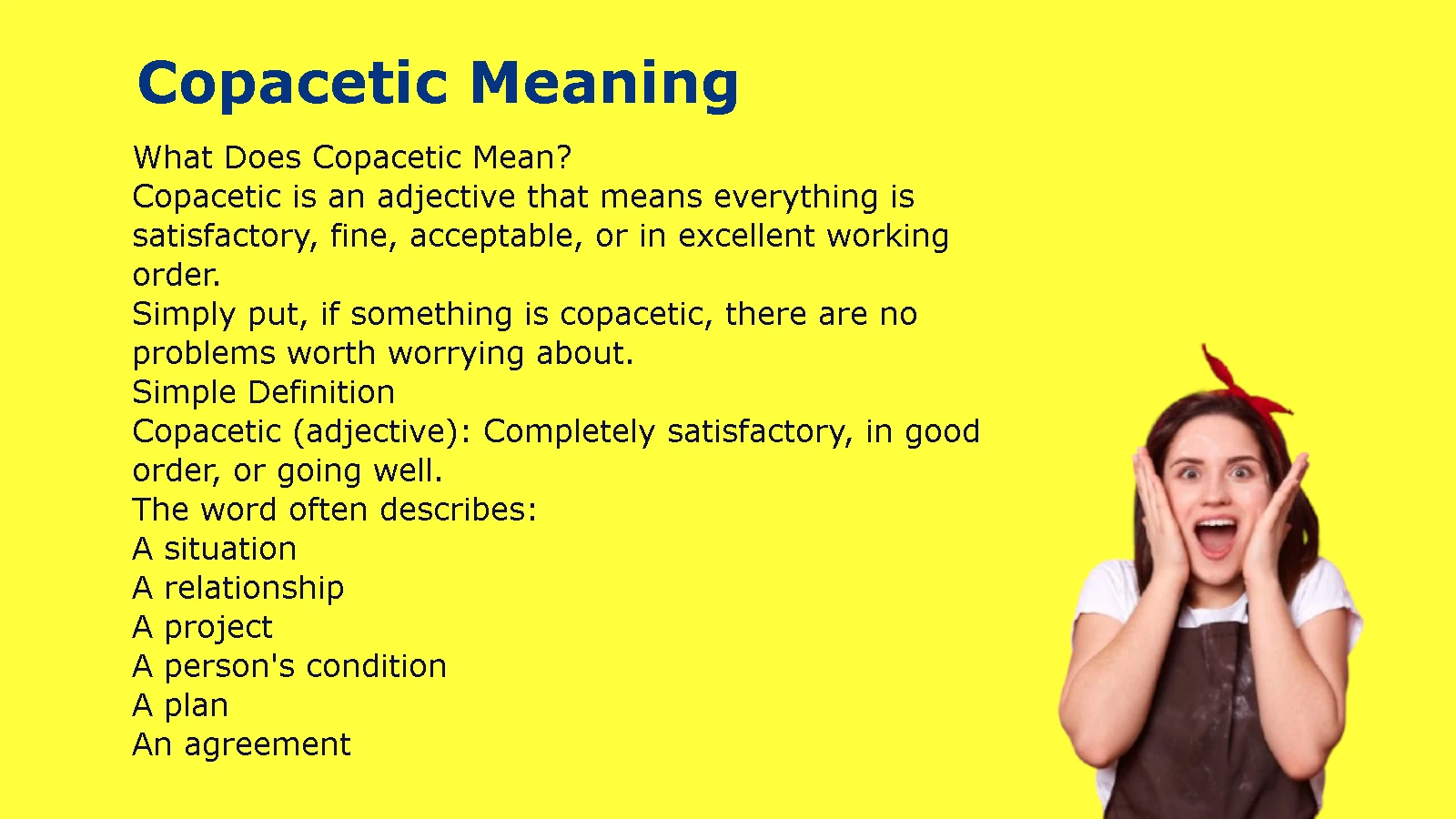
What Does Copacetic Mean?
Copacetic is an adjective that means everything is satisfactory, fine, acceptable, or in excellent working order.
Simply put, if something is copacetic, there are no problems worth worrying about.
Simple Definition
Copacetic (adjective): Completely satisfactory, in good order, or going well.
The word often describes:
- A situation
- A relationship
- A project
- A person’s condition
- A plan
- An agreement
It suggests that everything is running smoothly rather than being exceptionally wonderful.
For example:
- Everything is copacetic now that we fixed the issue.
- The team confirmed the event was copacetic before guests arrived.
- Our travel plans are finally copacetic after changing the flights.
In each example, copacetic means everything is organized, acceptable, and free from significant problems.
Copacetic Meaning in Plain English
Many dictionaries define the word using terms like satisfactory or acceptable, but everyday English makes it even simpler.
Think of copacetic as saying:
- Everything’s okay.
- Things are going smoothly.
- No worries.
- Everything’s under control.
- We’re all set.
Imagine you’re planning a family barbecue.
The weather clears up. The food is ready. Everyone arrives on time. The grill works perfectly.
At that moment, someone might smile and say:
“Everything’s copacetic.”
It doesn’t necessarily mean everything is perfect. It simply means everything is going well enough that nobody needs to worry.
Is Copacetic Positive, Negative, or Neutral?
The word carries a positive meaning.
However, it’s usually moderately positive instead of extremely enthusiastic.
Here’s how it compares:
| Expression | Strength |
| Terrible | Very Negative |
| Bad | Negative |
| Okay | Neutral |
| Fine | Slightly Positive |
| Copacetic | Positive |
| Great | Very Positive |
| Excellent | Extremely Positive |
Notice that copacetic sits somewhere between fine and great.
It suggests satisfaction rather than excitement.
Common Synonyms of Copacetic
Depending on the situation, you can replace copacetic with several other words.
| Synonym | Best Used When |
| Fine | Everyday conversation |
| Okay | Informal speech |
| Satisfactory | Formal writing |
| Acceptable | Professional settings |
| All right | Casual conversation |
| Good | General situations |
| In order | Organization |
| Under control | Managing problems |
| Running smoothly | Projects or events |
| Hunky-dory | Informal and playful |
| Peachy | Friendly conversation |
Each synonym carries a slightly different tone.
For example:
- The office is copacetic.
- The office is running smoothly.
Both communicate nearly the same idea, although the second sounds more formal.
Common Antonyms of Copacetic
The opposite of copacetic includes words that describe disorder or problems.
| Antonym | Meaning |
| Chaotic | Completely disorganized |
| Messy | Untidy or confusing |
| Problematic | Causing difficulties |
| Broken | Not functioning |
| Unsatisfactory | Not meeting expectations |
| Faulty | Having defects |
| Disorganized | Poorly arranged |
| Troubled | Full of problems |
Examples:
- The meeting became chaotic after the presentation failed.
- Our schedule wasn’t exactly copacetic after several delays.
How to Pronounce Copacetic
Many English learners hesitate because copacetic looks longer than it sounds.
Fortunately, pronunciation is straightforward once you break it into syllables.
Standard Pronunciation
koh-puh-SET-ik
IPA Pronunciation
/ˌkoʊ.pəˈset.ɪk/
Syllable Breakdown
co • pa • cet • ic
The primary stress falls on:
SET
Say it slowly:
koh — puh — SET — ik
Once you practice a few times, the pronunciation becomes natural.
Pronunciation Tips
Keep these simple tips in mind:
- Stress the third syllable.
- Don’t rush the ending.
- Avoid saying “copy-setic.”
- Avoid emphasizing the first syllable.
A good trick is to say:
Go + pa + SET + tick
The rhythm feels surprisingly natural.
Why People Mispronounce Copacetic
The unusual spelling causes confusion.
Common incorrect pronunciations include:
- Co-pay-setic
- Copy-setic
- Cop-a-static
- Copa-setic
These mistakes happen because English doesn’t always spell words the way they’re spoken.
Fortunately, once you remember koh-puh-SET-ik, you’ll rarely forget it.
How to Use Copacetic in a Sentence
Learning a definition is only half the journey.
The best way to remember a word is to see it used naturally in different situations.
Below are examples you can copy into your own conversations or writing.
Copacetic in Everyday Conversation
Friends often use copacetic when checking whether everything is okay.
Examples:
- Don’t worry. Everything’s copacetic now.
- Is everything copacetic at home?
- The repairs are finished, so everything’s copacetic again.
- Once we solved the misunderstanding, things became copacetic.
- We’re copacetic. Thanks for asking.
Notice how the word replaces phrases like:
- Everything is fine.
- Everything is okay.
- No problems.
- Everything is under control.
Using Copacetic at Work
Although the word is informal, you may hear it in relaxed workplaces.
Examples:
- The software update is copacetic after today’s fixes.
- The client confirmed everything is copacetic.
- Our project timeline is finally copacetic.
- Finance approved the budget, so we’re copacetic.
- The conference setup looks copacetic.
In highly formal reports, however, words like satisfactory or operational usually sound more appropriate.
Using Copacetic in Writing
Writers often choose copacetic because it adds personality.
Examples:
- The neighborhood looked copacetic from the outside.
- By sunset, life felt completely copacetic again.
- Despite earlier tension, the family dinner became surprisingly copacetic.
- The old café had a calm, copacetic atmosphere.
The word paints a picture that feels relaxed and reassuring.
Copacetic in Fiction and Dialogue
Novelists frequently use unusual vocabulary to make dialogue memorable.
Example:
“Relax,” Jake laughed. “Everything’s copacetic.”
Another example:
“The storm has passed. We’re copacetic now.”
Notice how the word instantly creates a casual, confident tone.
Everyday Situations Where Copacetic Fits
Here are common scenarios where the word sounds natural.
| Situation | Example |
| Travel | Everything is copacetic after boarding the plane. |
| School | My grades are finally copacetic this semester. |
| Family | Dinner plans are copacetic now that everyone agreed. |
| Work | The presentation is copacetic after one final review. |
| Home | The plumbing is copacetic after yesterday’s repairs. |
| Sports | The team’s defense looked copacetic all game. |
| Technology | My laptop is copacetic after installing the update. |
Examples That Sound Natural
Here are a few longer examples that show how native speakers might use the word.
Example 1
Sarah spent all morning preparing for the meeting. The projector worked, the presentation loaded without errors, and every team member arrived early. She smiled and said, “Everything’s copacetic. Let’s get started.”
Example 2
After replacing the flat tire, checking the engine, and filling the gas tank, the family felt confident enough to continue the road trip. At that point, everything was copacetic again.
Example 3
The restaurant fixed the reservation mistake within minutes. Once everyone had a table and their meals arrived, the evening became completely copacetic.
These examples show that copacetic often appears after a problem has been solved, emphasizing that things have returned to normal.
Copacetic at a Glance
Sometimes, a quick summary is all you need. The table below highlights the key facts about copacetic.
| Feature | Details |
| Word | Copacetic |
| Part of Speech | Adjective |
| Meaning | Fine, satisfactory, or in good order |
| Pronunciation | koh-puh-SET-ik |
| IPA | /ˌkoʊ.pəˈset.ɪk/ |
| Tone | Informal |
| Common Use | Everyday conversations, storytelling, creative writing |
| Typical Contexts | Work, family, travel, relationships, daily life |
| Connotation | Positive and reassuring |
| Common Alternatives | Fine, okay, satisfactory, all right |
When to Use Copacetic
Knowing a word’s definition is useful. Knowing when to use it makes your English sound more natural.
Copacetic works best in situations where you want to reassure someone that everything is in order without sounding overly formal.
Use Copacetic When Things Are Running Smoothly
The word fits naturally when everything has settled into place.
For example:
- A project finishes on schedule.
- A delayed flight finally departs.
- A disagreement gets resolved.
- A party is fully set up before guests arrive.
- A repaired appliance starts working again.
Instead of saying, “Everything is okay,” you can say:
Everything is copacetic.
The meaning stays almost the same, yet your vocabulary sounds richer and more expressive.
Use It in Relaxed Conversations
Because copacetic has an informal tone, it feels most at home in everyday speech.
You might hear it:
- While chatting with friends
- During family conversations
- In casual workplace discussions
- In interviews with artists or musicians
- In novels and movie dialogue
For instance:
“Don’t stress. Everything’s copacetic now.”
The sentence feels friendly, confident, and reassuring without sounding stiff.
Use It to Describe Order After a Problem
One subtle feature of copacetic is that it often appears after a challenge has been resolved.
Imagine your internet stops working before an online meeting. After restarting the router, the connection returns and the meeting begins without further issues.
At that point, someone might say:
“We’re copacetic now.”
The word doesn’t just mean “fine.” It also hints that things are back on track after a disruption.
Is Copacetic Formal or Informal?
One of the most common questions people ask is whether copacetic belongs in formal writing.
The short answer is no.
Although the word appears in reputable dictionaries and has been part of American English for more than a century, it carries a distinctly informal tone. Native speakers often use it in conversation, fiction, interviews, and relaxed workplace settings. It sounds friendly, conversational, and a little playful.
When Copacetic Sounds Natural
Use copacetic in situations like these:
- Casual conversations
- Friendly emails
- Text messages
- Personal blogs
- Fiction and storytelling
- Informal workplace discussions
- Speeches with a conversational tone
Examples:
- “Everything’s copacetic now.”
- “The move went better than expected, so we’re copacetic.”
- “As long as everyone’s happy, we’re copacetic.”
When You Should Avoid Copacetic
Choose a more formal word when writing:
- Academic papers
- Legal documents
- Research reports
- Government correspondence
- Technical manuals
- Official business policies
Instead of writing:
The equipment is copacetic.
A formal report might say:
The equipment is fully operational.
Or:
The inspection found the equipment to be satisfactory.
Formal Alternatives
| Informal | More Formal Alternative |
| Copacetic | Satisfactory |
| Copacetic | Acceptable |
| Copacetic | In good condition |
| Copacetic | Fully operational |
| Copacetic | Functioning properly |
| Copacetic | In compliance |
Understanding the audience always matters more than using unusual vocabulary.
Origin and History of Copacetic
The meaning of copacetic is clear. Its origin is not.
Linguists have debated where the word came from for decades, and no single explanation has gained universal acceptance.
That uncertainty only adds to the word’s charm.
When Did the Word First Appear?
Most language historians trace copacetic to the early 20th century, with written evidence appearing around 1919.
By the 1920s, Americans used the word in newspapers, books, and everyday speech. It quickly became associated with the idea that everything was “all right” or “in excellent order.”
Unlike many modern slang terms, copacetic has survived for more than 100 years.
Theories About Its Origin
Although no theory has been proven, several explanations appear repeatedly in language research.
African American Vernacular English (AAVE)
Many scholars believe the word may have developed within African American Vernacular English, where it gradually spread into broader American English.
This theory receives considerable attention because the word appeared in communities where AAVE influenced regional speech patterns.
However, no written evidence definitively proves this origin.
Louisiana Creole Theory
Another proposal connects copacetic to Louisiana Creole.
Supporters argue that similar-sounding expressions may have evolved into the modern English word over time.
Again, the evidence remains inconclusive.
Hebrew Theory
Some researchers have suggested a possible connection to the Hebrew phrase kol b’seder, meaning everything is in order.
The similarity in meaning is interesting.
Even so, linguists generally consider this explanation speculative because there is little historical documentation linking the two.
Southern American English
Others believe the word simply developed as regional American slang before spreading across the country.
Like many colorful expressions, it may have started in spoken language long before anyone wrote it down.
What Experts Agree On
While scholars disagree about its exact origin, they largely agree on several points:
- The word entered written English during the early twentieth century.
- It has consistently meant fine, acceptable, or in good order.
- It remains primarily an American English expression.
- Its precise origin is still unknown.
This combination of certainty and mystery makes copacetic one of English’s more fascinating vocabulary words.
Is Copacetic Still Used Today?
Yes.
Although copacetic isn’t among the most common English adjectives, people still use it today.
You may not hear it every week, but when someone says it, most native speakers understand the meaning from context.
Why Isn’t It Used More Often?
English already has plenty of simple alternatives.
For example:
- Fine
- Okay
- Good
- All right
- Great
Because these words are shorter and more familiar, people naturally reach for them first.
Still, copacetic survives because it adds personality.
Instead of saying:
Everything is okay.
Someone might smile and say:
Everything’s copacetic.
That unexpected word often catches attention.
Where You Might Hear Copacetic Today
The word still appears in:
- Movies
- Television dialogue
- Podcasts
- Music lyrics
- Novels
- Interviews
- Social media posts
- Everyday conversations
Writers especially enjoy using it because it sounds distinctive without confusing most readers.
Does It Sound Old-Fashioned?
Some people think so.
Others see it as quirky rather than outdated.
Unlike truly obsolete words, copacetic still appears often enough that it feels recognizable, especially in American English.
Think of it as a classic expression that occasionally returns to the spotlight.
Words Similar to Copacetic
Although several words share a similar meaning, none match copacetic exactly.
Each has its own tone and level of formality.
| Word | Meaning | Best Used For |
| Fine | No problems | Everyday conversation |
| Okay | Acceptable | Informal speech |
| Good | Positive condition | General use |
| Satisfactory | Meets expectations | Formal writing |
| All right | Everything is okay | Casual speech |
| Hunky-dory | Everything is excellent | Informal, playful tone |
| Peachy | Everything is going well | Friendly conversation |
| Smooth | Working without problems | Projects and operations |
| Stable | Secure and consistent | Technical or professional settings |
| Under control | Managed successfully | Challenges or emergencies |
Each alternative emphasizes a slightly different shade of meaning.
Copacetic vs. Fine
These two words overlap more than any others.
Fine is far more common.
People use it every day.
Copacetic, however, sounds more expressive.
| Fine | Copacetic |
| Extremely common | Less common |
| Neutral | Slightly colorful |
| Works everywhere | Mostly informal |
| Simple | Distinctive |
Example
Fine:
The project is fine now.
Copacetic:
The project is copacetic now.
Both sentences communicate success, but the second sounds more memorable.
Copacetic vs. Okay
Many learners assume these words are identical.
They’re close—but not quite.
Okay simply means acceptable.
Copacetic usually suggests everything is running smoothly.
Example
After fixing your car, you could say:
It’s okay.
Or you could say:
It’s copacetic.
The second sentence implies the problem has been fully resolved.
Copacetic vs. Hunky-Dory
These words often appear together because both describe favorable situations.
The difference lies in tone.
| Copacetic | Hunky-dory |
| Calm | Playful |
| Relaxed | Cheerful |
| Everyday | Slightly humorous |
| Less exaggerated | More expressive |
Example:
Everything’s copacetic.
sounds calmer than
Everything’s hunky-dory.
Copacetic vs. Peachy
Both expressions suggest things are going well.
However, peachy sounds more upbeat and informal.
Some speakers even use peachy sarcastically.
Copacetic rarely carries sarcasm unless the speaker’s tone clearly signals it.
Example
Everything’s peachy.
often sounds cheerful.
Everything’s copacetic.
sounds reassuring.
Grammar Guide for Copacetic
Grammar becomes much easier once you know what kind of word copacetic is.
Part of Speech
Copacetic is an adjective.
That means it describes a noun or follows a linking verb.
Examples:
- The situation is copacetic.
- Everything looks copacetic.
- Their relationship remained copacetic.
Can Copacetic Be Used as a Noun?
No.
This sentence is incorrect:
❌ The copacetic was impressive.
Correct:
✅ Everything was copacetic.
Can Copacetic Be Used as a Verb?
No.
You cannot write:
❌ We copaceticked the project.
Instead, say:
✅ We made the project run smoothly.
Can Copacetic Be Used as an Adverb?
No standard adverb form exists.
Avoid:
❌ He completed the work copacetically.
Instead, write:
✅ He completed the work smoothly.
Common Sentence Patterns
The adjective most commonly appears after linking verbs.
Examples include:
- Everything is copacetic.
- Things look copacetic.
- The project seems copacetic.
- Life became copacetic after the repairs.
These patterns sound natural to native speakers.
Common Mistakes People Make
Even advanced English learners sometimes misuse copacetic.
Here are the most common errors.
Assuming It Means “Perfect”
It doesn’t.
Copacetic means satisfactory or going well.
Something can be copacetic without being flawless.
Using It in Highly Formal Writing
Although it’s a real English word, it sounds informal.
Formal documents usually require more precise language.
Mispronouncing the Word
Remember:
koh-puh-SET-ik
The stress belongs on SET.
Overusing It
Because the word stands out, repeating it several times in the same conversation feels unnatural.
Mix in alternatives like:
- Fine
- Good
- All right
- Running smoothly
Variation makes your writing stronger.
Common Misspellings
The unusual spelling leads to frequent mistakes.
Common incorrect versions include:
- Copasetic
- Copesthetic
- Copacitic
- Copacetik
- Copasitik
- Copasetik
The accepted modern spelling is:
Copacetic
If you’re unsure, remember the middle contains:
…ca…ce…
not
…sa…se…
Keeping the standard spelling helps your writing appear polished and professional.
Idioms and Expressions With Similar Meanings
English has plenty of colorful expressions that communicate an idea similar to copacetic. While none of them are perfect substitutes, they all suggest that things are going well or that problems have been resolved.
Choosing the right expression depends on the situation, your audience, and the tone you want to create.
Everything Is Under Control
This phrase reassures people that someone has handled the situation effectively.
Examples:
- Everything is under control now.
- The event manager assured us everything was under control.
- Once the repairs were complete, everything was under control again.
This expression works well in both casual and professional conversations.
Good to Go
Good to go means something is ready or fully prepared.
Examples:
- The presentation is good to go.
- Your order is packed and good to go.
- Once everyone arrived, we were good to go.
Unlike copacetic, this phrase emphasizes readiness rather than overall satisfaction.
In Good Shape
This idiom means something is in a favorable condition.
Examples:
- The budget is in good shape.
- Your application is in good shape.
- The car is still in good shape after ten years.
It often refers to physical condition, finances, or planning.
On Track
When a project or plan is on track, it’s progressing as expected.
Examples:
- Construction remains on track.
- The team is on track to meet the deadline.
- Sales are on track to exceed expectations.
This phrase focuses on progress, while copacetic describes an overall satisfactory condition.
Smooth Sailing
This popular idiom means there are no significant difficulties ahead.
Examples:
- After solving the software bug, it was smooth sailing.
- Once everyone agreed, negotiations became smooth sailing.
The phrase often appears after overcoming an obstacle.
Everything Is Looking Good
Although simple, this expression remains one of the most natural alternatives.
Examples include:
- Everything is looking good.
- The renovations are looking good.
- Our travel plans are looking good.
Sometimes the simplest wording is also the clearest.
Practical Examples of Copacetic in Everyday Life
Understanding a word becomes much easier when you see it in realistic situations.
Here are several examples that reflect how native English speakers might naturally use copacetic.
Family Life
Imagine you’re hosting a large family dinner.
Earlier in the day, the oven stopped working, one guest canceled at the last minute, and the decorations arrived late. After replacing the oven, adjusting the seating plan, and finishing the decorations, everything comes together.
You might say:
“Everything’s copacetic now. Dinner can start.”
The sentence reassures everyone that the earlier problems have been resolved.
At Work
Your team spends weeks preparing for an important client presentation.
On the morning of the meeting, the projector fails and several files disappear. After the IT department restores the files and replaces the projector, the presentation begins without another issue.
A coworker smiles and says:
“Looks like we’re copacetic.”
The word reflects confidence that everything is back on track.
Traveling
Travel plans rarely go exactly as expected.
Suppose your flight gets delayed, but the airline rebooks you quickly. Your luggage arrives, your hotel reservation is confirmed, and transportation is waiting outside the airport.
At that point, your trip feels copacetic.
Home Repairs
A leaking pipe causes water to spread across the kitchen floor.
After calling a plumber, replacing the damaged pipe, and cleaning the area, everything returns to normal.
Instead of saying:
Everything is okay.
You could naturally say:
Everything’s copacetic again.
Mini Case Study: Choosing the Right Word
Let’s compare several ways to describe the same situation.
Scenario
A marketing team launches a new website.
Initially, they discover broken links, slow loading pages, and a few missing images. Within two days, the developers fix every issue.
Now compare these sentences.
Option 1
The website is okay.
This communicates the basic idea but lacks detail.
Option 2
The website is satisfactory.
This sounds professional and objective.
Option 3
The website is copacetic.
This sounds relaxed, confident, and conversational. It suggests that everything is working smoothly after earlier problems.
Which One Works Best?
| Context | Best Choice |
| Casual conversation | Copacetic |
| Business report | Satisfactory |
| Technical documentation | Fully operational |
| Friendly email | Copacetic |
| Academic writing | Satisfactory |
The lesson is simple: the best word depends on the audience and purpose.
What Language Experts Say About Copacetic
Language experts generally agree on several important facts about copacetic:
“Copacetic has meant ‘completely satisfactory’ or ‘in excellent order’ since the early twentieth century, even though its exact origin remains uncertain.”
This combination of a stable meaning and an uncertain history makes the word especially interesting to linguists.
Many uncommon English words gradually disappear over time. Copacetic, however, has remained recognizable because speakers appreciate its distinctive sound and positive meaning.
Its continued appearance in books, movies, and everyday conversation shows that expressive vocabulary still has a place in modern English.
Frequently Asked Questions About Copacetic Meaning
Is copacetic a real English word?
Yes. Copacetic is a legitimate English adjective recognized by major dictionaries. It means fine, satisfactory, or in good order.
What does copacetic mean in slang?
Although people sometimes describe it as slang, copacetic is better classified as an informal English word.
In everyday conversation, it simply means:
- Everything is okay.
- Everything is fine.
- Everything is under control.
Is copacetic an adjective?
Yes.
It functions as an adjective that describes the condition of a person, object, plan, or situation.
Example:
Everything is copacetic.
Where did the word copacetic come from?
The exact origin remains unknown.
Most researchers agree that the word entered American English during the early twentieth century, but they continue to debate how it developed.
Several theories exist, yet none has been conclusively proven.
Is copacetic commonly used today?
Yes, although it is less common than words like fine, good, or okay.
Many native English speakers recognize the word even if they don’t use it every day.
Is copacetic an American word?
Yes.
The word is most closely associated with American English, although English speakers in other countries may also understand it.
Can I use copacetic in formal writing?
Generally, no.
In formal documents, words such as satisfactory, acceptable, fully operational, or in good condition are usually better choices.
What’s the difference between copacetic and okay?
Both describe acceptable situations.
However, copacetic often suggests that everything is running smoothly and that any earlier problems have already been resolved.
How do you pronounce copacetic?
The standard pronunciation is:
koh-puh-SET-ik
The primary stress falls on the third syllable.
What are the best synonyms for copacetic?
Some of the closest alternatives include:
- Fine
- Okay
- All right
- Satisfactory
- Acceptable
- In good order
- Running smoothly
- Under control
- Hunky-dory
- Peachy
Each carries a slightly different tone, so choose the one that best fits your audience.
Key Takeaways
If you only remember a few things about copacetic, make them these:
- Copacetic means fine, satisfactory, or in good order.
- It is an adjective.
- The word is informal and works best in everyday conversation.
- It has been part of American English for more than a century.
- Its exact origin remains uncertain.
- Native speakers still recognize and occasionally use it today.
- It often suggests that everything is running smoothly, especially after a problem has been solved.
- Formal writing usually calls for alternatives like satisfactory or fully operational.
- The standard pronunciation is koh-puh-SET-ik.
Conclusion
The word copacetic may not appear as often as fine or okay, but it adds personality and precision to everyday English. It describes a situation that is satisfactory, orderly, and free from significant problems, making it an excellent choice when you want to reassure someone that everything is going well.
Although its exact origin remains one of English’s enduring mysteries, its meaning has stayed remarkably consistent for more than a hundred years. From casual conversations and workplace discussions to novels and films, copacetic continues to give speakers a distinctive way to say that everything is under control.
The next time someone asks how things are going, you’ll know exactly when this unique word fits. If everything is running smoothly and there are no major concerns, you can confidently say that everything is copacetic