Have you ever wondered whether “Opinion vs Belief” are just two similar ideas or completely different ways of thinking? This is a common confusion in English usage, especially when people express thoughts, judgments, and personal views in writing, conversation, or academic discussions. Although these two words often appear in similar contexts, they carry very different meanings and levels of certainty.
In simple terms, an Opinion is a personal viewpoint or judgment based on feelings, experience, or interpretation. It is not necessarily proven or universally accepted. On the other hand, a Belief is something a person accepts as true or real, often rooted in faith, trust, cultural influence, or strong conviction. While opinions can change easily, beliefs are usually deeper and more stable, shaping how people see the world.
This difference frequently appears in searches like opinion meaning, belief meaning, difference between opinion and belief, and opinion vs belief examples, especially among learners trying to improve English vocabulary, grammar clarity, and communication skills. It is also closely related to broader topics such as commonly confused English words, language accuracy, and effective expression in both academic and professional writing.
If you’ve ever said something like “In my opinion, this is better” or “I believe this is true,” you’re already using both concepts without realizing how different they are in meaning and strength.
Understanding the distinction between Opinion and Belief helps you communicate more precisely, express ideas more clearly, and avoid common language mistakes in everyday writing and speech.
What Is an Opinion in Opinion vs Belief?
An opinion is a personal view or judgment that does not require proof. It reflects how you feel or interpret something at a specific moment.
You can think of it as a mental snapshot. It captures your thinking right now, not forever.
What shapes an opinion?
Your opinions come from:
- Personal experience
- Education or knowledge
- Media exposure
- Cultural influence
- Taste and preference
For example, if you say, “This movie is boring,” you are not stating a fact. You are sharing an opinion based on your reaction.
Key traits of an opinion
Opinions have clear characteristics:
- They change easily with new information
- They differ from person to person
- They are subjective, not universal
- They don’t require proof
Real-life opinion examples
- “Pizza tastes better than burgers.”
- “That teacher explains things clearly.”
- “This phone is overpriced.”
- “Summer is the best season.”
None of these statements need proof. Someone else can easily disagree and still be correct from their perspective.
What Is a Belief in Opinion vs Belief?
A belief goes deeper than an opinion. It is something you accept as true, even without direct proof in many cases.
Beliefs shape how you see the world. They influence your identity, decisions, and values.
What forms a belief?
Beliefs usually come from:
- Upbringing and family influence
- Religion or spirituality
- Repeated life experiences
- Education and worldview
- Emotional impact
For example, someone may believe that honesty is always the best policy. That belief guides behavior across situations.
Key traits of a belief
Beliefs tend to:
- Stay stable over time
- Feel emotionally strong
- Influence decisions and behavior
- Resist change unless challenged deeply
Real-life belief examples
- “Hard work leads to success.”
- “Lying is morally wrong.”
- “There is life after death.”
- “People are naturally good.”
These statements are not just passing thoughts. They reflect a deeper internal system.
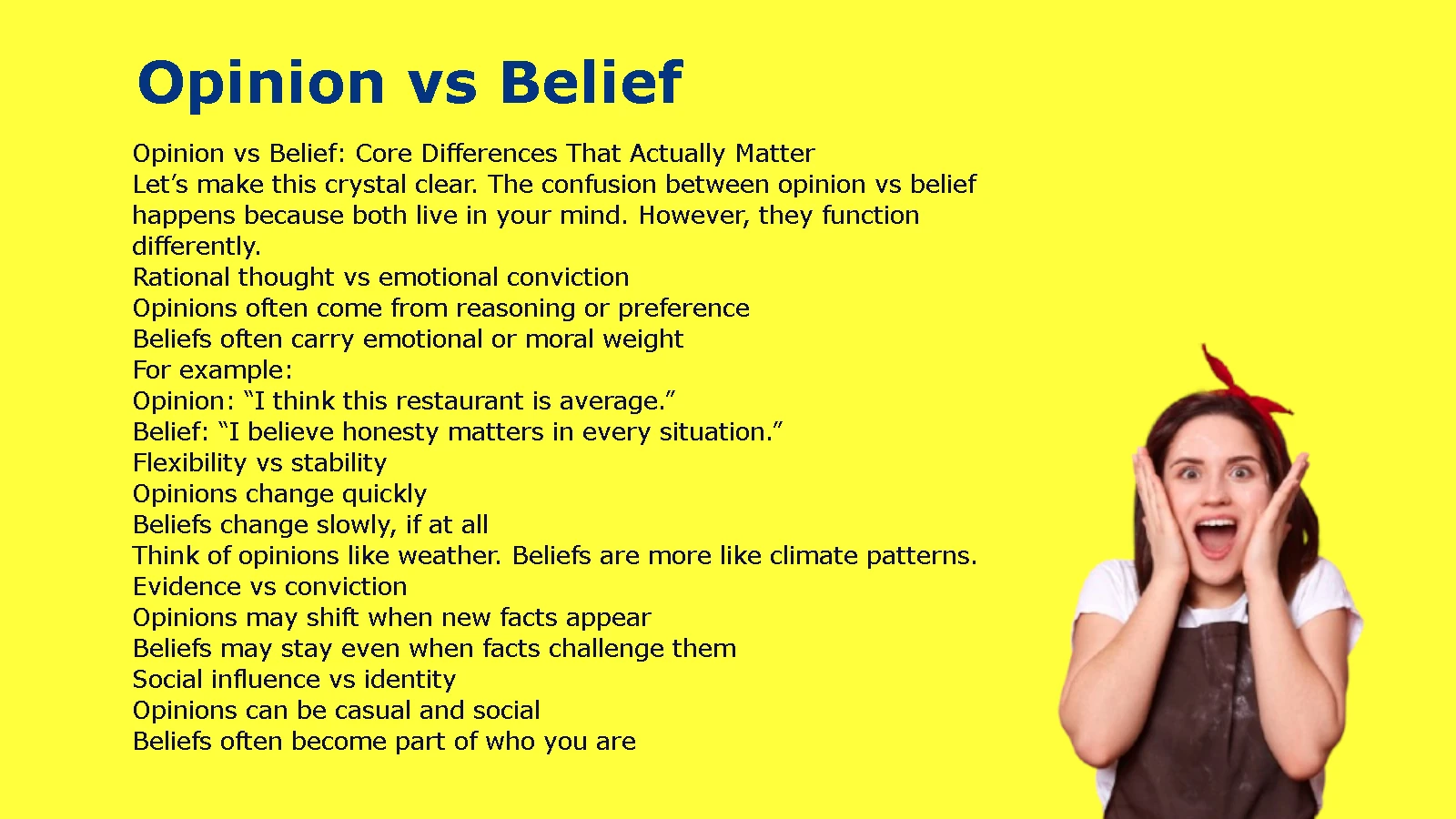
Opinion vs Belief: Core Differences That Actually Matter
Let’s make this crystal clear. The confusion between opinion vs belief happens because both live in your mind. However, they function differently.
Rational thought vs emotional conviction
- Opinions often come from reasoning or preference
- Beliefs often carry emotional or moral weight
For example:
- Opinion: “I think this restaurant is average.”
- Belief: “I believe honesty matters in every situation.”
Flexibility vs stability
- Opinions change quickly
- Beliefs change slowly, if at all
Think of opinions like weather. Beliefs are more like climate patterns.
Evidence vs conviction
- Opinions may shift when new facts appear
- Beliefs may stay even when facts challenge them
Social influence vs identity
- Opinions can be casual and social
- Beliefs often become part of who you are
Opinion vs Belief Comparison Table
| Feature | Opinion | Belief |
| Meaning | Personal view or judgment | Accepted truth or conviction |
| Source | Experience, preference, information | Values, faith, upbringing |
| Flexibility | Changes easily | Changes slowly |
| Emotional weight | Low to medium | High |
| Proof required | No | Not always |
| Example | “This food tastes good” | “Honesty is important” |
Why People Confuse Opinion vs Belief
You are not alone if you mix them up. Even native speakers do it.
Here’s why it happens:
Everyday language overlap
People often say:
- “I believe this pizza is amazing”
- “That’s just my belief”
In these cases, belief is used casually instead of opinion.
Emotional intensity
Strong opinions start sounding like beliefs. For example:
- “This policy is terrible” (opinion)
- “I strongly believe this policy is wrong” (belief-like tone)
Cultural influence
Some cultures treat beliefs and opinions as interchangeable in casual speech, which increases confusion.
Internet and social media
Online debates blur the line even more. People defend opinions like beliefs, especially in politics or lifestyle discussions.
When to Use Opinion in Opinion vs Belief
Use opinion when you talk about personal judgment or preference.
Best situations for opinion
- Reviews
- Feedback
- Preferences
- Comparisons
Example uses
- “In my opinion, this app is easier to use.”
- “I think this design looks better.”
- “That movie felt too long for me.”
Opinions work best when you want to stay flexible and open.
When to Use Belief in Opinion vs Belief
Use belief when something feels like a truth you accept deeply.
Best situations for belief
- Moral values
- Religious ideas
- Strong convictions
- Life principles
Example uses
- “I believe kindness matters more than success.”
- “She believes in working hard every day.”
- “Many people believe in fate.”
Beliefs shape identity. Opinions express preference.
Can Opinion Become a Belief?
Yes, and it happens more often than you think.
When you repeat an idea often enough or experience it strongly, it can shift from opinion to belief.
How this transformation happens
- Repetition reinforces the idea
- Emotional events strengthen memory
- Social validation supports acceptance
Example
You might start with:
- “I think exercise helps a bit.”
After consistent results:
- “I believe exercise is essential for health.”
That shift shows how thinking evolves over time.
Can Belief Change Over Time?
Beliefs can change, but it usually takes strong influence.
What changes beliefs?
- Major life events
- New education or exposure
- Personal reflection
- Emotional experiences
For example, someone raised with a strict belief system may shift after traveling and meeting different cultures.
“Beliefs don’t break easily, but they do evolve when life forces a new perspective.”
Opinion vs Belief in Everyday Communication
Let’s see how these words behave in real life.
Conversations
- Opinions help you express casual thoughts
- Beliefs guide deeper discussions
Social media
People often post opinions but defend them like beliefs. That’s where conflict starts.
Workplace
- Opinions help with brainstorming
- Beliefs influence company culture
Education
- Students share opinions in discussions
- Beliefs affect motivation and learning style
Common Mistakes in Opinion vs Belief Usage
People often slip up without realizing it.
Treating opinions as facts
“I think this is true, so it must be true.”
That creates misunderstanding in debates.
Confusing belief with knowledge
Belief is not the same as proven fact.
Overusing belief in casual speech
“I believe this sandwich is good.”
That sounds unnatural in many contexts.
Mislabeling strong opinions
Strong emotion does not automatically make something a belief.
Ignoring context
The right word depends on situation, not intensity alone.
Real-Life Case Study: Opinion vs Belief in Action
Imagine a workplace discussion about remote work.
Scenario
- Employee A says: “I think remote work improves productivity.”
- Employee B says: “I believe remote work is the future of all jobs.”
What happens here?
- Employee A expresses an opinion based on observation
- Employee B expresses a belief tied to long-term worldview
Outcome
The disagreement becomes deeper because belief carries emotional weight. The discussion shifts from logic to identity.
This shows why choosing the right word matters in real conversations.
Collocations and Natural Usage Patterns
Let’s look at how native speakers naturally use these words.
Common opinion phrases
- Strong opinion
- Personal opinion
- Expert opinion
- In my opinion
- Public opinion
Example sentences
- “Public opinion changed after the announcement.”
- “That’s just my personal opinion.”
Common belief phrases
- Strong belief
- Deep belief
- Religious belief
- Core belief
- Widely held belief
Example sentences
- “Her core belief is honesty above everything.”
- “Many cultures share similar religious beliefs.”
Opinion vs Belief vs Fact
These three often get mixed up.
| Type | Definition | Example |
| Opinion | Personal view | “This is the best song” |
| Belief | Accepted truth | “Hard work leads to success” |
| Fact | Proven reality | “Water boils at 100°C at sea level” |
Facts stay constant. Opinions and beliefs shift.
Easy Trick to Remember Opinion vs Belief
Here’s a simple mental shortcut:
- If it can change easily → Opinion
- If it feels deeply true → Belief
Think of it like this:
- Opinion = what you think right now
- Belief = what you stand for
Practice Section: Opinion or Belief
Try identifying each:
- “This restaurant is expensive.”
- “Honesty matters in relationships.”
- “I enjoy action movies more than comedy.”
- “People should help others in need.”
Answer Key
- Opinion
- Belief
- Opinion
- Belief
Fill in the Blanks: Opinion vs Belief Practice
Choose Opinion or Belief for each sentence.
- “I think this laptop is too expensive, that’s just my ______.”
- “She strongly holds the ______ that honesty is everything.”
- “In my ______, this restaurant serves the best pizza in town.”
- “He grew up with the ______ that hard work always pays off.”
- “That movie was boring, at least that’s my ______.”
- “Many people share the ______ that kindness makes life better.”
- “I have an ______ about the new design, but I’m not fully sure yet.”
- “Her ______ in equal rights shapes how she treats others.”
- “This phone is faster than the old one, in my ______.”
- “It is his ______ that success comes from discipline.”
- “I don’t like this color, that’s just my ______.”
- “Their ______ in teamwork helped the company grow.”
- “That café is overrated, in my ______.”
- “She lives by the ______ that learning never stops.”
- “He gave his ______ on the new policy during the meeting.”
- “A strong ______ in yourself can change your life.”
- “This game is more fun than the last one, that’s my ______.”
- “They share the ______ that education is the key to success.”
- “I formed my ______ after watching the full documentary.”
- “His ______ about honesty was shaped by his upbringing.”
Answer Key
- Opinion
- Belief
- Opinion
- Belief
- Opinion
- Belief
- Opinion
- Belief
- Opinion
- Belief
- Opinion
- Belief
- Opinion
- Belief
- Opinion
- Belief
- Opinion
- Belief
- Opinion
- Belief
Frequently Asked Questions
What is the main difference between opinion and belief?
Opinion is flexible. Belief is deeper and more stable.
Can opinions be wrong?
Yes, but they are subjective, not absolute truth.
Are beliefs always true?
Not necessarily. They reflect acceptance, not proof.
Can beliefs change easily?
No, they usually require strong influence or experience.
Is belief stronger than opinion?
Yes, belief carries more emotional weight.
Can someone hold both on the same topic?
Yes, depending on context and depth of thought.
Why do people confuse them?
Because both describe thoughts and judgments.
Is belief the same as faith?
Faith is a type of belief, often religious.
How do I know which one to use?
Ask yourself: is it preference or conviction?
Conclusion
Understanding opinion vs belief helps you communicate with clarity and confidence. You avoid misunderstandings, especially in debates or discussions where words carry weight.
Opinions shift like wind. Beliefs stay rooted like trees. Both matter, but they serve different roles in how you think, speak, and connect with others.
When you choose the right word, you don’t just sound correct—you sound clear.