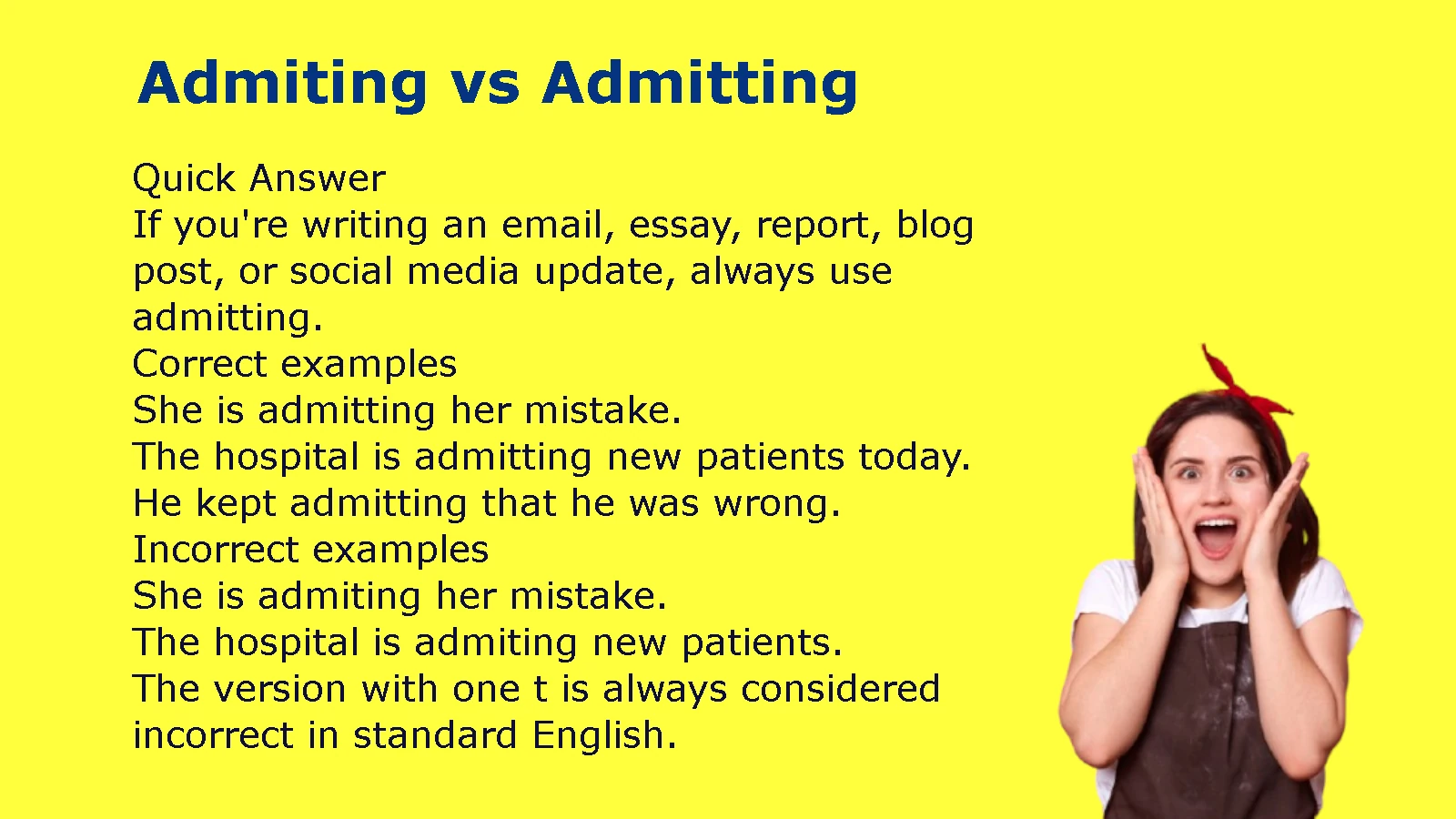
Admiting vs Admitting: Admitting is the correct spelling because the final t is doubled before adding -ing. Admiting is a common misspelling and is not accepted in standard English. Use admitting when referring to confessing, acknowledging something, or allowing someone to enter.
The confusion goes beyond just one extra letter. Many people search for how to spell admitting, admitting vs admiting, correct spelling of admitting, and why admitting has two t’s before sending an email, submitting an assignment, or publishing content. And here’s the kicker: a simple spelling mistake can make otherwise polished writing look unprofessional.
The good news? The rule is easier than you might think.
In this guide, you’ll learn the difference between Admiting vs Admitting, discover the admitting spelling accepted by dictionaries, understand the admitting meaning, and see plenty of admitting examples in real sentences. You’ll also learn how to spell admitting correctly, why admiting is considered incorrect, and an easy memory trick to help you avoid this common mistake every time.
By the end, you’ll know exactly which spelling to use and feel confident whenever you write the word.
Admiting vs Admitting: Quick Comparison
Before diving into the grammar, here’s a quick overview.
| Feature | Admiting | Admitting |
| Correct spelling | ❌ No | ✅ Yes |
| Standard English | ❌ No | ✅ Yes |
| Found in dictionaries | ❌ No | ✅ Yes |
| Accepted in academic writing | ❌ No | ✅ Yes |
| Accepted in business writing | ❌ No | ✅ Yes |
| Used in US English | ❌ No | ✅ Yes |
| Used in UK English | ❌ No | ✅ Yes |
Quick Answer
If you’re writing an email, essay, report, blog post, or social media update, always use admitting.
Correct examples
- She is admitting her mistake.
- The hospital is admitting new patients today.
- He kept admitting that he was wrong.
Incorrect examples
- She is admiting her mistake.
- The hospital is admiting new patients.
The version with one t is always considered incorrect in standard English.
Which Is Correct: Admiting or Admitting?
The correct spelling is admitting.
The verb admit follows a common English spelling pattern. Before adding -ing, the final t doubles.
Formula
admit
+
ing
↓
double the final “t”
↓
admitting
This isn’t a random exception. It’s part of a broader spelling rule that helps preserve pronunciation and keeps English words consistent.
Think about similar verbs:
| Base Verb | Correct Form |
| admit | admitting |
| commit | committing |
| omit | omitting |
| permit | permitting |
| refer | referring |
Each of these verbs doubles its final consonant before -ing.
Why “Admiting” Is Incorrect
The spelling admiting skips an important grammar rule.
English often doubles the last consonant before adding -ing or -ed when specific conditions are met. Since admit satisfies those conditions, dropping one t creates an incorrect spelling.
Although spell-checkers usually catch this mistake, it still appears frequently because people write the word the way it sounds.
Why Does “Admitting” Have Two Ts?
The answer lies in English spelling rules rather than pronunciation.
Many English verbs ending with a consonant-vowel-consonant (CVC) pattern double the last consonant before adding a suffix such as -ing or -ed.
The verb admit fits this pattern perfectly.
Let’s break it down.
| Letter | Type |
| a | Vowel |
| d | Consonant |
| m | Consonant |
| i | Vowel |
| t | Consonant |
The final three letters—m-i-t—form a consonant-vowel-consonant pattern, and the stress falls on the last syllable (ad-MIT). Those two characteristics trigger the doubling rule.
As a result:
- admit → admitting
- admit → admitted
Not:
- admiting ❌
- admited ❌
The Consonant-Doubling Rule Explained
A verb usually doubles its final consonant before adding -ing or -ed when all three of these conditions apply:
- The verb ends in one consonant.
- A single vowel comes immediately before that consonant.
- The final syllable is stressed.
The word admit satisfies every condition.
Visual Breakdown
| Rule | Does “Admit” Qualify? |
| Ends with one consonant | ✅ Yes |
| Single vowel before final consonant | ✅ Yes |
| Stress on final syllable | ✅ Yes |
Therefore:
admit → admitting
Why English Doubles Certain Letters
English spelling isn’t random. Many spelling rules developed to preserve pronunciation over time.
Without doubling the final consonant, readers might pronounce words differently or misunderstand the intended sound.
Consider these examples:
| Correct | Incorrect |
| running | runing |
| stopping | stoping |
| beginning | begining |
| admitting | admiting |
Although native speakers might still guess the intended pronunciation, the incorrect versions don’t follow standard English spelling conventions.
When Do You Double the Final Consonant Before Adding -ing?
Once you understand the rule, you’ll recognize it in hundreds of English words.
The General Rule
Double the final consonant when:
- The word ends with a consonant.
- One vowel comes immediately before it.
- The stress falls on the final syllable.
- You’re adding -ing, -ed, or another suffix beginning with a vowel.
Examples
| Base Verb | Correct -ing Form |
| admit | admitting |
| begin | beginning |
| occur | occurring |
| forget | forgetting |
| permit | permitting |
| refer | referring |
| regret | regretting |
| commit | committing |
| omit | omitting |
| prefer | preferring |
Notice that every one of these words doubles its final consonant.
Examples in Everyday Sentences
Seeing the rule in context makes it much easier to remember.
Admit
- She is admitting her mistake.
- They finally started admitting the truth.
Begin
- The meeting is beginning now.
- We’re beginning a new project.
Permit
- The school isn’t permitting phones during exams.
- The city is permitting outdoor events again.
Refer
- She’s referring to last week’s discussion.
- The report keeps referring to updated data.
Notice how every verb follows the same spelling pattern.
When You Do Not Double the Final Consonant
Not every English verb doubles its last letter.
Many verbs end differently or place stress on another syllable, so they simply add -ing without changing the spelling.
Examples
| Base Verb | Correct Form |
| open | opening |
| visit | visiting |
| enter | entering |
| happen | happening |
| listen | listening |
| answer | answering |
| offer | offering |
| travel* | traveling (US) |
*In American English, traveling uses one l, while British English typically spells it travelling.
Why These Words Are Different
Take the word visit.
The stress falls on the first syllable:
VIS-it
Since the final syllable isn’t stressed, there’s no need to double the last consonant.
Similarly:
- open → opening
- listen → listening
- answer → answering
The spelling stays simple because the doubling rule doesn’t apply.
What Does “Admitting” Mean?
The word admitting has several meanings depending on context. Although the spelling stays the same, the definition changes based on how it’s used.
Understanding these meanings helps you recognize the word in conversations, books, news articles, and professional writing.
Admitting as Acknowledging the Truth
One of the most common meanings is accepting that something is true.
People often admit facts they previously denied or avoided discussing.
Examples
- She is admitting that she made a mistake.
- He kept admitting the evidence was correct.
- They’re finally admitting what happened.
This meaning often appears in conversations about honesty, responsibility, and accountability.
Admitting as Confessing a Mistake
Sometimes admitting means openly accepting responsibility for an action.
Examples include:
- admitting fault
- admitting guilt
- admitting responsibility
- admitting an error
Example Sentences
- The company is admitting its mistake and issuing refunds.
- He had difficulty admitting he was wrong.
- She avoided admitting her role in the misunderstanding.
Owning up to mistakes is generally viewed as a sign of integrity and maturity.
Admitting as Allowing Someone to Enter
Another meaning involves giving someone permission to enter a place.
Examples
- Security is admitting visitors one at a time.
- The museum is admitting guests until 6 p.m.
- The theater stopped admitting late arrivals.
You’ll often see this usage on signs or event notices.
For example:
“No one will be admitted after the performance begins.”
Here, admitted and admitting relate to allowing entry.
Admitting Someone Into an Institution
The word also refers to officially accepting someone into an organization or facility.
Examples include:
- admitting students
- admitting patients
- admitting members
- admitting applicants
Example Sentences
- The university is admitting students for the fall semester.
- The hospital is admitting emergency patients.
- The organization stopped admitting new members this year.
In these situations, admitting means formally accepting someone rather than simply letting them enter.
How to Use “Admitting” Correctly in Sentences
Learning grammar rules is helpful, but seeing real-world examples makes the difference.
Below are common situations where admitting naturally appears.
Everyday Conversation
People frequently use admitting while discussing honesty, mistakes, or personal experiences.
Examples:
- I’m finally admitting I need help.
- She’s admitting she forgot the meeting.
- They’re admitting they underestimated the challenge.
- Nobody enjoys admitting they’re wrong.
These examples sound natural because the word fits ordinary speech.
Academic Writing
In schools and universities, admitting often appears in formal discussions about evidence, research, or admissions.
Examples:
- The researcher is admitting the study has limitations.
- The committee is admitting qualified applicants this semester.
- The author avoids admitting uncertainty without supporting evidence.
Academic writing values precision, making correct spelling especially important.
Business Communication
Professional workplaces often use admitting when discussing accountability, customer service, or organizational decisions.
Examples:
- The company is admitting the production error.
- Management isn’t admitting liability at this stage.
- The conference is admitting registered attendees beginning at 8 a.m.
Using the correct spelling helps maintain professionalism and credibility.
Legal and Medical Contexts
The word has specialized meanings in legal and healthcare settings.
Legal examples
- The defendant is admitting guilt.
- The court is admitting new evidence.
- The witness avoided admitting responsibility.
Medical examples
- The hospital is admitting patients with scheduled procedures.
- Nurses began admitting emergency cases immediately.
- The clinic isn’t admitting walk-in patients today.
Common Mistakes People Make With “Admitting”
Even experienced writers occasionally hesitate when spelling admitting. The mistake usually isn’t caused by a lack of vocabulary. Instead, it happens because English spelling rules can feel inconsistent at first glance.
Fortunately, once you understand why admitting has two t’s, you’ll avoid several other common spelling errors as well.
Let’s look at the mistakes people make most often.
Writing “Admiting” Instead of “Admitting”
This is by far the most frequent error.
Many people simply add -ing to the base verb without thinking about the consonant-doubling rule.
Incorrect
- admiting
- She is admiting her mistake.
- They are admiting new students.
Correct
- admitting
- She is admitting her mistake.
- They are admitting new students.
A quick proofreading pass usually catches this mistake. However, understanding why it’s wrong makes you much less likely to repeat it.
Forgetting to Double the Final Consonant
The same spelling pattern appears in dozens of common English verbs.
Writers often make similar mistakes with words like these:
| Incorrect | Correct |
| begining | beginning |
| refering | referring |
| permiting | permitting |
| occuring | occurring |
| omiting | omitting |
| commiting | committing |
| regreting | regretting |
Notice a pattern?
Every correct spelling doubles the final consonant before adding -ing.
Confusing Pronunciation With Spelling
One reason admiting looks believable is that both versions sound almost identical when spoken.
English spelling doesn’t always mirror pronunciation.
For example:
- running
- stopping
- beginning
- admitting
Each contains a doubled consonant even though you may not hear a dramatic difference while speaking.
That’s why relying only on pronunciation can lead to spelling mistakes.
Depending Too Much on Autocorrect
Spell-check tools are helpful, but they aren’t perfect.
Sometimes:
- autocorrect misses errors inside names or specialized documents
- copied text keeps the original mistake
- grammar tools focus more on sentence structure than spelling consistency
Good writers still proofread carefully.
Think of spell-check as an assistant rather than the final editor.
Mixing Up Similar Verb Forms
Another common mistake involves confusing different forms of admit.
| Form | Correct Word |
| Base verb | admit |
| Present tense | admits |
| Present participle | admitting |
| Past tense | admitted |
| Past participle | admitted |
Examples:
- I admit my mistake.
- She admits she forgot.
- They are admitting new applicants.
- He admitted the truth yesterday.
- The company has admitted the error.
Understanding these forms helps you choose the correct word naturally.
Admitting in Different Tenses and Forms
The verb admit changes depending on tense and sentence structure.
Learning each form improves both writing accuracy and grammar.
Verb Forms of Admit
| Grammar Form | Word | Example |
| Base verb | admit | I admit the mistake. |
| Third-person singular | admits | She admits the truth. |
| Present participle | admitting | They’re admitting patients today. |
| Gerund | admitting | Admitting mistakes builds trust. |
| Past tense | admitted | He admitted everything. |
| Past participle | admitted | They have admitted the error. |
Notice that only the -ing and -ed forms double the final t.
Understanding the Gerund
Sometimes admitting acts as a noun.
This form is called a gerund.
Examples:
- Admitting your mistakes takes courage.
- Admitting the truth was difficult.
- Admitting defeat isn’t always failure.
Although the word comes from a verb, the entire phrase functions as the subject of the sentence.
Understanding the Present Participle
The same spelling also serves as the present participle.
Examples:
- She is admitting the mistake.
- They’re admitting visitors today.
- We are admitting applications online.
Here, admitting combines with a helping verb to create the present continuous tense.
Quick Comparison
| Sentence | Function |
| Admitting mistakes is healthy. | Gerund |
| She is admitting her mistake. | Present participle |
The spelling stays the same even though the grammar changes.
Synonyms of “Admitting”
The best synonym depends on the meaning you intend.
Sometimes admitting means acknowledging something. Other times it refers to allowing someone inside or accepting them into an organization.
Choosing the right synonym keeps your writing precise.
Synonyms for Acknowledging the Truth
These words fit when someone accepts a fact or mistake.
| Synonym | Best Used When |
| acknowledging | recognizing truth |
| confessing | admitting guilt or wrongdoing |
| conceding | accepting after disagreement |
| accepting | recognizing reality |
| recognizing | identifying a fact |
| owning up to | informal admission |
| affirming | confirming something |
| disclosing | revealing information |
Examples
- She is acknowledging her mistake.
- He is confessing the truth.
- They’re conceding defeat.
Each carries a slightly different tone, so choose carefully.
Synonyms for Allowing Entry
When admitting means letting someone enter, these alternatives work well.
| Synonym | Common Context |
| allowing | general permission |
| permitting | formal approval |
| letting in | casual conversation |
| granting access | business or technology |
| welcoming | hospitality |
| accepting | memberships or applications |
| authorizing entry | official settings |
Examples:
- Security is allowing visitors inside.
- The museum is welcoming guests.
- Staff are granting access to registered attendees.
Common Phrases With “Admitting”
Many expressions containing admitting appear regularly in news articles, workplaces, schools, hospitals, and everyday conversations.
Understanding them improves both reading comprehension and vocabulary.
Admitting Defeat
This phrase means accepting that you cannot win.
Example:
After several failed attempts, the team finally admitted defeat.
It often suggests humility and realism rather than weakness.
Admitting Responsibility
This expression means accepting accountability for an action or decision.
Example:
The manager began admitting responsibility for the project’s delays.
Strong leaders often earn respect by admitting responsibility when mistakes occur.
Admitting Fault
To admit fault means acknowledging that you caused a problem.
Examples:
- She avoided admitting fault.
- The driver ended up admitting fault after reviewing the evidence.
Admitting Guilt
You’ll frequently hear this phrase in legal settings.
Example:
The suspect considered admitting guilt during negotiations.
It refers to formally acknowledging responsibility for a crime or offense.
Admitting Error
Businesses, researchers, and professionals often use this expression.
Examples:
- The company issued a statement admitting error.
- Scientists have no problem admitting errors when new evidence appears.
This willingness strengthens credibility because it shows a commitment to accuracy.
Admitting Patients
Hospitals use this phrase every day.
It refers to officially accepting patients for treatment.
Example:
The emergency department is admitting patients around the clock.
Admitting Students
Schools, colleges, and universities regularly use this expression.
Example:
The university is admitting transfer students for the spring semester.
Here, admitting means accepting applicants into an educational program.
Admitting Evidence
This phrase appears in courts.
Example:
The judge ruled on whether to admit the evidence before trial.
Although the sentence often uses admit, you’ll also encounter:
The court is admitting additional evidence.
Admitting Liability
Businesses and insurance companies frequently use this legal phrase.
Example:
The company settled the claim without admitting liability.
In other words, it resolved the dispute without officially accepting legal responsibility.
Words That Follow the Same Spelling Rule
One of the easiest ways to remember admitting is to group it with other verbs that obey the same rule.
Instead of memorizing isolated words, you’ll recognize a repeating pattern.
Comparison Table
| Base Verb | Correct -ing Form | Correct -ed Form |
| admit | admitting | admitted |
| commit | committing | committed |
| omit | omitting | omitted |
| permit | permitting | permitted |
| occur | occurring | occurred |
| refer | referring | referred |
| regret | regretting | regretted |
| prefer | preferring | preferred |
| transfer | transferring* | transferred* |
*In American English, transferring and transferred use a doubled r because the stress falls on the final syllable.
What These Words Have in Common
Each verb:
- ends with a consonant
- has a single vowel before the final consonant
- places stress on the last syllable
- doubles the final consonant before adding -ing or -ed
Once you recognize this pattern, you’ll spell many words correctly without memorizing each one individually.
Practice Examples
Compare these sentences.
| Incorrect | Correct |
| She is refering to the report. | She is referring to the report. |
| They are omiting important facts. | They are omitting important facts. |
| The event is occuring today. | The event is occurring today. |
| He keeps commiting the same mistake. | He keeps committing the same mistake. |
| We are permiting visitors. | We are permitting visitors. |
Reading these examples side by side helps reinforce the correct spelling.
Words That People Commonly Misspell Like “Admitting”
The same spelling mistake appears in many everyday words.
Instead of learning each one separately, focus on the shared rule.
Common Misspellings
| Incorrect Spelling | Correct Spelling |
| admiting | admitting |
| begining | beginning |
| refering | referring |
| occuring | occurring |
| omiting | omitting |
| commiting | committing |
| permiting | permitting |
| regreting | regretting |
| prefering | preferring |
| transfering | transferring |
These errors appear frequently in emails, social media posts, assignments, and even business documents.
A Simple Pattern to Remember
Whenever you encounter a verb like admit, ask yourself these questions:
- Does the word end in a single consonant?
- Is there only one vowel before it?
- Is the last syllable stressed?
- Am I adding -ing or -ed?
If the answer to all four questions is yes, double the final consonant.
That single habit will help you spell admitting correctly every time while also improving your accuracy with many other English verbs.
How to Remember the Correct Spelling of “Admitting”
Spelling rules can feel overwhelming until you spot the pattern behind them. Instead of memorizing admitting as an isolated word, remember the rule that creates it. Once the rule sticks, you’ll automatically spell dozens of similar words correctly.
Here are several practical ways to remember the correct spelling.
Use the “Double Before -ing” Rule
The easiest memory trick is to remember this simple formula:
Short verb
+
Stress on the last syllable
+
Ends with one consonant
=
Double the final consonant before adding -ing
Since admit ends with t and the stress falls on the second syllable (ad-MIT), you double the t before adding -ing.
admit → admitting
The same rule applies to:
- commit → committing
- omit → omitting
- permit → permitting
- refer → referring
- occur → occurring
Once you recognize the pattern, the correct spelling becomes much easier to remember.
Think of the Past Tense
Many people already know that the past tense is admitted with two t’s.
If admitted has two t’s, then admitting should follow the same pattern.
| Base Verb | Past Tense | Present Participle |
| admit | admitted | admitting |
This comparison reinforces the spelling naturally.
Read the Word in Context
Instead of memorizing individual spellings, practice reading complete sentences.
Examples:
- She’s admitting that she made a mistake.
- The school is admitting new students this fall.
- The hospital is admitting emergency patients.
- He avoided admitting the truth.
Seeing the word in everyday situations helps your brain recognize the correct form automatically.
Proofread With Purpose
Before sending an email, publishing a blog post, or submitting an assignment, quickly scan for verbs ending in -ing.
Ask yourself:
- Did I double the final consonant where required?
- Does this verb follow the consonant-vowel-consonant pattern?
- Does the final syllable receive the stress?
This habit takes only a few seconds but prevents many common spelling mistakes.
Build Word Families
Learning related words together makes them easier to remember.
| Word Family | Correct Forms |
| admit | admits, admitted, admitting |
| commit | commits, committed, committing |
| omit | omits, omitted, omitting |
| permit | permits, permitted, permitting |
Instead of studying one word at a time, learn the entire family.
Case Study: Why “Admiting” Is Such a Common Mistake
Imagine two students writing the same sentence:
“The company is admitting responsibility for the error.”
One student writes:
“The company is admiting responsibility for the error.”
The other writes:
“The company is admitting responsibility for the error.”
Although the difference is only one letter, the second sentence immediately appears more polished and professional.
Teachers, editors, recruiters, and employers often notice spelling accuracy because it reflects attention to detail. A small mistake like admiting won’t necessarily change the meaning, but it can affect the reader’s impression of your writing.
The lesson is simple: understanding the spelling rule helps you avoid mistakes that can weaken otherwise strong writing.
Common Grammar Tips for Using “Admitting”
Correct spelling is only part of effective writing. Using admitting naturally also matters.
Use It With the Right Verb Tense
Examples:
- She is admitting her mistake. ✅
- They were admitting visitors all morning. ✅
- The university has been admitting international students for decades. ✅
Each sentence uses admitting correctly within a continuous verb tense.
Use It as a Gerund
A gerund functions as a noun.
Examples:
- Admitting mistakes shows maturity.
- Admitting the truth requires courage.
- Admitting failure often leads to growth.
In each sentence, admitting acts as the subject rather than the main verb.
Avoid Redundant Phrasing
Instead of writing:
- He admitted that he was admitting the truth.
Write:
- He admitted the truth.
- He acknowledged the truth.
- He confessed what happened.
Clear, concise writing is usually stronger.
Frequently Asked Questions About Admiting vs Admitting
Is admiting ever correct?
No. Admiting is always a misspelling in standard English.
Whether you’re writing in American English or British English, the correct spelling is admitting.
Why is admitting spelled with two t’s?
The word follows the consonant-doubling rule.
Because admit ends with a consonant-vowel-consonant pattern and the final syllable is stressed, the final t doubles before adding -ing.
Is admitting correct in both US and UK English?
Yes.
Both American and British English use admitting with two t’s.
There is no regional variation for this word.
Is admitting a verb or a noun?
It can be both, depending on how it’s used.
As a verb:
- She is admitting the mistake.
As a gerund (a noun formed from a verb):
- Admitting mistakes builds trust.
The spelling remains the same in both cases.
What is the past tense of admit?
The past tense is admitted.
Examples:
- She admitted the error.
- They admitted responsibility.
- He admitted his mistake immediately.
Like admitting, admitted doubles the final t.
Why isn’t it spelled admiting?
Because English spelling rules require doubling the final consonant in this type of verb before adding -ing.
The same pattern appears in words like:
- committing
- omitting
- referring
- occurring
- permitting
Is admitting a gerund or a present participle?
It can be either.
Gerund
- Admitting mistakes helps you learn.
Present participle
- She is admitting her mistake.
The grammatical role changes, but the spelling does not.
What spelling rule explains admitting?
The rule is straightforward:
Double the final consonant before adding -ing when:
- the word ends in one consonant,
- that consonant follows a single vowel,
- and the final syllable is stressed.
Since admit meets all three conditions, the correct spelling becomes admitting.
Quick Reference Table
| Question | Correct Answer |
| Correct spelling | Admitting |
| Incorrect spelling | Admiting |
| Double the final t? | Yes |
| Accepted in US English? | Yes |
| Accepted in UK English? | Yes |
| Past tense | Admitted |
| Present participle | Admitting |
| Gerund | Admitting |
Comparison: Correct vs Incorrect Usage
| Incorrect Sentence | Correct Sentence |
| She is admiting the truth. | She is admitting the truth. |
| The hospital is admiting patients. | The hospital is admitting patients. |
| He kept admiting his mistake. | He kept admitting his mistake. |
| They are admiting new members. | They are admitting new members. |
| I was admiting I was wrong. | I was admitting I was wrong. |
Reviewing examples like these can help reinforce the correct spelling.
Quote to Remember
“Good writing isn’t about using bigger words. It’s about choosing the correct ones and spelling them accurately.”
While this quote applies to every piece of writing, it’s especially relevant when small spelling differences—such as admiting versus admitting—can affect clarity and credibility.
Key Takeaways
The difference between admiting and admitting is straightforward once you understand the spelling rule. Admitting is the only correct form in standard English, while admiting is always a misspelling. The extra t isn’t optional. It follows the well-established consonant-doubling rule that applies to verbs ending in a stressed consonant-vowel-consonant pattern before adding -ing or -ed.
Remember these essential points:
- Admitting is the correct spelling in both American and British English.
- Admiting should never be used in formal or informal writing.
- The verb admit doubles its final t before adding -ing and -ed.
- The same spelling pattern appears in words like committing, omitting, permitting, referring, occurring, preferring, and regretting.
- Understanding the rule is more effective than memorizing individual words because it helps you spell many English verbs correctly.
By recognizing this common pattern and practicing it in everyday writing, you’ll not only avoid the mistake of writing admiting but also strengthen your overall spelling, grammar, and confidence whenever you write in English.