Other Ways to Ask for a Quick Response in an Email begins with understanding how today’s fast-paced world and professional workplace shape our communication. I’ve often faced that moment in my inbox—half-waiting, half-annoyed, and wondering whether to nudge someone again. It may feel awkward to say it loud, but this thing actually matters more than people admit. When you’re asking for a quick response in an email, the way you sound can encourage cooperation or create pressure. Being too direct may seem pushy, while being too vague can delay results, leaving you stuck in that weird space between being clear enough and still polite, especially as deadlines creep, projects stall, and you can’t just wait forever.
The key is using the right wording and thoughtful phrasing that shows respect for the recipient’s time while still communicating urgency. A simple, refined, and professional tone helps maintain professionalism without sounding demanding or impatiently tapping your foot. This guide provides 20 alternatives and expressions to help you ask for a quicker reply without appearing impatient or, even worse, like you’ve lost patience already. By using polite language, you can strike the perfect balance, reinforcing the importance of your request while keeping communication moving on track with better efficiency and stronger decisions.
What Does “Ask for a Quick Response” Mean?
Asking for a quick response means politely requesting someone to reply within a short timeframe. It shows that the matter is important or time-sensitive while still respecting the recipient’s schedule.
When to Ask for a Quick Response
You can use these phrases when dealing with deadlines, approvals, client queries, urgent updates, or time-sensitive decisions. It’s especially common in professional emails where timely communication matters.
Is It Professional/Polite to Ask for a Quick Response?
Yes, it is professional when done politely. The key is to balance urgency with respect. Using softer, well-worded alternatives ensures your message sounds courteous rather than demanding.
1. Could You Please Respond at Your Earliest Convenience?
Scenario: Formal business emails.
Examples:
- Could you please respond at your earliest convenience regarding the proposal?
- I’d appreciate it if you could respond at your earliest convenience.
- Please review and respond at your earliest convenience.
- May I ask you to respond at your earliest convenience?
- Kindly respond at your earliest convenience with your feedback.
Tone: Polite and professional.
Best Use: Formal workplace communication.
2. I Would Appreciate a Prompt Response
Scenario: Professional follow-ups.
Examples:
- I would appreciate a prompt response to move forward.
- Your prompt response would be greatly appreciated.
- I’d appreciate a prompt response regarding this matter.
- Kindly provide a prompt response when possible.
- I would truly appreciate your prompt response.
Tone: Respectful and slightly urgent.
Best Use: Client or team communication.
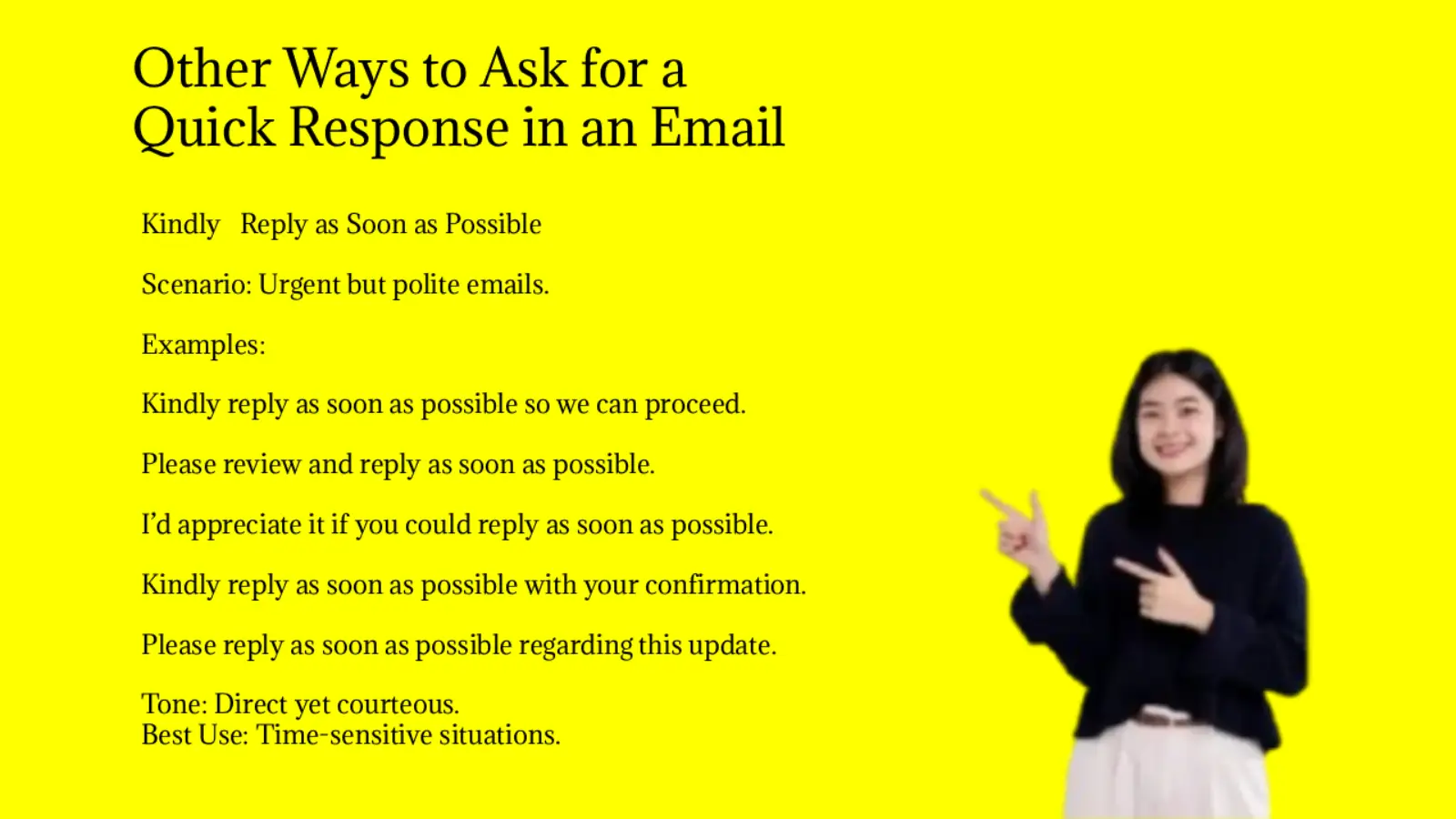
3. Kindly Reply as Soon as Possible
Scenario: Urgent but polite emails.
Examples:
- Kindly reply as soon as possible so we can proceed.
- Please review and reply as soon as possible.
- I’d appreciate it if you could reply as soon as possible.
- Kindly reply as soon as possible with your confirmation.
- Please reply as soon as possible regarding this update.
Tone: Direct yet courteous.
Best Use: Time-sensitive situations.
4. Please Let Me Know at Your Earliest Convenience
Scenario: Semi-formal communication.
Examples:
- Please let me know at your earliest convenience.
- I’d appreciate it if you could let me know soon.
- Kindly let me know your thoughts at your earliest convenience.
- Please let me know your decision at your earliest convenience.
- Let me know at your earliest convenience so we can proceed.
Tone: Polite and flexible.
Best Use: General professional emails.
5. Could You Get Back to Me Soon?
Scenario: Casual professional emails.
Examples:
- Could you get back to me soon on this?
- Please get back to me soon with your input.
- I’d appreciate it if you could get back to me soon.
- Can you get back to me soon regarding this issue?
- Kindly get back to me soon with an update.
Tone: Friendly and conversational.
Best Use: Internal team communication.
6. I Look Forward to Your Quick Reply
Scenario: Closing line in emails.
Examples:
- I look forward to your quick reply.
- Looking forward to your quick response.
- I look forward to your reply soon.
- Eagerly awaiting your quick reply.
- I look forward to hearing from you soon.
Tone: Positive and expectant.
Best Use: Email endings.
7. Please Respond at Your Earliest
Scenario: Short and direct emails.
Examples:
- Please respond at your earliest.
- Kindly respond at your earliest.
- I’d appreciate your response at your earliest.
- Please respond at your earliest with details.
- Respond at your earliest so we can proceed.
Tone: Brief and professional.
Best Use: Quick requests.
8. Your Timely Response Would Be Appreciated
Scenario: Formal requests.
Examples:
- Your timely response would be appreciated.
- I’d appreciate your timely response on this matter.
- Kindly provide a timely response.
- Your timely response will help us proceed.
- A timely response would be highly appreciated.
Tone: Formal and respectful.
Best Use: Clients and senior professionals.
9. Please Reply Promptly
Scenario: Clear urgency.
Examples:
- Please reply promptly to confirm.
- Kindly reply promptly with your feedback.
- Please reply promptly regarding this issue.
- I’d appreciate a prompt reply.
- Please reply promptly so we can move forward.
Tone: Direct and urgent.
Best Use: Tight deadlines.
10. I’d Appreciate Your Quick Feedback
Scenario: Feedback requests.
Examples:
- I’d appreciate your quick feedback on this draft.
- Please share your quick feedback.
- Your quick feedback would be helpful.
- Kindly provide quick feedback on the proposal.
- I’d appreciate your feedback as soon as possible.
Tone: Collaborative and polite.
Best Use: Reviews and approvals.
11. Please Let Me Know as Soon as You Can
Scenario: Friendly urgency.
Examples:
- Please let me know as soon as you can.
- Let me know as soon as you can so we can proceed.
- Kindly let me know as soon as possible.
- Please let me know your availability soon.
- Let me know as soon as you can regarding this.
Tone: Casual yet respectful.
Best Use: Team communication.
12. Could You Kindly Prioritize This?
Scenario: High-priority tasks.
Examples:
- Could you kindly prioritize this request?
- Please prioritize this and respond soon.
- I’d appreciate it if you could prioritize this.
- Kindly prioritize and share your update.
- Please prioritize this matter.
Tone: Firm but polite.
Best Use: Urgent business needs.
13. A Quick Response Would Be Helpful
Scenario: Soft urgency.
Examples:
- A quick response would be helpful.
- It would help if you could respond quickly.
- A quick reply would be appreciated.
- Your quick response would really help.
- A quick response would assist us in planning.
Tone: Gentle and polite.
Best Use: Non-demanding urgency.
14. Please Respond When Possible, Preferably Soon
Scenario: Flexible urgency.
Examples:
- Please respond when possible, preferably soon.
- Kindly reply when you can, preferably soon.
- Respond when possible, but soon if you can.
- Please get back when possible.
- Kindly respond soon if possible.
Tone: Flexible and considerate.
Best Use: Balanced communication.
15. I’d Be Grateful for a Swift Reply
Scenario: Formal gratitude-based request.
Examples:
- I’d be grateful for a swift reply.
- We would be grateful for a swift response.
- Kindly provide a swift reply.
- I’d appreciate a swift reply.
- A swift reply would be greatly appreciated.
Tone: Formal and appreciative.
Best Use: Polite formal emails.
16. Please Get Back to Me at the Earliest
Scenario: Urgent follow-ups.
Examples:
- Please get back to me at the earliest.
- Kindly get back at the earliest with updates.
- Please get back at the earliest regarding this.
- I’d appreciate it if you could get back soon.
- Please get back at the earliest convenience.
Tone: Direct but polite.
Best Use: Follow-up emails.
17. Looking Forward to Your Prompt Reply
Scenario: Email closing.
Examples:
- Looking forward to your prompt reply.
- I’m looking forward to your prompt response.
- Looking forward to hearing from you soon.
- I look forward to your prompt feedback.
- Looking forward to your response.
Tone: Positive and professional.
Best Use: Closing statements.
18. Kindly Provide an Update Soon
Scenario: Status updates.
Examples:
- Kindly provide an update soon.
- Please provide an update soon.
- I’d appreciate an update soon.
- Kindly share an update at your earliest.
- Please update me soon regarding this.
Tone: Polite and direct.
Best Use: Project tracking.
19. Please Confirm at Your Earliest
Scenario: Confirmation requests.
Examples:
- Please confirm at your earliest.
- Kindly confirm at your earliest convenience.
- Please confirm soon so we can proceed.
- I’d appreciate your confirmation soon.
- Kindly confirm availability at your earliest.
Tone: Professional and clear.
Best Use: Scheduling and approvals.
20. I’d Appreciate Hearing Back Soon
Scenario: Friendly follow-up.
Examples:
- I’d appreciate hearing back soon.
- It would be great to hear back soon.
- Kindly let me know soon.
- I’d appreciate your reply soon.
- Hope to hear back from you soon.
Tone: Friendly and polite.
Best Use: Gentle reminders.
21. When You Have a Moment, Please Respond
Scenario: Polite and non-intrusive request.
Examples:
- When you have a moment, please respond to this email.
- Kindly respond when you have a moment.
- Please review and respond when you have time.
- When convenient, please share your response.
- Please get back when you have a moment.
Tone: Gentle and respectful.
Best Use: Low-pressure situations.
22. I’d Appreciate Your Response Soon
Scenario: Friendly urgency.
Examples:
- I’d appreciate your response soon.
- Your response soon would be helpful.
- Kindly share your response soon.
- I’d really appreciate hearing from you soon.
- A response soon would help us proceed.
Tone: Warm and polite.
Best Use: General follow-ups.
23. Please Reply at Your Earliest Possible Time
Scenario: Formal email request.
Examples:
- Please reply at your earliest possible time.
- Kindly respond at your earliest possible time.
- I’d appreciate your reply at your earliest possible time.
- Please review and reply at your earliest.
- Kindly get back at your earliest possible time.
Tone: Formal and courteous.
Best Use: Professional communication.
24. Could You Please Update Me Soon?
Scenario: Asking for updates.
Examples:
- Could you please update me soon?
- Kindly update me soon regarding this.
- Please update me soon with progress.
- I’d appreciate an update soon.
- Could you update me soon on this matter?
Tone: Polite and direct.
Best Use: Project updates.
25. Please Don’t Delay in Responding
Scenario: Clear urgency.
Examples:
- Please don’t delay in responding.
- Kindly don’t delay your response.
- Please avoid delays in replying.
- A quick reply without delay would help.
- Please respond without delay.
Tone: Firm but professional.
Best Use: Time-critical matters.
26. Your Quick Attention Is Needed
Scenario: High-priority requests.
Examples:
- Your quick attention is needed on this matter.
- This requires your quick attention.
- Kindly give this your immediate attention.
- Your prompt attention would be appreciated.
- Please address this as soon as possible.
Tone: Urgent and professional.
Best Use: Critical tasks.
27. Please Share Your Input Soon
Scenario: Collaborative emails.
Examples:
- Please share your input soon.
- I’d appreciate your input soon.
- Kindly share your thoughts soon.
- Please provide your input as soon as possible.
- Your input soon would help us move forward.
Tone: Cooperative and polite.
Best Use: Team discussions.
28. Kindly Revert at the Earliest
Scenario: Business or corporate emails.
Examples:
- Kindly revert at the earliest.
- Please revert at your earliest convenience.
- Kindly revert soon with your feedback.
- Please revert regarding this matter.
- Revert at the earliest so we can proceed.
Tone: Formal and business-like.
Best Use: Corporate communication.
29. Please Respond Within [Timeframe]
Scenario: Deadline-specific request.
Examples:
- Please respond within 24 hours.
- Kindly reply within the given timeframe.
- Please respond by tomorrow.
- I’d appreciate a response within two days.
- Please reply before the deadline.
Tone: Clear and structured.
Best Use: Deadlines and deliverables.
30. I’d Appreciate a Speedy Reply
Scenario: Polite urgency.
Examples:
- I’d appreciate a speedy reply.
- A speedy reply would be helpful.
- Kindly provide a speedy response.
- I’d appreciate a quick turnaround.
- A speedy reply would help us proceed.
Tone: Polite with urgency.
Best Use: Quick decisions.
31. Please Treat This as Urgent
Scenario: Critical matters.
Examples:
- Please treat this as urgent.
- Kindly treat this request as urgent.
- This matter should be treated as urgent.
- Please prioritize and treat this urgently.
- Urgent attention is required here.
Tone: Direct and serious.
Best Use: High-priority issues.
32. Awaiting Your Prompt Response
Scenario: Formal closing.
Examples:
- Awaiting your prompt response.
- We are awaiting your prompt reply.
- Awaiting your response soon.
- I am awaiting your reply.
- Awaiting your feedback at the earliest.
Tone: Formal and expectant.
Best Use: Email endings.
33. Please Let Me Have Your Response Soon
Scenario: Polite request.
Examples:
- Please let me have your response soon.
- Kindly let me have your feedback soon.
- I’d appreciate if you could send your response soon.
- Please let me have your update soon.
- Kindly share your response soon.
Tone: Gentle and formal.
Best Use: Professional communication.
34. A Prompt Reply Will Help Us Proceed
Scenario: Explaining urgency.
Examples:
- A prompt reply will help us proceed.
- Your prompt response will help move things forward.
- A quick reply will allow us to continue.
- Prompt feedback will help us finalize.
- A prompt reply would be beneficial.
Tone: Logical and polite.
Best Use: Workflow-related emails.
35. Please Respond Without Much Delay
Scenario: Mild urgency.
Examples:
- Please respond without much delay.
- Kindly reply without delay.
- Please respond soon without delay.
- Avoid delays in responding.
- Kindly get back without delay.
Tone: Slightly firm but polite.
Best Use: Follow-ups.
36. Kindly Expedite Your Response
Scenario: Formal urgency.
Examples:
- Kindly expedite your response.
- Please expedite your reply.
- I’d appreciate it if you could expedite this.
- Kindly speed up your response.
- Please prioritize and expedite your reply.
Tone: Formal and urgent.
Best Use: Business-critical communication.
37. I’d Appreciate a Timely Reply
Scenario: Professional emails.
Examples:
- I’d appreciate a timely reply.
- A timely reply would be helpful.
- Kindly provide a timely response.
- I’d appreciate your timely feedback.
- Please ensure a timely reply.
Tone: Professional and respectful.
Best Use: General workplace emails.
38. Please Get Back to Me Quickly
Scenario: Casual urgency.
Examples:
- Please get back to me quickly.
- Can you get back to me quickly on this?
- Kindly respond quickly.
- Please reply quickly with your thoughts.
- Get back to me quickly so we can proceed.
Tone: Casual and direct.
Best Use: Team chats or informal emails.
39. Hoping for a Quick Turnaround
Scenario: Project-related emails.
Examples:
- Hoping for a quick turnaround on this.
- I’m hoping for a quick turnaround.
- A quick turnaround would be appreciated.
- We’re expecting a quick turnaround.
- Kindly ensure a quick turnaround.
Tone: Professional and optimistic.
Best Use: Deadlines and deliverables.
40. Please Respond as a Priority
Scenario: High-priority requests.
Examples:
- Please respond as a priority.
- Kindly treat this as a priority and respond.
- Please prioritize your response.
- This should be handled as a priority.
- Respond as a priority to proceed.
Tone: Firm and professional.
Best Use: Urgent business needs.
41. I’d Appreciate a Fast Response
Scenario: Direct but polite.
Examples:
- I’d appreciate a fast response.
- A fast response would be helpful.
- Kindly provide a fast response.
- Please respond fast if possible.
- A fast reply would help us proceed.
Tone: Direct and polite.
Best Use: Quick clarifications.
42. Please Don’t Hesitate to Reply Soon
Scenario: Friendly encouragement.
Examples:
- Please don’t hesitate to reply soon.
- Feel free to reply soon.
- Don’t hesitate to get back soon.
- Kindly reply soon without hesitation.
- Please respond soon.
Tone: Friendly and encouraging.
Best Use: Informal emails.
43. Kindly Acknowledge and Respond Soon
Scenario: Confirmation + response.
Examples:
- Kindly acknowledge and respond soon.
- Please confirm receipt and respond soon.
- Kindly acknowledge this email and reply.
- Please acknowledge and respond promptly.
- Kindly confirm and respond soon.
Tone: Professional and clear.
Best Use: Important communications.
44. Please Prioritize This and Respond
Scenario: Urgent tasks.
Examples:
- Please prioritize this and respond.
- Kindly prioritize and reply soon.
- Please handle this first and respond.
- Prioritize this request and respond.
- Please give this priority and respond.
Tone: Firm and directive.
Best Use: High-importance work.
45. I’d Value a Quick Reply
Scenario: Respectful tone.
Examples:
- I’d value a quick reply.
- Your quick reply would be valued.
- Kindly provide a quick reply.
- I’d truly value your prompt response.
- A quick reply would be appreciated.
Tone: Polite and appreciative.
Best Use: Professional emails.
46. Please Circle Back Soon
Scenario: Modern workplace language.
Examples:
- Please circle back soon on this.
- Kindly circle back with your update.
- Please circle back as soon as possible.
- Circle back soon with your feedback.
- Please circle back regarding this matter.
Tone: Casual corporate.
Best Use: Office communication.
47. Can You Respond Quickly?
Scenario: Direct request.
Examples:
- Can you respond quickly to this?
- Could you respond quickly regarding this matter?
- Can you reply quickly with your feedback?
- Please respond quickly so we can proceed.
- Can you get back quickly on this?
Tone: Direct and simple.
Best Use: Informal or urgent situations.
Conclusion
Asking for a quick response in an email doesn’t need to sound pushy. With the right phrasing, you can express urgency while staying polite and professional. These 47 alternatives give you flexibility for every situation—whether you’re writing formal business emails, following up with clients, or chatting with your team. Choosing the right tone helps you get faster replies while maintaining strong, respectful communication.