Ever found yourself searching for Other Ways to Say A Little Bit because the phrase feels overused or repetitive? While “a little bit” works in many situations, relying on it too often can make your writing and conversations sound less engaging.
The challenge is that “a little bit” can describe a small amount, a slight difference, or a minor degree of something. And here’s the kicker: using a more precise expression can make your message clearer, more natural, and more impactful.
Many people look for alternatives when writing emails, essays, social media posts, or everyday messages. Whether you need a synonym for a small quantity, a phrase that suggests a slight change, or a more professional way to express a limited amount, choosing the right words can strengthen your communication.
But don’t worry—there are plenty of excellent options available.
In this guide, you’ll discover Other Ways to Say A Little Bit, including formal, casual, and professional alternatives for different contexts. You’ll also learn how to use these expressions correctly and see examples that help you describe a small degree, tiny amount, or slight variation with confidence.
So if you’re ready to expand your vocabulary and make your language more polished, keep reading—you’ll find plenty of useful alternatives ahead.
What Does “Little Bit” Mean?
“Little bit” refers to a small amount, degree, or extent of something. It is commonly used to describe minor quantities, slight changes, or small levels of emotion, effort, time, or progress.
For example:
- I’m feeling a little bit tired.
- Can you move it a little bit to the left?
- We only need a little bit more time.
When to Use “Little Bit”
You can use “little bit” when talking about:
- Small amounts of something
- Slight changes or improvements
- Mild emotions or reactions
- Limited quantities of time, effort, or resources
- Casual conversations and everyday communication
Is It Professional/Polite to Say “Little Bit”?
Yes, “little bit” is both polite and widely accepted. However, in professional or formal writing, alternatives such as “slightly,” “somewhat,” “a small amount,” or “to a certain extent” may sound more polished and precise.
1. A Small Amount
Scenario: Discussing limited quantities.
Examples:
- We only need a small amount of information.
- Add a small amount of salt to the recipe.
- A small amount of effort can make a difference.
- There is only a small amount remaining.
- We invested a small amount to start.
Tone: Neutral and professional.
Best Use: Formal writing and business communication.
2. Slightly
Scenario: Describing a minor change.
Examples:
- The results improved slightly.
- I’m slightly concerned about the deadline.
- The room feels slightly warmer.
- Sales increased slightly this month.
- The design was slightly adjusted.
Tone: Professional and precise.
Best Use: Reports, emails, and formal discussions.
3. Somewhat
Scenario: Expressing a moderate degree.
Examples:
- I’m somewhat familiar with the process.
- The task was somewhat challenging.
- She seemed somewhat surprised.
- The issue is somewhat complicated.
- We are somewhat ahead of schedule.
Tone: Thoughtful and measured.
Best Use: Professional and academic settings.
4. A Touch
Scenario: Casual conversations.
Examples:
- The soup needs a touch more seasoning.
- I’m feeling a touch tired today.
- Could you lower the volume a touch?
- The color looks a touch darker.
- It’s a touch cooler outside.
Tone: Friendly and conversational.
Best Use: Informal speech.
5. A Tad
Scenario: Informal communication.
Examples:
- I’m a tad busy right now.
- The movie was a tad long.
- Turn it up a tad.
- She looks a tad nervous.
- We arrived a tad early.
Tone: Casual and relaxed.
Best Use: Everyday conversations.
6. A Bit
Scenario: Simple replacement for “little bit.”
Examples:
- I’m a bit tired.
- Could you wait a bit longer?
- The task is a bit difficult.
- We need a bit more time.
- He seemed a bit upset.
Tone: Natural and versatile.
Best Use: Daily conversations and writing.
7. A Fraction
Scenario: Referring to a very small amount.
Examples:
- Costs dropped by a fraction.
- We only need a fraction of the budget.
- A fraction more effort would help.
- The difference is only a fraction.
- It moved a fraction to the right.
Tone: Precise and analytical.
Best Use: Technical and numerical discussions.
8. Marginally
Scenario: Describing minimal change.
Examples:
- Revenue increased marginally.
- The score improved marginally.
- Conditions are marginally better.
- The update was marginally effective.
- Performance improved marginally.
Tone: Professional and formal.
Best Use: Business reports and analysis.
9. To Some Degree
Scenario: Expressing partial extent.
Examples:
- I agree to some degree.
- The changes helped to some degree.
- We succeeded to some degree.
- It affected everyone to some degree.
- The solution worked to some degree.
Tone: Balanced and objective.
Best Use: Formal discussions.
10. A Hint Of
Scenario: Describing slight presence.
Examples:
- There was a hint of excitement.
- The dish has a hint of garlic.
- I noticed a hint of frustration.
- The sky showed a hint of pink.
- His voice carried a hint of doubt.
Tone: Descriptive and expressive.
Best Use: Creative writing.
11. Slightly More
Scenario: Comparing small increases.
Examples:
- We need slightly more information.
- The second option is slightly more affordable.
- She arrived slightly more prepared.
- Demand was slightly more than expected.
- The updated version is slightly more efficient.
Tone: Professional.
Best Use: Comparisons and evaluations.
12. A Smidgen
Scenario: Informal reference to tiny amounts.
Examples:
- Add a smidgen of sugar.
- I’m a smidgen tired.
- Move it a smidgen left.
- The room is a smidgen brighter.
- We need a smidgen more patience.
Tone: Playful and casual.
Best Use: Friendly conversations.
13. A Trace
Scenario: Referring to a very small presence.
Examples:
- There was a trace of sadness.
- The report showed a trace of improvement.
- A trace of doubt remained.
- We found a trace of evidence.
- The scent carried a trace of vanilla.
Tone: Descriptive.
Best Use: Writing and storytelling.
14. Moderately
Scenario: Expressing limited intensity.
Examples:
- The task was moderately difficult.
- Sales performed moderately well.
- She was moderately interested.
- The weather was moderately warm.
- Traffic was moderately heavy.
Tone: Professional.
Best Use: Formal descriptions.
15. A Measure Of
Scenario: Describing a small degree.
Examples:
- He showed a measure of patience.
- There was a measure of success.
- The plan achieved a measure of progress.
- She felt a measure of relief.
- The project gained a measure of support.
Tone: Formal and thoughtful.
Best Use: Professional writing.
16. Kind Of
Scenario: Casual conversations.
Examples:
- I’m kind of tired.
- It’s kind of interesting.
- We’re kind of busy today.
- She looked kind of confused.
- I’m kind of excited.
Tone: Informal and conversational.
Best Use: Everyday speech.
17. Sort Of
Scenario: Informal approximation.
Examples:
- I sort of understand.
- It sort of makes sense.
- We sort of finished the project.
- She sort of agreed.
- I’m sort of nervous.
Tone: Casual.
Best Use: Relaxed conversations.
18. A Drop
Scenario: Very small quantity.
Examples:
- Add a drop of lemon juice.
- There wasn’t a drop left.
- Just a drop more paint.
- A drop of kindness helps.
- We need a drop more fuel.
Tone: Simple and visual.
Best Use: Quantities and descriptions.
19. Barely
Scenario: Describing minimal extent.
Examples:
- I’m barely awake.
- The project barely met expectations.
- We barely finished on time.
- He barely noticed.
- The change was barely visible.
Tone: Direct and emphatic.
Best Use: Emphasizing small degrees.
20. Minimally
Scenario: Professional contexts.
Examples:
- Costs increased minimally.
- The design changed minimally.
- Risk was minimally affected.
- Productivity decreased minimally.
- The impact was minimally significant.
Tone: Formal.
Best Use: Business and technical writing.
21. To A Small Extent
Scenario: Formal explanation.
Examples:
- The policy helped to a small extent.
- We agree to a small extent.
- The update improved performance to a small extent.
- It contributed to a small extent.
- Demand rose to a small extent.
Tone: Professional.
Best Use: Reports and analysis.
22. A Little
Scenario: Simple everyday use.
Examples:
- I’m a little tired.
- We need a little help.
- Could you wait a little longer?
- She was a little surprised.
- The room is a little cold.
Tone: Natural and friendly.
Best Use: General conversations.
23. Partially
Scenario: Describing incomplete extent.
Examples:
- The task was partially completed.
- I partially agree.
- The issue was partially resolved.
- Funding was partially approved.
- The solution worked partially.
Tone: Neutral and professional.
Best Use: Formal communication.
24. In Small Measure
Scenario: Formal expression.
Examples:
- Success came in small measure.
- The effort helped in small measure.
- Progress occurred in small measure.
- Relief arrived in small measure.
- Support came in small measure.
Tone: Formal and elegant.
Best Use: Professional and literary writing.
25. A Hair
Scenario: Tiny difference.
Examples:
- Move it a hair to the left.
- The price is a hair higher.
- We arrived a hair late.
- The image is a hair blurry.
- She’s a hair taller.
Tone: Casual and conversational.
Best Use: Informal speech.
26. Just A Touch
Scenario: Friendly conversations.
Examples:
- I’m just a touch concerned.
- Add just a touch more spice.
- The room is just a touch warm.
- The design needs just a touch of color.
- He seemed just a touch nervous.
Tone: Friendly and soft.
Best Use: Casual communication.
27. Slightly Less
Scenario: Comparing reductions.
Examples:
- Costs were slightly less this month.
- The second option is slightly less expensive.
- Demand was slightly less than expected.
- We spent slightly less time.
- Traffic was slightly less busy.
Tone: Professional.
Best Use: Comparisons and reports.
28. In Part
Scenario: Partial contribution.
Examples:
- The success was due in part to teamwork.
- The issue occurred in part because of delays.
- Growth happened in part because of marketing.
- The improvement came in part from training.
- Results were achieved in part through planning.
Tone: Formal and analytical.
Best Use: Professional writing.
29. A Whisper Of
Scenario: Creative description.
Examples:
- There was a whisper of hope.
- The sky held a whisper of color.
- A whisper of doubt remained.
- Her smile showed a whisper of confidence.
- The air carried a whisper of rain.
Tone: Poetic and expressive.
Best Use: Creative and descriptive writing.
30. Ever So Slightly
Scenario: Emphasizing a very small degree.
Examples:
- The angle shifted ever so slightly.
- I’m ever so slightly concerned.
- Prices rose ever so slightly.
- The color changed ever so slightly.
- Performance improved ever so slightly.
Tone: Polite and refined.
Best Use: Formal writing and subtle descriptions.
31. A Tiny Amount
Scenario: Referring to a very small quantity.
Examples:
- We only need a tiny amount of paint.
- Add a tiny amount of sugar.
- A tiny amount of effort can help.
- There is a tiny amount left.
- We spent a tiny amount on supplies.
Tone: Simple and clear.
Best Use: Everyday conversations and instructions.
32. A Pinch
Scenario: Describing a very small amount.
Examples:
- Add a pinch of salt.
- There was a pinch of doubt in his voice.
- We need a pinch more creativity.
- She felt a pinch of nervousness.
- A pinch of patience goes a long way.
Tone: Casual and descriptive.
Best Use: Cooking and informal conversations.
33. A Scant Amount
Scenario: Talking about limited quantities.
Examples:
- We have a scant amount of time.
- Only a scant amount of evidence exists.
- The budget left a scant amount for extras.
- There was a scant amount of information available.
- They worked with a scant amount of resources.
Tone: Formal and precise.
Best Use: Professional and academic writing.
34. To A Limited Extent
Scenario: Describing something that applies only partially.
Examples:
- The strategy worked to a limited extent.
- We agreed to a limited extent.
- The changes helped to a limited extent.
- The solution addressed the issue to a limited extent.
- The update improved performance to a limited extent.
Tone: Professional and analytical.
Best Use: Reports and evaluations.
35. A Dash
Scenario: Referring to a small quantity or touch.
Examples:
- Add a dash of cinnamon.
- Her speech included a dash of humor.
- We need a dash of creativity.
- The design uses a dash of color.
- He showed a dash of confidence.
Tone: Friendly and expressive.
Best Use: Creative writing and casual speech.
36. A Modicum
Scenario: Formal reference to a small amount.
Examples:
- A modicum of patience is required.
- They achieved a modicum of success.
- We need a modicum of evidence.
- She showed a modicum of interest.
- The project received a modicum of support.
Tone: Formal and sophisticated.
Best Use: Professional and literary writing.
37. A Speck
Scenario: Emphasizing an extremely small amount.
Examples:
- There wasn’t a speck of dust.
- He showed a speck of concern.
- We found a speck of evidence.
- The sky didn’t have a speck of cloud.
- Not a speck of doubt remained.
Tone: Visual and descriptive.
Best Use: Storytelling and vivid descriptions.
38. Slightly Better
Scenario: Describing minor improvement.
Examples:
- The results are slightly better now.
- I’m feeling slightly better today.
- Sales performed slightly better this quarter.
- The revised draft is slightly better.
- Conditions became slightly better overnight.
Tone: Professional and conversational.
Best Use: Comparisons and progress updates.
39. A Wee Bit
Scenario: Friendly and informal expression.
Examples:
- I’m a wee bit tired.
- The room feels a wee bit cold.
- Could you move it a wee bit closer?
- She’s a wee bit nervous.
- We need a wee bit more time.
Tone: Warm and casual.
Best Use: Informal conversations.
40. Just A Fraction
Scenario: Highlighting a very small difference.
Examples:
- Costs increased by just a fraction.
- We need just a fraction more effort.
- The image moved just a fraction.
- The score improved by just a fraction.
- Demand rose just a fraction.
Tone: Precise and factual.
Best Use: Data and technical discussions.
41. In A Minor Way
Scenario: Referring to a small impact or degree.
Examples:
- The changes helped in a minor way.
- The issue affected us in a minor way.
- The update improved performance in a minor way.
- It contributed in a minor way to success.
- The delay impacted the project in a minor way.
Tone: Neutral and professional.
Best Use: Formal discussions and reports.
42. Not Much
Scenario: Casual expression for a small amount.
Examples:
- There’s not much left to do.
- We don’t need not much more time.
- Not much changed this week.
- I ate not much for lunch.
- There’s not much difference between them.
Tone: Informal and direct.
Best Use: Everyday conversations.
43. A Shade
Scenario: Referring to a slight difference.
Examples:
- The blue is a shade darker.
- Prices are a shade higher.
- She seemed a shade concerned.
- The room feels a shade warmer.
- The second option is a shade better.
Tone: Subtle and conversational.
Best Use: Comparisons and descriptions.
44. By A Small Margin
Scenario: Describing a slight difference.
Examples:
- We won by a small margin.
- Sales increased by a small margin.
- The proposal passed by a small margin.
- Productivity improved by a small margin.
- The team led by a small margin.
Tone: Professional and factual.
Best Use: Business, sports, and analytics.
45. A Trickle
Scenario: Referring to a small flow or amount.
Examples:
- Orders arrived in a trickle.
- Donations came in a trickle.
- Information was released in a trickle.
- Customers entered in a trickle.
- Leads started coming in a trickle.
Tone: Descriptive and visual.
Best Use: Business reports and storytelling.
46. To A Minor Degree
Scenario: Formal expression for a small extent.
Examples:
- The decision affected profits to a minor degree.
- We agree to a minor degree.
- The policy succeeded to a minor degree.
- The changes improved efficiency to a minor degree.
- The issue influenced results to a minor degree.
Tone: Formal and analytical.
Best Use: Academic and professional writing.
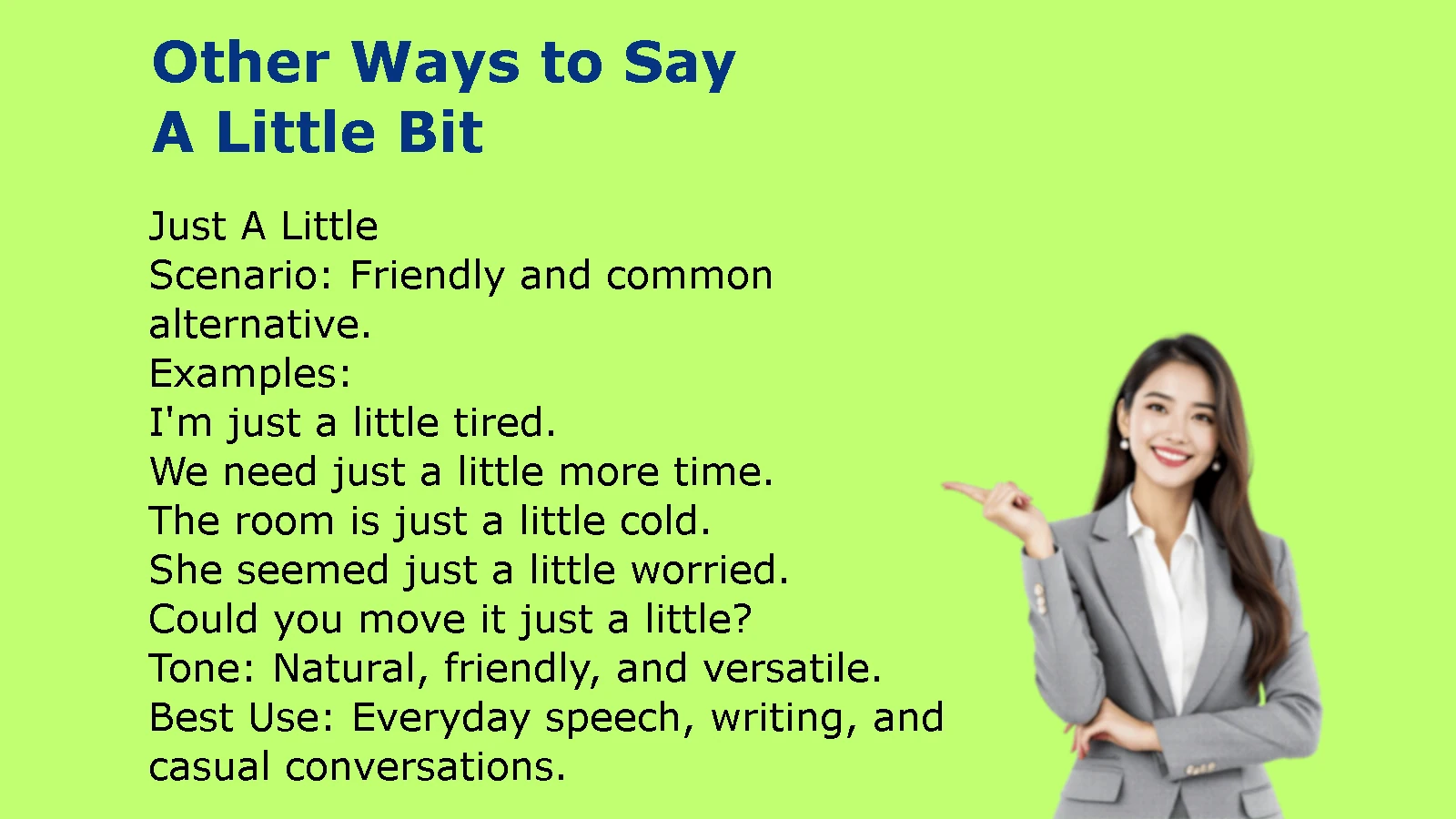
47. Just A Little
Scenario: Friendly and common alternative.
Examples:
- I’m just a little tired.
- We need just a little more time.
- The room is just a little cold.
- She seemed just a little worried.
- Could you move it just a little?
Tone: Natural, friendly, and versatile.
Best Use: Everyday speech, writing, and casual conversations.
Conclusion
While “little bit” is a common and useful phrase, relying on it too often can make your writing and conversations feel repetitive. Using alternatives such as “a bit,” “slightly,” “a tad,” “a small amount,” or “to a limited extent” allows you to express small quantities, minor changes, or subtle feelings with greater variety and precision.
The best alternative depends on the situation. Casual expressions work well in everyday conversations, while formal options are better suited for professional emails, reports, and academic writing. By incorporating these 47 other ways to say “little bit,” you can make your communication more engaging, natural, and tailored to your audience.