Ever wondered if there are more polished or natural ways to say Other Ways to Say “First of All” in writing or speech? Whether you’re starting an essay, structuring an argument, or speaking in a professional setting, repeating the same phrase can quickly feel repetitive and flat.
That’s the challenge. You want to sound clear and organized, but using “first of all” too often can make your language feel basic or overused. And here’s the kicker: in formal writing or presentations, your opening words set the tone for everything that follows.
But don’t worry—there are plenty of better options.
In this guide, you’ll discover Other Ways to Say “First of All”, along with polite ways to start a sentence, formal transition phrases, and alternative sequencing expressions that improve clarity and flow. You’ll also learn how to use transition words for writing, essay introduction phrases, and structured opening expressions to make your communication sound more natural and professional.
So, whether you’re writing an essay, giving a presentation, or simply trying to sound more fluent, this breakdown will give you the right words to start strong every time.
What Does “First of All” Mean?
“First of all” is a transitional phrase used to introduce the initial point in a discussion, explanation, argument, or list. It signals that more points or information will follow and helps organize thoughts clearly.
When to Use “First of All”
Use “first of all” when presenting multiple ideas, giving instructions, making an argument, explaining a process, or emphasizing the most important starting point. It works in both spoken and written communication.
Is It Professional/Polite to Say “First of All”?
Yes, “first of all” is generally professional and polite. However, in formal writing, business communication, and academic contexts, alternatives such as “to begin with,” “initially,” or “in the first place” may sound more polished and sophisticated.
1. To Begin With
Scenario: Starting an explanation or discussion.
Examples:
- To begin with, we need to review the project goals.
- To begin with, let’s examine the facts.
- To begin with, customer feedback has been positive.
- To begin with, I appreciate your time today.
- To begin with, there are several options available.
Tone: Professional and organized.
Best Use: Formal presentations, reports, and meetings.
2. Firstly
Scenario: Structured writing or speeches.
Examples:
- Firstly, thank you for joining us.
- Firstly, we should identify the problem.
- Firstly, let’s discuss the budget.
- Firstly, safety must be our priority.
- Firstly, I would like to clarify the objective.
Tone: Formal and academic.
Best Use: Essays, reports, and professional discussions.
3. First
Scenario: Simple and direct communication.
Examples:
- First, let’s address the main concern.
- First, gather all the necessary information.
- First, I want to thank everyone.
- First, let’s look at the data.
- First, we need a clear strategy.
Tone: Clear and concise.
Best Use: Everyday conversations and instructions.
4. Initially
Scenario: Describing the starting stage of a process.
Examples:
- Initially, the project faced several challenges.
- Initially, we planned a smaller launch.
- Initially, customer interest was limited.
- Initially, the team worked remotely.
- Initially, we considered another approach.
Tone: Professional and analytical.
Best Use: Business reports and project discussions.
5. At the Outset
Scenario: Formal introductions.
Examples:
- At the outset, I’d like to thank our sponsors.
- At the outset, it’s important to define our goals.
- At the outset, we should establish expectations.
- At the outset, the company focused on growth.
- At the outset, transparency was a key value.
Tone: Formal and sophisticated.
Best Use: Speeches, reports, and official documents.
6. In the First Place
Scenario: Explaining reasoning.
Examples:
- In the first place, why was the policy created?
- In the first place, we need to understand the issue.
- In the first place, the decision was based on data.
- In the first place, safety concerns prompted the change.
- In the first place, we wanted better results.
Tone: Logical and persuasive.
Best Use: Arguments and explanations.
7. To Start With
Scenario: Casual or professional introductions.
Examples:
- To start with, let’s review the agenda.
- To start with, I’d like your opinion.
- To start with, we need a plan.
- To start with, the results look promising.
- To start with, let’s discuss expectations.
Tone: Friendly and approachable.
Best Use: Meetings and conversations.
8. Before Anything Else
Scenario: Emphasizing priority.
Examples:
- Before anything else, thank you for your support.
- Before anything else, ensure everyone is safe.
- Before anything else, let’s clarify the objectives.
- Before anything else, complete the registration.
- Before anything else, check the requirements.
Tone: Emphatic and thoughtful.
Best Use: Prioritizing important information.
9. The First Thing Is
Scenario: Giving instructions.
Examples:
- The first thing is to understand the problem.
- The first thing is gathering accurate information.
- The first thing is creating a timeline.
- The first thing is contacting the client.
- The first thing is reviewing the proposal.
Tone: Practical and direct.
Best Use: Training and guidance.
10. Primarily
Scenario: Highlighting the main point.
Examples:
- Primarily, our focus is customer satisfaction.
- Primarily, the budget affects the decision.
- Primarily, we aim to improve efficiency.
- Primarily, the issue concerns communication.
- Primarily, the project serves local communities.
Tone: Professional and focused.
Best Use: Business communication.
11. As a Starting Point
Scenario: Introducing an initial idea.
Examples:
- As a starting point, let’s analyze the data.
- As a starting point, consider customer needs.
- As a starting point, we should define success.
- As a starting point, review previous results.
- As a starting point, let’s discuss priorities.
Tone: Collaborative and strategic.
Best Use: Planning sessions.
12. At First
Scenario: Discussing beginnings.
Examples:
- At first, the process seemed complicated.
- At first, we expected different results.
- At first, there was some confusion.
- At first, participation was low.
- At first, the strategy appeared risky.
Tone: Reflective and conversational.
Best Use: Storytelling and explanations.
13. Foremost
Scenario: Highlighting importance.
Examples:
- Foremost, we value integrity.
- Foremost, customer safety comes first.
- Foremost, education remains our mission.
- Foremost, we seek long-term success.
- Foremost, quality is our priority.
Tone: Strong and authoritative.
Best Use: Formal speeches and leadership communication.
14. To Kick Things Off
Scenario: Informal introductions.
Examples:
- To kick things off, let’s hear from our guest.
- To kick things off, we’ll review the highlights.
- To kick things off, I’d like to thank everyone.
- To kick things off, let’s share ideas.
- To kick things off, here’s a quick overview.
Tone: Energetic and engaging.
Best Use: Events and team meetings.
15. Let’s Start By
Scenario: Guiding a process.
Examples:
- Let’s start by reviewing the objectives.
- Let’s start by gathering information.
- Let’s start by identifying challenges.
- Let’s start by setting expectations.
- Let’s start by outlining the plan.
Tone: Collaborative and friendly.
Best Use: Workshops and discussions.
16. Most Importantly
Scenario: Highlighting a key first point.
Examples:
- Most importantly, everyone remained safe.
- Most importantly, customers were satisfied.
- Most importantly, we met our goals.
- Most importantly, communication improved.
- Most importantly, the project stayed on schedule.
Tone: Emphatic and professional.
Best Use: Presentations and summaries.
17. At the Beginning
Scenario: Referring to an initial stage.
Examples:
- At the beginning, we faced uncertainty.
- At the beginning, expectations were modest.
- At the beginning, resources were limited.
- At the beginning, the team was small.
- At the beginning, we focused on planning.
Tone: Narrative and reflective.
Best Use: Storytelling and reports.
18. For Starters
Scenario: Casual discussions.
Examples:
- For starters, we need more information.
- For starters, let’s check the numbers.
- For starters, customer demand is increasing.
- For starters, the website needs updates.
- For starters, let’s discuss the basics.
Tone: Conversational and relaxed.
Best Use: Informal meetings and chats.
19. To Open With
Scenario: Beginning a speech or presentation.
Examples:
- To open with, I’d like to share a story.
- To open with, let’s examine the facts.
- To open with, thank you all for attending.
- To open with, here’s an important update.
- To open with, let’s review the objectives.
Tone: Professional and polished.
Best Use: Public speaking.
20. As an Initial Step
Scenario: Process explanations.
Examples:
- As an initial step, complete the application.
- As an initial step, review the guidelines.
- As an initial step, gather the documents.
- As an initial step, define your goals.
- As an initial step, consult the team.
Tone: Structured and professional.
Best Use: Instructions and procedures.
21. Above All Else
Scenario: Stressing importance.
Examples:
- Above all else, prioritize safety.
- Above all else, remain honest.
- Above all else, focus on quality.
- Above all else, support your team.
- Above all else, respect deadlines.
Tone: Strong and authoritative.
Best Use: Leadership and motivational communication.
22. At the Start
Scenario: Referring to the beginning of an event.
Examples:
- At the start, everyone was uncertain.
- At the start, we reviewed the plan.
- At the start, goals were clearly defined.
- At the start, resources were limited.
- At the start, the team met daily.
Tone: Neutral and informative.
Best Use: Reports and narratives.
23. To Lead Off
Scenario: Introducing the first point.
Examples:
- To lead off, let’s discuss the budget.
- To lead off, I’d like to share some data.
- To lead off, here are the key findings.
- To lead off, let’s review our objectives.
- To lead off, thank you for being here.
Tone: Professional and organized.
Best Use: Presentations and meetings.
24. The First Step Is
Scenario: Instructions and planning.
Examples:
- The first step is defining your goal.
- The first step is collecting data.
- The first step is contacting support.
- The first step is reviewing the contract.
- The first step is building a strategy.
Tone: Direct and instructional.
Best Use: Tutorials and guidance.
25. Before We Begin
Scenario: Opening remarks.
Examples:
- Before we begin, I’d like to thank everyone.
- Before we begin, let’s review the rules.
- Before we begin, are there any questions?
- Before we begin, let’s outline the agenda.
- Before we begin, please silence your phones.
Tone: Polite and professional.
Best Use: Meetings, seminars, and presentations.
26. To Commence
Scenario: Formal introductions.
Examples:
- To commence, let’s discuss the objectives.
- To commence, I would like to welcome everyone.
- To commence, we will review the findings.
- To commence, let’s establish priorities.
- To commence, we’ll begin with an overview.
Tone: Highly formal.
Best Use: Official speeches and documents.
27. First and Foremost
Scenario: Emphasizing the most important point.
Examples:
- First and foremost, thank you for your dedication.
- First and foremost, safety remains our priority.
- First and foremost, we value our customers.
- First and foremost, honesty is essential.
- First and foremost, teamwork drives success.
Tone: Strong and respectful.
Best Use: Leadership and professional communication.
28. As a First Measure
Scenario: Discussing actions and plans.
Examples:
- As a first measure, conduct a risk assessment.
- As a first measure, gather feedback.
- As a first measure, review current policies.
- As a first measure, analyze the data.
- As a first measure, establish objectives.
Tone: Strategic and professional.
Best Use: Business planning.
29. At the Very Beginning
Scenario: Emphasizing an early stage.
Examples:
- At the very beginning, expectations were unclear.
- At the very beginning, resources were scarce.
- At the very beginning, we focused on learning.
- At the very beginning, progress was slow.
- At the very beginning, the concept was simple.
Tone: Reflective and descriptive.
Best Use: Storytelling and reports.
30. To Get Started
Scenario: Beginning a task or discussion.
Examples:
- To get started, let’s review the basics.
- To get started, gather the necessary materials.
- To get started, here’s a brief overview.
- To get started, let’s identify the key issues.
- To get started, we’ll discuss the objectives.
Tone: Friendly and practical.
Best Use: Tutorials, meetings, and training sessions.
31. To Begin
Scenario: Starting a discussion or explanation.
Examples:
- To begin, let’s review the main objectives.
- To begin, I’d like to thank everyone for attending.
- To begin, we should examine the available data.
- To begin, let’s clarify our expectations.
- To begin, here is a brief overview of the project.
Tone: Professional and straightforward.
Best Use: Meetings, presentations, and formal writing.
32. As a First Point
Scenario: Presenting an organized argument or explanation.
Examples:
- As a first point, customer satisfaction has improved.
- As a first point, we need to identify the problem.
- As a first point, the budget requires attention.
- As a first point, communication must be strengthened.
- As a first point, let’s discuss the timeline.
Tone: Structured and analytical.
Best Use: Reports, essays, and business discussions.
33. Before Moving Forward
Scenario: Introducing an essential starting idea.
Examples:
- Before moving forward, let’s review the requirements.
- Before moving forward, we need approval from management.
- Before moving forward, it’s important to understand the risks.
- Before moving forward, let’s address the main concern.
- Before moving forward, please complete the necessary forms.
Tone: Thoughtful and professional.
Best Use: Planning sessions and project management.
34. As an Opening Remark
Scenario: Beginning a speech or presentation.
Examples:
- As an opening remark, I’d like to thank our guests.
- As an opening remark, let me share a brief story.
- As an opening remark, let’s consider the current challenges.
- As an opening remark, I want to recognize the team’s efforts.
- As an opening remark, here’s some important context.
Tone: Formal and polished.
Best Use: Public speaking and official events.
35. To Set the Stage
Scenario: Introducing background information.
Examples:
- To set the stage, let’s review recent developments.
- To set the stage, I’ll explain how we got here.
- To set the stage, consider the market conditions.
- To set the stage, let’s look at some key statistics.
- To set the stage, here’s a quick summary of events.
Tone: Engaging and informative.
Best Use: Presentations, storytelling, and reports.
36. The Starting Point Is
Scenario: Defining where a process begins.
Examples:
- The starting point is understanding customer needs.
- The starting point is gathering accurate information.
- The starting point is creating a realistic plan.
- The starting point is identifying key stakeholders.
- The starting point is setting clear goals.
Tone: Practical and instructional.
Best Use: Training and strategy discussions.
37. Before We Get Into That
Scenario: Introducing preliminary information.
Examples:
- Before we get into that, let’s review the basics.
- Before we get into that, I’d like to provide some context.
- Before we get into that, let’s discuss the objectives.
- Before we get into that, there are a few things to note.
- Before we get into that, let’s address a common question.
Tone: Conversational and engaging.
Best Use: Informal presentations and discussions.
38. As a Preliminary Matter
Scenario: Addressing an important point first.
Examples:
- As a preliminary matter, all participants must register.
- As a preliminary matter, let’s define the scope.
- As a preliminary matter, safety guidelines should be reviewed.
- As a preliminary matter, we need management approval.
- As a preliminary matter, let’s establish expectations.
Tone: Formal and professional.
Best Use: Legal, corporate, and academic writing.
39. To Lay the Groundwork
Scenario: Preparing for a detailed discussion.
Examples:
- To lay the groundwork, let’s review the fundamentals.
- To lay the groundwork, we should analyze past results.
- To lay the groundwork, consider the following factors.
- To lay the groundwork, let’s define key terms.
- To lay the groundwork, I’ll provide some background information.
Tone: Strategic and informative.
Best Use: Business plans, reports, and presentations.
40. The Initial Focus Should Be
Scenario: Prioritizing the first area of attention.
Examples:
- The initial focus should be customer retention.
- The initial focus should be reducing costs.
- The initial focus should be improving communication.
- The initial focus should be staff training.
- The initial focus should be meeting deadlines.
Tone: Professional and goal-oriented.
Best Use: Project planning and management.
41. Before Addressing Anything Else
Scenario: Highlighting a priority issue.
Examples:
- Before addressing anything else, let’s discuss safety.
- Before addressing anything else, we need accurate data.
- Before addressing anything else, let’s confirm the budget.
- Before addressing anything else, resolve the technical issues.
- Before addressing anything else, let’s establish the facts.
Tone: Emphatic and organized.
Best Use: Problem-solving and decision-making.
42. As the First Order of Business
Scenario: Beginning a meeting or agenda.
Examples:
- As the first order of business, let’s approve the minutes.
- As the first order of business, we’ll review the budget.
- As the first order of business, let’s discuss staffing needs.
- As the first order of business, we’ll examine the proposal.
- As the first order of business, let’s set priorities.
Tone: Professional and official.
Best Use: Meetings and board discussions.
43. At the Top of the List
Scenario: Emphasizing the highest priority.
Examples:
- At the top of the list is customer satisfaction.
- At the top of the list should be workplace safety.
- At the top of the list is improving efficiency.
- At the top of the list is reducing expenses.
- At the top of the list is meeting client expectations.
Tone: Direct and focused.
Best Use: Prioritization and strategic planning.
44. As a Foundation
Scenario: Introducing a fundamental concept.
Examples:
- As a foundation, we need clear communication.
- As a foundation, trust must be established.
- As a foundation, let’s define our goals.
- As a foundation, strong leadership is essential.
- As a foundation, we should understand the basics.
Tone: Thoughtful and professional.
Best Use: Educational and leadership contexts.
45. To Open the Discussion
Scenario: Starting a conversation or meeting.
Examples:
- To open the discussion, I’d like to ask a question.
- To open the discussion, let’s review the agenda.
- To open the discussion, consider this recent development.
- To open the discussion, let’s examine the data.
- To open the discussion, I’d like your feedback.
Tone: Collaborative and engaging.
Best Use: Team meetings and workshops.
46. The First Priority Is
Scenario: Identifying the most important starting point.
Examples:
- The first priority is ensuring everyone’s safety.
- The first priority is meeting customer needs.
- The first priority is completing the project on time.
- The first priority is improving product quality.
- The first priority is resolving outstanding issues.
Tone: Clear and authoritative.
Best Use: Leadership, planning, and project management.
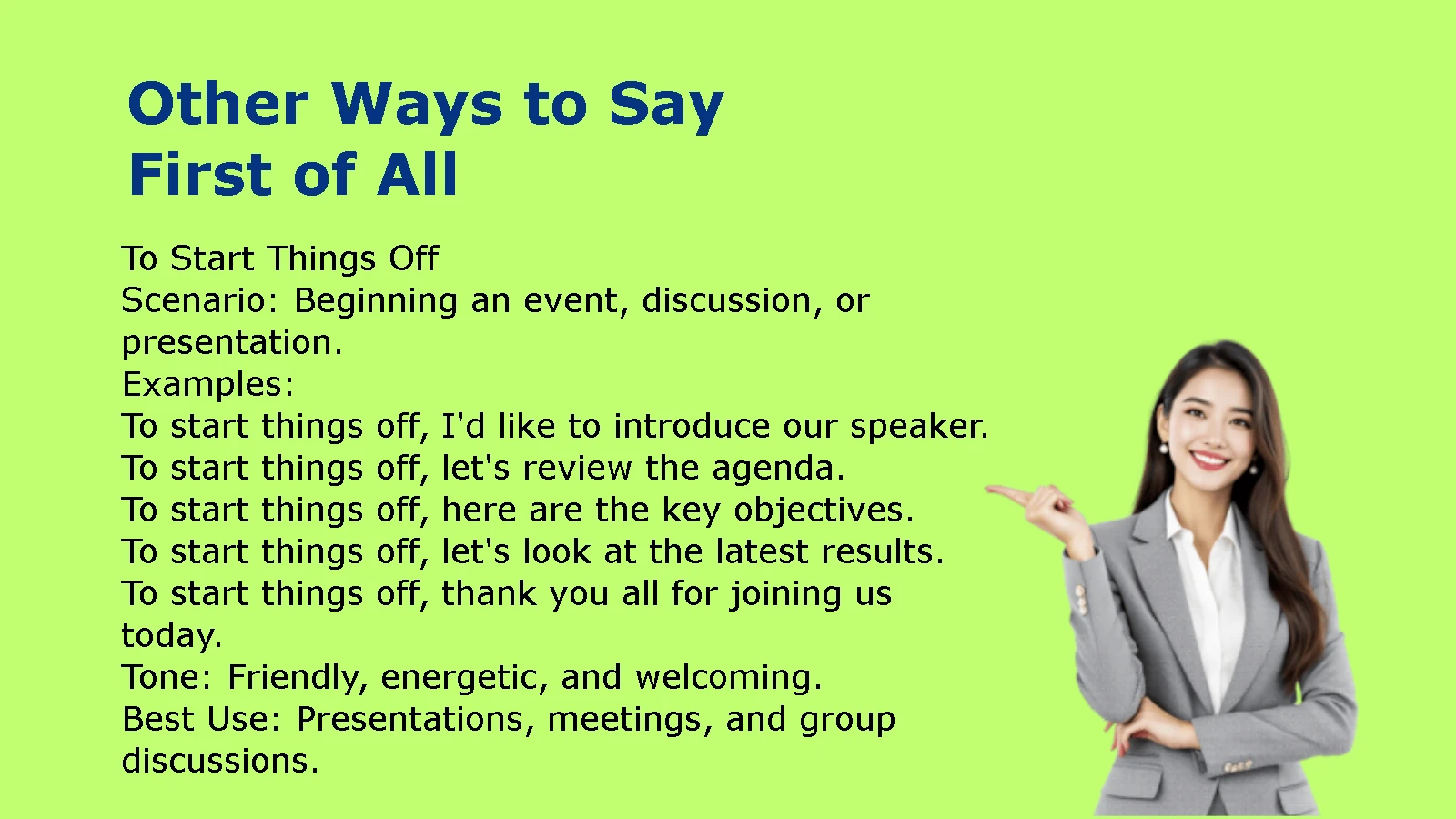
47. To Start Things Off
Scenario: Beginning an event, discussion, or presentation.
Examples:
- To start things off, I’d like to introduce our speaker.
- To start things off, let’s review the agenda.
- To start things off, here are the key objectives.
- To start things off, let’s look at the latest results.
- To start things off, thank you all for joining us today.
Tone: Friendly, energetic, and welcoming.
Best Use: Presentations, meetings, and group discussions.
Conclusion
“First of all” is a useful phrase for introducing the first point in a conversation, presentation, or piece of writing, but relying on it too often can make your communication sound repetitive. By using alternatives like “to begin with,” “first and foremost,” “as a starting point,” or “before anything else,” you can add variety, improve clarity, and match the tone of your message more effectively. Whether you’re writing a professional report, giving a speech, leading a meeting, or having a casual conversation, these 47 alternatives provide plenty of options to help your ideas flow naturally and make a stronger impression on your audience.