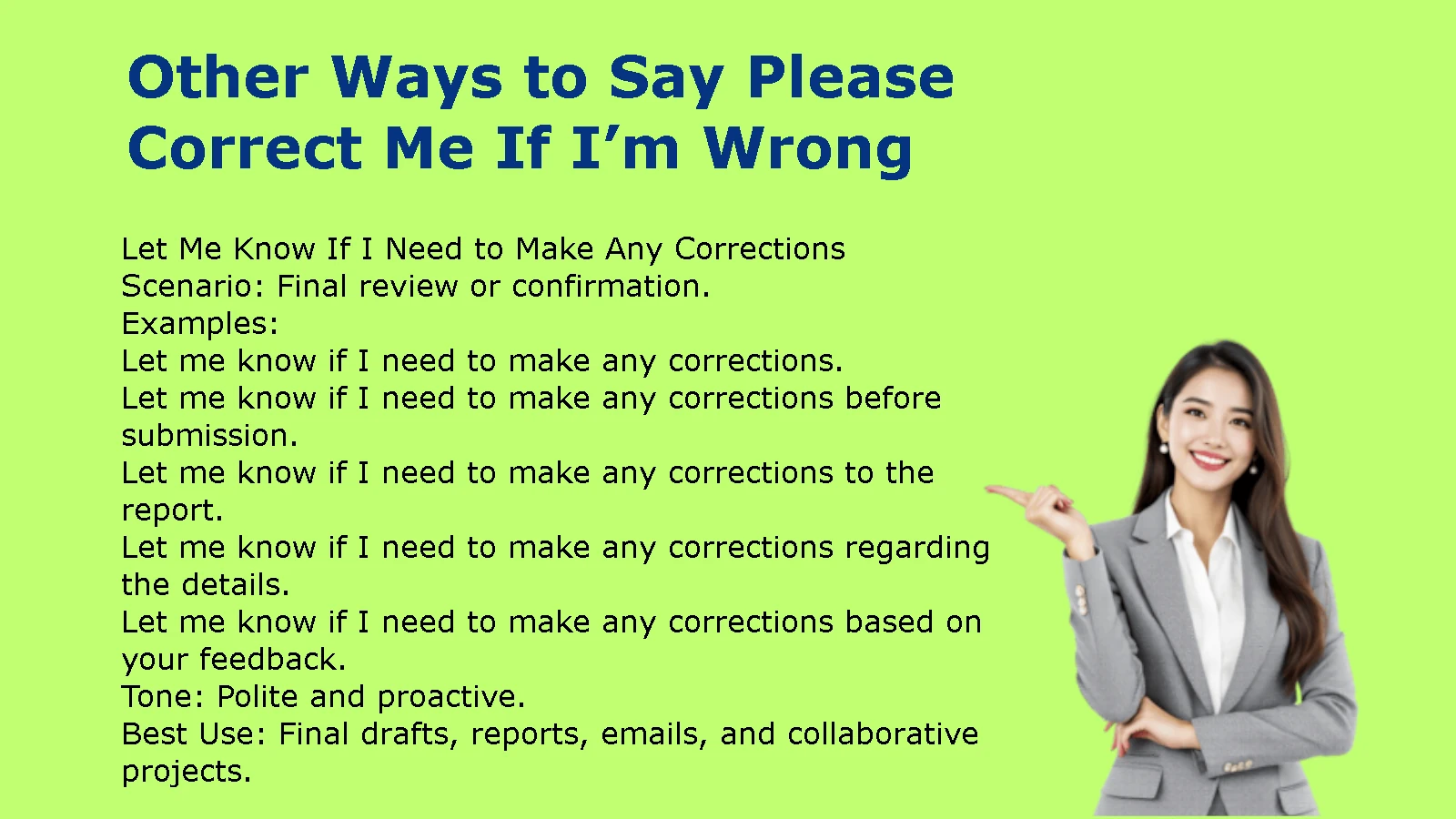
Ever found yourself wanting to say Other Ways to Say “Please Correct Me If I’m Wrong” without sounding unsure or overly formal? In conversations, emails, or workplace discussions, this phrase is often used when you want to invite feedback—but it can sometimes feel repetitive or a bit self-doubting.
That’s the challenge. You want to sound open-minded and professional, not hesitant or uncertain. And here’s the kicker: the way you phrase it can completely change how confident and collaborative you appear.
But don’t worry—there are plenty of smoother, more natural alternatives.
In this guide, you’ll discover Other Ways to Say “Please Correct Me If I’m Wrong”, along with polite ways to ask for clarification, professional feedback phrases, and alternative expressions for admitting uncertainty gracefully. You’ll also learn how these variations fit into emails, meetings, and everyday communication.
So whether you’re aiming for a more confident tone in business communication or just want to sound more natural in conversation, this will help you express yourself better. Let’s get started.
What Does “Please Correct Me If I’m Wrong” Mean?
“Please correct me if I’m wrong” is a phrase used when you want to share information while remaining open to clarification. It shows humility, willingness to learn, and respect for the other person’s knowledge or perspective.
When to Use “Please Correct Me If I’m Wrong”
This phrase is useful during discussions, meetings, emails, presentations, or everyday conversations when you are not completely certain about a fact or understanding. It helps encourage constructive feedback and prevents misunderstandings.
Is It Professional/Polite to Say “Please Correct Me If I’m Wrong”?
Yes, it is both professional and polite. It demonstrates confidence balanced with openness to feedback. However, using alternative expressions can make your communication feel more polished, conversational, or suitable for specific situations.
1. If I’m Mistaken, Please Let Me Know
Scenario: Professional discussions or emails.
Examples:
- If I’m mistaken, please let me know about the updated timeline.
- I believe this is the correct version, but if I’m mistaken, please let me know.
- If I’m mistaken, please let me know before we proceed.
- This is my understanding; if I’m mistaken, please let me know.
- If I’m mistaken, please let me know so I can make adjustments.
Tone: Professional and respectful.
Best Use: Workplace communication and formal discussions.
2. Let Me Know If I’ve Got This Wrong
Scenario: Casual or workplace conversations.
Examples:
- Let me know if I’ve got this wrong, but the meeting starts at noon.
- Let me know if I’ve got this wrong regarding the new policy.
- I think this is correct—let me know if I’ve got this wrong.
- Let me know if I’ve got this wrong before I send the report.
- Let me know if I’ve got this wrong about the schedule.
Tone: Friendly and approachable.
Best Use: Informal workplace communication.
3. Feel Free to Correct Me
Scenario: Open discussions or brainstorming sessions.
Examples:
- Feel free to correct me if I missed anything.
- Feel free to correct me regarding the project details.
- I may be overlooking something, so feel free to correct me.
- Feel free to correct me if my interpretation is inaccurate.
- Feel free to correct me if there’s a better explanation.
Tone: Open and collaborative.
Best Use: Team meetings and group conversations.
4. I May Be Wrong, But…
Scenario: Sharing an opinion or assumption.
Examples:
- I may be wrong, but I think the deadline was extended.
- I may be wrong, but that’s how I understood it.
- I may be wrong, but the data suggests otherwise.
- I may be wrong, but I recall a different outcome.
- I may be wrong, but that seems to be the case.
Tone: Humble and conversational.
Best Use: Expressing uncertain viewpoints.
5. Please Let Me Know If My Understanding Is Incorrect
Scenario: Formal communication.
Examples:
- Please let me know if my understanding is incorrect.
- Please let me know if my understanding of the policy is inaccurate.
- Please let me know if my understanding needs clarification.
- Please let me know if my understanding differs from yours.
- Please let me know if my understanding requires revision.
Tone: Professional and polished.
Best Use: Business emails and reports.
6. Am I Understanding This Correctly?
Scenario: Seeking clarification.
Examples:
- Am I understanding this correctly?
- Am I understanding this correctly regarding the process?
- Am I understanding this correctly based on our discussion?
- Am I understanding this correctly before moving forward?
- Am I understanding this correctly about the requirements?
Tone: Curious and respectful.
Best Use: Clarifying information in real time.
7. Please Tell Me If I’m Off Base
Scenario: Informal workplace discussions.
Examples:
- Please tell me if I’m off base here.
- Please tell me if I’m off base about the budget.
- Please tell me if I’m off base with this idea.
- Please tell me if I’m off base regarding the strategy.
- Please tell me if I’m off base in my assumptions.
Tone: Casual and collaborative.
Best Use: Brainstorming and idea-sharing.
8. I’d Appreciate Any Corrections
Scenario: Formal and respectful communication.
Examples:
- I’d appreciate any corrections to my understanding.
- I’d appreciate any corrections before publication.
- I’d appreciate any corrections regarding the figures.
- I’d appreciate any corrections if I overlooked details.
- I’d appreciate any corrections to ensure accuracy.
Tone: Polite and professional.
Best Use: Reports, presentations, and academic writing.
9. Let Me Know If I’m Missing Something
Scenario: Collaborative discussions.
Examples:
- Let me know if I’m missing something important.
- Let me know if I’m missing something in the proposal.
- Let me know if I’m missing something about the process.
- Let me know if I’m missing something from the report.
- Let me know if I’m missing something critical.
Tone: Open-minded and cooperative.
Best Use: Teamwork and project planning.
10. Please Set Me Straight If Needed
Scenario: Friendly conversations.
Examples:
- Please set me straight if needed.
- Please set me straight if my facts are wrong.
- Please set me straight if I misunderstood.
- Please set me straight about the timeline.
- Please set me straight if I overlooked anything.
Tone: Casual and friendly.
Best Use: Informal discussions.
11. Correct Me If I’ve Misunderstood
Scenario: Clarifying information.
Examples:
- Correct me if I’ve misunderstood the instructions.
- Correct me if I’ve misunderstood the objective.
- Correct me if I’ve misunderstood your point.
- Correct me if I’ve misunderstood the requirements.
- Correct me if I’ve misunderstood the details.
Tone: Professional and direct.
Best Use: Meetings and workplace conversations.
12. Please Clarify If I’m Mistaken
Scenario: Seeking confirmation.
Examples:
- Please clarify if I’m mistaken about the schedule.
- Please clarify if I’m mistaken regarding the process.
- Please clarify if I’m mistaken in my interpretation.
- Please clarify if I’m mistaken about the policy.
- Please clarify if I’m mistaken about the expectations.
Tone: Respectful and inquisitive.
Best Use: Formal conversations.
13. I’m Open to Correction
Scenario: Professional discussions.
Examples:
- I’m open to correction if necessary.
- I’m open to correction on this topic.
- I’m open to correction regarding the data.
- I’m open to correction if there’s updated information.
- I’m open to correction if my conclusion is inaccurate.
Tone: Confident yet humble.
Best Use: Expert or workplace discussions.
14. Please Point Out Any Errors
Scenario: Reviewing work.
Examples:
- Please point out any errors in my report.
- Please point out any errors in my reasoning.
- Please point out any errors before submission.
- Please point out any errors in the analysis.
- Please point out any errors you notice.
Tone: Direct and professional.
Best Use: Editing and quality checks.
15. Let Me Know If I’m Mistaken
Scenario: Everyday communication.
Examples:
- Let me know if I’m mistaken about the date.
- Let me know if I’m mistaken regarding the details.
- Let me know if I’m mistaken before I proceed.
- Let me know if I’m mistaken about the plan.
- Let me know if I’m mistaken in my understanding.
Tone: Friendly and neutral.
Best Use: Casual and professional settings.
16. Please Correct Any Misunderstandings
Scenario: Group discussions.
Examples:
- Please correct any misunderstandings I may have.
- Please correct any misunderstandings about the project.
- Please correct any misunderstandings regarding the policy.
- Please correct any misunderstandings before we continue.
- Please correct any misunderstandings in my summary.
Tone: Cooperative and professional.
Best Use: Meetings and presentations.
17. Tell Me If I’ve Misread the Situation
Scenario: Discussing events or circumstances.
Examples:
- Tell me if I’ve misread the situation.
- Tell me if I’ve misread the client’s response.
- Tell me if I’ve misread the feedback.
- Tell me if I’ve misread the expectations.
- Tell me if I’ve misread what happened.
Tone: Reflective and thoughtful.
Best Use: Interpersonal conversations.
18. Please Let Me Know If That’s Not Accurate
Scenario: Sharing information.
Examples:
- Please let me know if that’s not accurate.
- Please let me know if that’s not accurate regarding the figures.
- Please let me know if that’s not accurate based on recent updates.
- Please let me know if that’s not accurate before publishing.
- Please let me know if that’s not accurate in any way.
Tone: Professional and courteous.
Best Use: Emails and reports.
19. Am I Missing Anything?
Scenario: Reviewing plans or ideas.
Examples:
- Am I missing anything important?
- Am I missing anything in this proposal?
- Am I missing anything before we move forward?
- Am I missing anything in the checklist?
- Am I missing anything significant?
Tone: Curious and collaborative.
Best Use: Team projects and planning.
20. I Welcome Any Corrections
Scenario: Formal communication.
Examples:
- I welcome any corrections to my analysis.
- I welcome any corrections regarding the report.
- I welcome any corrections if my information is outdated.
- I welcome any corrections from the team.
- I welcome any corrections before final approval.
Tone: Respectful and professional.
Best Use: Business and academic settings.
21. Please Advise If I’m Incorrect
Scenario: Formal workplace communication.
Examples:
- Please advise if I’m incorrect about the timeline.
- Please advise if I’m incorrect regarding the procedure.
- Please advise if I’m incorrect in my assumptions.
- Please advise if I’m incorrect about the requirements.
- Please advise if I’m incorrect in this assessment.
Tone: Formal and business-oriented.
Best Use: Professional emails.
22. Let Me Know If There’s a Better Way to Look at It
Scenario: Discussions and feedback sessions.
Examples:
- Let me know if there’s a better way to look at it.
- Let me know if there’s a better perspective.
- Let me know if there’s a better interpretation.
- Let me know if there’s a better approach.
- Let me know if there’s a better explanation.
Tone: Open-minded and collaborative.
Best Use: Brainstorming and problem-solving.
23. I Could Be Mistaken
Scenario: Expressing uncertainty politely.
Examples:
- I could be mistaken, but I thought the deadline changed.
- I could be mistaken, but that’s what I remember.
- I could be mistaken, but the report was approved.
- I could be mistaken, but I heard a different update.
- I could be mistaken, but that was my understanding.
Tone: Humble and conversational.
Best Use: Informal and professional discussions.
24. Please Verify My Understanding
Scenario: Formal clarification.
Examples:
- Please verify my understanding of the process.
- Please verify my understanding before I proceed.
- Please verify my understanding of the requirements.
- Please verify my understanding of the policy.
- Please verify my understanding of the timeline.
Tone: Professional and precise.
Best Use: Workplace and academic communication.
25. Feel Free to Point Out Any Mistakes
Scenario: Collaborative work.
Examples:
- Feel free to point out any mistakes in the document.
- Feel free to point out any mistakes in my reasoning.
- Feel free to point out any mistakes before submission.
- Feel free to point out any mistakes you notice.
- Feel free to point out any mistakes in the presentation.
Tone: Friendly and receptive.
Best Use: Team collaboration.
26. Let Me Know If My Assumption Is Wrong
Scenario: Discussing ideas or plans.
Examples:
- Let me know if my assumption is wrong.
- Let me know if my assumption is wrong about the schedule.
- Let me know if my assumption is wrong regarding the project.
- Let me know if my assumption is wrong before we proceed.
- Let me know if my assumption is wrong about the budget.
Tone: Practical and direct.
Best Use: Planning and decision-making.
27. Please Correct Any Inaccuracies
Scenario: Professional review.
Examples:
- Please correct any inaccuracies in the report.
- Please correct any inaccuracies in my summary.
- Please correct any inaccuracies before publication.
- Please correct any inaccuracies in the presentation.
- Please correct any inaccuracies you identify.
Tone: Formal and detail-oriented.
Best Use: Reports and official documents.
28. Tell Me Where I’m Wrong
Scenario: Honest feedback discussions.
Examples:
- Tell me where I’m wrong in this analysis.
- Tell me where I’m wrong about the proposal.
- Tell me where I’m wrong if I missed a key point.
- Tell me where I’m wrong regarding the strategy.
- Tell me where I’m wrong in my reasoning.
Tone: Direct and confident.
Best Use: Constructive feedback sessions.
29. I’d Like to Be Corrected If Necessary
Scenario: Formal and respectful communication.
Examples:
- I’d like to be corrected if necessary.
- I’d like to be corrected if my information is outdated.
- I’d like to be corrected if my interpretation is wrong.
- I’d like to be corrected if I overlooked details.
- I’d like to be corrected if my conclusion is inaccurate.
Tone: Polite and professional.
Best Use: Business and academic environments.
30. Please Let Me Know Where I’m Mistaken
Scenario: Seeking detailed clarification.
Examples:
- Please let me know where I’m mistaken.
- Please let me know where I’m mistaken in the report.
- Please let me know where I’m mistaken about the process.
- Please let me know where I’m mistaken regarding the timeline.
- Please let me know where I’m mistaken in my understanding.
Tone: Respectful and open-minded.
Best Use: Clarification and collaborative discussions.
31. Please Tell Me If I’m Overlooking Something
Scenario: Reviewing plans or discussing ideas.
Examples:
- Please tell me if I’m overlooking something important.
- Please tell me if I’m overlooking something in the proposal.
- Please tell me if I’m overlooking something before we proceed.
- Please tell me if I’m overlooking something in the report.
- Please tell me if I’m overlooking something significant.
Tone: Thoughtful and collaborative.
Best Use: Project planning and team discussions.
32. Let Me Know If My Interpretation Is Incorrect
Scenario: Clarifying information or feedback.
Examples:
- Let me know if my interpretation is incorrect.
- Let me know if my interpretation of the data is incorrect.
- Let me know if my interpretation differs from the intended meaning.
- Let me know if my interpretation of the policy is incorrect.
- Let me know if my interpretation needs adjustment.
Tone: Professional and analytical.
Best Use: Business, legal, or academic conversations.
33. I’d Appreciate Your Feedback If I’m Mistaken
Scenario: Seeking constructive input.
Examples:
- I’d appreciate your feedback if I’m mistaken.
- I’d appreciate your feedback if I misunderstood the requirements.
- I’d appreciate your feedback if my assumptions are incorrect.
- I’d appreciate your feedback if I missed anything important.
- I’d appreciate your feedback if my conclusions are inaccurate.
Tone: Respectful and receptive.
Best Use: Professional discussions and mentoring situations.
34. Please Don’t Hesitate to Correct Me
Scenario: Encouraging open communication.
Examples:
- Please don’t hesitate to correct me if needed.
- Please don’t hesitate to correct me regarding the timeline.
- Please don’t hesitate to correct me if my information is outdated.
- Please don’t hesitate to correct me during the presentation.
- Please don’t hesitate to correct me if I misunderstood.
Tone: Warm and welcoming.
Best Use: Team meetings and collaborative environments.
35. I’m Happy to Be Corrected
Scenario: Showing humility and openness.
Examples:
- I’m happy to be corrected if I’m mistaken.
- I’m happy to be corrected on any of these points.
- I’m happy to be corrected if there’s new information.
- I’m happy to be corrected regarding the details.
- I’m happy to be corrected if my understanding is incomplete.
Tone: Friendly and confident.
Best Use: Professional and casual discussions.
36. Please Let Me Know If I’ve Misinterpreted Anything
Scenario: Discussing complex information.
Examples:
- Please let me know if I’ve misinterpreted anything.
- Please let me know if I’ve misinterpreted the instructions.
- Please let me know if I’ve misinterpreted the feedback.
- Please let me know if I’ve misinterpreted the results.
- Please let me know if I’ve misinterpreted your comments.
Tone: Careful and professional.
Best Use: Detailed workplace communication.
37. Am I Off Track Here?
Scenario: Informal feedback requests.
Examples:
- Am I off track here with my thinking?
- Am I off track here regarding the project goals?
- Am I off track here about the strategy?
- Am I off track here with this conclusion?
- Am I off track here in my assessment?
Tone: Casual and collaborative.
Best Use: Brainstorming and team discussions.
38. Please Share Any Corrections
Scenario: Formal review situations.
Examples:
- Please share any corrections you may have.
- Please share any corrections before final approval.
- Please share any corrections to the document.
- Please share any corrections regarding the report.
- Please share any corrections if needed.
Tone: Professional and courteous.
Best Use: Reports, drafts, and presentations.
39. Let Me Know If This Isn’t Right
Scenario: Casual workplace communication.
Examples:
- Let me know if this isn’t right.
- Let me know if this isn’t right regarding the schedule.
- Let me know if this isn’t right before I submit it.
- Let me know if this isn’t right about the policy.
- Let me know if this isn’t right based on the latest update.
Tone: Friendly and straightforward.
Best Use: Quick conversations and emails.
40. Please Correct My Understanding If Needed
Scenario: Clarifying expectations.
Examples:
- Please correct my understanding if needed.
- Please correct my understanding of the process.
- Please correct my understanding regarding the requirements.
- Please correct my understanding of the timeline.
- Please correct my understanding if I’ve missed any details.
Tone: Professional and respectful.
Best Use: Workplace discussions and client communication.
41. I Welcome Clarification
Scenario: Discussing uncertain information.
Examples:
- I welcome clarification if I’m mistaken.
- I welcome clarification regarding this issue.
- I welcome clarification on the updated policy.
- I welcome clarification if my understanding is incomplete.
- I welcome clarification on any of these points.
Tone: Open-minded and professional.
Best Use: Formal discussions and meetings.
42. Please Help Me Understand If I’m Wrong
Scenario: Learning or training situations.
Examples:
- Please help me understand if I’m wrong.
- Please help me understand if I missed something important.
- Please help me understand if my conclusion is inaccurate.
- Please help me understand if I misunderstood the process.
- Please help me understand if there’s a better approach.
Tone: Humble and eager to learn.
Best Use: Educational and mentoring conversations.
43. Let Me Know If I Need to Reconsider
Scenario: Evaluating ideas or decisions.
Examples:
- Let me know if I need to reconsider this approach.
- Let me know if I need to reconsider my assumptions.
- Let me know if I need to reconsider this strategy.
- Let me know if I need to reconsider my interpretation.
- Let me know if I need to reconsider my conclusion.
Tone: Reflective and professional.
Best Use: Strategic planning and decision-making.
44. Please Point Me in the Right Direction If I’m Wrong
Scenario: Seeking guidance.
Examples:
- Please point me in the right direction if I’m wrong.
- Please point me in the right direction regarding this process.
- Please point me in the right direction if I misunderstood the requirements.
- Please point me in the right direction about the next steps.
- Please point me in the right direction if my assumptions are incorrect.
Tone: Respectful and collaborative.
Best Use: Mentorship and workplace learning.
45. I’m Open to Any Necessary Corrections
Scenario: Formal and professional communication.
Examples:
- I’m open to any necessary corrections.
- I’m open to any necessary corrections to the report.
- I’m open to any necessary corrections regarding the analysis.
- I’m open to any necessary corrections before publication.
- I’m open to any necessary corrections if my information is outdated.
Tone: Professional and accommodating.
Best Use: Reports, presentations, and business communication.
46. Please Tell Me If My Reasoning Is Flawed
Scenario: Discussing logic or analysis.
Examples:
- Please tell me if my reasoning is flawed.
- Please tell me if my reasoning overlooks anything.
- Please tell me if my reasoning is incomplete.
- Please tell me if my reasoning doesn’t align with the facts.
- Please tell me if my reasoning could be improved.
Tone: Analytical and thoughtful.
Best Use: Problem-solving, debates, and professional reviews.
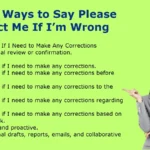
47. Let Me Know If I Need to Make Any Corrections
Scenario: Final review or confirmation.
Examples:
- Let me know if I need to make any corrections.
- Let me know if I need to make any corrections before submission.
- Let me know if I need to make any corrections to the report.
- Let me know if I need to make any corrections regarding the details.
- Let me know if I need to make any corrections based on your feedback.
Tone: Polite and proactive.
Best Use: Final drafts, reports, emails, and collaborative projects.
Conclusion
Using alternatives to “Please correct me if I’m wrong” can make your communication sound more polished, confident, and engaging while still showing openness to feedback. Whether you’re participating in a business meeting, writing a professional email, collaborating with a team, or having a casual conversation, the right phrase can encourage constructive discussion and reduce misunderstandings. The 47 alternatives in this guide give you plenty of options to express humility, invite clarification, and demonstrate a willingness to learn. By choosing the expression that best fits the situation, you can communicate more effectively and build stronger personal and professional relationships.