Choosing the right words is essential in communication. Whether you’re writing an email, participating in a meeting, or sharing your thoughts in a casual conversation, the way you express yourself affects how your ideas are received. A small shift in phrasing can make your message clearer, more persuasive, and more respectful.
Learning Other Ways to Say “In My Opinion” allows you to sound confident, professional, and approachable. Using varied expressions not only enriches your language but also helps you connect with others more effectively, showing thoughtfulness and consideration for tone and context.
What Does “Other Ways to Say ‘In My Opinion’” Mean?
When we say “in my opinion”, we are expressing a personal belief or perspective. It signals that the statement reflects our thoughts rather than objective facts. Using alternatives adds variety to your communication, making it sound natural and engaging. These alternatives also help adjust tone, from casual chats with friends to professional discussions in the workplace.
When to Use “Other Ways to Say ‘In My Opinion’”
You can use alternatives to “in my opinion” in multiple settings:
- Casual conversations: Sharing ideas with friends or family without sounding too formal.
- Professional contexts: Offering feedback or insights during meetings, presentations, or emails.
- Social discussions: Expressing viewpoints in debates, online forums, or social media posts while remaining polite and considerate.
The key is choosing the right expression based on the audience and context, keeping your tone warm, clear, and respectful.
Is It Professional or Polite to Say It?
Yes, expressing your opinion is both professional and polite if done thoughtfully. Saying “in my opinion” or its alternatives signals that you are aware your view is subjective. It shows respect for others’ perspectives and maintains boundaries in discussions.
Some phrases sound formal and assertive, like “from my perspective,” while others feel friendly and casual, like “I think that…” Knowing which fits your setting ensures your communication remains polite, professional, and persuasive.
30 Alternatives to “In My Opinion”
Here’s a list of 30 alternatives, each with explanation, examples, and a note on best use:
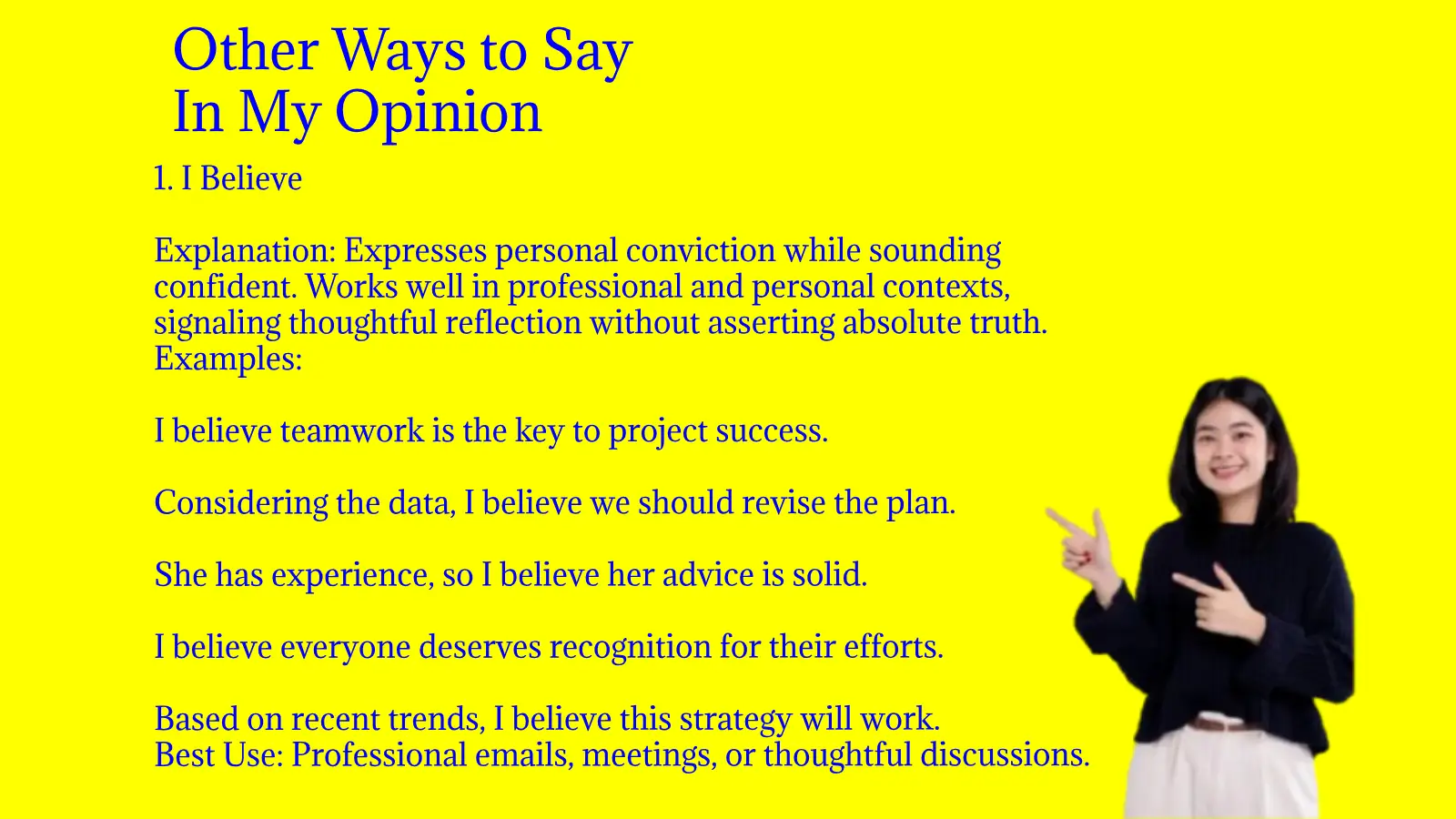
1. I Believe
Explanation: Expresses personal conviction while sounding confident. Works well in professional and personal contexts, signaling thoughtful reflection without asserting absolute truth.
Examples:
- I believe teamwork is the key to project success.
- Considering the data, I believe we should revise the plan.
- She has experience, so I believe her advice is solid.
- I believe everyone deserves recognition for their efforts.
- Based on recent trends, I believe this strategy will work.
Best Use: Professional emails, meetings, or thoughtful discussions.
2. From My Perspective
Explanation: Highlights your personal viewpoint, making it clear that others may see things differently. It’s effective in debates or collaborative discussions.
Examples:
- From my perspective, the marketing plan needs more research.
- It seems confusing; from my perspective, we could simplify it.
- From my perspective, that approach may save time.
- The presentation looks strong, but from my perspective, visuals need improvement.
- From my perspective, this solution balances cost and quality well.
Best Use: Professional meetings or diplomatic discussions.
3. As I See It
Explanation: Casual yet assertive, this phrase is friendly and conversational. It conveys your point without sounding authoritative.
Examples:
- As I see it, we should prioritize customer feedback.
- The project is ambitious, but as I see it, it’s achievable.
- As I see it, collaboration will boost efficiency.
- As I see it, the proposal could use a few tweaks.
- Market trends are shifting, and as I see it, we need to adapt.
Best Use: Informal discussions and brainstorming sessions.
4. I Think
Explanation: Simple, casual, and versatile. Conveys your opinion naturally in both spoken and written communication.
Examples:
- I think this approach will save us time.
- We could add more visuals; I think it helps engagement.
- I think the team did a fantastic job.
- This feature seems outdated, I think it needs improvement.
- I think we should test both options before deciding.
Best Use: Casual or semi-professional conversations.
5. To My Mind
Explanation: Slightly formal, reflective, and polite. It signals thoughtfulness and personal reasoning.
Examples:
- To my mind, the report captures all key points.
- The design is elegant, and to my mind, it fits our brand.
- To my mind, feedback should always be constructive.
- The schedule is tight, but to my mind, it’s manageable.
- To my mind, we could refine the strategy further.
Best Use: Professional reports, emails, and reflective discussions.
6. Personally
Explanation: Direct and casual, emphasizes that the statement is your viewpoint.
Examples:
- Personally, I enjoy collaborative projects.
- I’d choose option B personally because it’s more efficient.
- Personally, I prefer morning meetings.
- That approach feels risky personally, but it’s worth considering.
- Personally, I think we need clearer guidelines.
Best Use: Friendly conversations or less formal emails.
7. As Far as I’m Concerned
Explanation: Shows strong personal stance while remaining polite. Often used in formal or semi-formal debates.
Examples:
- As far as I’m concerned, this is the best strategy.
- The project is challenging, but as far as I’m concerned, it’s achievable.
- As far as I’m concerned, deadlines should take priority.
- As far as I’m concerned, collaboration is essential.
- As far as I’m concerned, this option balances cost and quality.
Best Use: Professional discussions where you need to assert your viewpoint.
8. My View Is
Explanation: Neutral and professional, making your opinion sound balanced and thoughtful.
Examples:
- My view is that we need more testing before launch.
- Considering the data, my view is the budget is sufficient.
- My view is that collaboration drives better results.
- Based on experience, my view is this approach works best.
- My view is that client feedback should guide revisions.
Best Use: Workplace discussions and formal emails.
9. I’d Say
Explanation: Informal and conversational. Makes your opinion sound approachable and easygoing.
Examples:
- I’d say the team is doing well overall.
- The task seems doable; I’d say we proceed cautiously.
- I’d say this proposal needs minor tweaks.
- I’d say it’s better to discuss this in person.
- I’d say feedback will help refine the plan.
Best Use: Casual discussions or team chats.
10. It Seems to Me
Explanation: Polite and tentative. Shows your opinion while leaving room for others’ input.
Examples:
- It seems to me that the schedule is realistic.
- The results are promising; it seems to me we’re on track.
- It seems to me the design needs slight adjustments.
- It seems to me that collaboration would help here.
- Considering the feedback, it seems to me we need another review.
Best Use: Polite suggestions in professional or social settings.
11. I Feel
Explanation: Expresses a personal sentiment or instinct. Effective in both casual and emotional conversations because it conveys authenticity while remaining polite.
Examples:
- I feel this approach will resonate with our audience.
- The plan looks solid, but I feel we need more research.
- I feel teamwork will improve productivity.
- I feel the feedback should be addressed immediately.
- Based on experience, I feel this method works best.
Best Use: Casual discussions or when sharing emotional insights.
12. I Would Argue
Explanation: Suggests a viewpoint while inviting discussion. Polite yet assertive, it works well in debates or analytical conversations.
Examples:
- I would argue that this strategy saves time.
- Considering the data, I would argue the risk is minimal.
- I would argue collaboration is key to success.
- Based on previous projects, I would argue for testing first.
- I would argue this solution balances cost and quality effectively.
Best Use: Debates, professional discussions, or analytical settings.
13. I Maintain
Explanation: Shows firmness in your belief without being aggressive. Works well in professional contexts or formal writing.
Examples:
- I maintain that customer feedback should guide improvements.
- Based on experience, I maintain this method is reliable.
- I maintain collaboration leads to better outcomes.
- I maintain that deadlines should always be respected.
- I maintain the proposal aligns with our objectives.
Best Use: Formal writing, professional emails, or presentations.
14. I’m Convinced
Explanation: Indicates strong belief or certainty in your opinion. Effective in persuasive contexts or motivational discussions.
Examples:
- I’m convinced teamwork will drive success.
- Based on results, I’m convinced this approach is effective.
- I’m convinced we should explore alternative strategies.
- I’m convinced communication is critical for project success.
- I’m convinced the team is prepared for challenges.
Best Use: Persuasive presentations or discussions requiring confidence.
15. To My Way of Thinking
Explanation: Slightly formal, polite, and reflective. Shows personal reasoning without dismissing others’ ideas.
Examples:
- To my way of thinking, a flexible schedule boosts productivity.
- This marketing approach seems strong to my way of thinking.
- To my way of thinking, collaboration is essential.
- The proposal looks complete to my way of thinking.
- To my way of thinking, testing both options is best.
Best Use: Professional reports, reflective conversations, or formal writing.
16. I Hold the View
Explanation: Formal and professional, conveys a considered opinion. Often used in debates or structured discussions.
Examples:
- I hold the view that efficiency must be prioritized.
- Based on experience, I hold the view collaboration works best.
- I hold the view deadlines should guide planning.
- I hold the view that client feedback is essential.
- I hold the view this method ensures consistent results.
Best Use: Formal discussions, academic writing, or business presentations.
17. In My Estimation
Explanation: Reflects calculated judgment or evaluation. Useful in analytical or professional contexts where opinion is based on reasoning.
Examples:
- In my estimation, the project will be completed on time.
- The budget seems sufficient, in my estimation.
- In my estimation, testing both options reduces risks.
- Quality is key, in my estimation, for long-term success.
- In my estimation, collaboration improves efficiency.
Best Use: Professional and analytical conversations.
18. I Consider
Explanation: Indicates a reflective, thoughtful opinion. Polite and professional, suitable for formal writing or serious discussions.
Examples:
- I consider teamwork crucial for meeting deadlines.
- I consider the proposal well-structured and thorough.
- I consider customer feedback essential for improvement.
- I consider collaboration an important strategy.
- I consider testing the best way to ensure accuracy.
Best Use: Formal writing, workplace discussions, or evaluations.
19. I Reckon
Explanation: Informal, conversational, and common in British English. Adds a friendly tone while expressing your opinion.
Examples:
- I reckon this plan will work well.
- Based on experience, I reckon teamwork improves efficiency.
- I reckon we should finalize the proposal soon.
- I reckon the design could be simplified.
- I reckon testing both options is safer.
Best Use: Casual conversations or friendly discussions.
20. I Take the View
Explanation: Formal and polite, used to express considered judgment or perspective. Works well in meetings, debates, or reports.
Examples:
- I take the view that deadlines should guide priorities.
- Considering past projects, I take the view collaboration helps most.
- I take the view that client satisfaction is vital.
- I take the view this approach balances cost and quality.
- I take the view testing both options is essential.
Best Use: Professional or structured settings.
21. It Is My Belief
Explanation: Formal, thoughtful, and respectful. Shows your opinion is considered and reasoned.
Examples:
- It is my belief that teamwork increases efficiency.
- Based on experience, it is my belief the strategy works.
- It is my belief client feedback is invaluable.
- It is my belief deadlines must guide planning.
- It is my belief this solution balances cost and quality.
Best Use: Formal writing, reports, and business emails.
22. I Would Suggest
Explanation: Softens your opinion by offering it as guidance. Polite, collaborative, and non-imposing.
Examples:
- I would suggest testing both options before deciding.
- To improve efficiency, I would suggest a weekly review.
- I would suggest adding more visuals to the presentation.
- I would suggest considering alternative strategies.
- I would suggest feedback sessions for better results.
Best Use: Professional or collaborative settings.
23. I’m of the Opinion
Explanation: Polite, formal, and confident. Signals personal belief while remaining professional and respectful.
Examples:
- I’m of the opinion that collaboration improves productivity.
- Considering the data, I’m of the opinion this approach works.
- I’m of the opinion deadlines must guide priorities.
- I’m of the opinion client feedback is essential.
- I’m of the opinion testing both options is best.
Best Use: Formal meetings, debates, or professional correspondence.
24. I Would Contend
Explanation: Assertive yet polite; used in discussions or debates to present a strong but reasoned perspective.
Examples:
- I would contend that teamwork is key to project success.
- Based on results, I would contend this plan is effective.
- I would contend deadlines should guide planning.
- I would contend collaboration enhances efficiency.
- I would contend testing both options reduces risks.
Best Use: Professional debates or persuasive arguments.
25. As I Understand It
Explanation: Shows your opinion is based on interpretation, leaving room for discussion. Polite and diplomatic.
Examples:
- As I understand it, the plan meets all requirements.
- The budget seems sufficient, as I understand it.
- As I understand it, teamwork improves outcomes.
- The proposal is thorough, as I understand it.
- As I understand it, testing both options is recommended.
Best Use: Diplomatic conversations and collaborative discussions.
26. I Opine
Explanation: Formal, concise, and professional. Often used in academic or legal contexts.
Examples:
- I opine that this approach will work best.
- I opine that deadlines should guide priorities.
- I opine collaboration improves productivity.
- I opine testing both options is essential.
- I opine client feedback should guide revisions.
Best Use: Academic writing, professional reports, or formal debates.
27. I Advocate
Explanation: Shows you strongly support a viewpoint while remaining professional. Useful in persuasive or leadership contexts.
Examples:
- I advocate implementing weekly team check-ins.
- Based on data, I advocate this strategy.
- I advocate collaboration to improve efficiency.
- I advocate prioritizing client satisfaction.
- I advocate testing both options before finalizing.
Best Use: Leadership discussions, proposals, or persuasive settings.
28. I Hold That
Explanation: Formal, confident, and assertive. Works in debates, presentations, or reports to present reasoning.
Examples:
- I hold that deadlines should guide planning.
- I hold that collaboration ensures success.
- I hold that client feedback is invaluable.
- I hold that testing both options is essential.
- I hold that this approach balances cost and quality.
Best Use: Debates, professional discussions, and reports.
29. I Suggest
Explanation: Friendly and collaborative. Offers your opinion as a helpful recommendation rather than a directive.
Examples:
- I suggest adding more visuals to the presentation.
- I suggest testing both options before finalizing.
- I suggest scheduling weekly check-ins.
- I suggest reviewing client feedback carefully.
- I suggest adjusting timelines for efficiency.
Best Use: Professional teamwork or collaborative settings.
30. I Think It’s Fair to Say
Explanation: Polite, conversational, and inclusive. Softens your opinion while making it clear.
Examples:
- I think it’s fair to say teamwork improves outcomes.
- Considering feedback, I think it’s fair to say changes are needed.
- I think it’s fair to say the plan is ambitious.
- I think it’s fair to say collaboration is key.
- I think it’s fair to say testing both options is wise.
Best Use: Casual discussions, professional meetings, or social conversations.
FAQs About “Other Ways to Say ‘In My Opinion’”
1. What are some polite alternatives to “In My Opinion”?
Polite alternatives include “From my perspective,” “I believe,” “As I see it,” and “It seems to me.” These phrases signal that your statement is personal and thoughtful, allowing you to share your viewpoint respectfully in both casual and professional settings.
2. Can I use these alternatives in professional emails?
Yes! Phrases like “My view is,” “I would suggest,” “I hold the view,” and “To my mind” are professional, clear, and considerate. They convey your opinion without sounding pushy, making them ideal for workplace discussions, reports, and presentations.
3. Which phrases are best for casual conversations?
Casual, friendly alternatives include “I think,” “I feel,” “I’d say,” and “I reckon.” These expressions make your opinion approachable, perfect for conversations with friends, family, or informal team chats.
4. How do I choose the right alternative for different situations?
Consider your audience, context, and tone. Use formal phrases in professional or academic settings, polite yet assertive phrases in discussions or meetings, and casual expressions in everyday conversation. Matching your phrase to the situation ensures your communication is respectful and effective.
5. Will using different phrases make me sound more confident?
Absolutely! Using a variety of expressions shows that you can articulate your thoughts clearly and thoughtfully. It signals awareness of tone and audience, helping you sound both confident and approachable, while avoiding repetition in conversations or writing.
6. Are some alternatives better for written communication?
Yes. Phrases like “I hold that,” “It is my belief,” or “To my way of thinking” are well-suited for reports, essays, and emails. They sound professional, polished, and reflective, giving your writing a clear, authoritative tone while remaining respectful.
7. Can I combine these phrases with other expressions to soften opinions?
Definitely! Combining phrases like “I think” or “It seems to me” with softening words such as “perhaps” or “might” makes your opinion gentle and collaborative. For example: “I think we might benefit from testing both options.” This keeps conversations respectful and constructive.
8. Why is it important to vary the way I say “In My Opinion”?
Varying your phrasing prevents your language from sounding repetitive or robotic. It also demonstrates empathy, thoughtfulness, and adaptability, helping your ideas resonate with different audiences and enhancing clarity, persuasiveness, and professionalism.
Conclusion
Choosing varied ways to express your opinion strengthens communication and demonstrates thoughtfulness. Using these alternatives ensures your ideas are shared respectfully, clearly, and confidently, whether in casual chats, professional meetings, or online discussions.
Thoughtful communication creates strong first impressions, fosters collaboration, and maintains boundaries politely. By embracing these expressions, you encourage warm, respectful, and meaningful conversations that leave others feeling valued and understood.