Have you ever needed to apologize but felt that a simple “sorry” wasn’t enough? Finding Other Ways to Say Sorry to Someone can help you express genuine regret, rebuild trust, and communicate your feelings more effectively in both personal and professional situations.
The challenge is that “sorry” can sometimes sound repetitive, rushed, or lacking in sincerity—especially when the situation calls for a more thoughtful response. And here’s the kicker: the words you choose can greatly influence how your apology is received.
Many people search for polite ways to apologize, professional apology phrases, or heartfelt alternatives to sorry because they want their message to sound more meaningful and appropriate for the situation.
But don’t worry—there are plenty of better options.
In this guide, you’ll discover Other Ways to Say Sorry to Someone, including formal, casual, and sincere alternatives that fit different circumstances. You’ll also learn when to use each phrase, helping you apologize with confidence and strengthen your communication skills.
So if you want to make your apologies sound more genuine, respectful, and impactful, keep reading—you’ll find the perfect phrase for every situation.
What Does “Sorry” Mean?
“Sorry” is an expression used to show regret, remorse, or sympathy for something that happened. It acknowledges that a mistake, misunderstanding, or unfortunate situation has occurred and communicates a desire to make things right.
When to Use “Sorry”
You can use “sorry” when you have made a mistake, inconvenienced someone, hurt their feelings, arrived late, forgotten something important, or simply want to express sympathy. Additionally, it works in both personal and professional situations.
Is It Professional/Polite to Say “Sorry”?
Yes, saying “sorry” is both polite and professional. However, in workplace settings, alternatives such as “I apologize” or “Please accept my apologies” may sound more formal and polished. As a result, choosing the right phrase can help you match the tone of the situation.
1. I Apologize
Scenario: Formal workplace or professional setting.
Examples:
- I apologize for the delay in responding.
- I sincerely apologize for the misunderstanding.
- I apologize for any inconvenience caused.
- Please know that I apologize for my mistake.
- I apologize and appreciate your patience.
Tone: Formal and professional.
Best Use: Business emails and workplace communication.
2. My Apologies
Scenario: Respectful and concise apology.
Examples:
- My apologies for the confusion.
- My apologies for the late reply.
- My apologies for missing the meeting.
- Please accept my apologies for the oversight.
- My apologies for the inconvenience.
Tone: Polite and professional.
Best Use: Formal conversations and emails.
3. Please Forgive Me
Scenario: Personal situations involving deeper emotions.
Examples:
- Please forgive me for what I said.
- Please forgive me for hurting your feelings.
- I made a mistake; please forgive me.
- Please forgive me for disappointing you.
- I truly hope you can forgive me.
Tone: Sincere and heartfelt.
Best Use: Close relationships and emotional conversations.
4. I Regret My Actions
Scenario: Taking responsibility for a mistake.
Examples:
- I regret my actions and understand their impact.
- I truly regret what happened.
- I regret my actions and want to make things right.
- I deeply regret my behavior.
- I regret my actions and take full responsibility.
Tone: Serious and accountable.
Best Use: Meaningful apologies.
5. I Was Wrong
Scenario: Admitting fault directly.
Examples:
- I was wrong, and I admit it.
- I was wrong about the situation.
- I was wrong to react that way.
- Looking back, I was wrong.
- I was wrong, and I’m sorry.
Tone: Honest and mature.
Best Use: Conflict resolution.
6. I Didn’t Mean To Hurt You
Scenario: Emotional misunderstandings.
Examples:
- I didn’t mean to hurt you with my words.
- I truly didn’t mean to upset you.
- I didn’t mean to hurt your feelings.
- I never intended to cause pain.
- I didn’t mean for this to happen.
Tone: Compassionate and caring.
Best Use: Personal relationships.
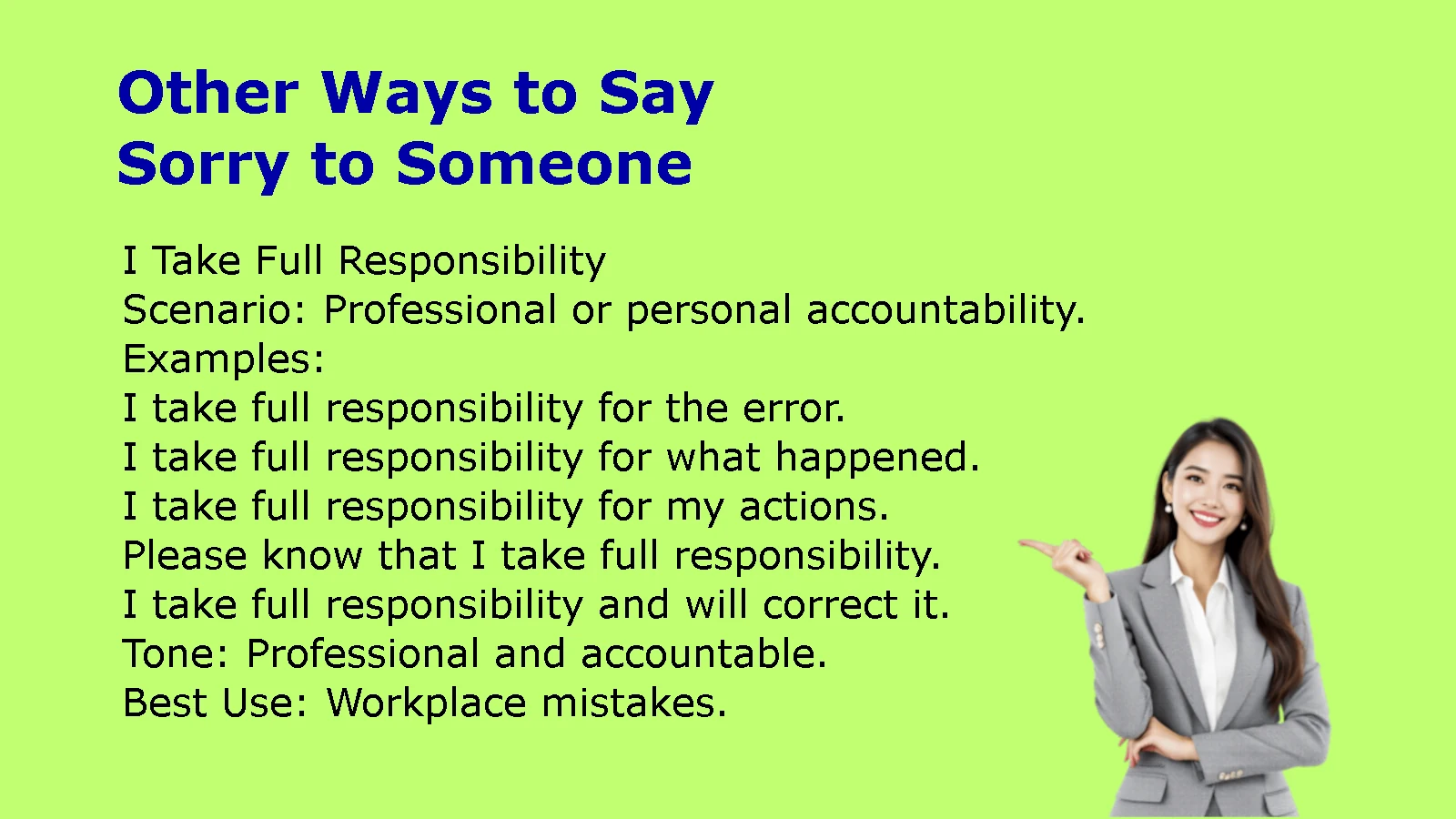
7. I Take Full Responsibility
Scenario: Professional or personal accountability.
Examples:
- I take full responsibility for the error.
- I take full responsibility for what happened.
- I take full responsibility for my actions.
- Please know that I take full responsibility.
- I take full responsibility and will correct it.
Tone: Professional and accountable.
Best Use: Workplace mistakes.
8. I Owe You an Apology
Scenario: Recognizing a need to apologize.
Examples:
- I owe you an apology for my behavior.
- I owe you an apology for being late.
- I owe you an apology for the confusion.
- I believe I owe you an apology.
- I owe you an apology and an explanation.
Tone: Respectful and sincere.
Best Use: Personal and professional settings.
9. I Feel Terrible About This
Scenario: Showing genuine regret.
Examples:
- I feel terrible about what happened.
- I feel terrible about letting you down.
- I feel terrible for causing this issue.
- I truly feel terrible about the situation.
- I feel terrible and want to fix it.
Tone: Emotional and sincere.
Best Use: Close relationships.
10. I Truly Regret It
Scenario: Deep remorse.
Examples:
- I truly regret it and wish I could change it.
- I truly regret my decision.
- I truly regret what I said.
- I truly regret my actions.
- I truly regret causing this problem.
Tone: Heartfelt and reflective.
Best Use: Serious apologies.
11. Please Accept My Apologies
Scenario: Formal apology.
Examples:
- Please accept my apologies for the delay.
- Please accept my apologies for the inconvenience.
- Please accept my apologies for the misunderstanding.
- Please accept my apologies for my mistake.
- Please accept my sincere apologies.
Tone: Formal and respectful.
Best Use: Professional communication.
12. I Stand Corrected
Scenario: Admitting you were mistaken.
Examples:
- I stand corrected and appreciate your input.
- I stand corrected on that matter.
- I stand corrected and apologize.
- Thank you for pointing it out; I stand corrected.
- I stand corrected and will improve.
Tone: Humble and professional.
Best Use: Workplace discussions.
13. I Shouldn’t Have Done That
Scenario: Acknowledging poor judgment.
Examples:
- I shouldn’t have done that.
- I shouldn’t have reacted that way.
- I shouldn’t have ignored your concerns.
- I shouldn’t have spoken so quickly.
- I shouldn’t have made that assumption.
Tone: Honest and reflective.
Best Use: Personal conversations.
14. I Wish I Could Take It Back
Scenario: Regret over words or actions.
Examples:
- I wish I could take it back.
- I wish I could undo what happened.
- I wish I could take back my words.
- I wish I could change that moment.
- I wish I could make things right.
Tone: Emotional and sincere.
Best Use: Personal relationships.
15. I Hope You Can Forgive Me
Scenario: Seeking reconciliation.
Examples:
- I hope you can forgive me.
- I hope you can forgive my mistake.
- I hope you can forgive my behavior.
- I hope you can forgive what happened.
- I hope you can forgive me in time.
Tone: Humble and heartfelt.
Best Use: Meaningful apologies.
16. I Didn’t Think It Through
Scenario: Poor decisions or mistakes.
Examples:
- I didn’t think it through properly.
- I didn’t think it through before acting.
- I didn’t think it through, and I regret it.
- I didn’t think it through carefully enough.
- I didn’t think it through at the time.
Tone: Reflective and honest.
Best Use: Admitting misjudgment.
17. I Deeply Regret This
Scenario: Serious situations.
Examples:
- I deeply regret this mistake.
- I deeply regret my actions.
- I deeply regret causing harm.
- I deeply regret the inconvenience.
- I deeply regret what occurred.
Tone: Serious and sincere.
Best Use: Significant mistakes.
18. I Was Out of Line
Scenario: Inappropriate behavior.
Examples:
- I was out of line, and I know it.
- I was out of line during our conversation.
- I was out of line to say that.
- I was out of line, and I apologize.
- I was out of line with my reaction.
Tone: Honest and accountable.
Best Use: Personal conflicts.
19. I Take the Blame
Scenario: Accepting responsibility.
Examples:
- I take the blame for the error.
- I take the blame for the misunderstanding.
- I take the blame for the delay.
- I take the blame for what happened.
- I take the blame and will improve.
Tone: Responsible and direct.
Best Use: Professional settings.
20. I’m Ashamed of My Behavior
Scenario: Deep regret.
Examples:
- I’m ashamed of my behavior.
- I’m ashamed of how I acted.
- I’m ashamed of my reaction.
- I’m ashamed of what I said.
- I’m ashamed and truly sorry.
Tone: Emotional and serious.
Best Use: Major personal mistakes.
21. I Never Meant Any Harm
Scenario: Unintentional hurt.
Examples:
- I never meant any harm.
- I never meant to offend you.
- I never meant to upset anyone.
- I never meant for this outcome.
- I never meant to cause problems.
Tone: Gentle and reassuring.
Best Use: Clarifying intentions.
22. I Feel Bad About It
Scenario: Casual apologies.
Examples:
- I feel bad about it.
- I really feel bad about what happened.
- I feel bad for causing trouble.
- I feel bad for forgetting.
- I feel bad about the misunderstanding.
Tone: Casual and sincere.
Best Use: Everyday situations.
23. I Humbly Apologize
Scenario: Respectful apology.
Examples:
- I humbly apologize for the mistake.
- I humbly apologize for my actions.
- I humbly apologize for the inconvenience.
- I humbly apologize for the confusion.
- I humbly apologize and appreciate your understanding.
Tone: Respectful and formal.
Best Use: Professional or formal settings.
24. I Want to Make Amends
Scenario: Repairing relationships.
Examples:
- I want to make amends for what happened.
- I want to make amends and move forward.
- I want to make amends for my mistake.
- I want to make amends and rebuild trust.
- I want to make amends however I can.
Tone: Constructive and sincere.
Best Use: Reconciliation efforts.
25. I Was Mistaken
Scenario: Admitting an error.
Examples:
- I was mistaken about the facts.
- I was mistaken, and I apologize.
- I was mistaken in my assumption.
- I was mistaken and appreciate the correction.
- I was mistaken in my judgment.
Tone: Professional and honest.
Best Use: Workplace and personal discussions.
26. I Should Have Known Better
Scenario: Reflecting on poor decisions.
Examples:
- I should have known better.
- I should have known better than to react that way.
- I should have known better and regret it.
- I should have known better at the time.
- I should have known better and learned from it.
Tone: Reflective and accountable.
Best Use: Personal apologies.
27. I Regret the Inconvenience
Scenario: Customer service or business settings.
Examples:
- I regret the inconvenience caused.
- I regret the inconvenience and appreciate your patience.
- I regret the inconvenience this has created.
- I regret the inconvenience and am working on a solution.
- I regret the inconvenience caused by the delay.
Tone: Professional and courteous.
Best Use: Formal communication.
28. I Wish Things Had Gone Differently
Scenario: Reflective apologies.
Examples:
- I wish things had gone differently.
- I wish things had gone differently between us.
- I wish things had gone differently during the meeting.
- I wish things had gone differently that day.
- I truly wish things had gone differently.
Tone: Thoughtful and sincere.
Best Use: Personal conversations.
29. I’m Truly Sorry
Scenario: Simple but heartfelt apology.
Examples:
- I’m truly sorry for what happened.
- I’m truly sorry for the misunderstanding.
- I’m truly sorry for hurting you.
- I’m truly sorry for my mistake.
- I’m truly sorry and hope to make it right.
Tone: Genuine and heartfelt.
Best Use: Almost any situation.
30. I Hope We Can Move Forward
Scenario: Resolving conflicts.
Examples:
- I hope we can move forward from this.
- I hope we can move forward together.
- I hope we can move forward despite my mistake.
- I hope we can move forward and rebuild trust.
- I hope we can move forward positively.
Tone: Optimistic and constructive.
Best Use: Rebuilding relationships.
31. I Take Responsibility for My Mistake
Scenario: Accepting accountability in personal or professional situations.
Examples:
- I take responsibility for my mistake and will correct it.
- I take responsibility for what happened.
- I take responsibility for the confusion caused.
- I take responsibility and appreciate your patience.
- I take responsibility for my actions.
Tone: Accountable and professional.
Best Use: Workplace issues or serious misunderstandings.
32. I Was Inconsiderate
Scenario: Recognizing that your actions affected someone negatively.
Examples:
- I was inconsiderate, and I regret it.
- I was inconsiderate of your feelings.
- I was inconsiderate when I made that decision.
- I realize I was inconsiderate.
- I was inconsiderate and truly apologize.
Tone: Reflective and sincere.
Best Use: Personal relationships and friendships.
33. I Let You Down
Scenario: When you failed to meet someone’s expectations.
Examples:
- I know I let you down.
- I let you down, and I’m sorry.
- I realize I let you down with my actions.
- I let you down, and I regret it deeply.
- I never intended to let you down.
Tone: Emotional and heartfelt.
Best Use: Close relationships and team environments.
34. I Was Careless
Scenario: Admitting negligence or lack of attention.
Examples:
- I was careless, and I apologize.
- I was careless with the details.
- I was careless and caused unnecessary problems.
- I admit I was careless.
- I was careless, and I’ll do better next time.
Tone: Honest and responsible.
Best Use: Work-related errors or everyday mistakes.
35. I Understand Why You’re Upset
Scenario: Showing empathy before apologizing.
Examples:
- I understand why you’re upset.
- I understand why you feel that way.
- I understand why this hurt you.
- I understand why you’re disappointed.
- I understand your frustration.
Tone: Empathetic and understanding.
Best Use: Conflict resolution and emotional conversations.
36. I Shouldn’t Have Said That
Scenario: Regretting spoken words.
Examples:
- I shouldn’t have said that.
- I shouldn’t have said those things in anger.
- I shouldn’t have spoken to you that way.
- I shouldn’t have made that comment.
- I shouldn’t have said it without thinking.
Tone: Regretful and sincere.
Best Use: Arguments and misunderstandings.
37. I Regret Hurting You
Scenario: Emotional apologies.
Examples:
- I regret hurting you.
- I truly regret hurting your feelings.
- I regret hurting someone I care about.
- I regret hurting you with my actions.
- I deeply regret hurting you.
Tone: Compassionate and heartfelt.
Best Use: Personal and romantic relationships.
38. I Was Unfair
Scenario: Admitting unequal or unreasonable treatment.
Examples:
- I was unfair to you.
- I was unfair in my judgment.
- I realize I was unfair.
- I was unfair, and I apologize.
- I was unfair in how I handled the situation.
Tone: Honest and mature.
Best Use: Personal and workplace conflicts.
39. I Wish I Had Handled It Better
Scenario: Reflecting on poor decisions.
Examples:
- I wish I had handled it better.
- I wish I had responded differently.
- I wish I had handled the situation more thoughtfully.
- I wish I had handled things with more care.
- I truly wish I had handled it better.
Tone: Reflective and sincere.
Best Use: After disagreements or mistakes.
40. I Didn’t Intend to Cause Trouble
Scenario: Clarifying intentions.
Examples:
- I didn’t intend to cause trouble.
- I didn’t intend to make things difficult.
- I didn’t intend to create problems.
- I didn’t intend for things to turn out this way.
- I didn’t intend to upset anyone.
Tone: Gentle and reassuring.
Best Use: Minor misunderstandings.
41. I Feel Awful About What Happened
Scenario: Showing strong regret.
Examples:
- I feel awful about what happened.
- I feel awful for causing this situation.
- I feel awful about my behavior.
- I truly feel awful for hurting you.
- I feel awful and want to make things right.
Tone: Emotional and sincere.
Best Use: Personal apologies.
42. I Hope You’ll Accept My Apology
Scenario: Seeking forgiveness respectfully.
Examples:
- I hope you’ll accept my apology.
- I hope you’ll accept my sincere apology.
- I hope you’ll accept my apology for the misunderstanding.
- I hope you’ll accept my apology and allow me to explain.
- I hope you’ll accept my apology for my actions.
Tone: Respectful and humble.
Best Use: Formal and personal situations.
43. I Was Thoughtless
Scenario: Acknowledging a lack of consideration.
Examples:
- I was thoughtless, and I’m sorry.
- I was thoughtless in my actions.
- I realize I was thoughtless.
- I was thoughtless and didn’t consider your feelings.
- I was thoughtless, and I regret it.
Tone: Reflective and apologetic.
Best Use: Personal relationships.
44. I Made a Poor Decision
Scenario: Admitting bad judgment.
Examples:
- I made a poor decision.
- I made a poor decision, and I regret it.
- I realize I made a poor decision.
- I made a poor decision that affected others.
- I made a poor decision and learned from it.
Tone: Responsible and mature.
Best Use: Professional and personal mistakes.
45. I Value Our Relationship and I’m Sorry
Scenario: Preserving an important connection.
Examples:
- I value our relationship and I’m sorry.
- I value our friendship and regret my actions.
- I value what we have and apologize.
- I value our connection and want to make things right.
- I value our relationship and hope we can move forward.
Tone: Warm and heartfelt.
Best Use: Friends, family, and partners.
46. I Want to Earn Back Your Trust
Scenario: Rebuilding damaged trust.
Examples:
- I want to earn back your trust.
- I want to earn back your trust through my actions.
- I know trust takes time, and I want to earn it back.
- I want to earn back your trust after my mistake.
- I want to earn back your trust and prove I’ve learned.
Tone: Sincere and committed.
Best Use: Serious apologies and relationship repair.
47. From the Bottom of My Heart, I’m Sorry
Scenario: Deeply emotional apologies.
Examples:
- From the bottom of my heart, I’m sorry.
- From the bottom of my heart, I apologize for hurting you.
- From the bottom of my heart, I’m sorry for my actions.
- From the bottom of my heart, I regret what happened.
- From the bottom of my heart, I’m truly sorry.
Tone: Deeply heartfelt and emotional.
Best Use: Meaningful personal apologies and reconciliation.
Conclusion
Although saying “sorry” is one of the most common ways to express regret, using thoughtful alternatives can make your apology feel more genuine and impactful. Moreover, different situations call for different tones, whether professional, heartfelt, reflective, or empathetic. By choosing expressions such as “I apologize,” “I take responsibility,” “I want to make amends,” or “From the bottom of my heart, I’m sorry,” you can communicate sincerity more effectively. Ultimately, a meaningful apology is not just about the words you choose but also about showing accountability, understanding, and a willingness to make things right.