Have you ever wondered whether it’s “Affend” or “Offend” and why only one of these words looks correct in standard English? This is a common spelling confusion that appears in searches, writing mistakes, and everyday communication, especially among English learners trying to improve their English vocabulary, grammar accuracy, and word choice.
The truth is simple but important: “Offend” is the correct and standard word in the English language, while “Affend” is a common misspelling that often happens due to pronunciation confusion or typing errors. Even though they may look similar at first glance, only “offend” is recognized in American English and British English as part of formal and informal communication.
If you’ve ever struggled with commonly confused words, spelling mistakes, or English grammar rules, this guide will make things clear. You’ll learn the correct meaning of offend, why “affend” is incorrect, how the word is used in real-life sentences, and the difference in tone across regional English (US vs UK usage). We’ll also cover practical examples, related vocabulary like insult, upset, annoy, hurt feelings, and common mistakes learners make when using this word.
So, if you’re ready to eliminate this spelling confusion and strengthen your understanding of commonly misspelled English words, let’s break down Affend vs Offend in a simple and practical way.
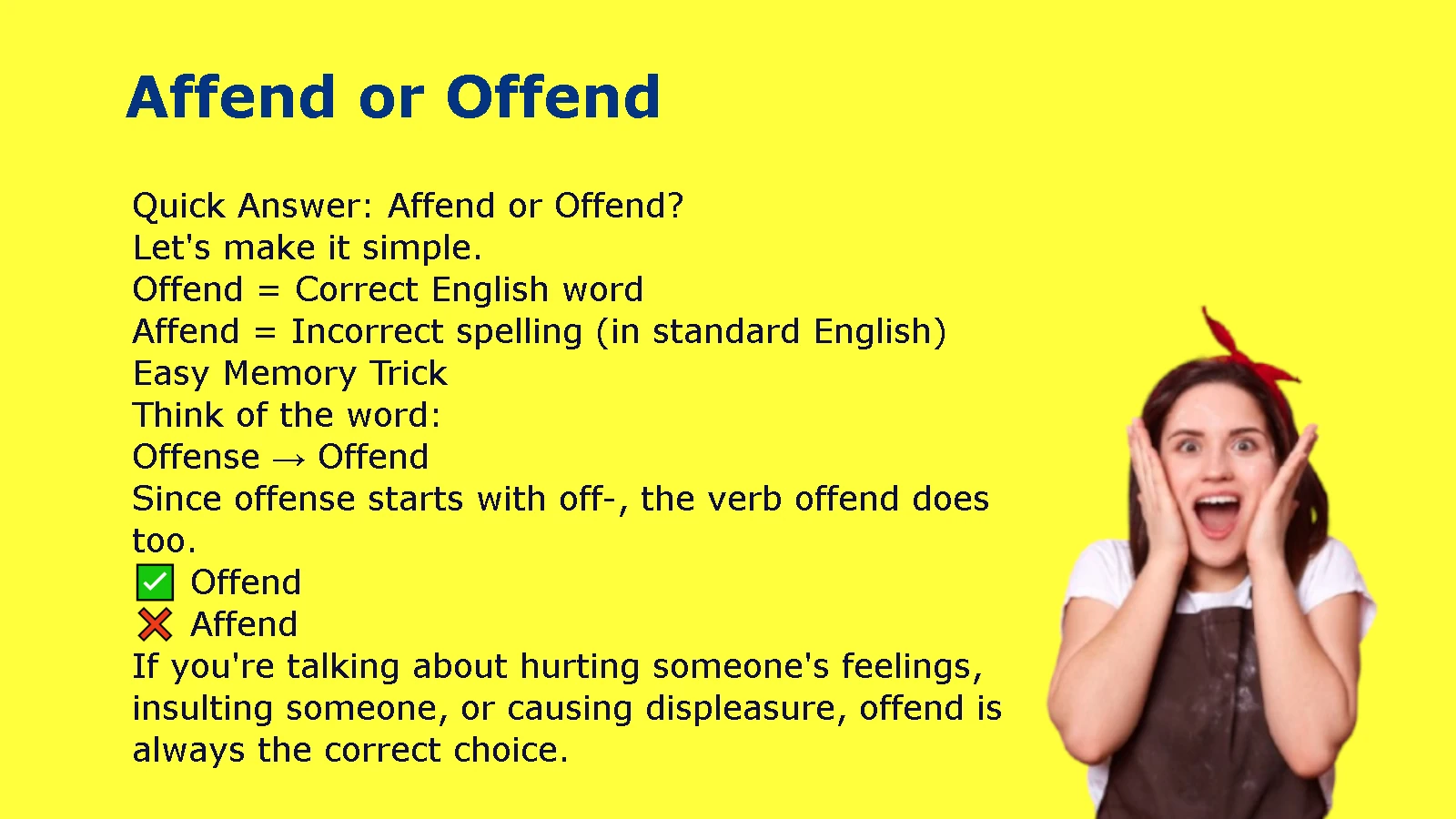
Quick Answer: Affend or Offend?
Let’s make it simple.
Offend = Correct English word
Affend = Incorrect spelling (in standard English)
Easy Memory Trick
Think of the word:
Offense → Offend
Since offense starts with off-, the verb offend does too.
✅ Offend
❌ Affend
If you’re talking about hurting someone’s feelings, insulting someone, or causing displeasure, offend is always the correct choice.
What Does “Offend” Mean?
The verb offend means:
- To hurt someone’s feelings
- To insult someone
- To upset or annoy someone
- To violate accepted standards or rules
Common Examples
- I didn’t mean to offend you.
- His comment may offend some people.
- The joke offended several audience members.
- Please tell me if anything I say offends you.
Simple Definition
Offend = to cause emotional hurt, displeasure, or insult.
Is “Affend” a Real Word?
Here’s where confusion ends.
In modern standard English:
“Affend” is not considered a correct spelling.
If you look in major dictionaries, you’ll find offend, but not affend as a standard English verb.
What Usually Happens
People may write:
❌ I didn’t want to affend you.
But the correct sentence is:
✅ I didn’t want to offend you.
Key Insight
Whenever you’re deciding between affend and offend, choose offend.
Why Do People Confuse “Affend” and “Offend”?
The mistake is surprisingly common.
Similar Pronunciation
When speaking quickly, some accents make the beginning sound less distinct.
People may hear:
“uh-fend”
instead of
“off-end”
and assume the spelling starts with a.
Typing Errors
Many spelling mistakes happen because writers type based on sound rather than memory.
Influence of Other Words
English contains many words beginning with:
- affect
- affirm
- afford
- affair
Because of this pattern, some people mistakenly create affend.
Key Takeaway
The confusion comes from pronunciation and spelling habits—not grammar rules.
The Meaning Difference: Affend vs. Offend
Let’s compare them side by side.
| Word | Correct? | Meaning |
| Offend | ✅ Yes | To insult, upset, or hurt feelings |
| Affend | ❌ No | Misspelling of offend |
Simple Rule
If you’re writing standard English:
Use offend every time.
Real-Life Examples of “Offend”
Here are some examples you’ll encounter in everyday communication.
Personal Conversations
- I hope I didn’t offend you.
- She was offended by the remark.
- No offense intended.
Workplace Communication
- Be careful not to offend clients.
- The email offended several employees.
- Managers should avoid language that may offend staff.
Social Media
- Some users were offended by the post.
- The comment might offend certain readers.
- Public figures often apologize when they offend people.
Common Pattern
In all these examples, offend refers to causing emotional discomfort or insult.
Common Mistakes People Make
Many writers accidentally use the wrong spelling.
Mistake #1
❌ Don’t affend anyone.
✅ Don’t offend anyone.
Mistake #2
❌ I was affended by his words.
✅ I was offended by his words.
Mistake #3
❌ She didn’t mean to affend me.
✅ She didn’t mean to offend me.
Lesson
If you see affend, replace it with offend.
How to Remember the Correct Spelling
Need a quick memory trick?
The “Offense” Rule
Think:
Offense → Offend
Because both words share the same root, they begin with off.
Visual Memory
Imagine someone saying:
“No offense!”
Since you’ve probably heard that phrase many times, it naturally connects to:
offend
Quick Check
Ask yourself:
Can I spell offense?
If yes, then you can spell offend.
When “Offend” Is Commonly Used
You’ll often see the word in situations involving:
Feelings
- Hurt feelings
- Personal criticism
- Insensitive remarks
Culture
- Religious discussions
- Social issues
- Public statements
Professional Settings
- Workplace communication
- Customer service
- Public relations
Why It Matters
Using respectful language helps avoid offending others and improves communication.
Quick Decision Guide
Whenever you’re unsure:
Are you talking about insulting, upsetting, or hurting someone’s feelings?
➡ Use offend
Are you thinking about writing affend?
➡ Don’t. Use offend instead.
Simple. Reliable. Done.
FAQ: Affend or Offend?
Is “affend” a real English word?
No. In modern standard English, affend is generally considered a misspelling of offend.
Which spelling is correct?
Offend is the correct spelling.
Why do people write “affend”?
Usually because they spell the word based on how they hear it pronounced.
What does “offend” mean?
It means to insult, upset, annoy, or hurt someone’s feelings.
Can I use “affend” in formal writing?
No. Use offend instead.
Key Facts You Should Remember
- Offend is the correct English word.
- Affend is a common misspelling.
- Offend means to insult, upset, or hurt someone’s feelings.
- The word is related to offense.
- Professional and academic writing should always use offend.
Final Takeaway: The One Rule That Never Fails
Here’s the simple truth.
When choosing between affend and offend, there is only one correct option in standard English:
✅ Offend
❌ Affend
The confusion usually comes from pronunciation, but the spelling rule is straightforward. If you’re talking about hurting someone’s feelings, causing insult, or giving offense, always use offend.
Think of it this way:
Offense → Offend
Remember that connection, and you’ll never make this mistake again.
Because when it comes to “affend” or “offend,” the correct choice is always offend.