Have you ever wondered whether it is “across” or “accross” when writing in English? This is one of the most common spelling mistakes people make, especially when learning English as a second language or typing quickly online. The correct word is “across”, while “accross” is a frequent misspelling that often appears in informal writing.
Many learners also search for terms like across meaning, how to use across in a sentence, and is accross correct in English, which shows how confusing this simple word can be. In reality, “across” is a basic preposition used to describe movement from one side to another, position on the opposite side, or something that spans an area.
Understanding the difference between across vs accross is important for improving grammar accuracy, avoiding spelling mistakes, and writing more professionally in emails, essays, and online content. In this guide, you’ll learn the correct spelling, meaning, usage rules, common errors, and practical examples to help you use “across” confidently in everyday English.
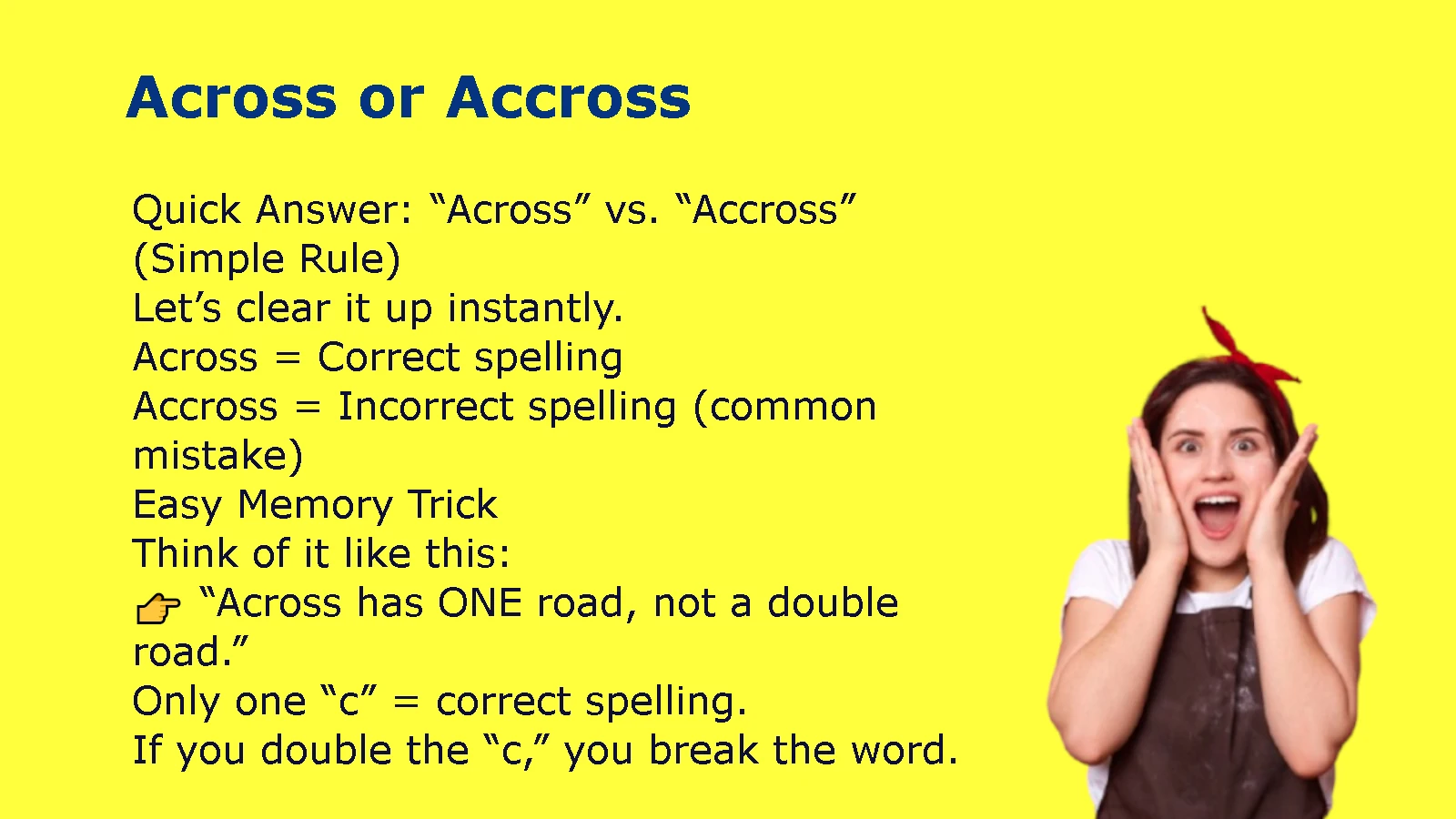
Quick Answer: “Across” vs. “Accross” (Simple Rule)
Let’s clear it up instantly.
- Across = Correct spelling
- Accross = Incorrect spelling (common mistake)
Easy Memory Trick
Think of it like this:
👉 “Across has ONE road, not a double road.”
Only one “c” = correct spelling.
If you double the “c,” you break the word.
Why People Get Confused Between “Across” and “Accross”
The mistake is very natural.
1. Pronunciation Trap
When spoken, “across” sounds slightly stressed, making the “c” feel doubled.
2. Visual Guessing
People assume English doubles consonants like:
- success
- address
- process
So they wrongly apply the same pattern.
3. Typing Speed Errors
Fast typing leads to accidental doubling of letters.
The Correct Spelling: “Across” Explained Clearly
“Across” is a preposition and adverb used to show movement or position from one side to another.
Core Meaning
- From one side to the other
- On the opposite side
- Spanning or extending over something
Simple Formula
Across = movement + direction
Real-Life Examples of “Across”
Here are correct uses:
- “She walked across the street.”
- “The shop is across from my house.”
- “He looked across the room.”
- “There is a bridge across the river.”
Mini Scenario
You’re standing outside:
“The café is across the road.”
Meaning: you just need to go to the opposite side.
Why “Accross” Is Always Wrong
Let’s be clear:
❌ “Accross” = Incorrect spelling
It is not recognized in standard English dictionaries.
What Happens If You Use It
- Looks like a spelling error
- Reduces writing credibility
- Can affect professional communication
Key Insight
English does not double the “c” in this word.
Side-by-Side Comparison Table
| Word | Meaning | Correct? | Example |
|---|---|---|---|
| Across | From one side to another | ✔️ Yes | She ran across the field |
| Accross | Not a real word | ❌ No | Incorrect spelling |
Most Common Mistakes People Make
1. Over-Doubling Letters
People confuse patterns like:
- address
- success
2. Fast Writing
Typing quickly leads to accidental spelling errors.
3. Autocorrect Blind Trust
Some devices may not always fix it.
Simple Tricks to Remember “Across”
Trick 1: One Bridge Rule
There is only one bridge (c) to cross.
Trick 2: Sound vs Spelling
Even if it sounds strong, spelling stays simple.
Trick 3: Break It Down
A + cross = across
Not “ac + cross”
Better Writing Alternatives (When Needed)
Instead of repeating “across,” you can also use:
- “from one side to the other”
- “opposite side of”
- “over”
- “through”
Example
- “The shop is across the street.”
- “The shop is on the opposite side of the street.”
FAQ: Across vs Accross
Is “accross” ever correct?
No. It is always incorrect in standard English.
Why do people write “accross”?
Because they assume English doubles consonants in similar-sounding words.
What is the easiest way to remember it?
Think: only one “c” crosses the road.
Does it affect professional writing?
Yes. It can make writing look careless.
Quick Summary
- “Across” = correct spelling
- “Accross” = wrong spelling
- Common mistake caused by pronunciation and typing habits
- Always use one “c” only
Final Takeaway
English spelling can be tricky, but this one is simple once you lock it in.
Whenever you feel unsure, remember this:
👉 There is only ONE “c” when you go across.
Because in writing—as in crossing a road—extra steps (or extra letters) only lead you in the wrong direction.