Have you ever come across the words “Stich vs Stitch” and wondered if they mean the same thing—or if one of them is even correct? This is a very common spelling confusion in English, especially for learners, writers, and even native speakers who type quickly and miss letters.
In most cases, the confusion happens because “stitch” is the correct spelling, while “stich” is simply a common misspelling. But things can get tricky when you see the word used in different contexts like sewing, embroidery, medicine, or even everyday phrases like “in a tight stitch.”
If you’ve ever hesitated while writing about sewing, fashion, or even medical stitches after an injury, you’re not alone. This mix-up appears often in searches like stitch meaning, stitch vs stich difference, and correct spelling of stitch, especially in English grammar and vocabulary usage.
The good news is that once you understand the meaning, spelling rule, and real-life usage of “stitch” in the English language, you’ll never confuse it again.
In this guide, you’ll learn the correct spelling of stitch vs stich, what “stitch” actually means in sewing and medical contexts, why people often misspell it, and how to use it correctly in sentences. You’ll also see common mistakes, simple memory tricks, and real examples that make the difference crystal clear.
So let’s break down this commonly confused word pair and clear up the confusion once and for all.
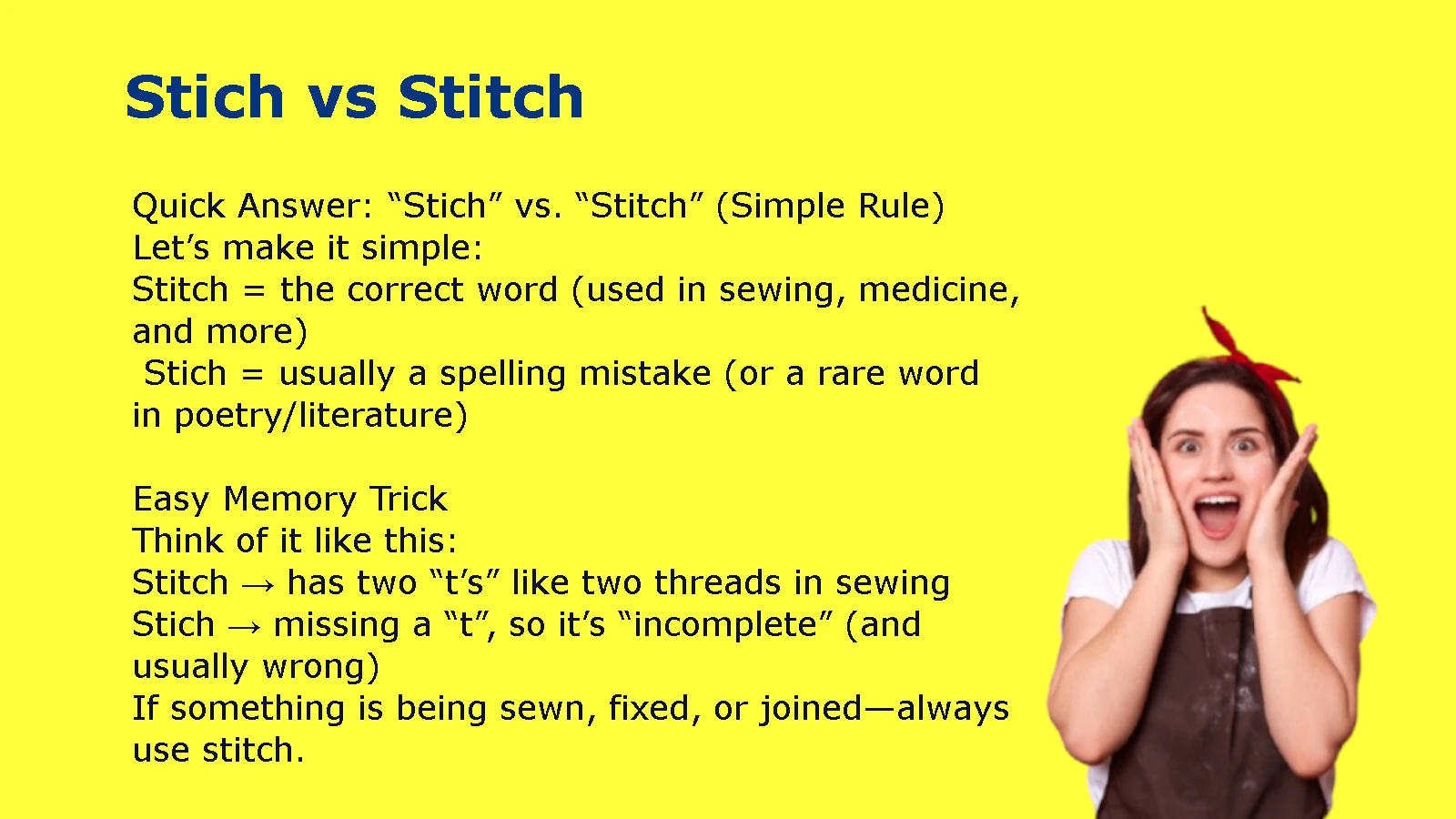
Quick Answer: “Stich” vs. “Stitch” (Simple Rule)
Let’s make it simple:
Stitch = the correct word (used in sewing, medicine, and more)
Stich = usually a spelling mistake (or a rare word in poetry/literature)
Easy Memory Trick
Think of it like this:
- Stitch → has two “t’s” like two threads in sewing
- Stich → missing a “t”, so it’s “incomplete” (and usually wrong)
If something is being sewn, fixed, or joined—always use stitch.
Why “Stich” vs “Stitch” Causes Confusion
The confusion happens because:
- The words look almost identical
- Fast typing leads to missing letters
- Some people assume both are correct
- Auto-correct sometimes fails in casual writing
But in standard English, only one is widely accepted.
“Stitch” Explained Clearly (Correct Usage)
The word stitch has multiple meanings depending on context.
1. Sewing Meaning
A stitch is a loop of thread used to sew fabric.
Examples:
- She made a neat stitch on the torn dress.
- The tailor fixed the shirt with tiny stitches.
- I learned basic sewing stitches today.
2. Medical Meaning
A stitch can also mean a surgical suture.
Examples:
- The doctor put five stitches in the wound.
- He needs his stitches removed after a week.
3. Pain Meaning (Side Stitch)
A stitch can mean a sudden sharp pain while running.
Examples:
- I got a stitch in my side during jogging.
- She stopped because of a painful stitch.
4. Figurative Meaning
Used in expressions or idioms.
Examples:
- “A stitch in time saves nine.”
- The joke made everyone stitch with laughter.
“Stich” Explained (Is It Even a Word?)
Here’s the truth:
In Modern English
- “stich” is considered a misspelling of “stitch”
- It is not used in formal writing
In Rare Cases
- “Stich” may appear in:
- Poetry (as stylistic variation)
- Names or surnames
- Historical or foreign transliterations
But in everyday English, it has no standard meaning.
Side-by-Side Comparison Table
| Word | Meaning | Correct Usage | Risk of Confusion | Example |
| Stitch | Sewing loop, medical suture, pain, expression | ✔ Correct | Low (clear standard word) | “She made a stitch.” |
| Stich | Usually a typo or rare proper noun | ✘ Incorrect in most cases | High | “Incorrect spelling of stitch” |
Common Mistakes People Make
Here’s where most confusion happens:
1. Typing Error
- “stich” instead of “stitch” in messages or essays
2. Fast Writing
- Missing one “t” while typing quickly
3. Mislearning
- Beginners assume both spellings are valid
4. Auto-correct Blindness
- Device sometimes doesn’t highlight the error clearly
Real-Life Examples of “Stitch”
Let’s make it practical:
- “The doctor gave him three stitches after the injury.”
- “She knows how to do embroidery stitching.”
- “I felt a sharp stitch while running.”
- “Use a strong stitch to repair the fabric.”
👉 In all cases, stitch is correct
What Happens When You Use “Stich” Wrong
Using “stich” in formal writing can lead to:
- Grammar mistakes
- Lower writing credibility
- Misunderstanding in exams or assignments
- SEO/spelling penalties in content writing
Example mistake:
- ❌ “The wound needed stiching.”
- ✔ “The wound needed stitching.”
Quick Decision Guide
Use this simple rule:
- Sewing / medical / pain → stitch
- Writing anything in English → stitch
- Unsure spelling → stitch
If you ever type “stich,” pause and check—it’s almost always wrong.
FAQ: “Stich” vs “Stitch”
Is “stich” a real English word?
Not in modern standard English. It is usually a spelling mistake.
What is the correct spelling for sewing?
Always stitch.
Why do people write “stich”?
Because of fast typing, confusion, or lack of awareness.
Can “stich” ever be correct?
Only in rare names or special contexts, not in general usage.
Key Facts You Should Remember
- Stitch = correct spelling
- Stich = usually incorrect
- Used in sewing, medicine, and expressions
- One missing “t” changes correctness completely
- Context does NOT make “stich” standard
Final Takeaway: The One Rule That Never Fails
If you remember only one thing, remember this:
👉 Always write “stitch” with two T’s
Because language is unforgiving with small mistakes, and this one-letter difference can change how professional your writing looks.
Think of it like sewing itself—
if a stitch is missing, the whole fabric weakens.
So in writing too:
No second “t” → no correct word.