Have you ever wondered whether “inflexible” vs “unflexible” is just a spelling variation or if one of them is actually incorrect? This is a common confusion in English grammar and vocabulary, especially among learners and writers trying to choose the right word in formal writing, essays, or professional communication. The keyword question often appears as is “unflexible” a word, or what is the correct form between inflexible meaning and its alternative.
Here’s the simple truth: “inflexible” is the standard and correct word in English, while “unflexible” is rarely used and generally considered incorrect or non-standard in modern usage. This difference comes from how prefixes like “in-” and “un-” work in English grammar, often creating confusion in commonly confused word pairs.
In this guide, you’ll learn the clear difference between inflexible vs unflexible, how each term is used in real contexts, why one is preferred in American English and British English, and how to avoid this common grammar mistake. Let’s break it down in a simple, practical way.
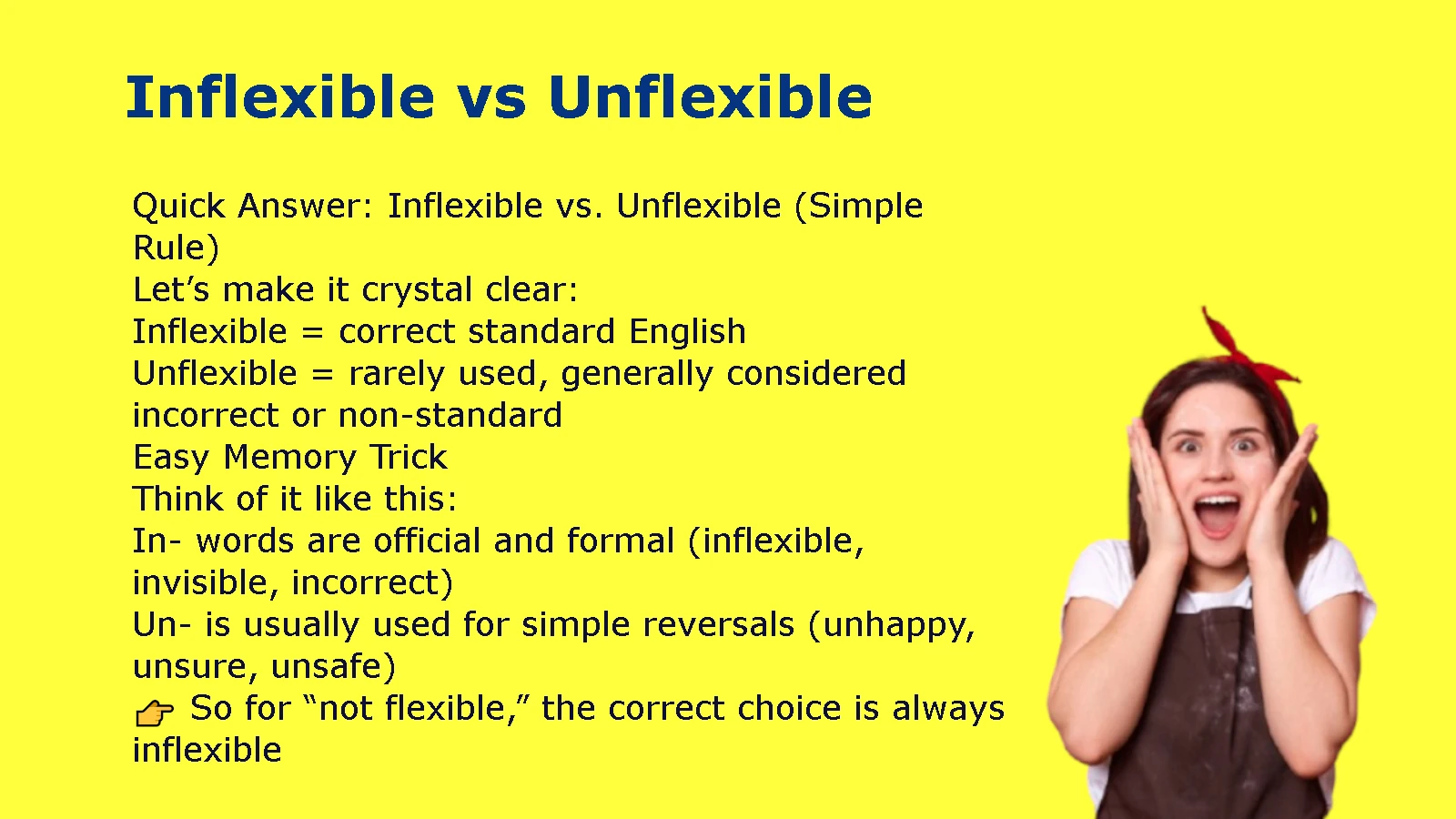
Quick Answer: Inflexible vs. Unflexible (Simple Rule)
Let’s make it crystal clear:
- Inflexible = correct standard English
- Unflexible = rarely used, generally considered incorrect or non-standard
Easy Memory Trick
Think of it like this:
- In- words are official and formal (inflexible, invisible, incorrect)
- Un- is usually used for simple reversals (unhappy, unsure, unsafe)
👉 So for “not flexible,” the correct choice is always inflexible
What Does “Inflexible” Mean?
The word inflexible means something that cannot bend, change, or be easily adjusted.
Standard Meaning
- Physically rigid (a metal rod is inflexible)
- Mentally strict or stubborn (an inflexible person or rule)
Real Examples
- “The manager is inflexible about deadlines.”
- “The plastic becomes inflexible in cold weather.”
- “Her schedule is inflexible due to tight work hours.”
👉 It is widely accepted in both formal and informal English.
What About “Unflexible”?
Now comes the confusing part.
Standard Status
- ❌ Not commonly accepted in formal English
- ❌ Considered incorrect in most dictionaries and style guides
- ⚠️ Sometimes used in informal speech, but very rare
Why It Exists
People try to logically apply “un-” to “flexible,” thinking it means the opposite. While that logic makes sense, English doesn’t always follow pattern-based formation.
Key Insight
English already assigned the role of “not flexible” to inflexible, so “unflexible” is unnecessary.
Why “Inflexible” Is the Correct Word
English often uses different prefixes for negation depending on the root word.
Pattern Rule
- In- = used for Latin-based words
→ inflexible, inactive, invisible - Un- = used for basic English words
→ unhappy, unfair, unknown
Since flexible comes through Latin influence (flexibilis), it naturally pairs with in-, not un-.
Common Mistake People Make
Here’s where confusion usually happens:
What Goes Wrong
- Learners think “un-” always means “not”
- They create “unflexible” logically
- Native usage doesn’t support it
Real Scenario
A student writes:
“The teacher is unflexible about late submissions.”
Result:
- Grammatically understood
- But considered incorrect or unnatural in formal writing
Correct version:
“The teacher is inflexible about late submissions.”
Side-by-Side Comparison Table
| Word | Meaning | Usage Status | Correctness |
| Inflexible | Not flexible, rigid, strict | Formal & standard | ✔ Correct |
| Unflexible | Attempted opposite of flexible | Rare / non-standard | ❌ Incorrect in formal English |
Real-Life Examples of “Inflexible”
Let’s see how it’s used naturally:
Work & Business
- “The company has inflexible policies on refunds.”
- “He is inflexible when negotiating contracts.”
Daily Life
- “My schedule is too inflexible for weekend trips.”
- “She has an inflexible routine every morning.”
Physical Meaning
- “Old plastic becomes inflexible over time.”
Can You Ever Use “Unflexible”?
Technically, you might see it in:
- Informal writing
- Learner mistakes
- Rare creative usage
But in practice:
👉 You should avoid it completely
Why?
Because native speakers almost never use it, and it may look incorrect.
The Biggest Mistake Learners Make
The core issue is assumption.
What People Think
“If ‘unhappy’ is correct, then ‘unflexible’ must also be correct.”
What English Actually Does
English does not apply prefixes evenly across all words.
Result
- “Unflexible” sounds logical
- But “inflexible” is the accepted form
How to Never Make This Mistake Again
Use this simple rule:
Golden Rule
If unsure, choose the dictionary-standard form:
👉 inflexible
Quick Checklist
- Does the word appear in formal writing? → Yes = use it
- Is it in dictionaries? → Yes = safe
- Sounds “made up”? → Avoid it
Better Alternatives to “Unflexible”
If you ever feel stuck, use these instead:
- Rigid
- Strict
- Unchanging
- Fixed
- Stubborn (for people)
These are all natural and widely accepted.
Quick Decision Guide
- Need correct formal word → Inflexible
- Trying “unflexible” → ❌ Avoid
- Unsure → Use synonym (rigid, strict)
Simple. Clean. Safe.
FAQ: Inflexible vs. Unflexible
Is “unflexible” a real word?
It exists in rare informal use but is not standard English.
Why is “inflexible” correct?
Because it follows Latin-based word formation rules.
Can I use “unflexible” in writing?
It is strongly discouraged in academic and professional writing.
What is the safest choice?
Always use inflexible.
Key Facts You Should Remember
- “Inflexible” = correct and standard
- “Unflexible” = non-standard and rarely used
- English prefix rules are not always symmetrical
- Dictionaries favor “inflexible”
Final Takeaway: The One Rule That Never Fails
Here’s the simplest way to remember it:
👉 If you want to say “not flexible,” always choose inflexible
👉 Never rely on “unflexible” in formal English
Language isn’t always logical, but it is consistent in usage. And in real communication, consistency matters more than guesswork.
So when it comes to “inflexible vs. unflexible,” the rule is simple:
One is correct. The other is not.