Ancestry meaning refers to a person’s family origin, lineage, or the generations of ancestors they descend from. The term is commonly used to describe ethnic background, family history, or inherited heritage and appears frequently in genealogy, history, and everyday conversations.
The confusion often comes from how the word is used in different contexts. Some people use it when talking about ethnic background, lineage, or family origins, while others encounter it in historical records, DNA tests, or everyday conversations. But here’s the good news: once you understand the concept, it’s easy to recognize when and how to use the word correctly.
In this guide, you’ll discover the Ancestry Meaning, explore its definition, pronunciation, and examples in a sentence, and learn how it differs from related terms like heritage, genealogy, lineage, and family history. You’ll also see common uses of the word and understand why it plays an important role in learning about your roots.
By the end, you’ll have a clear understanding of ancestry, its meaning in different contexts, and how to use it confidently in both writing and conversation.
What Is Ancestry?
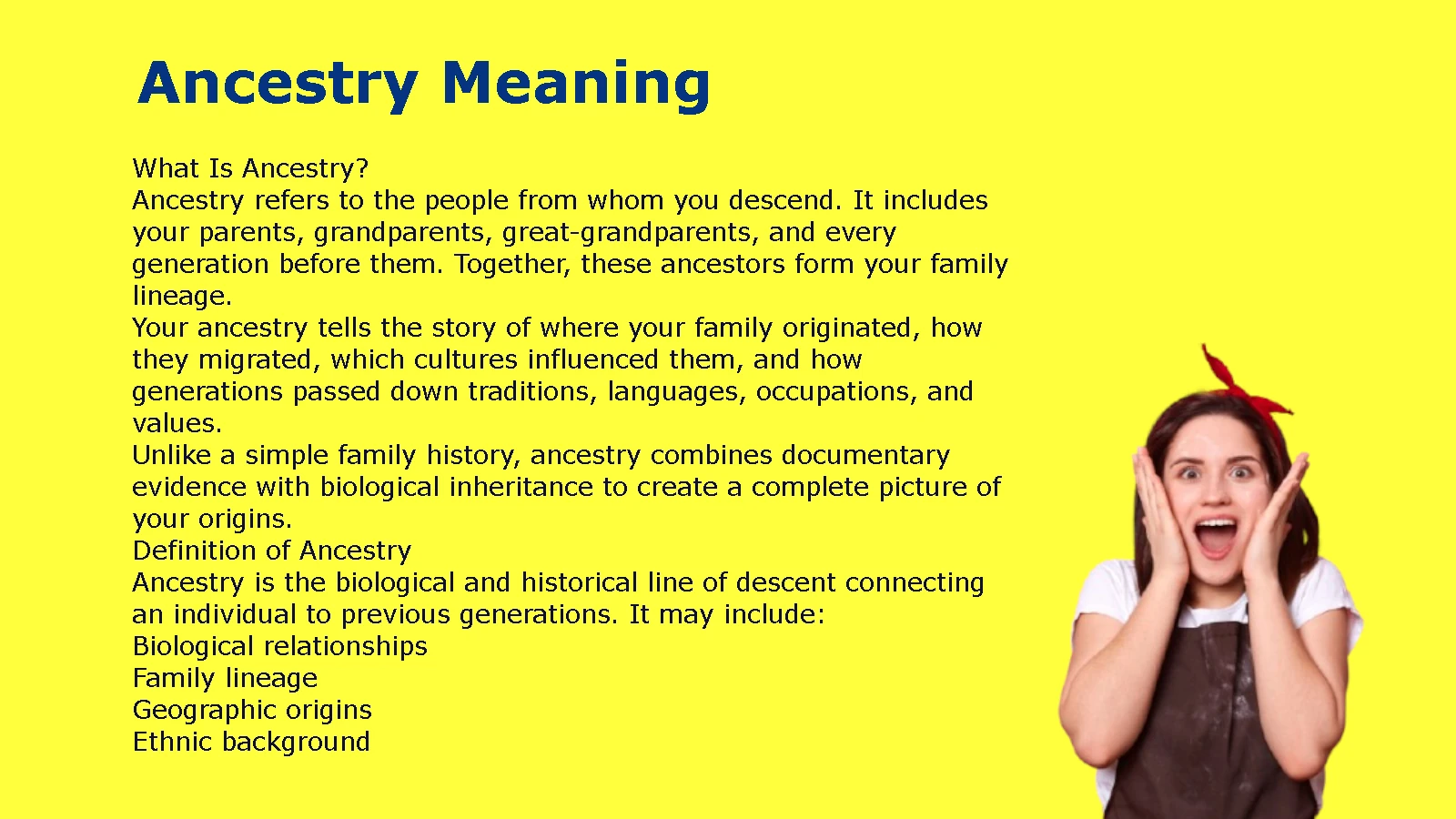
Ancestry refers to the people from whom you descend. It includes your parents, grandparents, great-grandparents, and every generation before them. Together, these ancestors form your family lineage.
Your ancestry tells the story of where your family originated, how they migrated, which cultures influenced them, and how generations passed down traditions, languages, occupations, and values.
Unlike a simple family history, ancestry combines documentary evidence with biological inheritance to create a complete picture of your origins.
Definition of Ancestry
Ancestry is the biological and historical line of descent connecting an individual to previous generations. It may include:
- Biological relationships
- Family lineage
- Geographic origins
- Ethnic background
- Cultural traditions
- Historical migration patterns
Although people often use “ancestry” and “genealogy” interchangeably, they aren’t exactly the same.
| Term | Meaning |
| Ancestry | Your biological and historical origins |
| Genealogy | The research process used to document family relationships |
| Heritage | Traditions, customs, beliefs, and cultural identity inherited from ancestors |
| Ethnicity | Shared cultural or genetic background associated with specific populations |
| Lineage | Direct line of descent from an ancestor |
Why Ancestry Matters
Researching your ancestry can answer questions you may have wondered about for years.
For example:
- Where did your family originate?
- Why did your ancestors migrate?
- Which languages did they speak?
- What occupations did they have?
- Did they participate in major historical events?
- Are family stories actually true?
Beyond satisfying curiosity, ancestry research helps preserve family history for future generations.
Many families lose valuable stories because older relatives pass away before sharing them. Recording family history today protects those memories forever.
How Ancestry Is Determined
Finding your ancestry isn’t based on guesswork. Researchers combine historical documents with genetic evidence to build an accurate picture of your family history.
Each source contributes a different piece of the puzzle.
Family Records and Historical Documents
Traditional genealogy begins with documents.
These records establish relationships between parents, children, spouses, and siblings while providing dates and locations that connect generations.
Common sources include:
- Birth certificates
- Marriage licenses
- Death records
- Census records
- Military service files
- Immigration records
- Church registers
- Wills
- Probate files
- Land deeds
Original documents generally carry more weight than family stories or unsourced online trees.
DNA Inheritance from Parents and Ancestors
Every person inherits approximately 50% of their DNA from each parent.
That inheritance continues backward through generations.
| Relationship | Average Shared DNA |
| Parent | 50% |
| Full sibling | About 50% |
| Grandparent | 25% |
| Aunt or uncle | 25% |
| First cousin | About 12.5% |
| Great-grandparent | 12.5% |
| Second cousin | Around 3.1% |
However, inheritance isn’t perfectly equal beyond your parents.
For example, you may inherit more DNA from one grandparent than another due to the random way chromosomes recombine before birth.
Genetic Genealogy Explained
Genetic genealogy combines DNA testing with traditional family history research.
Instead of relying only on paper records, genealogists compare DNA with thousands—or even millions—of other individuals.
When two people share significant DNA segments, they likely share a common ancestor.
Researchers then use historical records to identify that shared ancestor.
Combining Documentary Research with DNA
Neither historical records nor DNA alone provide a complete picture.
Instead, the strongest family trees combine both.
| Historical Records | DNA Evidence |
| Names | Biological relationships |
| Dates | Shared ancestors |
| Locations | Ethnic origins |
| Occupations | Genetic communities |
| Marriages | Relationship estimates |
This combination significantly reduces research errors.
The Different Types of Ancestry
Your ancestry includes much more than DNA percentages.
Several forms of ancestry contribute to your identity.
Biological Ancestry
Biological ancestry refers to the genetic relationships inherited from your parents and earlier generations.
DNA testing primarily measures biological ancestry.
Cultural Ancestry
Culture often passes through families regardless of genetics.
Examples include:
- Language
- Food traditions
- Religious practices
- Festivals
- Music
- Family customs
Someone adopted into another family may have biological ancestry from one population while identifying culturally with another.
Ethnic Ancestry
Ethnic ancestry reflects shared ancestry within populations that developed common traditions and genetics over centuries.
Examples include:
- Irish
- Italian
- Japanese
- Punjabi
- Yoruba
- Ashkenazi Jewish
- Māori
- Navajo
Modern DNA tests estimate ethnicity by comparing your DNA to reference populations.
Geographic Ancestry
Geographic ancestry identifies where your ancestors lived.
Migration often changes family history dramatically.
For example:
A family living in the United States today may trace earlier generations to:
- England
- Germany
- Poland
- Mexico
- Nigeria
- China
- India
- Lebanon
Each migration adds another chapter to the family’s story.
Religious and Community Ancestry
Many historical records were created by religious organizations.
Because of this, churches, mosques, synagogues, and temples often preserve family history unavailable elsewhere.
Religious ancestry may reveal:
- Baptisms
- Marriages
- Burials
- Community membership
- Naming traditions
Royal and Noble Ancestry Claims
Many families believe they’re descended from kings, queens, or famous historical figures.
Sometimes those stories prove true.
However, experienced genealogists verify such claims using documented evidence—not family legends.
Reliable proof usually requires:
- Multiple independent records
- Verified family relationships
- Historical documentation
- Peer-reviewed genealogy
Understanding Family Trees
A family tree visually represents relationships across generations.
It allows researchers to organize ancestors, descendants, and relatives into an understandable structure.
Without a well-organized tree, ancestry research quickly becomes confusing.
What Is a Family Tree?
A family tree is a diagram showing how family members are related over time.
It typically begins with one individual and expands upward to parents, grandparents, great-grandparents, and beyond.
Some trees also include descendants.
Common Family Tree Structures
Several formats exist.
| Type | Purpose |
| Pedigree chart | Direct ancestors only |
| Descendant chart | Descendants of one ancestor |
| Fan chart | Circular visualization of ancestors |
| Timeline tree | Family history with historical events |
| Relationship chart | Shows extended relatives |
Each serves different research goals.
Direct Ancestors vs. Collateral Relatives
Understanding this distinction helps organize research efficiently.
Direct ancestors include:
- Parents
- Grandparents
- Great-grandparents
Collateral relatives include:
- Siblings
- Aunts
- Uncles
- Cousins
- Nieces
- Nephews
Collateral relatives often provide valuable clues when direct records are missing.
Generational Terminology Explained
Genealogy uses consistent terminology across generations.
| Generation | Relationship |
| Parents | First ascending generation |
| Grandparents | Second generation |
| Great-grandparents | Third generation |
| Second great-grandparents | Fourth generation |
| Third great-grandparents | Fifth generation |
Keeping generations organized prevents mistakes in research.
How Far Back Can Most People Trace Their Ancestry?
The answer depends on record availability.
In many countries:
- Modern civil records extend back 100–200 years.
- Church records often reach the 1500s or 1600s.
- Noble families may document earlier generations.
- DNA becomes less useful for identifying individual ancestors beyond several hundred years.
Most researchers can reliably document several generations with patience and evidence.
Essential Records Used in Ancestry Research
Every successful ancestry project depends on reliable records.
Some documents establish family relationships directly, while others provide supporting evidence.
Using multiple independent sources creates stronger conclusions.
Birth Certificates
Birth records usually contain:
- Child’s full name
- Date of birth
- Place of birth
- Parents’ names
- Mother’s maiden name
- Occupations
- Residence
Marriage Records
Marriage documents connect two families.
They frequently include:
- Bride and groom
- Parents’ names
- Witnesses
- Residence
- Occupations
- Ages
- Marriage location
Witnesses sometimes turn out to be close relatives.
Death Certificates
Death records help complete family timelines.
Common information includes:
- Date of death
- Place of death
- Cause of death
- Age
- Birthplace
- Parents
- Spouse
- Informant
Remember that details provided by informants may occasionally contain errors.
Census Records
Census records remain among the richest genealogy resources.
They can reveal:
- Household members
- Ages
- Birthplaces
- Occupations
- Education
- Immigration year
- Citizenship status
- Property ownership
Comparing multiple census years allows researchers to track families over decades.
Immigration and Passenger Lists
Passenger manifests document family migrations.
These records often contain:
- Departure port
- Arrival port
- Occupation
- Age
- Birthplace
- Traveling companions
- Destination
They help identify when and why families relocated.
Naturalization Records
Naturalization files can provide remarkable detail.
Researchers may discover:
- Original nationality
- Immigration date
- Residence
- Family members
- Previous citizenship
- Signature
- Photographs in later records
Military Records
Military documents often contain information unavailable elsewhere.
Useful records include:
- Draft registrations
- Service records
- Pension applications
- Unit assignments
- Medical examinations
- Awards
- Next of kin
These files frequently include precise birth dates and residences.
Church and Parish Registers
Before civil registration became common, churches documented most life events.
Registers typically record:
- Baptisms
- Confirmations
- Marriages
- Burials
- Family relationships
- Sponsors and witnesses
These records are especially valuable when government records do not exist.
Land and Property Records
Property transactions help establish where families lived and how wealth transferred between generations.
Land records may identify:
- Neighbors
- Family members
- Heirs
- Boundaries
- Occupations
They can also reveal migration patterns when families sold land before moving elsewhere.
Probate Records and Wills
A will often names spouses, children, siblings, and other relatives.
Probate files may include:
- Executors
- Heirs
- Property inventories
- Guardianship records
- Debt settlements
These documents help confirm family relationships that other records leave uncertain.
Newspaper Archives
Historical newspapers offer a glimpse into everyday life.
Researchers may find:
- Obituaries
- Marriage announcements
- Birth notices
- Business advertisements
- Court proceedings
- Community events
Obituaries, in particular, often list multiple generations of relatives.
Cemetery and Burial Records
Gravestones frequently preserve information that no other source records.
They may include:
- Birth and death dates
- Family relationships
- Military service
- Religious symbols
- Epitaphs
Nearby graves sometimes reveal entire family groups buried together.
City Directories
Before telephone books, city directories listed residents and businesses.
These publications can identify:
- Home addresses
- Occupations
- Employers
- Spouses
- Business owners
Researchers often use directories to fill the gaps between census years.
School and Employment Records
Educational and workplace records provide valuable context.
Examples include:
- Graduation lists
- Alumni directories
- Employee files
- Professional licenses
- Union membership records
Although these sources don’t always establish direct relationships, they help reconstruct an ancestor’s life and verify identities when multiple people share the same name.
Case Study: Breaking Through a Brick Wall
A researcher spent years searching for a great-grandfather who seemed to disappear after the 1910 census. Birth, marriage, and death records offered no clues. A city directory finally revealed a new address and occupation, which led to land records and a local newspaper article about the family’s move to another state. From there, census records, church registers, and probate files connected three previously unknown generations. The breakthrough came not from a single record but from combining several independent sources.
How to Research Your Ancestry Step by Step
Starting your ancestry research may feel overwhelming, but you don’t need to search centuries into the past on day one. The most successful genealogists begin with information they already know and expand their research one verified generation at a time. This method reduces mistakes and creates a family tree built on evidence rather than assumptions.
Think of ancestry research as assembling a giant puzzle. Every birth certificate, census record, photograph, and family story represents another piece. Some pieces fit immediately. Others may take months or even years to place correctly.
Start With Yourself
Every family tree starts with the living person doing the research.
Record everything you know, including:
- Full legal name
- Date and place of birth
- Parents’ names
- Marriage information
- Children’s names
- Places you’ve lived
- Schools attended
- Military service, if applicable
These details form the foundation of your ancestry research.
Interview Older Relatives Before Information Is Lost
One conversation with a grandparent can uncover details unavailable in any archive.
Ask open-ended questions such as:
- Where did your parents grow up?
- What family traditions do you remember?
- Did anyone immigrate from another country?
- What jobs did family members have?
- Do you remember old family homes?
- Are there any family stories that have been passed down?
Whenever possible, record interviews with permission. Even seemingly small details may solve a genealogy mystery years later.
Tip: Memories aren’t always perfect. Treat interviews as valuable clues and verify them using historical records.
Gather Family Documents and Photographs
Many important genealogy records are already sitting inside family homes.
Look for:
- Birth certificates
- Marriage licenses
- Military discharge papers
- Passports
- Immigration documents
- Family Bibles
- Old letters
- Diaries
- Graduation certificates
- Funeral programs
- Obituaries
- Newspaper clippings
Old photographs deserve special attention. Notes written on the back often identify relatives, locations, and dates.
Organize Names, Dates, and Locations
Good organization saves countless hours later.
Create a consistent filing system for:
| Category | Example |
| People | Full legal names with alternate spellings |
| Locations | Town, county, state, and country |
| Dates | Birth, marriage, death |
| Sources | Certificates, newspapers, census records |
| Photographs | Year, location, and individuals shown |
Using standardized formats prevents duplicate records and confusion.
Verify Every Fact Using Reliable Sources
Never assume a single record tells the complete story.
Instead:
- Compare multiple documents.
- Check original records whenever possible.
- Evaluate who created each record.
- Consider when it was created.
- Look for conflicting evidence.
For example, a death certificate may list an incorrect birthplace because the informant simply didn’t know.
Expand One Generation at a Time
Avoid jumping back several centuries simply because someone else’s online tree says you can.
Instead:
- Confirm yourself.
- Verify your parents.
- Confirm your grandparents.
- Continue to earlier generations.
Each generation should be supported by documented evidence before moving backward.
Resolve Conflicting Records
Historical documents often disagree.
You might discover:
- Different birth years
- Alternate name spellings
- Incorrect ages
- Multiple marriage dates
- Changing occupations
Rather than choosing the record you like best, evaluate every source carefully.
Questions to ask include:
- Was the person providing firsthand information?
- How close was the document created to the event?
- Does another independent record support it?
Keep Detailed Research Notes
Experienced genealogists document every search—even unsuccessful ones.
Good notes include:
- Archive searched
- Date searched
- Record collections examined
- Search terms used
- Results found
- Records not found
- Next research steps
Detailed notes prevent repeating the same work later.
DNA Testing for Ancestry
DNA testing has transformed family history research. Millions of people have discovered unknown relatives, solved adoption mysteries, and confirmed family connections through genetic genealogy.
However, DNA is only one piece of ancestry research.
How Ancestry DNA Tests Work
DNA tests compare specific genetic markers with large reference databases.
Scientists analyze thousands of locations throughout your genome to estimate:
- Ethnic origins
- Geographic ancestry
- Shared relatives
- Genetic communities
The larger the testing company’s database becomes, the more refined many ancestry estimates become.
Autosomal DNA Testing
Autosomal DNA is the most common ancestry test.
It analyzes DNA inherited from both parents.
Best used for:
- Finding cousins
- Ethnicity estimates
- Recent ancestry
- Building family trees
Most DNA matches fall within the past five to seven generations.
Y-DNA Testing
Only biological males inherit the Y chromosome.
Because fathers pass it almost unchanged to sons, Y-DNA helps trace the direct paternal line.
It is especially useful for:
- Surname studies
- Paternal ancestry
- Ancient paternal migrations
Women interested in Y-DNA research often test a close male relative from the same paternal line.
Mitochondrial DNA Testing
Mitochondrial DNA passes from mothers to all children.
Only daughters pass it to future generations.
This test traces the direct maternal line and can identify ancient maternal ancestry spanning thousands of years.
DNA Ethnicity Estimates
One of the most popular features of ancestry testing is ethnicity estimation.
These reports compare your DNA with people whose families have lived in specific regions for many generations.
Results might include estimates such as:
| Region | Example Estimate |
| England & Northwestern Europe | 38% |
| Ireland | 22% |
| Scotland | 14% |
| Germanic Europe | 11% |
| Eastern Europe | 8% |
| Sweden & Denmark | 7% |
Remember that these percentages are estimates rather than precise measurements.
DNA Matches and Shared Relatives
DNA companies compare your results with millions of other users.
Matches are ranked according to shared DNA.
Close matches often include:
- Parents
- Siblings
- First cousins
- Second cousins
- Third cousins
Even distant cousin matches can help solve longstanding genealogy mysteries.
Limitations of DNA Testing
DNA testing has remarkable strengths, but it also has limitations.
DNA cannot:
- Identify every ancestor by name.
- Replace historical records.
- Determine your nationality.
- Reveal every branch of your family tree equally.
- Explain family traditions or cultural identity.
Historical documentation remains essential.
What DNA Results Can and Cannot Tell You
Many beginners misunderstand what ancestry DNA reports actually measure.
Understanding their strengths and limitations helps avoid disappointment.
What DNA Can Reveal
DNA testing can identify:
- Biological relatives
- Shared ancestors
- Broad geographic origins
- Population groups
- Genetic communities
- Migration patterns
These insights become even more valuable when combined with documentary evidence.
What DNA Cannot Reveal
DNA cannot accurately determine:
- Exact tribal membership
- Specific historical individuals
- Complete family trees
- Every ethnic ancestor
- Family stories
- Cultural identity
For example, DNA may indicate Scandinavian ancestry without identifying which Viking-era ancestor contributed that DNA.
Recent Versus Ancient Ancestry
Autosomal DNA primarily reflects recent family history.
Older ancestors contribute progressively smaller amounts of DNA.
After many generations, you may inherit no measurable DNA from certain ancestors even though they remain part of your documented family tree.
Genetic Communities
Some DNA companies identify genetic communities instead of broad ethnic regions.
These communities represent groups of people who lived together over many generations.
Examples include:
- Appalachian settlers
- French Canadians
- Acadian descendants
- Pennsylvania Germans
- Southern Italy communities
These communities often provide more meaningful historical context than ethnicity percentages alone.
Relationship Predictions
DNA companies estimate relationships based on shared DNA.
Possible relationships include:
| Shared DNA | Likely Relationship |
| About 50% | Parent, child, or sibling |
| Around 25% | Grandparent, aunt, uncle, half sibling |
| Around 12.5% | First cousin |
| Around 6% | First cousin once removed |
| Around 3% | Second cousin |
Researchers combine these predictions with family trees to identify the exact relationship.
Health Reports vs. Ancestry Reports
Not every DNA company offers health testing.
An ancestry report focuses on:
- Family origins
- Ethnicity estimates
- DNA matches
- Migration history
Health reports analyze genetic variants associated with inherited medical risks.
These are separate analyses based on different scientific objectives.
How Ethnicity Estimates Are Created
Many people wonder why their ethnicity percentages change over time.
The answer lies in how genetic databases continue to improve.
Reference Populations
Scientists compare customer DNA with carefully selected reference populations.
These reference groups consist of individuals whose families have lived in one geographic region for many generations.
As databases expand, estimates become increasingly refined.
Population Genetics
Human populations have mixed continuously throughout history.
Wars, trade, migration, and marriage have blurred genetic boundaries.
Because of this, ethnicity estimates represent probabilities rather than exact measurements.
Statistical Modeling
Modern ancestry reports use advanced statistical models to compare DNA segments.
Instead of assigning every DNA segment with complete certainty, algorithms estimate the most likely geographic origin.
As computing methods improve, ethnicity estimates become more accurate.
Why Percentages Change
Many users notice updated ethnicity reports.
This does not mean their DNA changed.
Instead:
- Reference databases grew.
- More populations became available.
- Algorithms improved.
- Statistical confidence increased.
Updated estimates often provide greater regional detail than earlier reports.
Why Siblings Receive Different Results
Although siblings share the same parents, they inherit different combinations of DNA.
As a result:
- One sibling may inherit more Irish ancestry.
- Another may inherit more Scottish ancestry.
- Both results remain scientifically correct.
Random genetic inheritance explains these differences.
Common Challenges in Ancestry Research
Even experienced genealogists encounter obstacles.
Patience and careful analysis usually overcome them.
Name Spelling Variations
Historical records frequently contain inconsistent spelling.
Examples include:
- Johnson
- Johnston
- Jonson
- Johnsen
Many ancestors could not read or write, so officials often recorded names phonetically.
Always search for alternate spellings.
Missing Historical Records
Some records disappear due to:
- Fires
- Floods
- Wars
- Poor preservation
- Government changes
When one record is missing, substitute others whenever possible.
Adoption and Unknown Parentage
Modern DNA testing has helped thousands of adoptees identify biological relatives.
Researchers often combine:
- DNA matches
- Shared family trees
- Public records
- Newspaper archives
These cases require sensitivity because discoveries may affect living relatives.
Non-Paternity Events
Occasionally, documented family relationships differ from biological relationships.
Reasons vary and may include:
- Informal adoption
- Name changes
- Remarriage
- Misattributed parentage
DNA helps identify these situations while documentary research explains the historical context.
Migration and Border Changes
Countries have changed borders throughout history.
An ancestor born in one region may appear under several different national identities across successive records.
Understanding historical geography is essential.
Language Barriers
Older records may appear in:
- Latin
- German
- French
- Spanish
- Polish
- Russian
- Italian
Learning basic genealogical vocabulary dramatically improves research accuracy.
Conflicting Family Stories
Family traditions often contain a mixture of truth and exaggeration.
Treat every story as a valuable clue rather than established fact.
Supporting documentation determines historical accuracy.
Endogamy and Pedigree Collapse
Some communities experienced frequent marriages among relatives over generations.
Examples include:
- Island populations
- Small rural villages
- Certain religious communities
These patterns complicate DNA analysis because individuals may share multiple ancestral lines.
Genealogy Research Methods
Professional genealogists follow structured research strategies rather than random searches.
Each method addresses different research challenges.
Descending Research
This approach begins with one ancestor and traces all descendants.
It is especially useful for identifying living relatives and documenting entire family branches.
Ascending Research
Ascending research starts with yourself and works backward generation by generation.
This remains the most reliable method for beginners because each relationship is verified before moving further into the past.
Cluster Research
Sometimes the key to solving a family mystery isn’t the ancestor—it’s the people around them.
Cluster research examines:
- Friends
- Neighbors
- Business partners
- Witnesses
- Traveling companions
These individuals often appear repeatedly in historical records and can reveal hidden family connections.
FAN Club Method
The FAN Club Method focuses on an ancestor’s:
- Friends
- Associates
- Neighbors
Studying these social networks frequently uncovers migration routes, marriages, and extended family relationships that direct records overlook.
DNA-Assisted Genealogy
Modern researchers increasingly combine DNA evidence with documentary research.
A typical workflow includes:
- Identifying close DNA matches.
- Building their family trees.
- Finding shared ancestors.
- Confirming relationships using historical records.
This method has solved thousands of previously impossible genealogy cases.
One-Name Studies
These projects help researchers understand:
- Surname origins
- Geographic distribution
- Migration patterns
- Family connections across countries
They are particularly valuable for uncommon surnames.
Historical Events That Shape Your Ancestry
Your family history didn’t develop in isolation. Every generation lived through events that influenced where they lived, the language they spoke, the work they did, and the records they left behind. Understanding historical context often explains why an ancestor suddenly appeared in a new country or disappeared from local records.
Instead of viewing your family tree as a collection of names and dates, think of it as a timeline woven into world history.
Immigration Waves
Economic opportunity, religious freedom, political unrest, and natural disasters have driven migration for centuries.
Some of the largest migration movements include:
| Migration Event | Historical Impact |
| European migration to North America | Millions of new family lines established overseas |
| Irish migration during the Great Famine | Large Irish communities formed worldwide |
| Italian migration (late 1800s–early 1900s) | Significant settlement in the Americas and Australia |
| South Asian migration | Expansion into East Africa, the Middle East, Europe, and North America |
| Chinese migration | Global trade communities established across multiple continents |
Passenger lists and naturalization records frequently document these journeys.
Colonization and Settlement
Colonization reshaped populations across the globe.
As settlers moved into new territories, families established communities, acquired land, and created records that remain valuable to genealogists today.
Researchers often consult:
- Land grants
- Colonial censuses
- Church registers
- Tax records
- Probate files
Slavery and Forced Migration
For many families, ancestry research involves tracing individuals affected by slavery, indentured labor, deportation, or forced relocation.
Although these records can be difficult to locate, researchers often combine:
- Plantation records
- Freedmen’s records
- Court documents
- Church records
- Military service files
- DNA evidence
This work requires patience and careful source evaluation.
Border Changes
National borders have changed repeatedly throughout history.
As a result, one ancestor may appear in records associated with different countries without ever moving.
Understanding historical maps helps researchers interpret these changes correctly.
Epidemics and Natural Disasters
Pandemics, earthquakes, floods, droughts, and famines affected entire communities.
These events often explain:
- Sudden deaths
- Family relocations
- Changes in occupation
- Orphaned children
- Lost property
Historical newspapers provide valuable context for these events.
Digital Tools for Ancestry Research
Technology has transformed genealogy.
Millions of historical records are now searchable online, allowing researchers to explore family history from anywhere in the world.
However, digital convenience should never replace careful analysis.
Online Genealogy Databases
Large genealogy databases provide access to billions of indexed records.
Researchers can search for:
- Birth records
- Marriage records
- Death certificates
- Census schedules
- Military records
- Immigration documents
- Family trees
Always verify information using original records whenever possible.
Digital Archives
National, state, provincial, and local archives continue digitizing historical collections.
These archives often contain:
- Court records
- Land deeds
- Tax records
- Probate files
- Maps
- Government correspondence
Many valuable collections are available free of charge.
Government Record Collections
Government websites frequently publish historical civil records.
Depending on local laws, these may include:
- Vital records
- Electoral rolls
- Military registrations
- Property ownership
- Business licenses
Official records generally carry greater evidentiary value than user-submitted family trees.
Historical Map Collections
Old maps provide important geographic context.
They help identify:
- County boundary changes
- Former towns
- Property ownership
- Churches
- Schools
- Cemeteries
Comparing historical and modern maps often resolves confusing location discrepancies.
Newspaper Archives
Digitized newspapers remain among the richest genealogy resources.
Researchers may discover:
- Obituaries
- Wedding announcements
- Birth notices
- Community events
- Legal notices
- Business advertisements
- School achievements
These articles often reveal personal details unavailable in government records.
Cemetery Databases
Many cemeteries now maintain searchable online indexes.
Researchers may locate:
- Burial locations
- Family plots
- Military markers
- Photographs of gravestones
- Memorial inscriptions
Burial records frequently identify spouses and children buried nearby.
Family Tree Software
Genealogy software helps organize:
- Individuals
- Sources
- Photographs
- DNA matches
- Research notes
- Timelines
Good organization reduces duplicate entries and simplifies collaboration with relatives.
AI-Assisted Genealogy Tools
Artificial intelligence increasingly assists genealogy research.
AI can help:
- Transcribe handwritten documents.
- Translate historical records.
- Improve faded photographs.
- Organize research files.
- Suggest possible record matches.
Despite these advances, researchers should review every AI-generated suggestion before adding it to a family tree.
Quote: “Technology accelerates discovery, but evidence still proves ancestry.”
How to Verify Ancestry Information
Accurate genealogy depends on evidence rather than assumptions.
Even a small mistake can lead researchers down the wrong family line for generations.
Verification is the foundation of credible ancestry research.
Evaluate Original vs. Secondary Sources
Not all records carry equal weight.
| Source Type | Reliability | Example |
| Original Source | High | Birth certificate, marriage register, census page |
| Secondary Source | Moderate | Family history book, obituary, biography |
| Derivative Source | Varies | Online transcription, abstract, user-created tree |
Whenever possible, consult the original document instead of relying on a transcription.
Cross-Reference Multiple Records
One document rarely tells the complete story.
For stronger conclusions, compare information across several sources.
For example, verify a birth date using:
- Birth certificate
- Census record
- Church baptism register
- Military draft card
- Death certificate
Consistent evidence strengthens confidence in your conclusions.
Avoid Copying Unsourced Online Family Trees
Online family trees can provide helpful clues, but they are not proof.
Common mistakes include:
- Incorrect parents
- Duplicate individuals
- Impossible birth dates
- Confused identities
- Unsupported royal ancestry claims
Treat online trees as research leads rather than established facts.
Proper Source Citation
Document every source you use.
A complete citation should identify:
- Record collection
- Archive or repository
- Volume or page number
- Image number, if applicable
- Access date for digital collections
Clear citations allow other researchers to verify your findings.
The Genealogical Proof Standard (GPS)
Professional genealogists often follow the Genealogical Proof Standard (GPS).
Its core principles include:
- Conduct reasonably exhaustive research.
- Use complete and accurate source citations.
- Analyze and correlate all evidence.
- Resolve conflicting information.
- Present a well-supported conclusion.
Following these principles helps ensure your family tree is both accurate and trustworthy.
Building an Accurate Family Tree
A family tree grows stronger with careful documentation.
Adding names quickly may seem exciting, but accuracy should always take priority over speed.
Record Evidence Carefully
Attach supporting records to every individual whenever possible.
Useful evidence includes:
- Birth records
- Marriage records
- Census entries
- Military files
- Land deeds
- Probate documents
- Photographs
Future researchers will appreciate the supporting documentation.
Manage Duplicate Individuals
Duplicate entries commonly occur when researchers import information from multiple sources.
Review your tree regularly to identify:
- Duplicate people
- Alternate spellings
- Incorrect relationships
- Repeated photographs
Cleaning duplicates improves overall accuracy.
Add Photographs and Documents
Historical records become more meaningful when paired with visual materials.
Consider adding:
- Family portraits
- Wedding photographs
- Military photographs
- Newspaper clippings
- Letters
- Diaries
- Maps
- Property deeds
These items preserve the stories behind the names.
Track Uncertain Relationships
Not every relationship can be proven immediately.
Instead of guessing, clearly mark uncertain connections and explain why additional research is needed.
Transparency protects the integrity of your family tree.
Update Your Tree as New Evidence Appears
Genealogy is never truly finished.
New discoveries may include:
- Recently digitized records
- Newly available DNA matches
- Corrected historical documents
- Additional family photographs
- Newly discovered relatives
Review your research periodically to incorporate new evidence.
Privacy, Ethics, and DNA Testing
Modern genealogy involves living people as well as historical ancestors.
Respecting privacy is essential.
DNA Privacy Considerations
Before submitting DNA, understand:
- How your genetic data will be stored.
- Whether it may be shared for research.
- Available privacy settings.
- Data deletion options.
Read company privacy policies carefully before testing.
Data Sharing Policies
Many genealogy platforms allow users to control:
- Match visibility
- Tree visibility
- Contact preferences
- DNA sharing permissions
Adjust these settings according to your comfort level.
Obtain Consent Before Testing Relatives
Never submit another person’s DNA sample without their informed consent.
Respect their decision, even if they decline.
Ethical genealogy values personal choice.
Prepare for Unexpected Discoveries
DNA testing occasionally reveals:
- Unknown siblings
- Misattributed parentage
- Adoptions
- Previously unknown cousins
These discoveries can have emotional consequences.
Approach sensitive situations with empathy and respect.
Protect Sensitive Family Information
Before publishing information about living relatives:
- Obtain permission.
- Avoid sharing private details publicly.
- Follow applicable privacy laws.
- Respect family preferences.
Responsible genealogy balances historical curiosity with personal privacy.
Common Myths About Ancestry
Misconceptions can lead researchers astray.
Understanding the facts helps you build a more accurate family history.
| Myth | Reality |
| Everyone descends from royalty. | Most claims require documented evidence and many prove incorrect. |
| DNA testing identifies every ancestor. | DNA estimates relationships and origins but cannot name every ancestor. |
| Ethnicity percentages are exact. | They are statistical estimates that may change as reference databases improve. |
| Family stories are always accurate. | Oral history is valuable but should be verified with records. |
| Online family trees are always correct. | Many contain errors or unsupported conclusions. |
| Genealogy is only for older people. | People of all ages research and preserve family history. |
Frequently Asked Questions About Ancestry
What is the difference between ancestry and genealogy?
Ancestry refers to your biological and historical origins, while genealogy is the process of researching and documenting those family relationships.
How accurate are ancestry DNA tests?
DNA tests are highly reliable for identifying close biological relationships. Ethnicity estimates are also scientifically based, but they remain estimates that may become more refined as databases expand.
Can DNA testing identify specific ancestors?
No. DNA testing identifies genetic relationships and population origins. Historical records are still necessary to identify individual ancestors by name.
How many generations can I realistically trace?
The answer depends on the availability of records. In many regions, researchers can reliably document family lines several centuries into the past, especially where church registers, civil records, and land documents have been preserved.
Why do ethnicity estimates change?
Your DNA remains the same. Updates occur because companies improve their reference populations and analytical methods, resulting in more precise estimates.
Why do siblings receive different ancestry results?
Each sibling inherits a unique combination of DNA from their parents. As a result, ethnicity percentages may differ even though they share the same parents.
What records should beginners search first?
Start with the most recent records available, including:
- Birth certificates
- Marriage licenses
- Death certificates
- Census records
- Family photographs
- Interviews with relatives
Working backward one generation at a time creates the most accurate family tree.
Can adopted individuals research their ancestry?
Yes. Many adoptees combine DNA testing with public records, adoption records (where legally accessible), and historical documents to explore their biological ancestry.
Is it possible to trace ancestry without DNA?
Absolutely. Genealogy existed long before DNA testing. Historical documents remain the primary evidence for identifying ancestors and documenting family relationships.
Key Takeaways
Researching your ancestry is one of the most rewarding ways to understand your family’s past. Every document, photograph, interview, and DNA match contributes another piece to your family’s story. While modern technology has made genealogy more accessible than ever, successful research still depends on careful analysis, reliable evidence, and patience.
The strongest family trees combine historical records, genetic genealogy, and critical thinking. By verifying every fact, documenting your sources, and respecting the privacy of living relatives, you can create a family history that future generations will trust and appreciate.
Best Practices for Successful Ancestry Research
- Start with yourself and work backward one verified generation at a time.
- Interview older relatives before valuable memories are lost.
- Use multiple independent sources to confirm every relationship.
- Treat online family trees as clues, not proof.
- Combine DNA evidence with historical records for stronger conclusions.
- Document every source to support future research.
- Stay organized with research notes, timelines, and properly labeled files.
- Review and update your family tree as new records and DNA matches become available.
- Respect privacy and obtain consent when researching living relatives.
Building an accurate family tree isn’t a race. It’s a long-term project that preserves your family’s legacy for future. With curiosity, persistence, and sound research practices, you can uncover the people, places, and events that shaped your family’s unique journey through history.