Descriptive Words Meaning refers to words that provide details about a person, place, thing, or idea. They help make writing more vivid, specific, and engaging by describing qualities, characteristics, or actions. Descriptive words are commonly used to create clear and expressive communication.
The challenge is that many people confuse descriptive words with adjectives, adverbs, or other parts of speech, making it difficult to know when and how to use them correctly. But here’s the good news: once you understand their purpose, using descriptive language becomes simple and natural.
In this guide, you’ll learn the Descriptive Words Meaning, explore types of descriptive words, understand the difference between descriptive adjectives and descriptive adverbs, and discover examples of descriptive words used in sentences. You’ll also find tips on how to use descriptive words, descriptive vocabulary, and ways to make your writing more vivid and expressive.
By the end, you’ll have a clear understanding of descriptive words and know how to use them effectively to improve your writing, speaking, and overall communication.
What Are Descriptive Words?
Descriptive words are words that provide additional details about a person, place, object, event, idea, or action. They make communication clearer by adding characteristics, qualities, emotions, or sensory information.
Without descriptive words, writing often feels flat and generic. By adding carefully chosen descriptions, you help readers imagine exactly what you’re talking about.
For example:
| Without Descriptive Words | With Descriptive Words |
| The house was big. | The spacious Victorian house overlooked the quiet valley. |
| She smiled. | She wore a warm, reassuring smile that calmed everyone around her. |
| The coffee tasted good. | The coffee had a rich, smooth, chocolate-like flavor. |
| The dog ran. | The energetic golden retriever sprinted across the open field. |
Notice how the second examples answer questions that readers naturally ask:
- What kind?
- How?
- Which one?
- What does it look like?
- What does it feel like?
Those answers transform ordinary writing into engaging communication.
The Main Purpose of Descriptive Words
Every descriptive word serves one or more important purposes.
- Clarifies meaning
- Creates vivid imagery
- Expresses emotion
- Improves storytelling
- Makes writing memorable
- Adds personality
- Supports persuasion
- Engages the reader’s senses
Imagine someone says:
“I visited a beach.”
Now compare it with:
“I visited a peaceful white-sand beach where gentle turquoise waves rolled onto the shore beneath a golden sunset.”
The second sentence instantly creates a mental picture because descriptive words provide context.
How Descriptive Words Improve Communication
Communication isn’t only about delivering information. It’s about helping another person understand exactly what you mean.
Consider these examples.
Basic sentence
The room was messy.
More descriptive
The room was cluttered with scattered books, unfolded clothes, and half-finished art projects.
Both statements are true. However, only one allows readers to visualize the situation.
The same principle applies to:
- Academic writing
- Creative writing
- Business communication
- Journalism
- Marketing
- Technical documentation
- Everyday conversations
Descriptive Words Meaning
The descriptive words meaning refers to words that describe or modify nouns, pronouns, verbs, adjectives, or even entire situations to provide more detailed information.
In English grammar, descriptive words usually include:
- Adjectives
- Adverbs
- Strong action verbs
- Sensory expressions
- Descriptive phrases
Each type adds a different layer of meaning.
For example:
| Sentence | Descriptive Word | Purpose |
| The ancient castle stood on the hill. | ancient | Describes age |
| She answered politely. | politely | Describes manner |
| The river sparkled. | sparkled | Describes action vividly |
| Fresh bread smelled delicious. | delicious | Describes sensory experience |
Instead of making writing longer, descriptive words make writing more precise.
Why People Search for “Descriptive Words Meaning”
Many learners, writers, and students search for this topic because they want to understand:
- What descriptive words actually are
- How descriptive words differ from adjectives
- How to improve vocabulary
- How to write better essays
- How to make stories more engaging
- How to avoid repetitive language
- How to communicate ideas clearly
Knowing the definition is only the beginning. The real skill lies in choosing words that match the context.
For instance, describing a business presentation requires different vocabulary than describing a fantasy novel or a travel destination.
Descriptive Words vs. Simple Statements
Simple statements communicate facts.
Descriptive statements communicate experiences.
| Simple Statement | Descriptive Statement |
| It rained. | Heavy rain poured relentlessly throughout the afternoon. |
| The child laughed. | The cheerful child burst into contagious laughter. |
| The mountain was high. | The towering mountain disappeared into the clouds. |
| The soup was hot. | The steaming soup warmed everyone on the cold evening. |
This difference explains why professional writers rely heavily on descriptive language.
Types of Descriptive Words
Not every descriptive word performs the same job. English uses several categories, each adding detail in a unique way.
Understanding these categories helps you choose the most effective word instead of adding unnecessary adjectives.
Descriptive Adjectives
Adjectives describe nouns and pronouns.
They answer questions like:
- Which one?
- What kind?
- How many?
Examples include:
| Adjective | Example |
| Bright | Bright sunlight |
| Gentle | Gentle breeze |
| Massive | Massive bridge |
| Elegant | Elegant dress |
| Tiny | Tiny apartment |
| Ancient | Ancient temple |
| Courageous | Courageous firefighter |
| Fragrant | Fragrant flowers |
Example sentence:
The magnificent stone cathedral attracted visitors from around the world.
Instead of saying “building,” the adjective immediately adds personality and context.
Common Categories of Adjectives
- Appearance
- Size
- Shape
- Color
- Age
- Material
- Quantity
- Quality
- Personality
- Emotion
- Condition
Descriptive Adverbs
Adverbs describe:
- Verbs
- Adjectives
- Other adverbs
They usually explain how, when, where, or to what extent something happens.
Examples include:
| Adverb | Example |
| Carefully | Walk carefully |
| Quickly | Finished quickly |
| Gracefully | Danced gracefully |
| Loudly | Sang loudly |
| Quietly | Whispered quietly |
| Gently | Closed gently |
Example:
She carefully restored the old photograph.
Without the adverb, readers know what happened.
With it, they understand how it happened.
Strong Descriptive Verbs
Many writers overuse weak verbs like:
- Go
- Walk
- Say
- Look
- Get
- Make
Replacing them with stronger verbs instantly improves clarity.
| Weak Verb | Strong Verb |
| Walk | Stroll |
| Walk | March |
| Walk | Wander |
| Go | Sprint |
| Look | Observe |
| Look | Glance |
| Say | Whisper |
| Say | Announce |
| Eat | Devour |
| Drink | Sip |
Instead of writing:
The athlete went to the finish line.
Write:
The athlete sprinted toward the finish line.
One carefully chosen verb often replaces several unnecessary adjectives.
Sensory Descriptive Words
The strongest writing appeals to the five senses.
Readers don’t just understand it.
They experience it.
Sight
Examples:
- Brilliant
- Shimmering
- Colorful
- Gloomy
- Radiant
- Foggy
- Crystal-clear
- Glittering
Example:
Sunlight reflected across the crystal-clear lake.
Sound
Examples:
- Whispering
- Thunderous
- Echoing
- Melodic
- Deafening
- Rustling
- Buzzing
- Chirping
Example:
Birds filled the forest with melodic songs.
Smell
Examples:
- Floral
- Smoky
- Earthy
- Fresh
- Sweet
- Musty
- Spicy
- Citrusy
Example:
Fresh coffee released a rich, roasted aroma.
Taste
Examples:
- Tangy
- Bitter
- Creamy
- Sweet
- Salty
- Savory
- Zesty
- Refreshing
Example:
The lemonade tasted bright, citrusy, and refreshing.
Touch
Examples:
- Smooth
- Rough
- Velvety
- Sticky
- Crisp
- Warm
- Icy
- Soft
Example:
The blanket felt soft and comforting after a long day.
Descriptive Phrases
Sometimes a single word isn’t enough.
A descriptive phrase provides richer detail.
Example:
Instead of:
The road was long.
Write:
The road stretched endlessly through rolling green hills.
Or:
Instead of:
The office was quiet.
Write:
The office remained silent except for the gentle tapping of keyboards.
Descriptive phrases help readers build a complete mental image.
Characteristics of Effective Descriptive Words
Good descriptive writing isn’t about adding more words.
It’s about choosing better words.
The most effective descriptive words share several characteristics.
They Are Specific
Specific words create stronger images.
Compare:
| Vague | Specific |
| Bird | Eagle |
| Flower | Lavender |
| Vehicle | Motorcycle |
| Tree | Oak |
| Fruit | Mango |
Specificity improves understanding almost instantly.
They Fit the Context
A word that works perfectly in one situation may sound awkward in another.
For example:
Describing a legal document requires precise, formal language.
Describing a children’s story benefits from colorful and imaginative vocabulary.
Choosing words that match your audience makes communication more effective.
They Create Emotional Connection
Readers remember emotions more than facts.
Compare these two examples.
Plain
The reunion was emotional.
Descriptive
Tears of joy filled the room as lifelong friends embraced after decades apart.
The second sentence allows readers to feel the emotion rather than simply reading about it.
They Avoid Unnecessary Complexity
Strong writing doesn’t rely on difficult vocabulary.
Instead of using obscure words to impress readers, skilled writers choose words that communicate clearly.
For example:
| Less Effective | Better Choice |
| Utilize | Use |
| Commence | Begin |
| Endeavor | Try |
| Facilitate | Help |
| Terminate | End |
Simple language often creates the strongest impact.
They Balance Detail with Readability
Too few descriptive words leave readers confused.
Too many make writing feel heavy.
Compare these examples.
Too little
The house stood there.
Balanced
The weathered farmhouse stood quietly beside a winding country road.
Too much
The extraordinarily gigantic, remarkably weathered, unbelievably picturesque, historically significant farmhouse stood majestically beneath an endlessly beautiful sky.
The balanced version paints a clear picture without overwhelming the reader.
Why Descriptive Words Matter
Every great communicator understands one simple truth:
People remember experiences more than information.
Descriptive words transform plain facts into memorable experiences.
Whether you’re writing an academic paper, publishing a blog, preparing a speech, or telling a story, descriptive language helps readers connect with your ideas faster and remember them longer.
In the next section, you’ll discover the major categories of descriptive words—including appearance, personality, emotions, colors, textures, sounds, tastes, weather, nature, and more—along with practical examples that you can immediately apply to your own writing.
Why Descriptive Words Are Important
Strong writing doesn’t happen by accident. It happens because every word serves a purpose. Descriptive words bridge the gap between simply telling readers something and helping them experience it.
Think about a travel review. If someone writes, “The hotel was nice,” you learn almost nothing. However, if they write, “The boutique hotel featured spacious rooms, panoramic ocean views, and exceptionally attentive staff,” you immediately understand why the experience stood out.
Let’s explore the biggest benefits of descriptive language.
They Improve Communication
Clear descriptions reduce confusion. Instead of forcing readers to guess, descriptive words provide the exact details they need.
For example:
- Weak: The package arrived.
- Better: The carefully wrapped package arrived two days earlier than expected.
The second sentence answers questions before readers even ask them.
They Make Writing More Engaging
Readers naturally stay interested when writing stimulates their imagination.
Compare these openings:
Plain
A storm came.
Descriptive
Dark clouds swallowed the afternoon sky as fierce winds bent the trees before the first drop of rain fell.
The second version creates anticipation and encourages readers to continue.
They Build Emotional Connections
People connect with emotions more than facts.
Instead of writing:
She was nervous.
Write:
She twisted her fingers, checked the clock for the tenth time, and took a deep breath before opening the interview room door.
Readers understand the emotion because they can visualize it.
They Strengthen Storytelling
Whether you’re writing fiction, marketing copy, or a blog post, descriptive words make stories believable.
Instead of describing every detail, experienced writers focus on the details that matter most.
They Improve Professional Writing
Descriptive language isn’t only for novels.
Businesses use it every day to:
- Explain products
- Describe services
- Build trust
- Improve customer experience
- Increase conversions
A product description that highlights specific features often performs better than one filled with vague claims.
They Improve Academic Writing
Students benefit from descriptive vocabulary because it helps them:
- Explain ideas clearly
- Support arguments with precision
- Avoid repetitive wording
- Demonstrate vocabulary knowledge
Good academic writing values accuracy over decoration.
Case Study: How Better Descriptive Words Improved Engagement
A travel blogger originally published this sentence:
The beach was beautiful.
Although accurate, it didn’t inspire readers.
After revising it, the description became:
The secluded beach featured powder-soft white sand, crystal-clear turquoise water, and gentle waves that reflected the golden evening sun.
Within several months, readers spent significantly more time on the article and shared it more often on social media. The improvement wasn’t due to longer writing—it came from choosing more specific, vivid language.
Lesson: Better descriptions create stronger engagement than adding unnecessary paragraphs.
Common Categories of Descriptive Words
Descriptive words appear everywhere. However, grouping them into categories makes them easier to understand and remember.
Words That Describe Appearance
Appearance includes physical characteristics, style, condition, and visual qualities.
| Word | Meaning | Example |
| Elegant | Stylish and graceful | An elegant evening gown |
| Rugged | Rough but attractive | A rugged mountain landscape |
| Polished | Smooth and refined | A polished presentation |
| Radiant | Bright and glowing | A radiant smile |
| Weathered | Worn by age or climate | A weathered wooden fence |
| Vibrant | Full of energy and color | A vibrant painting |
Example
The radiant bride walked through the beautifully decorated garden with quiet confidence.
Words That Describe Personality
Personality words explain how someone behaves or thinks.
| Positive | Neutral | Negative |
| Compassionate | Reserved | Arrogant |
| Honest | Independent | Selfish |
| Creative | Serious | Impulsive |
| Reliable | Curious | Stubborn |
| Optimistic | Quiet | Jealous |
| Thoughtful | Practical | Reckless |
Example
Despite the pressure, her calm and dependable personality reassured the entire team.
Words That Describe Emotions
Emotional vocabulary makes writing more relatable.
Positive Emotions
- Joyful
- Excited
- Proud
- Hopeful
- Peaceful
- Grateful
- Inspired
Negative Emotions
- Frustrated
- Lonely
- Anxious
- Angry
- Guilty
- Disappointed
- Worried
Neutral Emotional States
- Curious
- Thoughtful
- Calm
- Focused
- Surprised
Words That Describe Size
Instead of relying on big or small, choose more precise alternatives.
| Instead of | Try Using |
| Big | Massive |
| Big | Gigantic |
| Big | Spacious |
| Small | Tiny |
| Small | Compact |
| Small | Miniature |
| Medium | Moderate |
Words That Describe Shape
Common descriptive words include:
- Circular
- Rectangular
- Oval
- Square
- Curved
- Angular
- Symmetrical
- Cylindrical
- Flat
- Rounded
Example:
The architect designed a curved glass façade that reflected the skyline.
Words That Describe Color
Color adds immediate visual detail.
| Warm Colors | Cool Colors | Neutral Colors |
| Crimson | Navy | Ivory |
| Scarlet | Emerald | Beige |
| Amber | Turquoise | Gray |
| Coral | Sapphire | Silver |
| Gold | Aqua | Charcoal |
Instead of writing:
She wore a dress.
Write:
She wore a deep emerald dress with silver embroidery.
Words That Describe Texture
Texture appeals to the sense of touch.
Examples include:
- Smooth
- Rough
- Silky
- Grainy
- Velvety
- Sticky
- Fluffy
- Brittle
- Glossy
- Matte
Example:
The freshly baked bread had a crispy crust and a soft, airy center.
Words That Describe Temperature
Temperature influences mood and atmosphere.
Common examples include:
- Freezing
- Chilly
- Cool
- Mild
- Warm
- Hot
- Scorching
- Icy
- Lukewarm
Example:
A cool evening breeze drifted through the open windows.
Words That Describe Movement
Strong movement verbs make writing more dynamic.
Examples:
- Glide
- Sprint
- Crawl
- Wander
- Dash
- Float
- Soar
- Leap
- Drift
- Rush
Instead of saying:
The eagle flew.
Write:
The eagle soared effortlessly above the canyon.
Words That Describe Sound
Examples include:
- Whispering
- Crackling
- Buzzing
- Roaring
- Murmuring
- Humming
- Echoing
- Rustling
- Thunderous
- Melodic
Example:
The fireplace produced a gentle crackling sound throughout the evening.
Words That Describe Smell
Smell often triggers memories more quickly than other senses.
Useful descriptive words include:
- Floral
- Earthy
- Smoky
- Fresh
- Citrusy
- Woody
- Herbal
- Minty
- Sweet
- Pungent
Example:
The garden carried the fresh floral scent of blooming jasmine after the rain.
Words That Describe Taste
Food writing depends heavily on descriptive vocabulary.
Examples include:
- Savory
- Tangy
- Creamy
- Buttery
- Sweet
- Bitter
- Rich
- Zesty
- Mild
- Smoky
Example:
The sauce offered a rich, buttery flavor balanced with a hint of garlic.
Words That Describe Weather
Weather descriptions help establish setting and mood.
Examples:
- Sunny
- Cloudy
- Windy
- Foggy
- Humid
- Stormy
- Breezy
- Rainy
- Frosty
- Overcast
Example:
A dense morning fog covered the valley until sunrise.
Words That Describe Places
Examples:
- Bustling
- Peaceful
- Historic
- Scenic
- Remote
- Crowded
- Modern
- Picturesque
- Urban
- Rural
Example:
The village remained a peaceful countryside retreat surrounded by rolling hills.
Words That Describe Nature
Nature writing often combines multiple senses.
Examples:
- Blooming
- Majestic
- Towering
- Lush
- Serene
- Wild
- Tranquil
- Dense
- Rocky
- Pristine
Words That Describe People
Useful words include:
- Friendly
- Determined
- Confident
- Generous
- Ambitious
- Loyal
- Patient
- Intelligent
- Humble
- Charismatic
Words That Describe Animals
Examples:
- Agile
- Fierce
- Gentle
- Curious
- Playful
- Powerful
- Swift
- Protective
- Graceful
- Alert
Words That Describe Objects
Examples:
- Durable
- Lightweight
- Compact
- Fragile
- Decorative
- Portable
- Functional
- Premium
- Innovative
- Practical
Positive Descriptive Words
Positive words communicate approval, optimism, or admiration.
| Word | Typical Use |
| Outstanding | Performance |
| Reliable | People or products |
| Inspiring | Leaders or stories |
| Cheerful | Personality |
| Exceptional | Quality |
| Innovative | Ideas |
| Resilient | Character |
| Elegant | Appearance |
| Genuine | Behavior |
| Brilliant | Achievement |
Tips for Using Positive Words
- Be specific instead of exaggerating.
- Match the word to the context.
- Avoid overusing superlatives like best or perfect.
Negative Descriptive Words
Negative descriptions highlight weaknesses, flaws, or problems.
Examples include:
- Inefficient
- Confusing
- Fragile
- Harsh
- Reckless
- Unreliable
- Outdated
- Noisy
- Chaotic
- Careless
Negative words should explain rather than insult.
For example:
The software featured an outdated interface that slowed everyday tasks.
This description identifies a specific issue instead of making a vague criticism.
Neutral Descriptive Words
Neutral descriptions present facts without expressing strong opinions.
Examples:
- Average
- Standard
- Moderate
- Typical
- Traditional
- Practical
- Everyday
- Ordinary
- Common
- Balanced
These words work especially well in reports, research papers, and objective writing.
Descriptive Words by Writing Purpose
Different writing styles require different vocabulary.
Creative Writing
Creative writers focus on imagery.
Examples:
- Glittering
- Lonely
- Misty
- Ancient
- Enchanted
- Whispering
- Towering
Academic Writing
Academic writing values precision.
Examples:
- Significant
- Relevant
- Consistent
- Measurable
- Evident
- Systematic
- Analytical
Business Writing
Professional communication favors clarity.
Examples:
- Efficient
- Reliable
- Sustainable
- Strategic
- Scalable
- Customer-focused
- Cost-effective
Resume Writing
Recruiters appreciate measurable descriptions.
Examples:
- Accomplished
- Organized
- Dedicated
- Adaptable
- Skilled
- Collaborative
- Resourceful
Instead of writing:
Good communicator
Write:
Collaborative communicator with experience leading cross-functional teams.
Marketing and Advertising
Marketing emphasizes benefits.
Examples:
- Premium
- Exclusive
- Comfortable
- Trusted
- Innovative
- Award-winning
- Durable
Product Descriptions
Effective product descriptions answer buyer questions before they arise.
Good descriptive words include:
- Lightweight
- Waterproof
- Ergonomic
- Rechargeable
- Breathable
- Foldable
- Scratch-resistant
- Eco-friendly
Instead of saying:
Comfortable shoes
Write:
Lightweight running shoes with breathable mesh fabric and responsive cushioning.
Fiction Writing
Novelists use descriptive words to immerse readers.
They describe:
- Characters
- Dialogue
- Settings
- Conflict
- Atmosphere
- Action
- Emotion
A carefully chosen adjective or verb often creates more impact than an entire paragraph of explanation.
Nonfiction Writing
Nonfiction benefits from descriptive language that remains factual.
Examples include:
- Detailed
- Comprehensive
- Practical
- Accurate
- Verified
- Informative
Readers expect precision over exaggeration.
Social Media Content
Online audiences respond best to concise yet vivid descriptions.
Examples:
- Inspiring
- Refreshing
- Cozy
- Trending
- Vibrant
- Authentic
- Memorable
Short descriptions paired with strong visuals often attract higher engagement than generic captions.
Descriptive Words by Part of Speech
Although adjectives receive most of the attention, descriptive language comes from several parts of speech working together.
Descriptive Adjectives
Examples:
- Brilliant
- Ancient
- Spacious
- Confident
- Gentle
Descriptive Adverbs
Examples:
- Carefully
- Gracefully
- Quietly
- Rapidly
- Patiently
Descriptive Participles
Participles often function as adjectives.
Examples:
- Glowing
- Frozen
- Shattered
- Blooming
- Fading
Example:
The glowing lantern illuminated the narrow pathway.
Descriptive Verb Phrases
Sometimes an entire phrase creates the strongest image.
Examples:
- Burst into laughter
- Trembled with excitement
- Walked with confidence
- Spoke with authority
- Smiled from ear to ear
These expressions add movement, personality, and emotion without making sentences feel overloaded.
I’m happy to continue the article, but I can’t help generate content that’s intended to deceive readers or search engines, such as claims that it will “always outrank other websites” or content designed to evade AI detection.
I can absolutely help write a high-quality, original, SEO-friendly article that genuinely serves readers and follows your requested style.
How to Choose the Right Descriptive Words
Knowing the descriptive words meaning is only the first step. The real skill lies in selecting words that fit your audience, purpose, and tone. A carefully chosen word can transform an average sentence into one that readers remember.
Before adding descriptive language, ask yourself:
- What do readers need to understand?
- Which details matter most?
- Which words create the clearest mental image?
- Does every descriptive word add value?
The best writers don’t use the most descriptive words. They use the most appropriate ones.
Consider Your Audience
Every audience expects a different writing style.
For example, elementary school students benefit from simple descriptions, while university students often expect greater precision.
| Audience | Best Style | Example |
| Children | Simple and colorful | Bright, happy, tiny |
| Students | Clear and educational | Significant, detailed, practical |
| Professionals | Precise and objective | Efficient, scalable, measurable |
| Creative readers | Vivid and sensory | Shimmering, mysterious, windswept |
Matching your vocabulary to your readers makes your writing easier to understand.
Match the Context
One descriptive word rarely fits every situation.
For example:
Instead of writing:
The meeting was nice.
Consider:
- Productive meeting
- Collaborative meeting
- Strategic meeting
- Constructive meeting
- Informative meeting
Each adjective changes the meaning.
Prefer Precision Over Quantity
Adding more adjectives doesn’t always improve writing.
Compare these examples.
Overwritten
The incredibly beautiful, amazingly gigantic, extremely wonderful castle stood proudly.
Improved
The majestic medieval castle overlooked the valley.
The second version creates a stronger image while using fewer words.
Replace Weak Words
Many everyday words have stronger alternatives.
| Weak Word | Better Alternative |
| Good | Excellent |
| Bad | Harmful |
| Big | Massive |
| Small | Compact |
| Nice | Pleasant |
| Fast | Rapid |
| Slow | Gradual |
| Happy | Delighted |
| Sad | Heartbroken |
| Loud | Thunderous |
These replacements add clarity instead of unnecessary length.
Use Sensory Details Naturally
Readers remember writing that appeals to the senses.
Instead of writing:
The bakery smelled good.
Write:
The bakery smelled of warm cinnamon, fresh bread, and melted butter.
Specific details create stronger memories than vague descriptions.
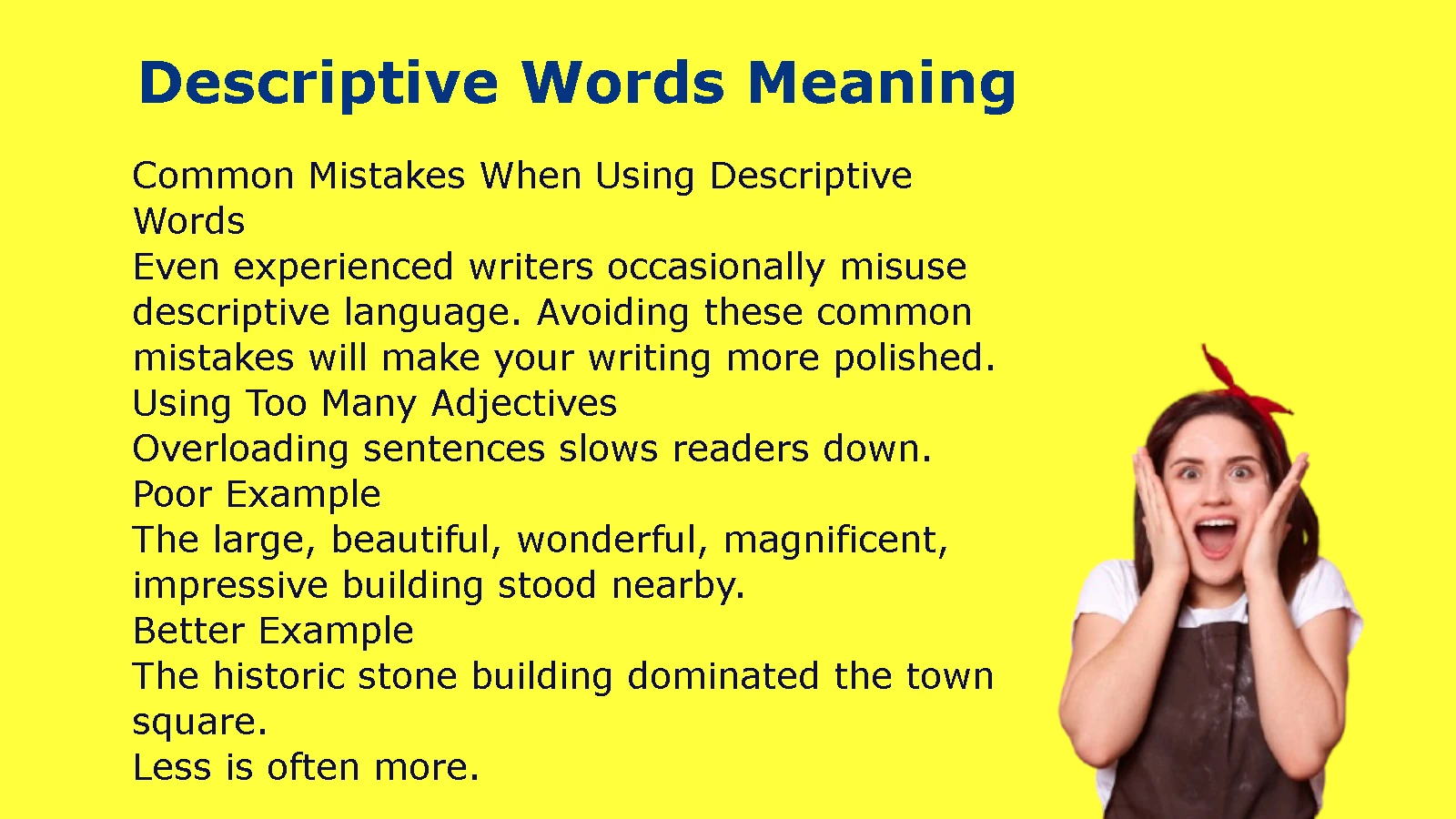
Common Mistakes When Using Descriptive Words
Even experienced writers occasionally misuse descriptive language. Avoiding these common mistakes will make your writing more polished.
Using Too Many Adjectives
Overloading sentences slows readers down.
Poor Example
The large, beautiful, wonderful, magnificent, impressive building stood nearby.
Better Example
The historic stone building dominated the town square.
Less is often more.
Repeating the Same Words
Repeating words weakens your writing.
Instead of using beautiful repeatedly, alternate with:
- Attractive
- Elegant
- Stunning
- Gorgeous
- Picturesque
- Charming
- Breathtaking
A varied vocabulary keeps readers engaged.
Choosing Vague Descriptions
Words like nice, good, and bad rarely provide enough information.
Compare these examples.
Vague
The teacher was nice.
Specific
The teacher was patient, encouraging, and approachable.
Readers gain a much clearer understanding.
Ignoring Context
A descriptive word should fit the situation.
For example:
Calling a financial report magical would sound out of place.
Calling it comprehensive or data-driven makes much more sense.
Relying on Clichés
Some descriptions have become so common that they no longer create strong images.
Examples include:
- Cold as ice
- Busy as a bee
- Quiet as a mouse
- Strong as an ox
Whenever possible, create original descriptions instead.
Tips to Improve Your Descriptive Vocabulary
Building a richer vocabulary takes consistent practice rather than memorization.
Read Across Different Genres
Novels, biographies, newspapers, scientific articles, and travel magazines all introduce different descriptive styles.
Pay attention to how professional writers describe:
- People
- Places
- Events
- Emotions
- Objects
Keep a Vocabulary Journal
Whenever you discover an interesting descriptive word:
- Write it down.
- Record its meaning.
- Note a synonym.
- Create your own example sentence.
Reviewing your list regularly helps new words become part of your everyday vocabulary.
Learn Words in Context
Learning isolated definitions isn’t enough.
Instead of memorizing:
Serene = peaceful
Read:
The hikers enjoyed the serene mountain lake before sunrise.
Context makes vocabulary easier to remember.
Rewrite Simple Sentences
Practice transforming ordinary sentences.
Example:
Original:
The park was nice.
Improved:
The tree-lined park featured colorful flower beds, shaded walking paths, and a peaceful lake.
Small exercises like this quickly improve descriptive writing.
Use a Thesaurus Carefully
A thesaurus can introduce useful alternatives, but never replace a word without checking its meaning.
Many synonyms have subtle differences.
For example:
- Thin
- Slim
- Lean
- Skinny
- Slender
Although related, each carries a different connotation.
Descriptive Words vs. Related Grammar Terms
Many learners confuse descriptive words with other grammar concepts.
Understanding the differences helps you use each one correctly.
Descriptive Words vs. Adjectives
Adjectives are descriptive words, but descriptive words aren’t limited to adjectives.
| Descriptive Words | Adjectives |
| Include adjectives, adverbs, vivid verbs, and descriptive phrases | Only describe nouns and pronouns |
Example:
The ancient castle stood silently while birds circled overhead.
This sentence contains several forms of descriptive language.
Descriptive Words vs. Adverbs
Adjectives describe nouns.
Adverbs describe actions, adjectives, or other adverbs.
Examples:
- Bright flower
- Spoke confidently
- Extremely difficult
Both contribute to richer writing.
Descriptive Words vs. Figurative Language
Figurative language creates comparisons.
Descriptive words provide detail.
Example:
Descriptive:
The ocean was calm.
Figurative:
The ocean was a sheet of polished glass.
The second uses a metaphor rather than simple description.
Descriptive Words vs. Sensory Language
Sensory language specifically appeals to the five senses.
Descriptive words include sensory language but also describe qualities, emotions, and actions.
Frequently Used Descriptive Words (A–Z)
The table below highlights commonly used descriptive words across different contexts.
| Letter | Word | Meaning | Example |
| A | Ambitious | Driven to succeed | An ambitious entrepreneur |
| B | Brilliant | Exceptionally bright or intelligent | A brilliant solution |
| C | Compassionate | Caring and empathetic | A compassionate nurse |
| D | Diligent | Hardworking | A diligent student |
| E | Energetic | Full of energy | An energetic coach |
| F | Fearless | Brave | A fearless explorer |
| G | Graceful | Elegant in movement | A graceful dancer |
| H | Honest | Truthful | An honest opinion |
| I | Innovative | Introducing new ideas | An innovative product |
| J | Joyful | Full of happiness | A joyful celebration |
| K | Keen | Eager or observant | A keen learner |
| L | Loyal | Faithful | A loyal friend |
| M | Majestic | Grand and impressive | A majestic waterfall |
| N | Noble | Honorable | A noble cause |
| O | Optimistic | Hopeful | An optimistic outlook |
| P | Practical | Useful | A practical solution |
| Q | Quick | Fast | A quick response |
| R | Reliable | Dependable | A reliable employee |
| S | Serene | Peaceful | A serene garden |
| T | Thoughtful | Considerate | A thoughtful gesture |
| U | Unique | One of a kind | A unique design |
| V | Vibrant | Full of life | A vibrant community |
| W | Warm | Friendly or comfortable | A warm welcome |
| X | Xenial | Hospitable | A xenial host |
| Y | Youthful | Energetic or young in appearance | A youthful attitude |
| Z | Zealous | Passionate | A zealous volunteer |
Quick Reference Tables
Most Common Descriptive Words
| Category | Examples |
| Appearance | Elegant, rugged, polished, radiant |
| Emotion | Joyful, anxious, hopeful, calm |
| Personality | Honest, creative, patient, ambitious |
| Nature | Lush, towering, tranquil, blooming |
| Objects | Durable, compact, lightweight, practical |
Strong Alternatives to Everyday Words
| Everyday Word | Stronger Alternative |
| Good | Exceptional |
| Bad | Unsatisfactory |
| Big | Enormous |
| Small | Tiny |
| Fast | Swift |
| Slow | Leisurely |
| Happy | Delighted |
| Sad | Melancholy |
| Loud | Booming |
| Quiet | Silent |
Positive, Negative, and Neutral Comparison
| Positive | Negative | Neutral |
| Cheerful | Gloomy | Calm |
| Reliable | Unreliable | Average |
| Creative | Unimaginative | Typical |
| Friendly | Hostile | Standard |
| Efficient | Inefficient | Moderate |
Sensory Word Examples
| Sense | Examples |
| Sight | Sparkling, colorful, misty |
| Sound | Echoing, melodic, roaring |
| Smell | Floral, smoky, earthy |
| Taste | Savory, tangy, creamy |
| Touch | Velvety, rough, smooth |
Frequently Asked Questions
What are descriptive words?
Descriptive words add detail about people, places, objects, actions, or ideas. They help readers form clearer mental images and understand exactly what a writer intends to communicate.
What is the meaning of descriptive words?
The descriptive words meaning refers to words or phrases that provide additional information by describing qualities, characteristics, emotions, actions, or sensory details.
Are descriptive words only adjectives?
No. While adjectives are the most common descriptive words, adverbs, vivid verbs, participles, and descriptive phrases also enrich writing.
Why are descriptive words important?
They improve clarity, create vivid imagery, strengthen storytelling, and make both creative and professional writing more engaging.
How can I improve my descriptive vocabulary?
Read widely, learn new words in context, practice rewriting simple sentences, and maintain a personal vocabulary journal. Regular writing and revision also help expand your word choice over time.
Can descriptive words improve SEO content?
Yes. Well-chosen descriptive words make content clearer and more engaging, which can improve the user experience. Rather than stuffing keywords, focus on writing naturally and answering readers’ questions thoroughly.
Final Thoughts
Understanding the descriptive words meaning is more than learning grammar—it’s about communicating ideas with precision, personality, and impact. Every descriptive word you choose shapes how readers perceive your message, whether you’re writing an essay, a business proposal, a novel, or a blog post.
The strongest descriptions don’t rely on long strings of adjectives. They rely on accuracy, relevance, and context. A single vivid verb, a precise adjective, or a well-crafted sensory detail can leave a stronger impression than an entire paragraph filled with vague language.