Kooky means strange, eccentric, or unconventional, while cooky is a rare spelling variant of cookie. Since cookie is the standard spelling for the baked treat, cooky is seldom used in modern English. When comparing Cooky vs. Kooky, choose the word that matches your intended meaning.
The confusion often happens because “cooky” is a less common spelling of cookie, while “kooky” describes someone or something that is quirky, eccentric, or unconventional. But here’s the kicker: mixing them up can change the meaning of your sentence entirely.
In this guide, you’ll learn the difference between Cooky vs Kooky, explore the cooky meaning, kooky meaning, and correct spelling, and discover how to use cooky and kooky in a sentence with real-life examples. You’ll also learn when to use cooky or kooky, common spelling mistakes to avoid, and a simple memory trick to help you choose the right word every time.
What Does “Cooky” Mean?
Cooky is a noun. It is an alternative spelling of “cookie,” a small sweet baked dessert usually made from flour, sugar, butter, eggs, and flavorings such as chocolate chips, vanilla, or nuts.
Although cookie has become the standard spelling in modern American English, cooky still appears in some dictionaries as an accepted variant. Today, you’ll mostly encounter it in older books, historical publications, regional writing, or business and brand names.
Dictionary Meaning
Cooky (noun)
- A variant spelling of cookie
- A small sweet baked dessert
- Less common than the standard spelling cookie
Most modern style guides recommend using cookie unless you’re quoting historical material or referring to a proper name that intentionally uses cooky.
Origin of the Word “Cooky”
The history of cooky traces back to the same roots as cookie.
The English word cookie comes from the Dutch word koekje, meaning “little cake.” Dutch settlers brought the word to North America during the seventeenth century. As English spelling evolved, both cookie and cooky appeared in printed works for many years.
Eventually, cookie became the preferred spelling in American English, while cooky gradually faded from everyday use.
Why Is “Cookie” More Common Today?
Language changes over time. Publishers, dictionaries, schools, and newspapers slowly standardized spellings to improve consistency.
Today:
- Cookie is the preferred spelling.
- Cooky is considered a variant.
- Most spell checkers automatically suggest cookie.
This doesn’t make cooky incorrect. It simply makes it much less common.
Where You Might Still See “Cooky”
Although rare, cooky still appears in specific contexts.
You’ll occasionally find it in:
- Historical novels
- Older dictionaries
- Vintage cookbooks
- Family recipes
- Company or product names
- Regional publications
For example:
- Grandma baked fresh cookies every Sunday.
- The old cookbook referred to chocolate cookies instead of cookies.
These examples aren’t mistakes. They simply reflect an older spelling preference.
Pronunciation of “Cooky”
The pronunciation matches cookie.
| Word | IPA | Phonetic Pronunciation |
| Cooky | /ˈkʊki/ | KOO-kee |
There is no pronunciation difference between cooky and cookie.
Examples of “Cooky” in Sentences
- My grandfather still spells cookie as cooky.
- The antique cookbook includes dozens of cooky recipes.
- The bakery kept the vintage spelling on its original sign.
- That old newspaper advertised homemade cookies.
What Does “Kooky” Mean?
Unlike cooky, kooky has nothing to do with food.
Kooky is an adjective that describes someone or something that’s eccentric, quirky, unusual, unconventional, or delightfully odd.
The word usually carries a lighthearted tone rather than a negative one. Calling someone kooky often suggests they’re creative, imaginative, or amusing because they think differently.
Dictionary Meaning
Kooky (adjective)
- Eccentric
- Odd in an entertaining way
- Unconventional
- Quirky
- Slightly bizarre without being threatening
The word generally describes behavior, personalities, fashion, ideas, or artistic styles.
Origin of “Kooky”
Unlike cooky, kooky developed much later.
Linguists trace the word to American slang during the early twentieth century. It became especially popular in the 1950s and 1960s, when people often used it to describe unusual trends, artistic movements, or eccentric personalities.
Over time, the meaning softened. Today, kooky usually implies harmless individuality rather than serious abnormality.
How “Kooky” Is Used Today
You’ll often hear kooky in conversations about:
- Fashion
- Movies
- Television
- Art
- Interior design
- Humor
- Personalities
- Creative ideas
For example:
- She has a kooky sense of humor.
- His apartment has a wonderfully kooky design.
- That inventor came up with another kooky idea.
In each sentence, the word suggests originality rather than criticism.
Pronunciation of “Kooky”
The pronunciation is nearly identical to cooky except for the long vowel sound at the beginning.
| Word | IPA | Phonetic Pronunciation |
| Kooky | /ˈkuːki/ | KOO-kee |
Although many speakers pronounce both words almost the same in casual speech, dictionaries distinguish them by vowel quality.
Examples of “Kooky” in Sentences
- My neighbor collects hundreds of rubber ducks. It’s a kooky hobby.
- The movie mixes science fiction with kooky comedy.
- She decorated her office with kooky artwork.
- Everyone loved his kooky personality.
Cooky vs Kooky: The Key Difference
The biggest difference is simple.
Cooky relates to food.
Kooky relates to personality, behavior, or style.
Even though they differ by only one letter, they belong to completely different parts of English vocabulary.
| Feature | Cooky | Kooky |
| Part of Speech | Noun | Adjective |
| Meaning | Variant spelling of cookie | Eccentric or quirky |
| Refers To | Food | Personality or behavior |
| Modern Usage | Rare | Common |
| Tone | Neutral | Informal |
| Common Context | Baking, recipes | Conversations, entertainment, art |
| Standard Alternative | Cookie | None |
| Example | Chocolate cooky | Kooky artist |
Quick Comparison
Think of it this way:
- Cooky = Cookie
- Kooky = Quirky
That simple association helps many people remember the difference.
Cooky vs Kooky: Side-by-Side Examples
Correct:
- She baked chocolate cookies.
- The antique cookbook spells it cooky.
- His kooky ideas eventually inspired a successful business.
- Their house has a fun, kooky design.
Incorrect:
- ❌ She baked chocolate kooky.
- ❌ He’s very cooky because he wears colorful hats.
The first sentence accidentally describes a dessert as eccentric.
The second mistakenly uses the food-related spelling to describe someone’s personality.
Is “Cooky” Just Another Spelling of “Cookie”?
Yes.
That’s the short answer.
The longer answer is more interesting because it reflects how English evolves over time.
Historical Spelling Variations
English has always contained alternative spellings.
Many words that look fixed today once appeared in several forms. Printing practices weren’t always standardized, and regional preferences influenced spelling choices.
For decades, publications used both:
- Cookie
- Cooky
Eventually, cookie became dominant.
Modern Dictionary Treatment
Major dictionaries recognize cooky as a variant spelling rather than a completely separate word.
That distinction matters.
A variant spelling means:
- The meaning stays the same.
- The pronunciation stays the same.
- One spelling simply becomes more common than the other.
Why Most Writers Choose “Cookie”
Professional writers almost always use cookie because:
- Readers recognize it instantly.
- Schools teach it as the standard spelling.
- Publishers prefer consistency.
- Search engines overwhelmingly favor it.
- Modern dictionaries list it as the primary entry.
Unless you’re preserving historical authenticity, cookie is usually the better choice.
When “Cooky” Still Makes Sense
There are situations where using cooky is perfectly appropriate.
These include:
- Quoting historical documents
- Reproducing vintage recipes
- Referring to official business names
- Preserving original spellings in archival materials
For example:
An 1890 cookbook may repeatedly use cooky, and changing every instance to cookie would alter the historical text.
Cookie vs Cooky at a Glance
| Question | Answer |
| Are they different words? | No |
| Do they have different meanings? | No |
| Is one incorrect? | No |
| Which spelling is standard today? | Cookie |
| Is cooky outdated? | Mostly, yes |
| Can both appear in dictionaries? | Yes |
A Helpful Memory Trick
If you’re ever unsure, remember these simple cues:
- Cooky belongs in the kitchen.
- Cookie is the spelling you’ll see almost everywhere today.
- Kooky belongs to quirky people, unusual ideas, and eccentric personalities.
Why Do People Confuse Cooky and Kooky?
It’s easy to see why cooky vs kooky causes confusion. The words differ by only one letter, and many people pronounce them almost the same in everyday conversation. If you’ve only heard the words rather than seen them in writing, it’s even easier to mix them up.
The confusion becomes more common because cooky is now rare. Most people recognize cookie, but they may assume cooky is simply a misspelling. Meanwhile, kooky appears frequently in books, movies, television shows, and online conversations. As a result, writers sometimes replace one with the other without realizing they have changed the meaning.
They Look Almost Identical
Compare the spellings:
| Word | Letters |
| Cooky | C-O-O-K-Y |
| Kooky | K-O-O-K-Y |
The only difference is the first letter.
Since our brains often recognize words by their overall shape rather than examining every letter, these two can easily fool even experienced readers.
They Sound Similar
Many English speakers pronounce both words with a similar rhythm.
Although dictionaries distinguish the vowel sounds, casual speech often reduces those differences. Context usually tells listeners which word the speaker means.
For example:
- “She baked a fresh cooky.”
- “She has a kooky personality.”
Even if the pronunciation sounds similar, the surrounding words immediately reveal the intended meaning.
Autocorrect Doesn’t Always Help
Modern spell checkers generally recognize cookie and kooky, but cooky isn’t always treated as the preferred spelling.
That means you might see suggestions like:
- Cooky → Cookie
- Kooky → Kooky (no correction)
If you accidentally write kooky recipe, your grammar checker may not flag it because kooky is a legitimate English word. The sentence is grammatically correct even though the meaning is wrong.
Context Is Everything
One of the easiest ways to choose the correct word is to ask a simple question:
Are you talking about food or personality?
- Food → Cookie (or the rare variant cooky)
- Personality or behavior → Kooky
That quick mental check prevents most mistakes.
When to Use “Cooky”
Although cookie is the preferred spelling today, cooky still has legitimate uses. Understanding those situations helps you recognize why the spelling appears in certain books, recipes, or historical documents.
Use “Cooky” in Historical Writing
Older publications often use cooky because it was more common in previous generations.
Examples include:
- Historical newspapers
- Vintage advertisements
- Antique cookbooks
- Family recipe collections
If you’re quoting these materials, it’s best to preserve the original spelling.
Use “Cooky” in Proper Names
Some businesses intentionally use cooky as part of their brand identity.
Changing the spelling would incorrectly alter the official name.
Examples might include:
- Bakery names
- Product labels
- Restaurant names
- Trademarked goods
Always follow the official spelling when referring to a brand.
Use “Cookie” for Everyday Writing
In nearly every modern situation, cookie is the better choice.
Examples:
- Chocolate chip cookies
- Oatmeal cookies
- Sugar cookies
- Fortune cookies
- Browser cookies
Readers expect this spelling because it’s the current standard.
Examples of Correct Usage
- My grandmother’s cookbook spells it cooky throughout.
- The bakery preserved the original Cooky Shop sign.
- That historical recipe calls for butter and flour to make one dozen cookys.
Notice that modern writers would almost always write cookies instead.
When to Use “Kooky”
Unlike cooky, kooky remains a common word in modern English.
Use it whenever you describe someone or something as pleasantly unusual, eccentric, unconventional, or quirky.
Describe Personalities
People often use kooky to describe someone with unusual habits or creative behavior.
Examples:
- A kooky inventor
- A kooky artist
- A kooky neighbor
- A kooky professor
The word often carries affection rather than criticism.
Describe Ideas
Not every unusual idea deserves rejection.
Sometimes a seemingly kooky suggestion becomes an innovative breakthrough.
Examples:
- A kooky business proposal
- A kooky science experiment
- A kooky invention
- A kooky solution
History contains many examples of ideas that sounded strange before becoming successful.
Describe Fashion
Fashion writers frequently use kooky to describe bold styles.
Examples include:
- Bright colors
- Mismatched patterns
- Oversized accessories
- Vintage combinations
Rather than meaning “bad,” the word often suggests originality.
Describe Entertainment
Many films, books, and television shows intentionally embrace a kooky style.
Examples:
- Eccentric characters
- Absurd comedy
- Whimsical storytelling
- Unpredictable dialogue
In entertainment, kooky usually becomes a compliment.
Cooky vs Kooky in Real Sentences
Examples make the difference much clearer.
Using “Cooky”
- The antique cookbook includes dozens of cooky recipes.
- Her grandmother always preferred the spelling cooky.
- The bakery displayed a vintage Cooky sign from the 1930s.
- The old newspaper advertised homemade cookys every Saturday.
Using “Cookie”
- I baked chocolate chip cookies yesterday.
- These peanut butter cookies are delicious.
- She decorated Christmas cookies with colorful icing.
- My favorite dessert is a warm oatmeal cookie.
Examples Using “Kooky”
- His kooky imagination keeps everyone laughing.
- The museum displayed a kooky collection of unusual sculptures.
- She wore a kooky hat shaped like a giant sunflower.
- Everyone enjoyed the author’s kooky sense of humor.
Practice Exercise
Choose the correct word.
- Grandma baked fresh ______.
- The scientist had a ______ theory.
- The vintage cookbook spells it ______.
- Their new comedy has a wonderfully ______ style.
Answers
- cookies (or cookies, depending on context)
- kooky
- cooky
- kooky
Common Mistakes to Avoid
Even confident writers occasionally confuse these words. Fortunately, the mistakes are easy to fix once you know what to watch for.
Mistake: Using “Kooky” for Dessert
❌ I baked chocolate kooky yesterday.
✅ I baked chocolate cookies yesterday.
Mistake: Using “Cooky” for Personality
❌ My uncle has a cooky personality.
✅ My uncle has a kooky personality.
Mistake: Assuming “Cooky” Is Wrong
Some people believe cooky isn’t a real word.
That’s incorrect.
It remains a recognized variant spelling of cookie, although it’s much less common today.
Mistake: Assuming They Mean the Same Thing
Because they sound alike, some writers mistakenly think they’re interchangeable.
They’re not.
One refers to baked goods.
The other describes eccentricity.
Synonyms of “Cooky” (Cookie)
Since cooky simply means cookie, its synonyms relate to baked treats rather than personality.
| Word | Best Used For |
| Cookie | Standard American spelling |
| Biscuit | British English sweet biscuit |
| Sweet biscuit | International audiences |
| Baked treat | General description |
| Dessert cookie | Clarifying food context |
| Snack | Casual reference |
Related Types of Cookies
- Chocolate chip cookie
- Oatmeal cookie
- Sugar cookie
- Gingerbread cookie
- Peanut butter cookie
- Shortbread cookie
- Fortune cookie
- Sandwich cookie
Synonyms of “Kooky”
The English language offers many alternatives depending on tone.
| Synonym | Meaning |
| Quirky | Pleasantly unusual |
| Eccentric | Unconventional |
| Offbeat | Different from the norm |
| Wacky | Silly and unusual |
| Oddball | Strange but entertaining |
| Whimsical | Playfully imaginative |
| Unconventional | Outside tradition |
| Bizarre | Extremely unusual |
| Peculiar | Noticeably different |
| Zany | Wildly amusing |
Choosing the Right Synonym
Each word has a slightly different flavor.
- Quirky sounds warm and positive.
- Eccentric often suggests intelligence or wealth.
- Wacky feels playful.
- Bizarre carries a stronger sense of strangeness.
- Whimsical emphasizes imagination and creativity.
Antonyms of “Kooky”
Sometimes the opposite word communicates your meaning more precisely.
| Antonym | Meaning |
| Conventional | Following tradition |
| Ordinary | Typical |
| Normal | Expected |
| Traditional | Long-established |
| Practical | Sensible and useful |
| Predictable | Easy to anticipate |
| Conservative | Resistant to unusual ideas |
| Standard | Widely accepted |
| Typical | Common |
| Mainstream | Generally accepted |
Grammar and Parts of Speech
Understanding grammar helps you avoid mistakes that spell checkers often miss.
Is “Cooky” a Noun?
Yes.
Like cookie, cooky functions as a countable noun.
Examples:
- one cooky
- two cookys (though cookies is standard today)
It names a thing rather than describing one.
Is “Kooky” an Adjective?
Yes.
It modifies nouns.
Examples:
- kooky scientist
- kooky artwork
- kooky comedy
- kooky personality
It answers the question:
“What kind?”
Can “Kooky” Become a Noun?
Not in standard English.
Instead, speakers usually say:
- A kook
- An eccentric person
- A quirky individual
For example:
- He’s a kook.
- She has a kooky personality.
Notice the difference between the noun kook and the adjective kooky.
Comparative and Superlative Forms
Like many adjectives, kooky changes form.
| Form | Example |
| Positive | kooky |
| Comparative | kookier |
| Superlative | kookiest |
Examples:
- This idea is kookier than the last one.
- That’s the kookiest movie I’ve ever seen.
Pronunciation Guide
Although many speakers pronounce these words similarly in casual conversation, dictionaries distinguish them slightly.
| Word | IPA | Phonetic Spelling |
| Cooky | /ˈkʊki/ | KOO-kee |
| Cookie | /ˈkʊki/ | KOO-kee |
| Kooky | /ˈkuːki/ | KOO-kee (long “oo”) |
In everyday American English, the difference is often subtle. That’s why written context matters much more than pronunciation when distinguishing cooky vs kooky.
Cooky vs Cookie vs Kooky
Now that you understand cooky and kooky, it’s helpful to compare all three words side by side. Although cooky and cookie refer to the same thing, kooky belongs to an entirely different category.
| Word | Part of Speech | Meaning | Modern Usage | Example |
| Cooky | Noun | A variant spelling of cookie | Rare | The old recipe called it a cooky. |
| Cookie | Noun | A small sweet baked dessert | Standard | She baked oatmeal cookies. |
| Kooky | Adjective | Eccentric, quirky, or unconventional | Common | His kooky ideas made everyone laugh. |
Which Spelling Should You Choose?
For almost every modern writing situation, the answer is simple.
- Use cookie when talking about the dessert.
- Use cooky only when preserving historical spelling or referring to a proper name.
- Use kooky when describing an unusual person, idea, style, or behavior.
That simple rule will keep your writing accurate and easy to understand.
Origin and Word History Timeline
The stories behind these words explain why they look alike but mean completely different things.
| Time Period | Language Development |
| 1600s | Dutch settlers bring the word koekje (“little cake”) to North America. |
| 1700s–1800s | Both cookie and cooky appear in American publications. |
| Early 1900s | Cookie gradually becomes the preferred spelling. |
| 1920s–1930s | The slang adjective kooky begins appearing in American English. |
| 1950s–1960s | Kooky becomes widely used to describe eccentric people and unusual styles. |
| Today | Cookie is standard, cooky is a recognized variant, and kooky remains a popular adjective. |
How the Meanings Diverged
Although cooky and kooky look related, they evolved independently.
- Cooky inherited its meaning from cookie, which came from Dutch.
- Kooky developed as American slang to describe eccentric behavior.
Their similar appearance is largely a coincidence rather than evidence of a shared modern meaning.
Which Word Should You Use Today?
Choosing the right word depends entirely on what you’re trying to say.
For Everyday Writing
Use cookie.
Readers instantly recognize it, and it’s the spelling you’ll find in schools, newspapers, recipes, and professional publications.
For Academic Writing
Stick with cookie unless you’re quoting a historical source.
Modern academic style values standardized spelling, so cookie is almost always the preferred choice.
For Historical or Archival Material
Use the original spelling exactly as it appears.
If an 1895 cookbook says cooky, preserve that spelling rather than modernizing it. Keeping the original wording maintains historical accuracy.
For Creative Writing
Context matters.
A historical novel might intentionally use cooky to reflect the language of its time. A contemporary story, however, should generally use cookie unless there’s a specific reason not to.
For SEO and Online Content
If you’re publishing online, cookie is the better option because it’s overwhelmingly more familiar to readers. The rare spelling cooky may still appear when discussing spelling variations, language history, or keyword comparisons like cooky vs kooky.
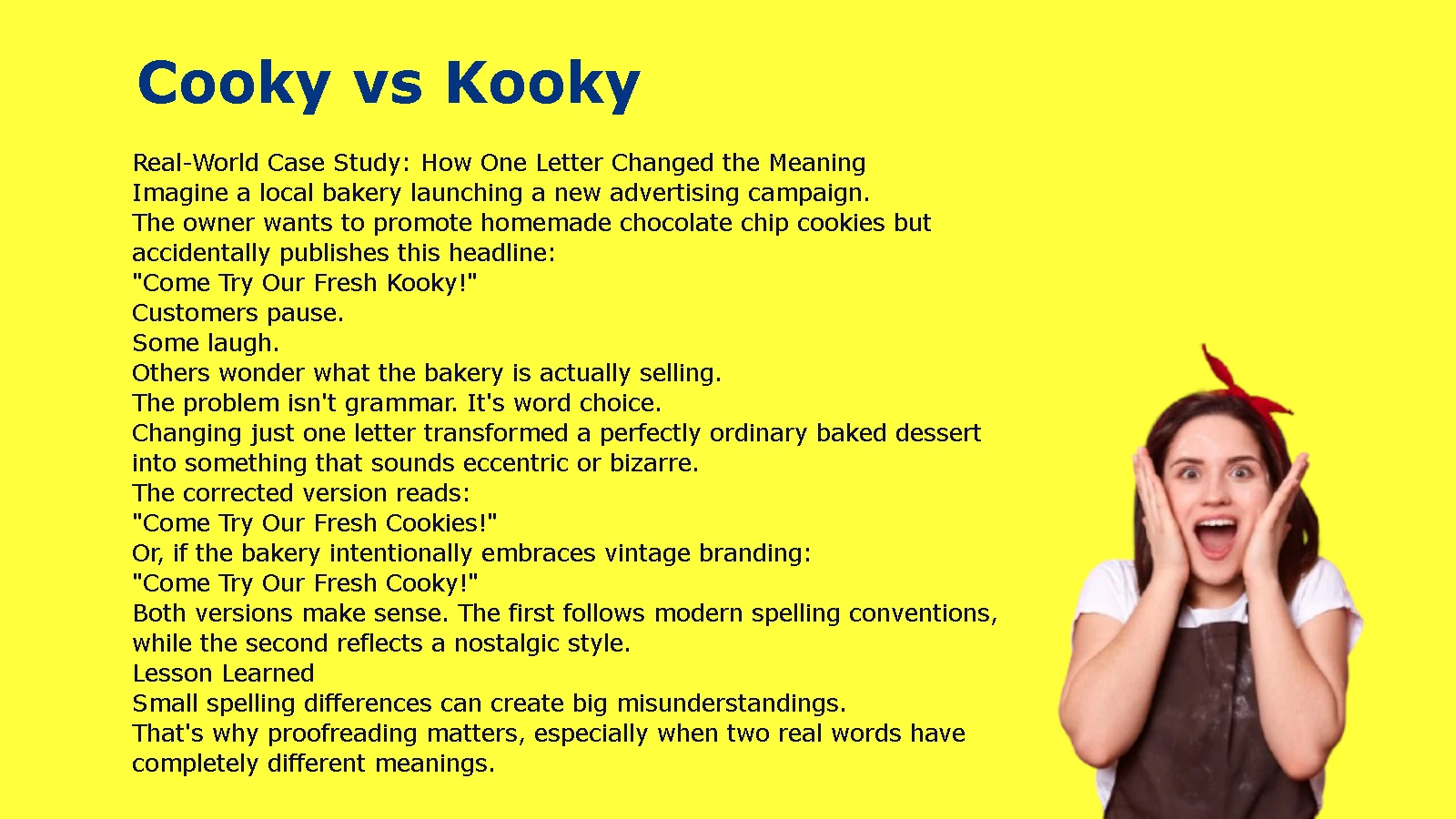
Real-World Case Study: How One Letter Changed the Meaning
Imagine a local bakery launching a new advertising campaign.
The owner wants to promote homemade chocolate chip cookies but accidentally publishes this headline:
“Come Try Our Fresh Kooky!”
Customers pause.
Some laugh.
Others wonder what the bakery is actually selling.
The problem isn’t grammar. It’s word choice.
Changing just one letter transformed a perfectly ordinary baked dessert into something that sounds eccentric or bizarre.
The corrected version reads:
“Come Try Our Fresh Cookies!”
Or, if the bakery intentionally embraces vintage branding:
“Come Try Our Fresh Cooky!”
Both versions make sense. The first follows modern spelling conventions, while the second reflects a nostalgic style.
Lesson Learned
Small spelling differences can create big misunderstandings.
That’s why proofreading matters, especially when two real words have completely different meanings.
Expert Writing Tip
Professional editors often recommend checking words that sound alike but carry different meanings.
“Good writing isn’t just about grammar. It’s about choosing the precise word your reader expects.”
That advice applies perfectly to cooky vs kooky. A spell checker may accept both words, but only one fits your intended message.
Quick Reference Cheat Sheet
| If You’re Talking About… | Use This Word |
| A baked dessert | Cookie |
| A historical spelling of cookie | Cooky |
| An eccentric person | Kooky |
| A quirky fashion style | Kooky |
| A vintage cookbook | Cooky may appear |
| A modern recipe | Cookie |
Memory Tricks to Remember the Difference
Sometimes a simple association is all you need.
Remember the Kitchen
If the word belongs in the kitchen, choose cookie.
The older spelling cooky also belongs here because it refers to the same baked treat.
Remember Quirky People
If you’re describing an unusual person, outfit, idea, or behavior, choose kooky.
Think:
- Kooky = Quirky
- Both words describe someone who’s delightfully different.
Use This Simple Formula
- Cookie = Dessert
- Cooky = Older spelling of cookie
- Kooky = Eccentric
That three-part formula eliminates almost every mistake.
Frequently Asked Questions
Is “cooky” a real word?
Yes. Cooky is a legitimate English word and a recognized variant spelling of cookie. Although it’s uncommon today, many dictionaries still include it.
Is “cooky” an acceptable spelling of “cookie”?
Yes. It’s acceptable, but it’s considered a less common or historical spelling. For most modern writing, cookie is the preferred choice.
Does “kooky” mean confused?
Not exactly.
Kooky usually means eccentric, quirky, whimsical, or unconventional. It often has a playful or affectionate tone rather than implying serious mental instability.
Is “kooky” offensive?
Generally, no.
When used respectfully, kooky often highlights someone’s originality or unusual personality. However, tone and context always matter. Calling someone kooky jokingly among friends feels different from using it to dismiss or belittle them.
Why is “cookie” more common than “cooky”?
Over time, publishers, educators, and dictionaries standardized cookie as the preferred spelling. As a result, cooky became much less common outside historical texts and proper names.
Are “cooky” and “kooky” pronounced the same?
Their pronunciations are very similar in everyday American English, though dictionaries distinguish the vowel sounds slightly. Because the difference is subtle, context is the best guide.
Can “kooky” be a compliment?
Absolutely.
People often use kooky to describe someone who’s imaginative, entertaining, or refreshingly different. In creative fields such as art, comedy, and design, the word is frequently positive.
Which spelling should I use in formal writing?
For formal writing:
- Use cookie for the baked dessert.
- Use kooky for eccentric or unconventional people and ideas.
- Use cooky only when quoting historical material or referring to an official name that uses that spelling.
Key Takeaways
Before you finish, here’s a quick recap of the most important points about cooky vs kooky:
- Cooky is a recognized but uncommon spelling of cookie.
- Cookie is the modern standard spelling for the popular baked dessert.
- Kooky is an adjective that means eccentric, quirky, or unusually unconventional.
- Although the words look and sound similar, they have completely different meanings.
- Most modern writers should choose cookie unless preserving historical spelling.
- Use kooky only when describing people, ideas, styles, or behavior—not food.
- When in doubt, remember: Cookie belongs in the kitchen. Kooky belongs in conversations about personalities and creativity.
Understanding this distinction helps you write more clearly, avoid common spelling mistakes, and communicate with confidence. Whether you’re proofreading an article, writing a recipe, or describing someone’s offbeat sense of humor, choosing the right word ensures your meaning comes across exactly as you intended.