Ever wondered why Cheer vs Chear confuses so many people in writing and spelling searches? One is a correct English word meaning joy, encouragement, or support, while the other is actually a common misspelling that often appears in informal typing and online searches.
That’s the problem. You’re trying to use the right spelling in emails, essays, captions, or even social media posts—but small spelling confusion can make your writing look careless. And here’s the kicker: even one wrong letter can change how professional your message appears.
You’re not alone if you’ve mixed them up before. Many learners struggle with spelling differences, commonly confused words, and English vocabulary mistakes, especially when words sound similar.
But don’t worry—this guide makes it simple.
In this article, you will learn the clear difference between Cheer vs Chear, understand the correct spelling, explore common spelling errors in English, and discover easy memory tricks to avoid confusion. You’ll also see real examples that show how “cheer” is used in everyday communication, from casual speech to formal writing.
So if you want to improve your English spelling accuracy, vocabulary clarity, and writing confidence, let’s break it down step by step.
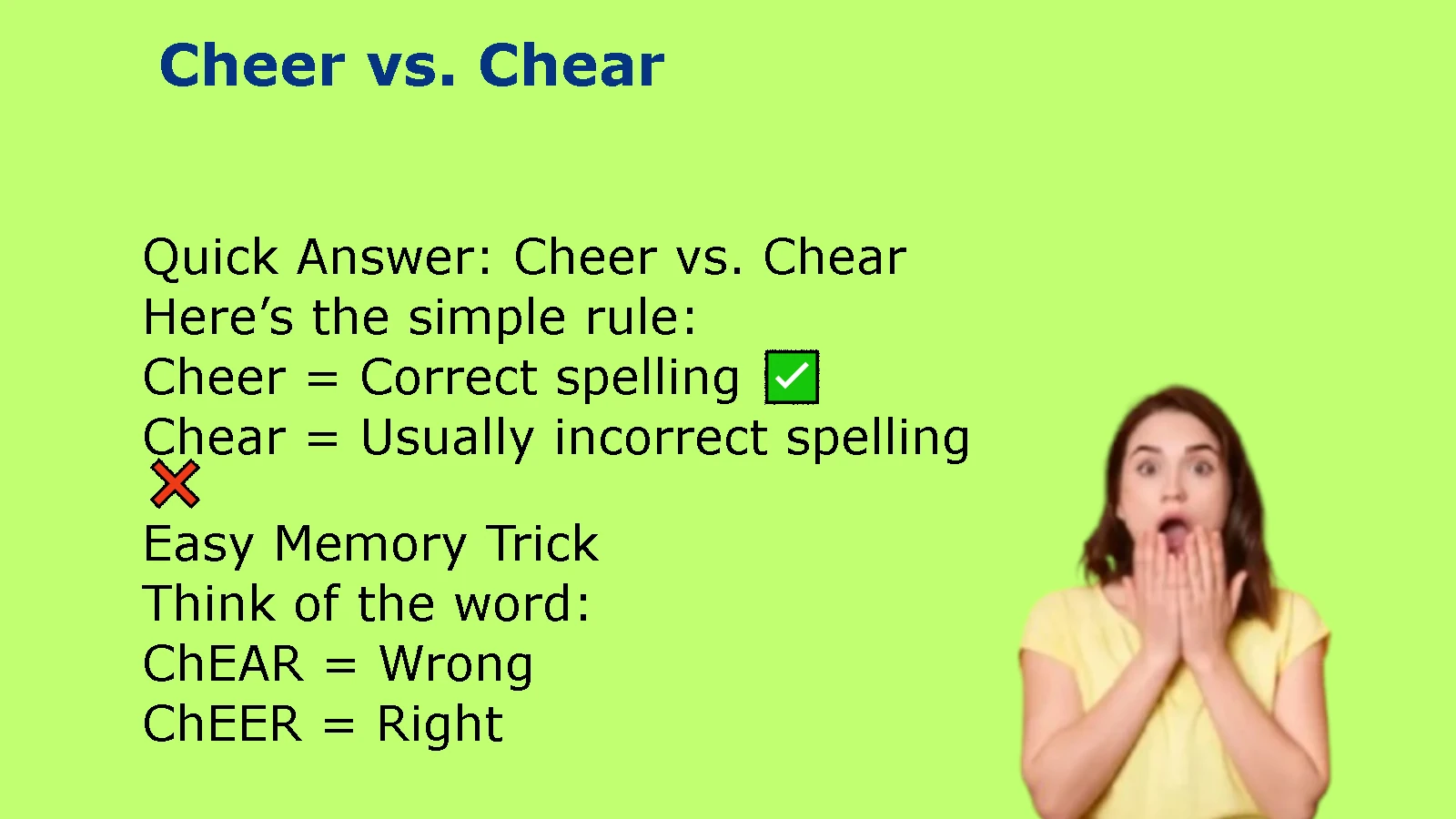
Quick Answer: Cheer vs. Chear
Here’s the simple rule:
Cheer = Correct spelling ✅
Chear = Usually incorrect spelling ❌
Easy Memory Trick
Think of the word:
ChEAR = Wrong
ChEER = Right
If you’re encouraging someone, celebrating, or showing support, the correct word is always cheer.
Is “Chear” a Real Word?
This is where many people get confused.
In modern English, chear is generally not accepted as the standard spelling of the word.
Most dictionaries recognize cheer as the correct spelling.
If you write:
“Let’s chear for our team.”
it will usually be marked as a spelling error.
The Correct Version
“Let’s cheer for our team.”
This is the standard spelling used in schools, workplaces, books, and everyday communication.
What Does “Cheer” Mean?
The word cheer has several common meanings.
As a Verb
To encourage, support, or applaud someone.
Examples:
- We cheer for our favorite team.
- The crowd cheered loudly after the goal.
- Everyone cheered when she won the award.
As a Noun
A shout of encouragement or happiness.
Examples:
- The stadium erupted in cheer.
- Her good news brought cheer to the office.
- Holiday decorations added cheer to the room.
As an Expression
People also use it to wish someone happiness.
Examples:
- Spread some cheer this season.
- Your smile brings cheer to everyone around you.
Why Do People Write “Chear”?
The mistake usually comes from pronunciation patterns.
Similar Sounding Words
Many English words use:
- ear
- eer
For example:
- hear
- fear
- deer
Because of this, some people naturally assume chear follows the same pattern.
Typing Errors
Another common reason is simple keyboard mistakes.
When typing quickly, people may accidentally replace ee with ea, creating chear instead of cheer.
Learning English
English spelling rules aren’t always predictable.
Many learners write words exactly how they sound, which can lead to mistakes like chear.
The History Behind “Cheer”
The word cheer has been part of English for centuries.
It comes from older forms of English and French that were related to mood, expression, and happiness.
Over time, cheer became the accepted spelling used throughout the English-speaking world.
Today, dictionaries, style guides, and educational resources consistently use cheer as the standard form.
Side-by-Side Comparison Table
| Word | Correct? | Meaning | Usage |
|---|---|---|---|
| Cheer | ✅ Yes | Encouragement, happiness, support | Standard English |
| Chear | ❌ No (usually) | Generally considered a misspelling | Avoid using |
Quick Rule
If you’re talking about support, celebration, or happiness, choose cheer.
Real-Life Examples of “Cheer”
Let’s look at common situations.
In Sports
- Fans cheer for their teams.
- Thousands cheered after the winning goal.
- The crowd’s cheer could be heard across the stadium.
In School
- Students cheered when the exam was canceled.
- The class gave a loud cheer for the winner.
At Work
- Employees cheered the successful project launch.
- Good news brought cheer to the office.
During Holidays
- Christmas decorations spread holiday cheer.
- The festival filled the town with cheer and excitement.
Common Mistakes People Make
Mistake #1: Using “Chear” in Formal Writing
Incorrect:
We will chear for you.
Correct:
We will cheer for you.
Mistake #2: Mixing Up “Cheer” and “Hear”
Because both words contain similar sounds, some writers mistakenly use the wrong vowel combination.
Remember:
- Hear → ear
- Cheer → eer
Mistake #3: Assuming Spell Check Isn’t Necessary
Even experienced writers make spelling mistakes.
A quick proofreading check can catch errors like chear instantly.
How to Remember the Correct Spelling
Want a foolproof method?
Memory Trick #1
A cheerleader cheers.
Notice both words contain ee.
Memory Trick #2
Think of:
“We cheer with excitement.”
The double e can remind you of extra energy.
Memory Trick #3
Whenever you’re unsure, remember:
Cheer = Happiness
Chear = Error
Cheer in Common Expressions
The word appears in many popular phrases.
Popular Examples
- Cheer up
- Good cheer
- Holiday cheer
- Cheer on
- Loud cheer
- Spread cheer
- Cheer someone up
Example Sentences
- Cheer up; things will get better.
- We cheered on our friends during the race.
- The celebration was full of good cheer.
When Should You Use “Cheer”?
Use cheer whenever you’re talking about:
- Encouragement
- Support
- Applause
- Celebration
- Happiness
- Positive emotions
Examples
- Cheer for your team.
- Cheer up a friend.
- Bring cheer to others.
- Give a cheer for the winner.
FAQ: Cheer vs. Chear
Is “chear” a word?
In modern standard English, chear is generally considered a misspelling of cheer.
Which spelling is correct?
Cheer is the correct spelling.
Why do people write “chear”?
Usually because of pronunciation assumptions, spelling confusion, or typing mistakes.
Is “chear” accepted in professional writing?
No. Professional writing should use cheer.
How can I remember the difference?
Think:
Cheer = Correct
Chear = Error
Quick Decision Guide
When writing, ask yourself:
Are you talking about encouragement, happiness, applause, or support?
Yes → Use Cheer
Unsure about the spelling?
Choose Cheer
Want to avoid mistakes?
Remember: Cheer has double “e.”
Key Facts to Remember
- Cheer is the correct modern English spelling.
- Chear is usually considered a spelling mistake.
- Cheer can be both a noun and a verb.
- The word relates to happiness, support, encouragement, and celebration.
- Double-check your spelling in formal writing.
Final Takeaway: Cheer Is Correct, Chear Is Not
The difference between cheer vs. chear is actually quite simple once you know the rule.
Cheer is the accepted English spelling used to express encouragement, support, happiness, and celebration. Chear, on the other hand, is typically a misspelling that should be avoided in both casual and professional writing.
Whenever you’re unsure, remember this simple rule:
Cheer = Correct spelling
Chear = Spelling mistake
By using cheer consistently, you’ll write with greater confidence, avoid common errors, and communicate more clearly in every situation.