Ever wondered why people often get confused between Emaculate vs. Immaculate when one of them isn’t even a correct English word? This spelling mix-up is more common than you think, especially in writing, emails, and everyday communication.
That’s the problem. You might be trying to sound polished, but a small spelling error can make your writing look less professional. You’re not alone if you’ve typed “emaculate” thinking it was right—many people do. And here’s the kicker: only one of these words is actually correct.
But don’t worry—this is easy to fix once you understand it.
In this guide, you’ll learn the difference between Emaculate vs. Immaculate, the correct spelling, meaning, and how to use immaculate properly in sentences. You’ll also discover common spelling mistakes, correct word usage, and simple memory tricks to avoid confusion in the future.
So, if you want to improve your grammar accuracy, spelling clarity, and writing confidence, let’s break it down step by step.
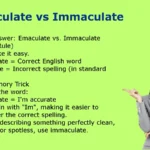
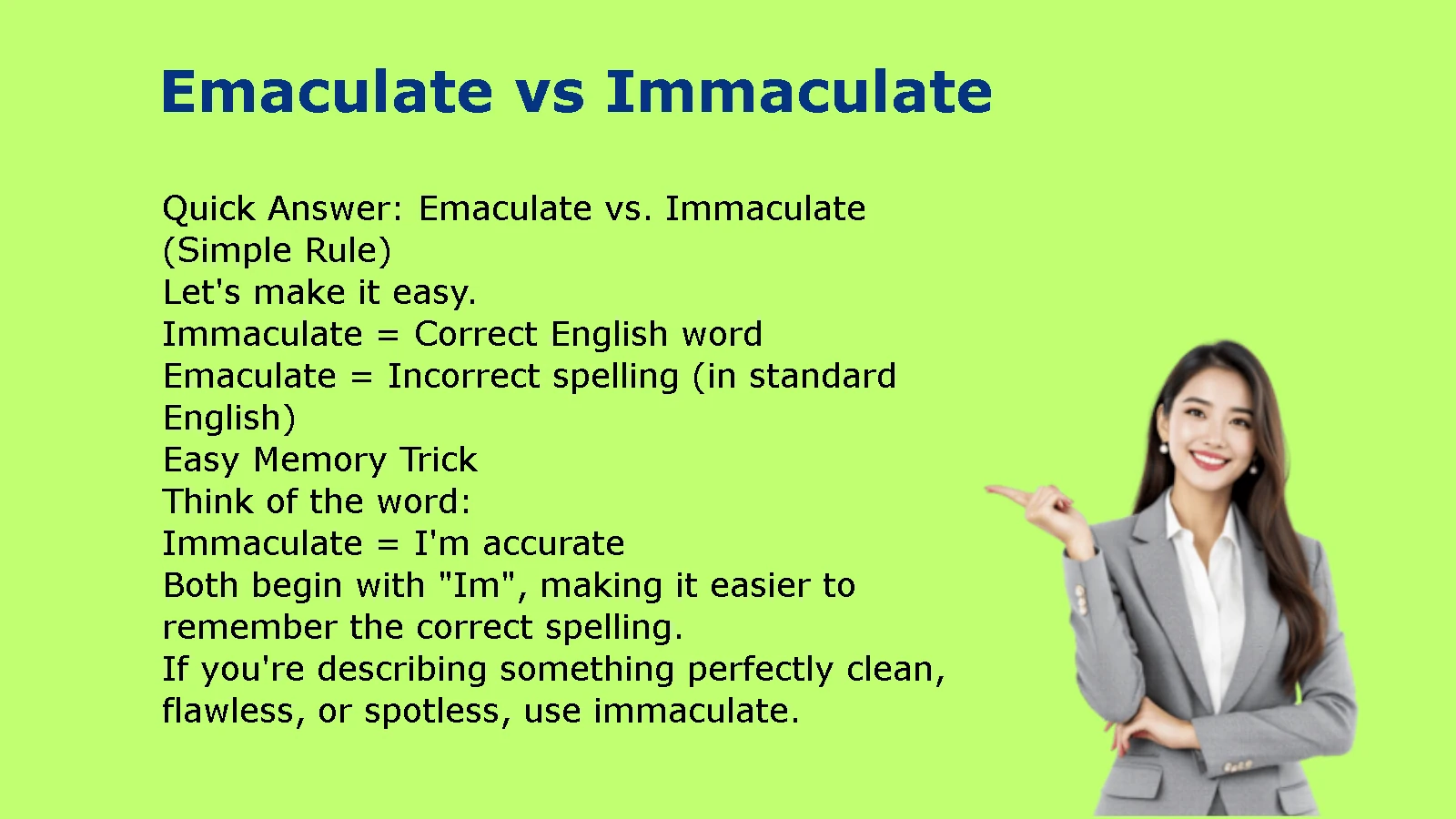
Quick Answer: Emaculate vs. Immaculate (Simple Rule)
Let’s make it easy.
Immaculate = Correct English word
Emaculate = Incorrect spelling (in standard English)
Easy Memory Trick
Think of the word:
Immaculate = I’m accurate
Both begin with “Im”, making it easier to remember the correct spelling.
If you’re describing something perfectly clean, flawless, or spotless, use immaculate.
What Does “Immaculate” Mean?
Immaculate is an adjective that describes something that is:
- Perfectly clean
- Free from mistakes
- Flawless in appearance
- Exceptionally neat and tidy
Common Meanings
- Spotlessly clean
- Perfect condition
- Without defects
- Exceptionally well-maintained
Examples
- Her house was immaculate.
- He arrived wearing an immaculate suit.
- The hotel room was immaculate from top to bottom.
- She maintained immaculate records throughout the project.
Is “Emaculate” a Real Word?
Here’s the straightforward answer:
No, “emaculate” is not a standard English word.
Most dictionaries do not recognize it as a valid English term.
What Usually Happens
People often:
- Misspell immaculate as emaculate
- Mishear the pronunciation
- Type it incorrectly on phones or keyboards
Example of the Mistake
❌ The office looked emaculate.
✅ The office looked immaculate.
The Dictionary Logic Behind Immaculate
Understanding the origin can make the spelling easier to remember.
Origin of Immaculate
The word comes from the Latin term:
immaculatus
Meaning:
- Unstained
- Spotless
- Pure
The prefix im- means “not.”
The root relates to stain or blemish.
Together, the word literally means:
Without stain or blemish.
That’s why the correct spelling begins with “Im”, not “Em.”
Why People Confuse Emaculate and Immaculate
The confusion is surprisingly common.
Similar Sound
When spoken quickly, some people hear:
- Immaculate
- Emaculate
as nearly identical.
Pronunciation Habits
Different accents can soften the first syllable, making the word sound like it begins with an “E.”
Typing Errors
Many misspellings happen because:
- The word is relatively long.
- Double letters can be difficult to remember.
- Autocorrect sometimes doesn’t catch every typo immediately.
“Immaculate” Explained Clearly (With Examples)
Let’s look at how native speakers use the word.
To Describe Cleanliness
- The kitchen was immaculate.
- Her apartment remained immaculate despite having pets.
To Describe Appearance
- He wore an immaculate white shirt.
- The garden looked immaculate after weeks of care.
To Describe Work Quality
- The report was immaculate.
- Her attention to detail produced immaculate results.
Key Takeaway
Whenever you mean:
- Spotless
- Perfect
- Flawless
- Extremely neat
Use immaculate.
The Biggest Mistake People Make
The most common error is assuming that emaculate is an alternative spelling.
It isn’t.
What Goes Wrong
Someone writes:
❌ The venue was emaculate.
Readers may:
- Notice the spelling mistake
- Question the writer’s credibility
- Become distracted from the message
Better Version
✅ The venue was immaculate.
Side-by-Side Comparison Table
| Term | Correct? | Meaning | Recommended Use |
| Emaculate | No | Not a standard English word | Avoid |
| Immaculate | Yes | Spotless, perfect, flawless | Use confidently |
Real-Life Examples of “Immaculate”
Let’s see the word in everyday situations.
Home
- Their living room was immaculate.
Workplace
- She keeps an immaculate desk.
Fashion
- His shoes were immaculate.
Hospitality
- Guests praised the hotel’s immaculate rooms.
Vehicles
- The classic car remained in immaculate condition.
Common Sentences People Misspell
Many people accidentally write:
❌ Emaculate appearance
✅ Immaculate appearance
❌ Emaculate condition
✅ Immaculate condition
❌ Emaculate home
✅ Immaculate home
❌ Emaculate records
✅ Immaculate records
Memory Tricks to Remember the Correct Spelling
Need a quick way to avoid mistakes?
Trick #1: Think “I’m Accurate”
Immaculate → I’m Accurate
Both begin with Im.
Trick #2: Remember the Double M
The correct word contains:
I-M-M-A-C-U-L-A-T-E
Notice the double M.
Trick #3: Use the Spotless Connection
Whenever you think:
- Spotless
- Perfect
- Clean
Think:
Immaculate
What to Say Instead of Immaculate
Depending on context, you can also use:
For Cleanliness
- Spotless
- Pristine
- Sparkling
- Clean
For Perfection
- Flawless
- Perfect
- Exceptional
- Faultless
Example
Instead of:
“The room was immaculate.”
You could say:
“The room was spotless.”
Quick Decision Guide (Use This Instantly)
If you’re writing and unsure:
Are you describing something clean or flawless?
Yes → Use immaculate
Are you considering the spelling “emaculate”?
Don’t use it.
Need complete certainty?
Choose:
Immaculate
FAQ: Emaculate vs. Immaculate
Is emaculate a real word?
No. It is generally considered a misspelling of immaculate.
Which spelling is correct?
Immaculate is the correct spelling.
Why do people write emaculate?
Usually because of pronunciation confusion or typing mistakes.
What does immaculate mean?
It means spotless, flawless, pure, or perfectly maintained.
Is immaculate formal or informal?
It works in both formal and informal English.
Case Study: A Professional Writing Mistake
A job applicant submitted a cover letter describing their work as:
“I maintain emaculate records.”
What Happened
The hiring manager noticed the spelling error immediately.
Although the applicant was qualified, the mistake weakened the impression of attention to detail.
Better Version
“I maintain immaculate records.”
Lesson
Using the correct spelling helps your writing appear more polished and professional.
Key Facts You Should Remember
- Immaculate is the correct English word.
- Emaculate is a common misspelling.
- Immaculate means spotless, flawless, or perfect.
- The word comes from Latin roots meaning “without stain.”
- Using the correct spelling improves clarity and professionalism.
Final Takeaway: The One Rule That Never Fails
When comparing Emaculate vs. Immaculate, the answer is simple:
Immaculate is correct. Emaculate is not.
If you’re describing something exceptionally clean, neat, perfect, or flawless, always choose immaculate.
Think of it this way:
If it belongs in a dictionary, a professional email, an essay, or an important document, the word you want is immaculate.
So the next time you’re unsure, remember:
Spotless = Immaculate.
And that one simple rule will keep you from making this common spelling mistake every time.