
Ever wondered why people get confused between Encode vs. Incode, even when they seem like simple tech terms? In reality, this mix-up is more common than you think—especially in programming, data processing, and digital communication where even a small spelling difference can change meaning completely.
That’s the problem. You might be searching for data encoding techniques, encryption methods, or programming functions, but end up unsure whether you’re even using the right term. And here’s the kicker: using the wrong word in technical writing can make your explanation look inaccurate or unprofessional.
But don’t worry—this confusion is easy to fix once you understand it clearly.
In this guide, you will learn the difference between Encode vs. Incode, including what each term actually means, how they are used in programming, web development, and data processing, and why “encode” is the correct and widely accepted technical term. You’ll also discover related concepts like data encoding, character encoding, encryption basics, and information transformation to strengthen your understanding.
So if you want clarity, accuracy, and confidence in your technical vocabulary, you’re in the right place. Let’s break it down.
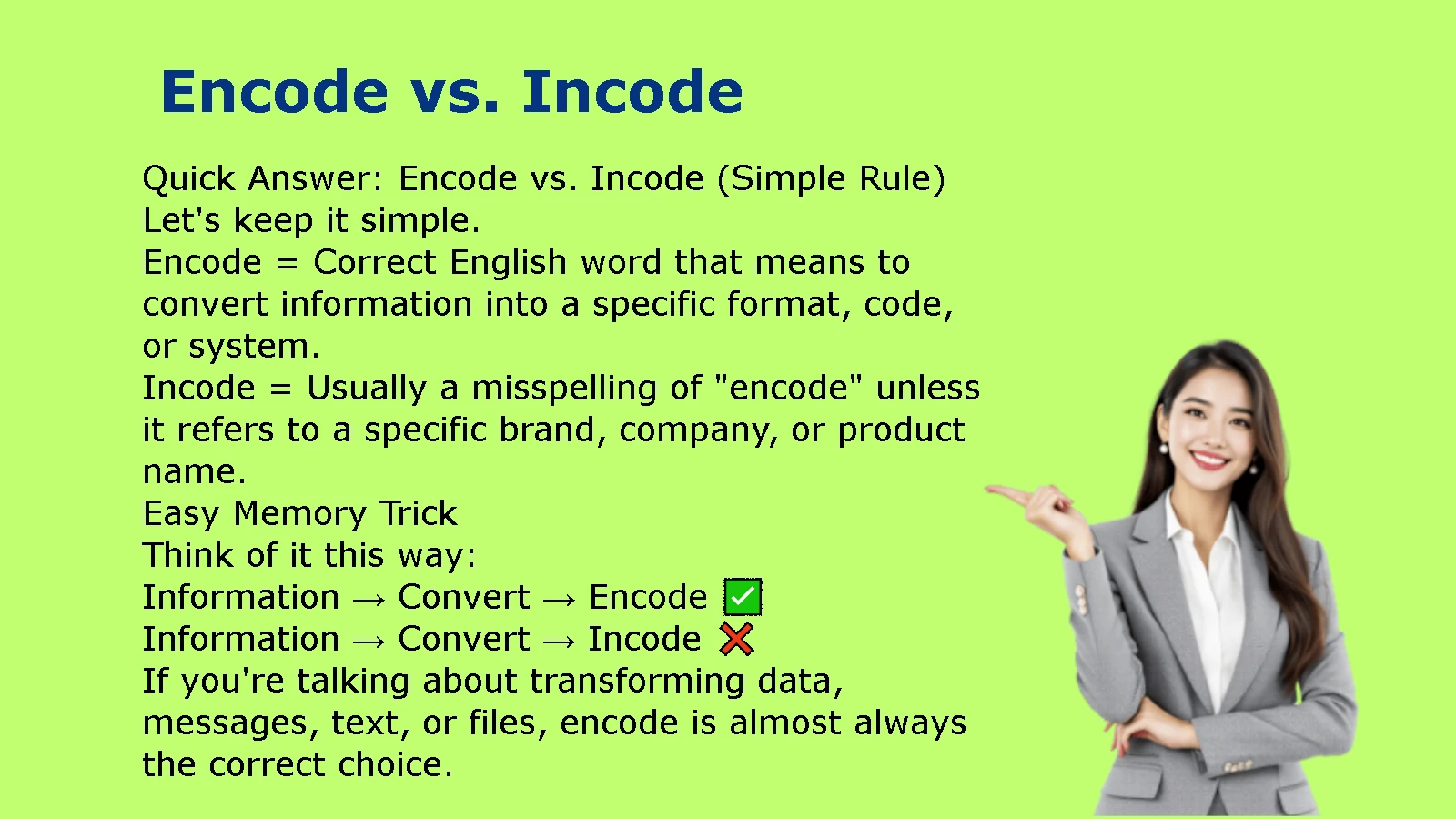
Quick Answer: Encode vs. Incode (Simple Rule)
Let’s keep it simple.
Encode = Correct English word that means to convert information into a specific format, code, or system.
Incode = Usually a misspelling of “encode” unless it refers to a specific brand, company, or product name.
Easy Memory Trick
Think of it this way:
Information → Convert → Encode ✅
Information → Convert → Incode ❌
If you’re talking about transforming data, messages, text, or files, encode is almost always the correct choice.
What Does “Encode” Mean?
The word encode is a standard English verb.
Simple Definition
To encode means to change information into another form so it can be stored, transmitted, processed, or kept secret.
Common Examples
- Encode a video before uploading it.
- Encode data into binary format.
- Encode a secret message.
- Encode characters using UTF-8.
Why It’s Important
Encoding helps computers understand, store, and exchange information efficiently.
Without encoding systems, modern digital communication would be nearly impossible.
What Does “Incode” Mean?
Here’s where the confusion begins.
Standard English Usage
In standard English dictionaries, incode is generally not recognized as a regular verb equivalent to “encode.”
What People Usually Mean
Most of the time, when someone writes:
“Please incode the file.”
They actually mean:
“Please encode the file.”
Exception: Brand Names and Company Names
Some organizations use Incode as a proper name.
For example:
- Incode
In these situations, “Incode” is a name rather than an English verb.
Key Takeaway
When writing normal English, choose encode.
When referring to a company, product, or brand called “Incode,” capitalize it as a proper noun.
The Core Difference Between Encode and Incode
Understanding the distinction is simple.
| Word | Correct English Verb? | Typical Use |
| Encode | Yes | Converting information into code or another format |
| Incode | No (usually) | Misspelling or brand name |
Quick Rule
If you’re describing an action involving data, messages, files, or information:
Use “encode.”
Why People Confuse Encode and Incode
Several factors contribute to the mix-up.
Similar Pronunciation
Some speakers pronounce “encode” quickly, making it sound similar to “incode.”
Typing Errors
The letters e and i are easy to confuse when typing fast.
Non-Native English Influence
Learners sometimes assume the prefix should be “in-” because many English words begin with it.
Examples:
- Include
- Increase
- Input
- Inform
As a result, they mistakenly write incode.
Auto-Correction Issues
Certain software or custom dictionaries may fail to flag the error.
The Meaning of Encode in Technology
Technology is where the word appears most often.
Data Encoding
Computers convert information into formats they can process.
Examples:
- Encoding text
- Encoding images
- Encoding audio
- Encoding video
Character Encoding
Systems use standards such as:
- ASCII
- UTF-8
- UTF-16
These encoding methods help computers interpret text correctly.
Programming Example
Developers frequently write:
text.encode(“utf-8”)
Notice that the correct term is always encode.
Encode vs. Incode in Programming
Programmers almost always use the word encode.
Correct Examples
- Encode the password.
- Encode the string.
- Encode user data before transmission.
- Encode the video stream.
Incorrect Examples
- Incode the password.
- Incode the file.
- Incode the text message.
These would generally be considered mistakes.
Why Accuracy Matters
Using the wrong term can cause confusion in documentation, tutorials, and technical discussions.
Common Examples of “Encode”
Let’s see the word in action.
Everyday Examples
- The app encodes your information securely.
- We need to encode the message.
- The camera encodes video automatically.
- The software encodes audio files.
Workplace Examples
- Please encode the survey results.
- The system encodes customer data.
- Engineers encode information before transmission.
Academic Examples
- Researchers encode observations into categories.
- Scientists encode data for analysis.
Common Mistakes People Make
Here are the errors seen most frequently.
Mistake #1: Using Incode as a Verb
Incorrect:
We need to incode the document.
Correct:
We need to encode the document.
Mistake #2: Assuming Both Are Interchangeable
They are not.
Only encode functions as the standard verb.
Mistake #3: Copying Incorrect Spellings
If a typo appears in a document or online post, others may repeat it without checking.
Real-Life Examples: Encode vs. Incode
Example 1: Office Communication
Manager:
Please encode the customer records before uploading them.
Correct usage.
Example 2: Technical Team
Developer:
The API encodes sensitive information.
Correct usage.
Example 3: Common Error
Employee:
Can you incode this file?
Most readers would recognize this as a spelling mistake.
Side-by-Side Comparison Table
| Feature | Encode | Incode |
| Standard English Word | Yes | No (usually) |
| Used in Technology | Yes | Rarely |
| Dictionary Recognition | Yes | Limited |
| Common in Programming | Yes | No |
| Usually a Typo | No | Yes |
| Can Be a Brand Name | Sometimes | Yes |
How to Remember the Correct Word
A simple memory trick can help.
Think of Encryption
Many people connect encoding with:
- Encryption
- Electronic data
- Encoding systems
Notice they all begin with the letter E.
Memory Formula
E = Encode = Electronic Information
This makes it easier to avoid writing “incode.”
When Is “Incode” Correct?
There are only a few situations where it works.
Brand or Company Names
If a company is officially named “Incode,” use that exact spelling.
Example:
- Incode offers identity verification solutions.
Product Names
Some software products may include “Incode” in their branding.
In those cases, preserve the official spelling.
Important Rule
As a verb, choose encode.
As a proper name, use Incode only when referring to the organization or product.
What to Use Instead of Incode
If you’re writing about data or technology, use:
- Encode
- Convert
- Transform
- Encrypt (when appropriate)
- Translate into code
Better Examples
Instead of:
Incode the message.
Write:
Encode the message.
Or:
Convert the message into code.
FAQ: Encode vs. Incode
Is “incode” a real word?
Generally, no. In standard English writing, it is usually considered a misspelling of “encode.”
Which spelling is correct?
Encode is the correct spelling when referring to converting information into a coded format.
Can I use “incode” in programming?
Not as a standard English verb. Developers use encode.
Why do people write “incode”?
Usually because of pronunciation confusion, typing mistakes, or unfamiliarity with the word.
Is Incode a company name?
Yes. Incode is an example where “Incode” is a proper noun.
Key Facts You Should Remember
- Encode is the correct English verb.
- Incode is usually a misspelling.
- Encoding means converting information into another format.
- Programmers, developers, and IT professionals use encode.
- Incode may be correct when referring to a company or brand name.
- The two words are not interchangeable in normal writing.
Final Takeaway: The One Rule That Never Fails
Here’s the simplest rule to remember:
If you’re talking about converting information, always use “encode.”
Whether you’re working with text, data, audio, video, passwords, or computer systems, encode is the accepted and correct term.
Incode, on the other hand, is usually just a spelling error unless you’re referring to a company, brand, or product that officially uses that name.
So whenever you’re unsure, ask yourself:
Am I describing an action involving information or data?
If the answer is yes, the correct choice is encode.
Because in the encode vs. incode debate, one word belongs in the dictionary—and the other usually belongs in the typo folder.