Ever wondered why some people are praised for being always on time while others constantly struggle with deadlines and punctuality? In both professional and everyday life, being reliable with time is more than just a habit—it’s a powerful impression builder.
The challenge is that simply saying “always on time” can feel repetitive or too basic, especially in resumes, interviews, or formal communication. You’re not alone if you’ve looked for more polished or professional alternatives. And here’s the kicker: the way you describe punctuality can actually influence how others perceive your reliability and work ethic.
But don’t worry—there are plenty of better ways to say it.
In this guide, you’ll discover Other Ways to Say Always on Time, along with powerful LSI keywords like punctual, time-conscious, reliable with deadlines, and dependable timekeeper expressions to help you sound more professional and natural. You’ll also learn how these phrases are used in real-life situations like interviews, emails, and workplace communication.
So if you want to upgrade your vocabulary and sound more polished when talking about punctuality, let’s get started.
What Does “Always on Time” Mean?
“Always on time” describes someone who consistently arrives, completes tasks, or meets deadlines exactly when expected. It highlights punctuality, dependability, and strong time-management skills.
When to Use “Always on Time”
This phrase is useful when describing employees, coworkers, students, service providers, or anyone known for being punctual. It commonly appears in performance reviews, resumes, recommendation letters, and everyday conversations.
Is It Professional/Polite to Say “Always on Time”?
Yes, “always on time” is both professional and polite. However, depending on the situation, alternatives such as “punctual,” “reliable,” or “consistently meets deadlines” may sound more polished and professional.
1. Punctual
Scenario: Describing a dependable employee or student.
Examples:
- She is always punctual for meetings.
- Our team values punctual employees.
- He remains punctual even during busy periods.
- Being punctual helps build trust.
- The manager praised her for being punctual.
Tone: Professional and straightforward.
Best Use: Resumes, performance reviews, and workplace communication.
2. Never Late
Scenario: Casual conversations about reliability.
Examples:
- He is never late for work.
- She’s never late to class.
- They are never late for appointments.
- You can count on him because he’s never late.
- My friend is never late for events.
Tone: Casual and direct.
Best Use: Everyday conversations.
3. Consistently Punctual
Scenario: Formal evaluations or recommendations.
Examples:
- She is consistently punctual and dependable.
- The employee remains consistently punctual.
- He has been consistently punctual throughout the year.
- Her attendance record shows she is consistently punctual.
- We appreciate team members who are consistently punctual.
Tone: Professional and formal.
Best Use: Reviews, reports, and recommendations.
4. Reliable
Scenario: Highlighting dependability.
Examples:
- He is reliable and always prepared.
- She has proven to be reliable.
- Reliable employees strengthen the team.
- We can depend on her because she is reliable.
- He remains reliable under pressure.
Tone: Professional and positive.
Best Use: Workplace and business settings.
5. Prompt
Scenario: Describing timely action.
Examples:
- She is prompt in responding to emails.
- He is always prompt for meetings.
- Prompt arrivals help projects run smoothly.
- The team appreciates prompt communication.
- She remains prompt despite a busy schedule.
Tone: Professional and polished.
Best Use: Business communication.
6. Dependably On Schedule
Scenario: Work and project management.
Examples:
- He is dependably on schedule.
- The project manager stays dependably on schedule.
- She completes assignments dependably on schedule.
- Our deliveries are dependably on schedule.
- The team remains dependably on schedule.
Tone: Formal and dependable.
Best Use: Professional reports.
7. Timely
Scenario: Discussing deadlines.
Examples:
- He provides timely updates.
- The report was submitted in a timely manner.
- She consistently delivers timely results.
- Timely communication prevents delays.
- The team values timely completion.
Tone: Professional and concise.
Best Use: Business and academic settings.
8. Right on Time
Scenario: Friendly and conversational.
Examples:
- You’re right on time.
- She arrived right on time for dinner.
- He was right on time for the interview.
- The package arrived right on time.
- We started right on time.
Tone: Casual and positive.
Best Use: Everyday conversations.
9. Dependable
Scenario: Emphasizing trustworthiness.
Examples:
- She is dependable in every situation.
- Dependable employees are valuable assets.
- He remains dependable and organized.
- Our clients find her dependable.
- She is dependable when deadlines matter.
Tone: Professional and warm.
Best Use: Workplace evaluations.
10. Consistently Reliable
Scenario: Professional recommendations.
Examples:
- He is consistently reliable.
- She has proven consistently reliable.
- The employee remains consistently reliable.
- Clients appreciate consistently reliable service.
- He is consistently reliable under pressure.
Tone: Formal and complimentary.
Best Use: Recommendation letters.
11. On Schedule
Scenario: Project or event management.
Examples:
- The project remains on schedule.
- She stays on schedule every week.
- We are on schedule for completion.
- The team kept everything on schedule.
- Deliveries arrived on schedule.
Tone: Professional and practical.
Best Use: Work-related discussions.
12. Deadline-Conscious
Scenario: Workplace performance.
Examples:
- She is highly deadline-conscious.
- Deadline-conscious employees improve productivity.
- He remains deadline-conscious during projects.
- The manager appreciates deadline-conscious workers.
- Being deadline-conscious helps teams succeed.
Tone: Professional and focused.
Best Use: Performance reviews.
13. Always Prompt
Scenario: Describing a person’s habits.
Examples:
- She is always prompt for appointments.
- He is always prompt with responses.
- The employee is always prompt and courteous.
- Clients appreciate always prompt service.
- She is always prompt with submissions.
Tone: Positive and professional.
Best Use: Formal praise.
14. Efficient With Time
Scenario: Highlighting time-management skills.
Examples:
- She is efficient with time.
- He remains efficient with time and resources.
- Efficient with time, she rarely misses deadlines.
- The team values employees who are efficient with time.
- Being efficient with time boosts productivity.
Tone: Professional and skill-focused.
Best Use: Resumes and evaluations.
15. Never Misses a Deadline
Scenario: Work performance.
Examples:
- He never misses a deadline.
- She never misses a deadline despite challenges.
- The employee never misses a deadline.
- Our manager never misses a deadline.
- Reliable workers rarely miss deadlines.
Tone: Strong and professional.
Best Use: Workplace achievements.
16. Well-Timed
Scenario: Describing actions or arrivals.
Examples:
- Her response was well-timed.
- The announcement was well-timed.
- He made a well-timed entrance.
- The update was well-timed.
- Their decision was well-timed.
Tone: Professional and polished.
Best Use: Formal communication.
17. Consistently On Time
Scenario: Performance reviews.
Examples:
- She is consistently on time.
- He has been consistently on time all year.
- Employees who are consistently on time improve workflow.
- The student is consistently on time.
- Our staff remains consistently on time.
Tone: Formal and direct.
Best Use: Evaluations and reports.
18. Reliable With Deadlines
Scenario: Project management.
Examples:
- She is reliable with deadlines.
- He remains reliable with deadlines.
- Reliable with deadlines, she earns trust.
- The team values members reliable with deadlines.
- Clients appreciate reliable deadline management.
Tone: Professional and dependable.
Best Use: Workplace settings.
19. Always Prepared
Scenario: General reliability.
Examples:
- She is always prepared and punctual.
- He arrives always prepared.
- Being always prepared creates confidence.
- The employee is always prepared for meetings.
- Students who are always prepared perform better.
Tone: Positive and professional.
Best Use: Reviews and recommendations.
20. Prompt and Reliable
Scenario: Professional praise.
Examples:
- She is prompt and reliable.
- The assistant is prompt and reliable.
- Prompt and reliable employees are highly valued.
- He remains prompt and reliable under pressure.
- Clients trust prompt and reliable service.
Tone: Professional and complimentary.
Best Use: Workplace feedback.
21. Steady and Dependable
Scenario: Describing long-term consistency.
Examples:
- He is steady and dependable.
- She remains steady and dependable.
- The team appreciates steady and dependable workers.
- Steady and dependable employees build trust.
- Clients value steady and dependable service.
Tone: Warm and professional.
Best Use: Recommendations and reviews.
22. Respectful of Deadlines
Scenario: Workplace communication.
Examples:
- She is respectful of deadlines.
- Employees should be respectful of deadlines.
- He remains respectful of deadlines and commitments.
- Respectful of deadlines, she earns respect.
- The manager appreciates deadline awareness.
Tone: Professional and respectful.
Best Use: Corporate environments.
23. Consistently Meets Expectations
Scenario: Performance assessments.
Examples:
- He consistently meets expectations.
- She consistently meets expectations regarding attendance.
- The employee consistently meets expectations.
- Consistently meeting expectations builds trust.
- Managers value employees who consistently meet expectations.
Tone: Formal and evaluative.
Best Use: Reviews and appraisals.
24. Clockwork Reliable
Scenario: Informal praise.
Examples:
- He is clockwork reliable.
- She arrives with clockwork reliability.
- The service is clockwork reliable.
- Everyone appreciates clockwork reliability.
- He remains clockwork reliable year-round.
Tone: Friendly and expressive.
Best Use: Casual conversations.
25. Always Dependable
Scenario: Highlighting trustworthiness.
Examples:
- She is always dependable.
- He remains always dependable.
- The employee is always dependable.
- Clients trust always dependable service.
- Always dependable workers are valuable.
Tone: Positive and professional.
Best Use: Recommendations and testimonials.
26. Regularly Ahead of Schedule
Scenario: Exceeding expectations.
Examples:
- She is regularly ahead of schedule.
- He completes work ahead of schedule.
- The project finished ahead of schedule.
- Teams appreciate people ahead of schedule.
- Deliveries arrived ahead of schedule.
Tone: Impressive and professional.
Best Use: Achievement-focused communication.
27. Time-Conscious
Scenario: Discussing work habits.
Examples:
- She is highly time-conscious.
- Time-conscious employees manage priorities well.
- He remains time-conscious under pressure.
- The team values time-conscious professionals.
- Being time-conscious improves efficiency.
Tone: Professional and skill-oriented.
Best Use: Workplace and resume language.
28. Consistently Meets Deadlines
Scenario: Professional evaluations.
Examples:
- She consistently meets deadlines.
- He consistently meets deadlines and goals.
- Employees who consistently meet deadlines are valuable.
- The manager praised her ability to meet deadlines.
- Consistently meeting deadlines improves trust.
Tone: Formal and professional.
Best Use: Reviews and recommendations.
29. Always Available When Expected
Scenario: Reliability and attendance.
Examples:
- She is always available when expected.
- He remains available when expected.
- Team members appreciate colleagues available when expected.
- Clients trust professionals available when expected.
- Being available when expected strengthens teamwork.
Tone: Professional and reassuring.
Best Use: Workplace communication.
30. Known for Punctuality
Scenario: Reputation and recognition.
Examples:
- She is known for punctuality.
- He is known for punctuality and professionalism.
- The employee is known for punctuality.
- Her punctuality has earned respect.
- The team values people known for punctuality.
Tone: Professional and complimentary.
Best Use: Recommendations, resumes, and recognition.
31. Habitually On Time
Scenario: Describing someone with a strong punctuality habit.
Examples:
- She is habitually on time for meetings.
- He is habitually on time, regardless of circumstances.
- Habitually on-time employees are highly respected.
- The student is habitually on time for class.
- She has always been habitually on time.
Tone: Professional and descriptive.
Best Use: Performance reviews and recommendations.
32. Exceptionally Punctual
Scenario: Praising outstanding time management.
Examples:
- She is exceptionally punctual.
- He is known for being exceptionally punctual.
- Exceptionally punctual employees set a great example.
- The manager praised her punctuality.
- She remains exceptionally punctual even during busy seasons.
Tone: Complimentary and professional.
Best Use: Formal praise and evaluations.
33. Dependably Prompt
Scenario: Highlighting reliability and timeliness.
Examples:
- He is dependably prompt for every meeting.
- She remains dependably prompt with assignments.
- Clients appreciate dependably prompt service.
- The employee is dependably prompt and organized.
- We can rely on her to be dependably prompt.
Tone: Professional and positive.
Best Use: Workplace communication.
34. Rarely Keeps Anyone Waiting
Scenario: Casual praise for punctuality.
Examples:
- She rarely keeps anyone waiting.
- He rarely keeps anyone waiting for appointments.
- Our friend rarely keeps anyone waiting.
- The consultant rarely keeps clients waiting.
- She has a reputation for rarely keeping anyone waiting.
Tone: Friendly and conversational.
Best Use: Informal conversations and testimonials.
35. Consistently Available on Time
Scenario: Discussing attendance and reliability.
Examples:
- He is consistently available on time.
- She is consistently available on time for meetings.
- Team members appreciate colleagues who are available on time.
- The employee remains consistently available on time.
- Clients value professionals who are available on time.
Tone: Professional and dependable.
Best Use: Workplace evaluations.
36. Always Meets Commitments
Scenario: Emphasizing reliability beyond punctuality.
Examples:
- She always meets commitments.
- He always meets commitments and deadlines.
- Employees who meet commitments build trust.
- The manager appreciates her dedication.
- She is known for always meeting commitments.
Tone: Professional and trustworthy.
Best Use: Reviews and recommendation letters.
37. Faithful to Schedules
Scenario: Describing strict adherence to timelines.
Examples:
- He is faithful to schedules.
- She remains faithful to schedules and plans.
- The project team stayed faithful to the schedule.
- Employees faithful to schedules improve productivity.
- Clients appreciate businesses faithful to schedules.
Tone: Formal and professional.
Best Use: Business and project management contexts.
38. Consistently Present When Needed
Scenario: Highlighting attendance and dependability.
Examples:
- She is consistently present when needed.
- He is consistently present when needed by the team.
- Reliable workers are present when needed.
- The manager values employees who are present when needed.
- She remains consistently present when needed.
Tone: Professional and supportive.
Best Use: Team evaluations and workplace discussions.
39. Timeliness-Oriented
Scenario: Discussing professional work habits.
Examples:
- She is highly timeliness-oriented.
- Timeliness-oriented employees improve efficiency.
- He remains timeliness-oriented in every project.
- The company values timeliness-oriented professionals.
- Being timeliness-oriented enhances productivity.
Tone: Formal and skill-focused.
Best Use: Resumes and professional profiles.
40. Predictably Punctual
Scenario: Emphasizing consistency.
Examples:
- He is predictably punctual.
- She remains predictably punctual every day.
- Predictably punctual employees are easy to depend on.
- The manager appreciates his consistency.
- Clients value predictably punctual service.
Tone: Professional and complimentary.
Best Use: Recommendations and reviews.
41. Always Arrives as Scheduled
Scenario: Discussing attendance and appointments.
Examples:
- She always arrives as scheduled.
- He always arrives as scheduled for meetings.
- The technician arrived as scheduled.
- Employees who arrive as scheduled earn trust.
- Our team values people who arrive as scheduled.
Tone: Professional and straightforward.
Best Use: Workplace and service-related communication.
42. Committed to Timeliness
Scenario: Highlighting dedication to punctuality.
Examples:
- She is committed to timeliness.
- He remains committed to timeliness and quality.
- The employee demonstrates a commitment to timeliness.
- Teams benefit from members committed to timeliness.
- Clients appreciate professionals committed to timeliness.
Tone: Formal and professional.
Best Use: Performance reviews and resumes.
43. Never Behind Schedule
Scenario: Describing someone who stays on track.
Examples:
- He is never behind schedule.
- She remains never behind schedule despite challenges.
- The project stayed on track and never behind schedule.
- Employees who stay ahead are rarely behind schedule.
- The team appreciates his consistency.
Tone: Professional and achievement-focused.
Best Use: Project management and workplace discussions.
44. Consistently Keeps Time Commitments
Scenario: Emphasizing responsibility.
Examples:
- She consistently keeps time commitments.
- He consistently keeps time commitments at work.
- Reliable employees keep their time commitments.
- The manager praised her consistency.
- Clients appreciate those who keep time commitments.
Tone: Professional and dependable.
Best Use: Evaluations and recommendations.
45. Recognized for Reliability
Scenario: Praising a person’s reputation.
Examples:
- She is recognized for reliability.
- He is recognized for reliability and punctuality.
- The employee is recognized for reliability.
- Clients appreciate reliable professionals.
- Her reliability has earned respect.
Tone: Complimentary and professional.
Best Use: Awards, recommendations, and testimonials.
46. Prompt Without Fail
Scenario: Highlighting unwavering punctuality.
Examples:
- He is prompt without fail.
- She is prompt without fail for every appointment.
- The employee remains prompt without fail.
- Clients value service that is prompt without fail.
- Our team appreciates his consistency.
Tone: Strong and positive.
Best Use: Formal praise and professional feedback.
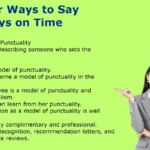
47. A Model of Punctuality
Scenario: Describing someone who sets the standard.
Examples:
- She is a model of punctuality.
- He has become a model of punctuality in the workplace.
- The employee is a model of punctuality and professionalism.
- Students can learn from her punctuality.
- His reputation as a model of punctuality is well deserved.
Tone: Highly complimentary and professional.
Best Use: Recognition, recommendation letters, and performance reviews.
Conclusion
Whether you’re describing a dependable employee, a reliable coworker, a punctual student, or someone who consistently respects deadlines, these 47 alternatives to “always on time” provide a variety of professional, casual, and expressive options. Using the right synonym can make your writing more engaging, strengthen resumes and performance reviews, and help you communicate reliability with greater precision. From “punctual” and “prompt” to “a model of punctuality” and “predictably punctual,” these alternatives allow you to highlight time management and dependability in a fresh and effective way.