Ever wondered why Stuck vs. Stock causes so much confusion, even for people who write every day? These two words look almost identical, but they mean completely different things—one refers to being unable to move or progress, while the other is related to supply, inventory, or financial shares.
That’s the problem. You’re not alone if you’ve ever paused mid-sentence wondering which one is correct. And here’s the kicker: using the wrong word can completely change your meaning and make your writing look unprofessional.
But don’t worry—this gets easier once you see the difference clearly.
In this guide, you’ll learn the real difference between Stuck vs. Stock, including their correct meanings, usage examples, and simple memory tricks to help you never confuse them again. You’ll also discover related terms like homophones, commonly confused words, and English spelling mistakes that often trip writers up.
So, if you want to improve your grammar accuracy and avoid one of the most common word mix-ups in English, you’re in the right place. Let’s break it down.
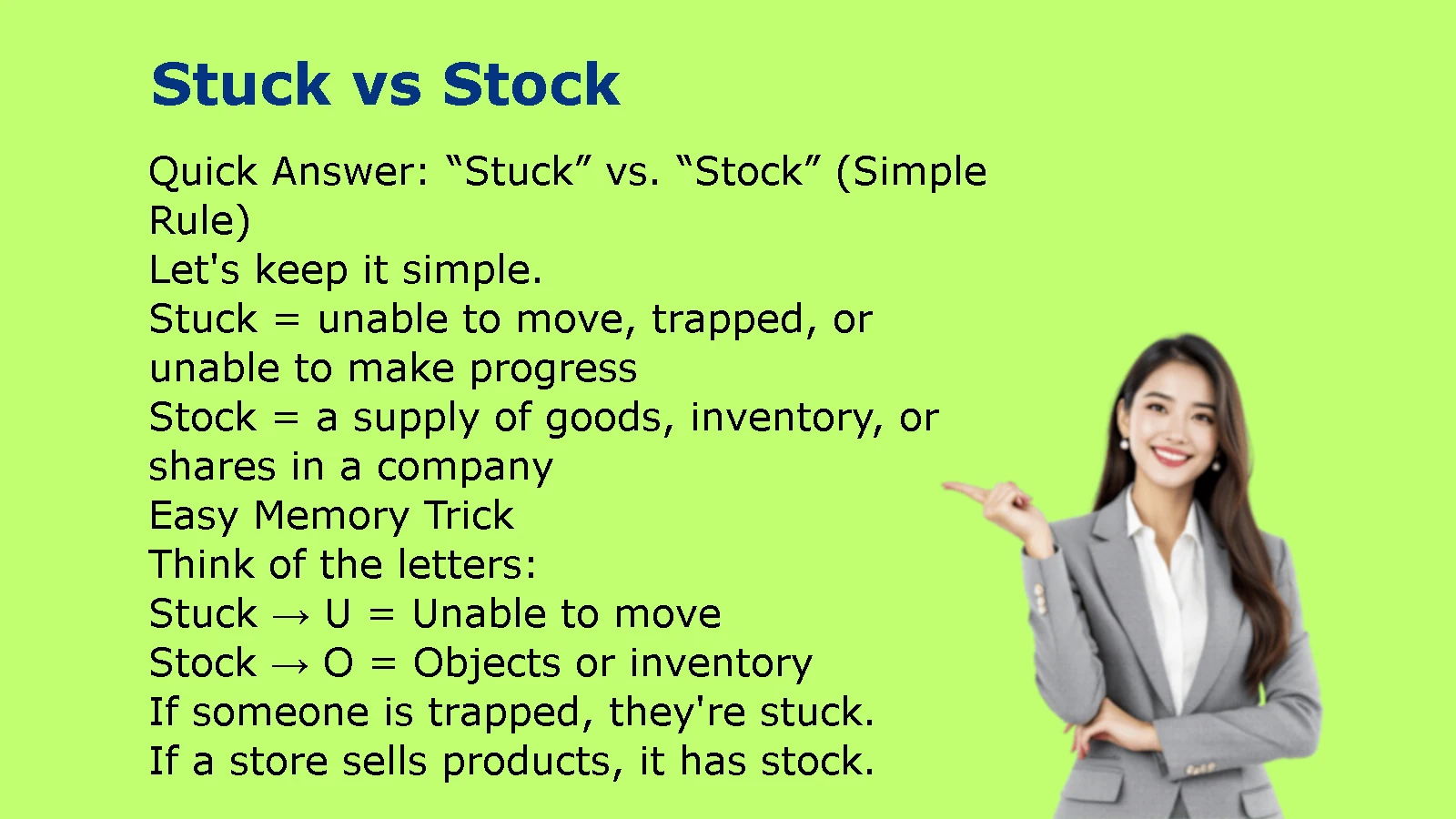
Quick Answer: “Stuck” vs. “Stock” (Simple Rule)
Let’s keep it simple.
Stuck = unable to move, trapped, or unable to make progress
Stock = a supply of goods, inventory, or shares in a company
Easy Memory Trick
Think of the letters:
Stuck → U = Unable to move
Stock → O = Objects or inventory
If someone is trapped, they’re stuck.
If a store sells products, it has stock.
How People Actually Confuse “Stuck” and “Stock”
The confusion usually happens when writing quickly or relying on spellcheck.
In Everyday Writing
People accidentally type:
- “I’m stock in traffic.”
- “The store is stuck with new products.”
Both sentences are incorrect.
In Online Messages
Autocorrect sometimes swaps one word for the other.
Why This Happens
- Similar spelling
- Similar pronunciation for some speakers
- Fast typing mistakes
- Lack of familiarity with context
The Core Difference Between “Stuck” and “Stock”
Think about what each word represents.
| Word | Meaning | Category |
|---|---|---|
| Stuck | Unable to move or progress | Adjective/Verb form |
| Stock | Inventory, supplies, or company shares | Noun |
Key Insight
Stuck describes a situation.
Stock describes a thing or resource.
“Stuck” Explained Clearly
The word stuck usually means trapped, unable to move, or unable to continue.
Common Uses of “Stuck”
- Stuck in traffic
- Stuck in an elevator
- Stuck on a difficult problem
- Stuck in mud
- Stuck in a routine
Examples
- We were stuck on the highway for two hours.
- She got stuck in the revolving door.
- I’m stuck on question number five.
- The car became stuck in the snow.
Key Takeaway
Whenever someone or something cannot move forward physically or mentally, stuck is usually the correct word.
“Stock” Explained Clearly
The word stock has several meanings, but all relate to supplies, ownership, or stored items.
Common Uses of “Stock”
- Store inventory
- Company shares
- Farm animals (livestock)
- Supplies kept for future use
Examples
- The store has plenty of stock available.
- He purchased stock in a technology company.
- The warehouse keeps extra stock for busy seasons.
- New products arrived in stock this morning.
Key Takeaway
If you’re talking about products, supplies, inventory, or investments, use stock.
The Biggest Mistake People Make
Many writers choose the word based on spelling rather than meaning.
What Goes Wrong
Incorrect:
- I’m stock in traffic.
- The truck got stock in the mud.
Correct:
- I’m stuck in traffic.
- The truck got stuck in the mud.
Why It Matters
Using the wrong word can completely change the meaning or make your writing appear careless.
Side-by-Side Comparison Table
Here’s a quick reference guide.
| Feature | Stuck | Stock |
|---|---|---|
| Meaning | Trapped or unable to move | Inventory or shares |
| Part of Speech | Adjective/Verb form | Noun |
| Related To | Movement and progress | Goods and supplies |
| Example | Stuck in traffic | Stock in a warehouse |
| Common Context | Problems, delays, obstacles | Business, shopping, investing |
Real-Life Examples of “Stuck”
Let’s see how native speakers use it.
Common Situations
- “I’m stuck at work.”
- “We got stuck in traffic.”
- “The zipper is stuck.”
- “She’s stuck on the last chapter.”
Mini Scenario
A student spends an hour trying to solve a math problem.
Correct sentence:
“I’m completely stuck.”
Not:
“I’m completely stock.”
Real-Life Examples of “Stock”
Now compare with stock.
Common Situations
- “The item is back in stock.”
- “The company issued more stock.”
- “We need to check our stock levels.”
- “That product is out of stock.”
Mini Scenario
A customer wants to buy a gaming console.
Store employee:
“Sorry, it’s currently out of stock.”
Not:
“Sorry, it’s currently out of stuck.”
Common Phrases Using “Stuck”
These expressions appear frequently in English.
Popular Examples
- Stuck in traffic
- Stuck at home
- Stuck in a rut
- Stuck with a problem
- Stuck on an idea
- Stuck in the past
Meaning Pattern
All of these involve being unable to move, escape, or progress.
Common Phrases Using “Stock”
These are common in business and shopping.
Popular Examples
- In stock
- Out of stock
- Stock market
- Stock price
- Stock inventory
- Stock room
Meaning Pattern
All relate to goods, supplies, or investments.
How to Avoid Confusion Every Time
Want a foolproof method?
Ask Yourself One Question
Am I talking about being trapped or unable to progress?
Use stuck.
Am I talking about products, supplies, or investments?
Use stock.
Quick Test
Sentence:
“The store has plenty of ____.”
Only stock makes sense.
Sentence:
“We were ____ in traffic.”
Only stuck makes sense.
What to Say Instead (Helpful Alternatives)
Sometimes a synonym makes the meaning clearer.
Alternatives for “Stuck”
- Trapped
- Immobilized
- Blocked
- Stranded
- Unable to proceed
Alternatives for “Stock”
- Inventory
- Supplies
- Goods
- Merchandise
- Shares
Quick Decision Guide (Use This Instantly)
When you’re unsure, follow this:
Use “Stuck” If:
✔ Someone cannot move
✔ Progress has stopped
✔ A person feels trapped
✔ Something is blocked
Use “Stock” If:
✔ You’re discussing inventory
✔ You’re discussing supplies
✔ You’re discussing business goods
✔ You’re discussing company shares
Simple. Reliable. Done.
FAQ: “Stuck” vs. “Stock”
Is “I’m stock in traffic” correct?
No. The correct phrase is:
“I’m stuck in traffic.”
What does “stock” mean in business?
It usually refers to inventory or ownership shares in a company.
Can “stuck” be a verb?
It’s commonly used as the past participle of stick, but often functions like an adjective.
Which word is more common in daily conversation?
Both are common, but stuck appears more often in everyday situations.
Why do people confuse them?
Because they look similar and are only one letter apart.
Case Study: An Embarrassing Email Mistake
A warehouse employee emailed a supplier:
“We are currently stuck on inventory.”
The supplier was confused.
What the employee meant was:
“We are currently low on stock.”
What Happened
- The message became unclear
- Extra emails were needed
- Time was wasted
Fix
Always check whether you’re discussing:
- A problem → stuck
- Inventory → stock
Key Facts You Should Remember
- Stuck means trapped or unable to move.
- Stock means inventory, supplies, or company shares.
- Stuck relates to obstacles and delays.
- Stock relates to business and goods.
- One letter changes the entire meaning.
- Context makes the correct choice obvious.
Final Takeaway: The One Rule That Never Fails
Here’s the simplest way to remember the difference.
If someone can’t move forward, they’re stuck.
If a business has products available, it has stock.
Think of it this way:
A customer may be stuck in traffic on the way to a store, while that same store may have the item in stock.
One word describes a problem. The other describes a supply.
Remember that distinction, and you’ll never confuse “Stuck” vs. “Stock” again.