Ever met someone who never seems to stop cracking jokes, even in serious moments? You’re probably searching for other ways to describe someone who jokes too much because the usual words like “funny” or “jokester” just don’t fully capture it.
The challenge is real. In some situations, you want to sound polite, descriptive, or even professional—but calling someone a “clown” or “comedian” can feel too casual or slightly off. And here’s the kicker: the right wording can completely change how your message is understood.
But don’t worry—there are plenty of better and more precise expressions.
In this guide, you’ll discover other ways to describe someone who jokes too much, including polite ways to describe a funny personality, alternative phrases for overly humorous behavior, and words for someone who is always joking in social situations. You’ll also learn how tone changes meaning, whether you’re writing casually, professionally, or creatively.
So if you want richer vocabulary and more natural expressions for describing humor-filled personalities, you’re in the right place. Let’s dive in.
What Does “Someone Who Jokes Too Much” Mean?
A person who “jokes too much” is someone who frequently uses humor, even in situations where it may not always be appropriate. They might be naturally funny, overly playful, or use jokes as a way to communicate, deflect, or connect with others.
When to Use These Descriptions
These alternatives can be used in casual conversations, storytelling, writing, or even workplace feedback (when phrased carefully). They are especially useful when you want to avoid sounding judgmental or when you want to sound more expressive and accurate.
Is It Professional or Polite to Say “Jokes Too Much”?
It depends on the context. In professional settings, directly saying “jokes too much” may sound informal or slightly negative. Instead, softer phrases like “uses humor frequently” or “has a playful communication style” are more appropriate and respectful.
1. Naturally Funny
Scenario: Describing someone with effortless humor
Examples:
- He’s naturally funny in every conversation.
- She has a naturally funny personality that lights up the room.
- They are naturally funny without even trying.
- I think he’s just naturally funny in meetings.
- She comes across as naturally funny in all situations.
Tone: Positive and appreciative
Best Use: Compliments and friendly descriptions
2. Overly Playful
Scenario: Someone who jokes in serious situations
Examples:
- He can be overly playful during meetings.
- She gets overly playful when things are serious.
- They tend to be overly playful at work.
- He was a bit overly playful during the discussion.
- She stays overly playful even in formal settings.
Tone: Neutral to slightly critical
Best Use: Professional feedback or observations
3. Constantly Joking
Scenario: Frequent humor in conversations
Examples:
- He is constantly joking around in class.
- She is constantly joking, even during serious talks.
- They are constantly joking with everyone.
- He was constantly joking during the presentation.
- She tends to be constantly joking at work.
Tone: Neutral descriptive
Best Use: General behavior description
4. Class Clown Type
Scenario: Someone who entertains others often
Examples:
- He’s the class clown type in every group.
- She acts like the class clown during meetings.
- They have a class clown personality.
- He naturally falls into the class clown role.
- She is known as the class clown among friends.
Tone: Casual and slightly humorous
Best Use: Informal or school-related context
5. Always Making Jokes
Scenario: Continuous humor in speech
Examples:
- He is always making jokes about everything.
- She’s always making jokes, even in serious moments.
- They are always making jokes in conversations.
- He was always making jokes during work hours.
- She tends to be always making jokes with friends.
Tone: Neutral to light
Best Use: Everyday conversation
6. Humor-Driven Personality
Scenario: Personality centered on humor
Examples:
- He has a humor-driven personality.
- She is very humor-driven in her communication style.
- They are humor-driven in most conversations.
- He approaches life with a humor-driven mindset.
- She’s known for her humor-driven nature.
Tone: Positive and descriptive
Best Use: Personality profiling or writing
7. Lighthearted Communicator
Scenario: Someone who keeps things fun
Examples:
- He is a lighthearted communicator.
- She remains a lighthearted communicator even in stress.
- They are lighthearted communicators in teams.
- He has a lighthearted communication style.
- She’s known as a lighthearted communicator at work.
Tone: Professional and polite
Best Use: Workplace or formal descriptions
8. Always in Joke Mode
Scenario: Constant humor mindset
Examples:
- He’s always in joke mode during conversations.
- She stays in joke mode even in serious meetings.
- They are always in joke mode with friends.
- He goes into joke mode naturally.
- She tends to be in joke mode all the time.
Tone: Casual and playful
Best Use: Informal storytelling
9. Uses Humor Frequently
Scenario: Neutral professional description
Examples:
- He uses humor frequently in discussions.
- She uses humor frequently in presentations.
- They use humor frequently to connect with others.
- He tends to use humor frequently at work.
- She uses humor frequently in conversations.
Tone: Neutral and professional
Best Use: Workplace communication
10. Joke-Oriented Personality
Scenario: Core personality trait
Examples:
- He has a joke-oriented personality.
- She is very joke-oriented in social settings.
- They are joke-oriented in group discussions.
- He tends to be joke-oriented in every interaction.
- She has a joke-oriented communication style.
Tone: Descriptive and neutral
Best Use: Writing or profiling
11. Always Trying to Be Funny
Scenario: Effort-based humor
Examples:
- He is always trying to be funny.
- She is always trying to be funny in class.
- They are always trying to be funny during meetings.
- He was always trying to be funny in conversations.
- She tends to be always trying to be funny.
Tone: Neutral, slightly informal
Best Use: Casual observations
12. Comedic Personality
Scenario: Naturally humorous person
Examples:
- He has a comedic personality.
- She is known for her comedic personality.
- They bring a comedic personality to the team.
- He has a strong comedic personality.
- She expresses a comedic personality in conversations.
Tone: Positive and descriptive
Best Use: Compliments or bios
13. Overuses Humor
Scenario: Slightly critical tone
Examples:
- He overuses humor in serious situations.
- She tends to overuse humor during meetings.
- They sometimes overuse humor in discussions.
- He was overusing humor in the presentation.
- She may overuse humor when stressed.
Tone: Mildly critical
Best Use: Constructive feedback
14. Teasing Personality
Scenario: Light teasing behavior
Examples:
- He has a teasing personality.
- She is very teasing with friends.
- They are naturally teasing in conversations.
- He uses a teasing tone often.
- She tends to be playful and teasing.
Tone: Friendly and light
Best Use: Close relationships
15. Witty Talker
Scenario: Quick and clever humor
Examples:
- He is a witty talker in meetings.
- She is a witty talker with friends.
- They are witty talkers in discussions.
- He has a naturally witty talker style.
- She comes across as a witty talker.
Tone: Positive and intelligent
Best Use: Compliments or character description
16. Playful Banter Lover
Scenario: Someone who enjoys back-and-forth joking
Examples:
- He is a playful banter lover in conversations.
- She enjoys playful banter with everyone.
- They are known as playful banter lovers in the group.
- He always turns talks into playful banter.
- She keeps things fun as a playful banter lover.
Tone: Friendly and social
Best Use: Casual friendships and group chats
17. Humor-Saturated Personality
Scenario: Humor is a dominant trait
Examples:
- He has a humor-saturated personality.
- She is humor-saturated in most conversations.
- They bring a humor-saturated vibe to meetings.
- He tends to be humor-saturated at all times.
- She expresses a humor-saturated communication style.
Tone: Neutral descriptive
Best Use: Writing or personality analysis
18. Nonstop Jokester
Scenario: Someone who rarely stops joking
Examples:
- He is a nonstop jokester in class.
- She is a nonstop jokester during work hours.
- They act like nonstop jokesters in groups.
- He becomes a nonstop jokester around friends.
- She tends to be a nonstop jokester everywhere.
Tone: Casual and slightly humorous
Best Use: Informal conversation
19. Comedy-Focused Talker
Scenario: Humor is central to communication
Examples:
- He is a comedy-focused talker in discussions.
- She is a comedy-focused talker at gatherings.
- They are comedy-focused talkers in groups.
- He speaks like a comedy-focused talker.
- She brings a comedy-focused talker energy.
Tone: Neutral to positive
Best Use: Descriptive writing
20. Always in Humor Mode
Scenario: Constant joking mindset
Examples:
- He is always in humor mode.
- She stays in humor mode during conversations.
- They are always in humor mode at school.
- He switches to humor mode instantly.
- She remains in humor mode all day.
Tone: Casual and playful
Best Use: Informal speech
21. Light Joke Enthusiast
Scenario: Enjoys frequent light jokes
Examples:
- He is a light joke enthusiast.
- She is a light joke enthusiast in conversations.
- They are light joke enthusiasts in groups.
- He behaves like a light joke enthusiast.
- She tends to be a light joke enthusiast at work.
Tone: Friendly and soft
Best Use: Positive descriptions
22. Humor-Heavy Speaker
Scenario: Uses humor heavily in speech
Examples:
- He is a humor-heavy speaker in meetings.
- She is a humor-heavy speaker in class.
- They are humor-heavy speakers in discussions.
- He gives humor-heavy responses often.
- She has a humor-heavy communication style.
Tone: Neutral professional
Best Use: Workplace observation
23. Quip Machine
Scenario: Constant short jokes or witty remarks
Examples:
- He is a quip machine in conversations.
- She is a quip machine during meetings.
- They act like a quip machine in groups.
- He becomes a quip machine when relaxed.
- She is known as a quip machine among friends.
Tone: Playful and humorous
Best Use: Casual descriptions
24. Joke-Centric Person
Scenario: Humor is central trait
Examples:
- He is a joke-centric person.
- She is joke-centric in her communication.
- They are joke-centric in group talks.
- He has a joke-centric approach to conversations.
- She tends to be joke-centric in social settings.
Tone: Neutral descriptive
Best Use: Personality writing
25. Social Comedian Type
Scenario: Acts like a comedian socially
Examples:
- He is a social comedian type in groups.
- She acts like a social comedian at gatherings.
- They are social comedian types in conversations.
- He naturally becomes a social comedian.
- She is known as a social comedian among friends.
Tone: Light and playful
Best Use: Informal or fun descriptions
26. Humor-Oriented Speaker
Scenario: Communication style centered on humor
Examples:
- He is a humor-oriented speaker in meetings.
- She is humor-oriented in conversations.
- They are humor-oriented speakers in discussions.
- He uses a humor-oriented speaking style.
- She tends to be humor-oriented in interactions.
Tone: Neutral professional
Best Use: Workplace or formal writing
27. Persistent Jester
Scenario: Someone who keeps joking repeatedly
Examples:
- He is a persistent jester in class.
- She is a persistent jester during meetings.
- They are persistent jesters in groups.
- He remains a persistent jester all day.
- She behaves like a persistent jester often.
Tone: Slightly humorous, descriptive
Best Use: Informal descriptions
28. Always Cracking Jokes
Scenario: Frequent joke-making behavior
Examples:
- He is always cracking jokes in conversations.
- She is always cracking jokes at work.
- They are always cracking jokes in groups.
- He was always cracking jokes during class.
- She tends to be always cracking jokes.
Tone: Casual and clear
Best Use: Everyday speech
29. Humor-First Communicator
Scenario: Humor comes first in communication
Examples:
- He is a humor-first communicator.
- She is humor-first in conversations.
- They are humor-first communicators in groups.
- He takes a humor-first approach to talks.
- She tends to be humor-first socially.
Tone: Professional-friendly
Best Use: Writing or analysis
30. Jest-Driven Talker
Scenario: Motivated by jokes in speech
Examples:
- He is a jest-driven talker in meetings.
- She is a jest-driven talker in class.
- They are jest-driven talkers in groups.
- He uses a jest-driven style of communication.
- She tends to be a jest-driven talker.
Tone: Neutral descriptive
Best Use: Creative writing
31. Comedic Overcommunicator
Scenario: Overuses humor in communication
Examples:
- He is a comedic overcommunicator in discussions.
- She is a comedic overcommunicator at work.
- They are comedic overcommunicators in groups.
- He tends to overcommunicate with humor.
- She becomes a comedic overcommunicator sometimes.
Tone: Slightly formal, analytical
Best Use: Professional feedback
32. Joke-Spinning Personality
Scenario: Constantly creating jokes
Examples:
- He has a joke-spinning personality.
- She is a joke-spinning type in conversations.
- They are joke-spinning individuals in groups.
- He is always joke-spinning during talks.
- She tends to be joke-spinning socially.
Tone: Creative and playful
Best Use: Writing or storytelling
33. Humor-Reliant Speaker
Scenario: Relies heavily on humor
Examples:
- He is a humor-reliant speaker in meetings.
- She is humor-reliant in conversations.
- They are humor-reliant communicators.
- He tends to be humor-reliant in groups.
- She uses humor-reliant speech often.
Tone: Neutral professional
Best Use: Workplace description
34. Joke-Happy Personality
Scenario: Very enthusiastic about jokes
Examples:
- He has a joke-happy personality.
- She is joke-happy in every conversation.
- They are joke-happy in group chats.
- He tends to be joke-happy all the time.
- She is known for her joke-happy nature.
Tone: Light and cheerful
Best Use: Friendly descriptions
35. Witty Overuser
Scenario: Overuses witty remarks
Examples:
- He is a witty overuser in discussions.
- She is a witty overuser in class.
- They are witty overusers in conversations.
- He tends to overuse wit in speech.
- She becomes a witty overuser at times.
Tone: Slightly critical
Best Use: Feedback or analysis
36. Humor-Spreading Talker
Scenario: Spreads humor in conversations
Examples:
- He is a humor-spreading talker in groups.
- She is humor-spreading in conversations.
- They are humor-spreading communicators.
- He tends to spread humor everywhere.
- She is known as a humor-spreading talker.
Tone: Positive and warm
Best Use: Compliments or profiles
37. Constant Comic Relief
Scenario: Always trying to lighten mood
Examples:
- He is constant comic relief in meetings.
- She provides constant comic relief in class.
- They act as constant comic relief in groups.
- He becomes comic relief naturally.
- She is known for being constant comic relief.
Tone: Positive and descriptive
Best Use: Informal or storytelling
38. Habitual Joker
Scenario: Someone who jokes as a habit
Examples:
- He is a habitual joker in every conversation.
- She’s a habitual joker at work and home.
- They are habitual jokers in group discussions.
- He tends to be a habitual joker even in serious moments.
- She comes across as a habitual joker naturally.
Tone: Neutral to slightly informal
Best Use: General personality description
39. Humor-Dominant Communicator
Scenario: Humor dominates their speech style
Examples:
- He is a humor-dominant communicator in meetings.
- She is humor-dominant in most conversations.
- They are humor-dominant communicators in groups.
- He uses a humor-dominant style of speaking.
- She tends to be humor-dominant socially.
Tone: Analytical and neutral
Best Use: Workplace or behavioral writing
40. Serial Jokester
Scenario: Someone who tells jokes continuously
Examples:
- He is a serial jokester in class discussions.
- She is a serial jokester during office meetings.
- They behave like serial jokesters in groups.
- He turns into a serial jokester around friends.
- She is known as a serial jokester everywhere she goes.
Tone: Playful and slightly exaggerated
Best Use: Casual or humorous descriptions
41. Always in Comedy Mode
Scenario: Constant humorous mindset
Examples:
- He is always in comedy mode during conversations.
- She stays in comedy mode at all times.
- They are always in comedy mode with friends.
- He switches to comedy mode instantly.
- She remains in comedy mode throughout the day.
Tone: Light and casual
Best Use: Informal communication
42. Light Humor Addict
Scenario: Strong attraction to humor
Examples:
- He is a light humor addict in conversations.
- She is a light humor addict at gatherings.
- They are light humor addicts in groups.
- He behaves like a light humor addict socially.
- She tends to be a light humor addict naturally.
Tone: Playful and descriptive
Best Use: Casual personality descriptions
43. Joking Enthusiast
Scenario: Loves making jokes frequently
Examples:
- He is a joking enthusiast in every discussion.
- She is a joking enthusiast among friends.
- They are joking enthusiasts in group chats.
- He becomes a joking enthusiast when relaxed.
- She is known as a joking enthusiast in her circle.
Tone: Friendly and positive
Best Use: Compliments or informal writing
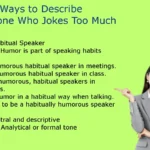
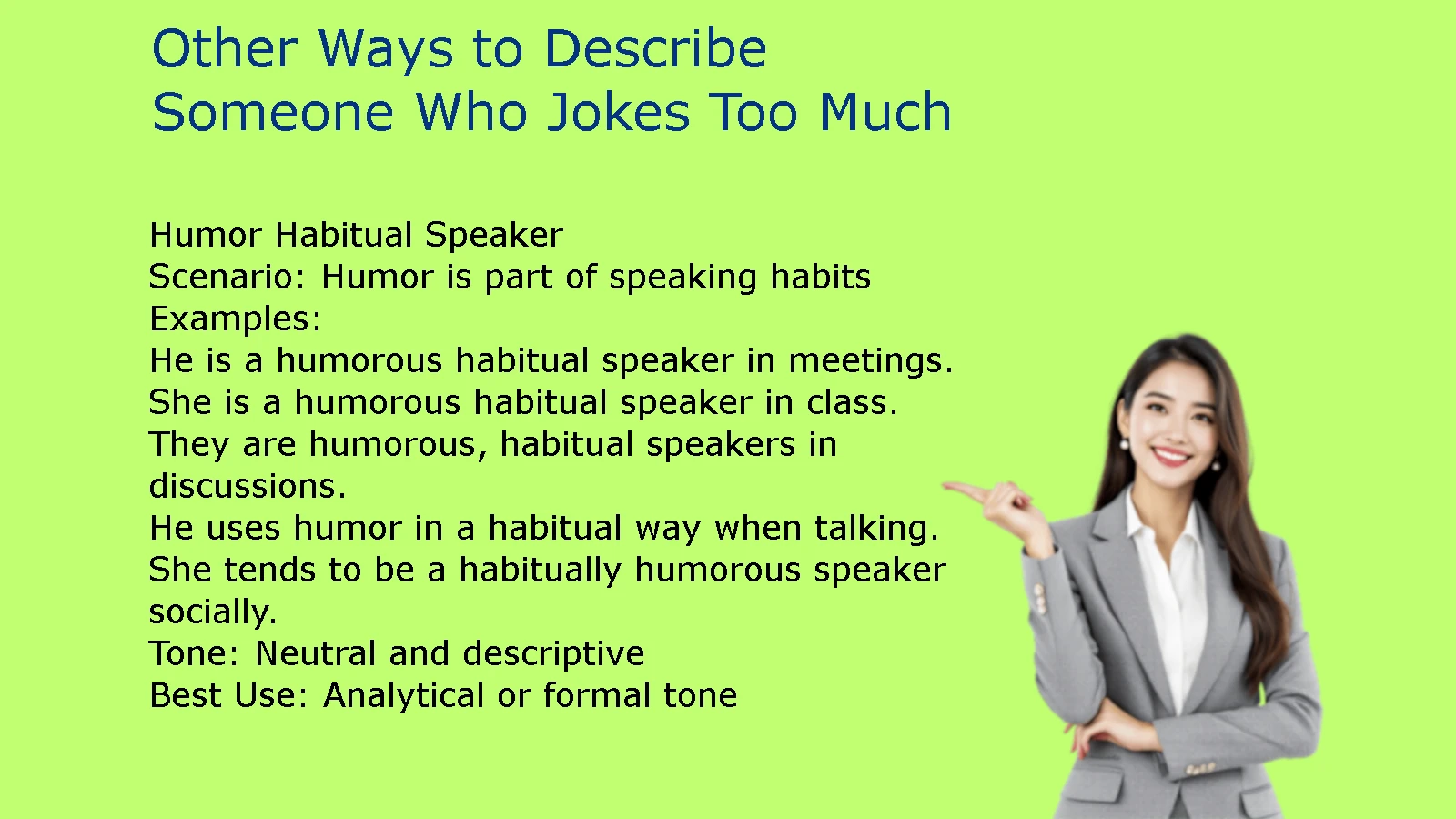
44. Humor Habitual Speaker
Scenario: Humor is part of speaking habit
Examples:
- He is a humor habitual speaker in meetings.
- She is a humor habitual speaker in class.
- They are humor habitual speakers in discussions.
- He uses humor in a habitual way when talking.
- She tends to be a humor habitual speaker socially.
Tone: Neutral and descriptive
Best Use: Analytical or formal tone
45. Joke-Driven Personality
Scenario: Behavior driven by jokes
Examples:
- He has a joke-driven personality in conversations.
- She is joke-driven in group interactions.
- They are joke-driven individuals in social settings.
- He tends to be joke-driven at all times.
- She expresses a joke-driven nature naturally.
Tone: Balanced and descriptive
Best Use: Personality profiling
46. Perpetual Prankster
Scenario: Constant joking and playful teasing
Examples:
- He is a perpetual prankster in the group.
- She is a perpetual prankster among friends.
- They are perpetual pranksters at school.
- He behaves like a perpetual prankster daily.
- She is known as a perpetual prankster everywhere.
Tone: Playful and fun
Best Use: Informal or humorous writing
47. Comedy-Oriented Personality
Scenario: Overall personality shaped by humor
Examples:
- He has a comedy-oriented personality in conversations.
- She is comedy-oriented in social settings.
- They are comedy-oriented individuals in groups.
- He tends to be comedy-oriented in most situations.
- She expresses a comedy-oriented communication style.
Tone: Neutral, slightly formal
Best Use: Writing, bios, or descriptions
Conclusion
Now you have a complete set of 47 creative alternatives to describe someone who jokes too much. These expressions range from playful and casual to professional and analytical, allowing you to choose the perfect tone for any situation—whether you’re writing, speaking, or simply describing personality traits more vividly.