Have you ever wondered whether Protestors vs. Protesters is the correct spelling? You’re not alone. Many writers, students, and professionals come across both versions in English grammar, news articles, academic writing, and everyday communication, leaving them unsure which one to use.
The confusion is understandable. Both words refer to people who participate in a protest, demonstration, or public movement, and both appear in published content. But here’s the kicker: one spelling is generally more common in modern American English, while the other still appears in various forms of written English.
The good news? The difference is much simpler than it seems.
In this guide, you’ll learn the correct usage of Protestors vs. Protesters, how these spellings compare in grammar and usage, which version is preferred in different style guides, and when each word is appropriate in formal or informal writing. You’ll also see real-world examples to help you choose the right spelling with confidence.
So, before you use either term in your next article, essay, or email, let’s clear up the confusion once and for all.
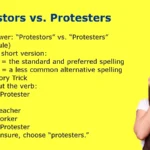
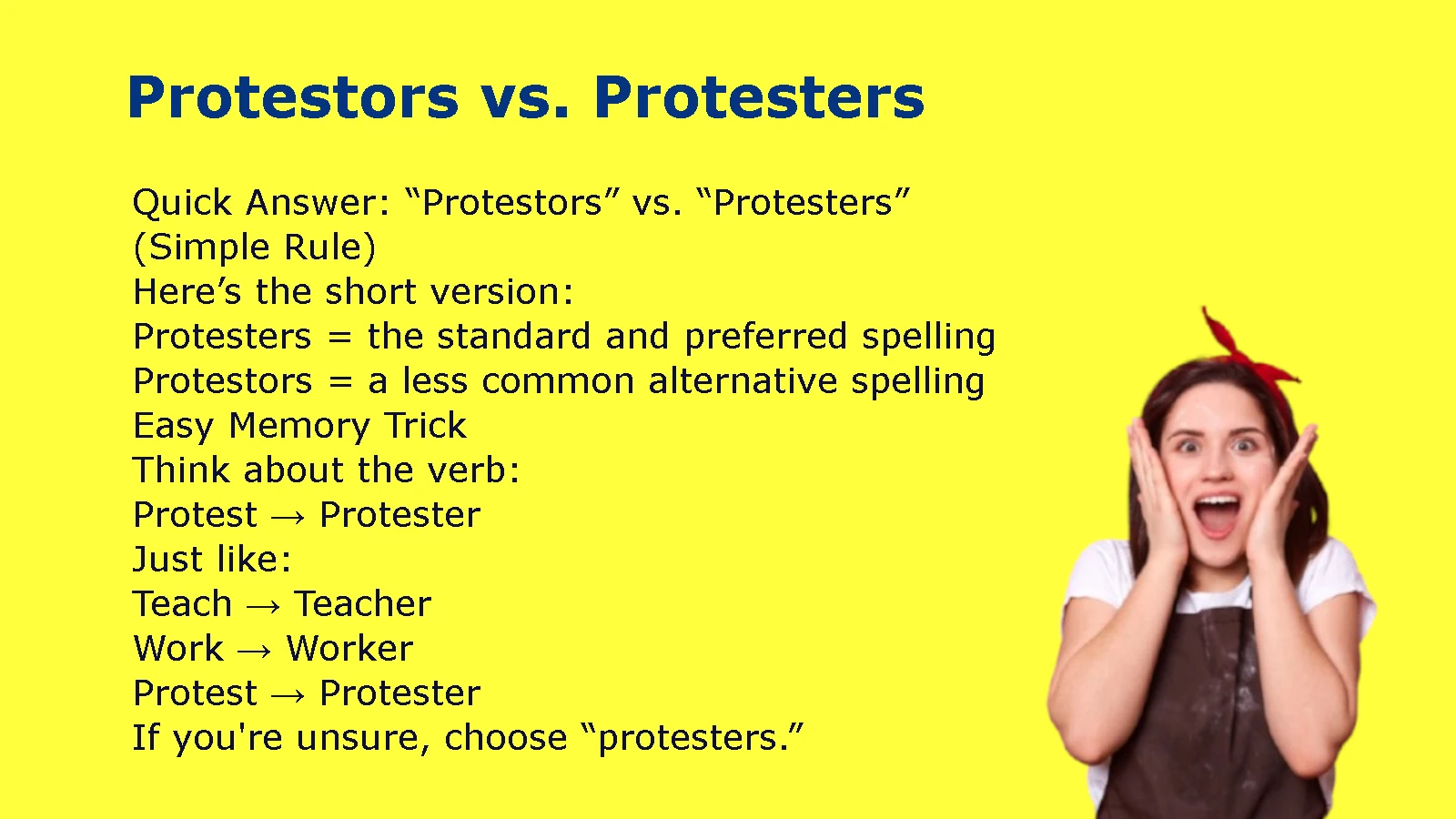
Quick Answer: “Protestors” vs. “Protesters” (Simple Rule)
Here’s the short version:
Protesters = the standard and preferred spelling
Protestors = a less common alternative spelling
Easy Memory Trick
Think about the verb:
Protest → Protester
Just like:
- Teach → Teacher
- Work → Worker
- Protest → Protester
If you’re unsure, choose “protesters.”
Which Spelling Is More Common?
While both words exist, “protesters” is overwhelmingly more common in modern English.
What You’ll See Most Often
- News articles
- Academic writing
- Business publications
- Government reports
- Professional communication
Almost always use:
“Protesters”
Why?
English commonly forms nouns for people using the -er ending:
- Runner
- Speaker
- Teacher
- Writer
- Protester
Because it follows the usual pattern, it feels more natural to most readers.
Key Takeaway
If you’re writing for a broad audience, “protesters” is usually the safest choice.
Why Do Both “Protestors” and “Protesters” Exist?
This is where many people get confused.
Historically, English has allowed multiple endings for nouns that describe people performing actions.
Examples include:
- Adviser / Advisor
- Counselor / Counsellor
- Donor / Donner (historically)
Similarly, both “protestor” and “protester” developed over time.
The Modern Trend
Language usage gradually favored:
Protester
As a result, “protestor” became less common.
Key Insight
The issue isn’t correctness.
It’s preference and frequency.
The Grammar Behind “Protester”
Let’s look at how the word is formed.
Verb + -er Pattern
English often creates a person noun by adding -er to a verb.
Examples:
| Verb | Person |
|---|---|
| Teach | Teacher |
| Paint | Painter |
| Run | Runner |
| Write | Writer |
| Protest | Protester |
Because of this pattern, “protester” feels more consistent with standard English word formation.
Why Writers Prefer It
- More familiar
- More widely accepted
- Easier for readers to recognize
- Recommended by many style guides
Is “Protestor” Wrong?
No.
This is one of the biggest misconceptions.
The Truth
“Protestor” is not grammatically incorrect.
Many dictionaries recognize it as a valid variant spelling.
The Problem
It’s simply much less common.
Because readers encounter it less often, some assume it’s a typo.
Example
Both sentences are technically correct:
- The protesters gathered outside city hall.
- The protestors gathered outside city hall.
However, the first sentence will look more natural to most readers.
Key Takeaway
Correct? Yes.
Preferred? Usually not.
“Protesters” vs. “Protestors” in News Writing
News organizations generally favor consistency.
Common News Usage
Most major publications use:
Protesters
Examples:
- Protesters marched through downtown.
- Thousands of protesters attended the rally.
- Protesters demanded policy changes.
Why Newsrooms Prefer It
Readers recognize it instantly.
Editors also prefer the standard spelling to avoid unnecessary distractions.
Professional Writing Tip
If you’re writing articles, blogs, or reports, choose “protesters.”
Side-by-Side Comparison Table
Here’s a quick comparison:
| Feature | Protesters | Protestors |
|---|---|---|
| Correct spelling | Yes | Yes |
| Most common usage | Yes | No |
| Preferred in journalism | Yes | Rarely |
| Professional writing | Recommended | Less preferred |
| Reader familiarity | High | Lower |
Quick Conclusion
If you must choose one, choose “protesters.”
Real-Life Examples of “Protesters”
Let’s see the preferred spelling in action.
Common Examples
- Protesters gathered peacefully in the city center.
- Hundreds of protesters attended the demonstration.
- Protesters called for policy reforms.
- The protesters carried signs and banners.
- Local protesters organized the event online.
What Readers Expect
In modern English, these sentences feel natural and familiar.
Real-Life Examples of “Protestors”
Although less common, you’ll still encounter this spelling.
Examples
- Protestors assembled outside the courthouse.
- Several protestors spoke to reporters.
- The protestors demanded immediate action.
- Protestors remained at the site overnight.
Reader Reaction
Most readers understand the meaning immediately.
However, some may pause because the spelling appears less familiar.
Why Many People Think “Protestor” Is Incorrect
The confusion often comes from frequency.
What Happens
People see:
- Protesters
- Teachers
- Writers
- Speakers
far more often than:
- Protestors
As a result, the uncommon spelling feels unusual.
Similar Situations
Consider:
- Adviser vs. Advisor
- Acknowledgement vs. Acknowledgment
- Grey vs. Gray
Both versions may be correct, but one tends to dominate.
Key Lesson
Common usage often influences what people perceive as “correct.”
Which Spelling Should You Use?
For nearly all situations:
Use “Protesters”
Best for:
- Blogs
- News articles
- School assignments
- Academic writing
- Business communication
- Professional documents
When Might “Protestors” Be Acceptable?
- Quoting a source directly
- Following a publication’s style preference
- Maintaining consistency in older texts
Safe Rule
When in doubt:
Choose “protesters.”
How to Avoid Mistakes Every Time
Want a foolproof approach?
Follow These Steps
- Write “protesters”
- Check for consistency throughout the document
- Match any required style guide
- Keep quotations unchanged
Why This Works
You’ll align with modern usage and reader expectations.
Quick Decision Guide (Use This Instantly)
Ask yourself:
Are you writing for school, work, or publication?
Use:
Protesters
Are you quoting someone who used “protestors”?
Keep:
Protestors
Still unsure?
Choose:
Protesters
Simple. Reliable. Done.
FAQ: “Protestors” vs. “Protesters”
Is “protestor” a real word?
Yes. It is a recognized alternative spelling of “protester.”
Which spelling is more common?
“Protesters” is far more common in modern English.
Do dictionaries accept both?
Yes. Most major dictionaries recognize both spellings.
Which spelling should students use?
Students should generally use “protesters.”
Which spelling looks more professional?
In most professional contexts, “protesters” is preferred.
Case Study: An Editor’s Choice
A freelance writer submitted an article discussing a public demonstration.
The article consistently used:
“Protestors”
What Happened?
The editor changed every instance to:
“Protesters”
Why?
The publication’s style guide preferred the more common spelling.
Result
The article matched reader expectations and maintained consistency.
Lesson
Professional editors typically favor “protesters.”
Key Facts You Should Remember
- Both spellings exist.
- Both are grammatically correct.
- “Protesters” is much more common.
- News organizations usually prefer “protesters.”
- Most professional writers choose “protesters.”
- “Protestor” is a valid but less common variant.
Final Takeaway: The One Rule That Never Fails
Here’s the simple truth.
The debate over “protestors” vs. “protesters” isn’t really about right versus wrong. Both words are accepted in English, and both refer to people who participate in protests.
The difference is usage.
“Protesters” has become the standard spelling in modern English. It’s the version you’ll see most often in journalism, education, business writing, and everyday communication.
So if you’re writing for a general audience, remember this rule:
Use “protesters.”
It’s clearer, more familiar, and aligns with modern usage.
And when clarity matters, choosing the spelling readers expect is almost always the best decision.