Ever typed Seak vs Seek and wondered which spelling is actually correct? You’re not alone. These two words are often confused in English grammar, especially by writers, students, and professionals who want their writing skills to look polished and error-free.
The problem is that seek is a real English word, while seak is typically a spelling mistake. Yet many people accidentally use the wrong version in emails, essays, social media posts, and everyday communication. And here’s the kicker: even a small word confusion like this can affect your credibility and make your writing appear less professional.
But don’t worry—this is one of the easiest grammar mistakes to fix.
In this guide, you’ll learn the difference between Seak vs Seek, discover the correct word usage, understand the meaning of seek, and see practical examples that eliminate any doubt. You’ll also learn helpful tips for avoiding common spelling errors and improving your overall English vocabulary.
So whether you’re writing for school, work, or everyday conversations, this guide will help you use the correct word with confidence every time. Let’s clear up the confusion once and for all.
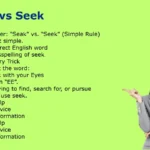
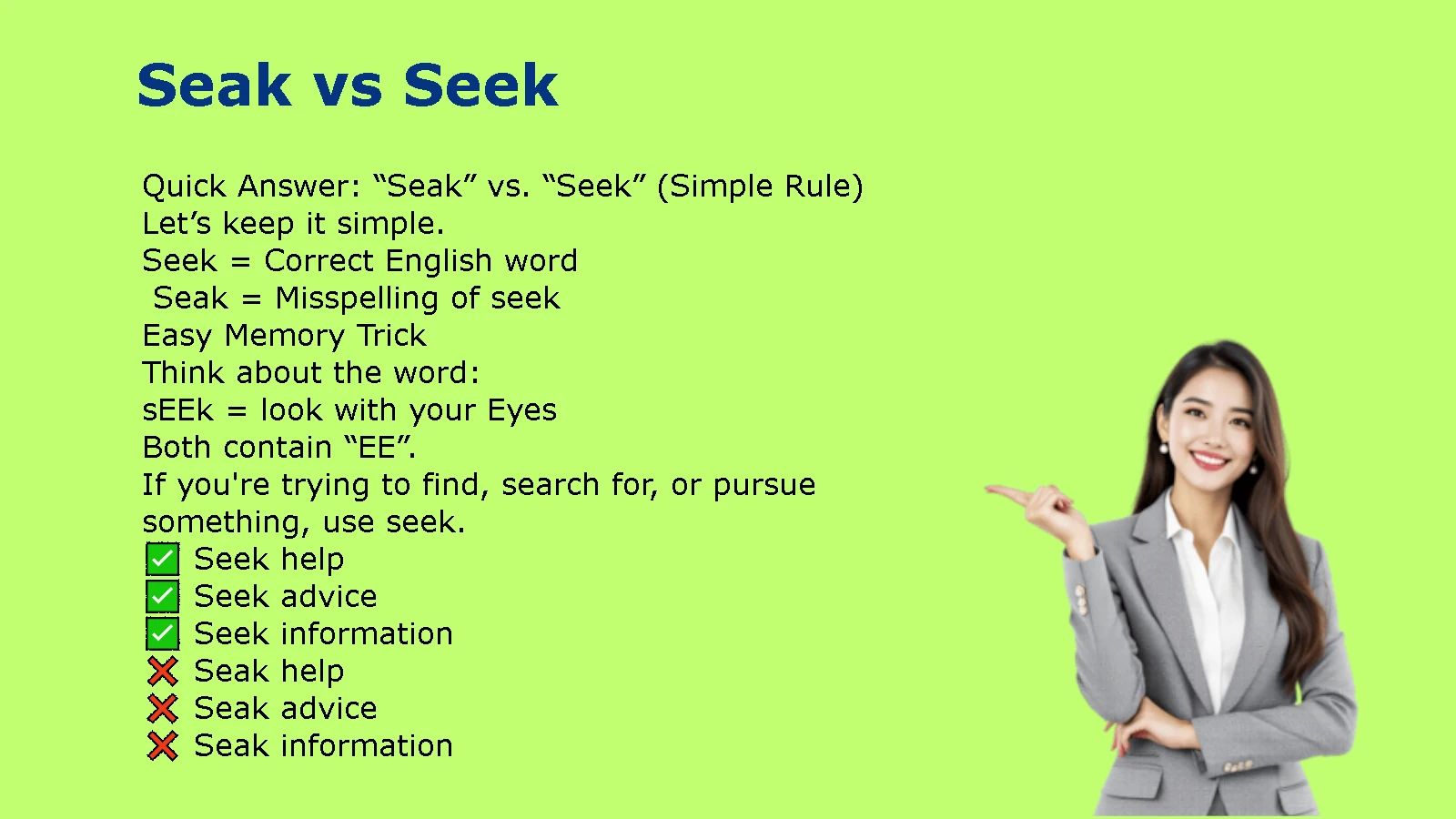
Quick Answer: “Seak” vs. “Seek” (Simple Rule)
Let’s keep it simple.
Seek = Correct English word
Seak = Misspelling of seek
Easy Memory Trick
Think about the word:
sEEk = look with your Eyes
Both contain “EE”.
If you’re trying to find, search for, or pursue something, use seek.
✅ Seek help
✅ Seek advice
✅ Seek information
❌ Seak help
❌ Seak advice
❌ Seak information
What Does “Seek” Mean?
The verb seek means:
- To search for something
- To try to obtain something
- To ask for something
- To pursue a goal or opportunity
Common Examples
- I want to seek a better job.
- She decided to seek professional advice.
- They seek new opportunities every year.
- We must seek the truth.
Simple Definition
Seek = Look for or try to get something.
Is “Seak” a Real Word?
For most English learners and writers, the answer is simple:
No, “seak” is not a standard English word.
When people write seak, they almost always mean seek.
Why It Appears Online
People often:
- Misspell seek
- Type quickly
- Rely on pronunciation
- Make keyboard errors
As a result, “seak” frequently appears in searches, social media posts, and informal writing.
Key Insight
If your intention is to mean “look for,” always use seek.
Why People Confuse “Seak” and “Seek”
The confusion isn’t surprising.
Similar Pronunciation
Many English words use different spellings for similar sounds:
- Peak
- Weak
- Speak
- Break
Because of this, some people assume “seak” follows the same pattern.
Typing Habits
When typing quickly, it’s easy to replace:
ee → ea
Result:
seek → seak
Learning English by Sound
Many learners write words the way they hear them.
Since seek sounds similar to words ending in -eak, mistakes happen naturally.
The Spelling Logic Behind “Seek”
English spelling isn’t always predictable, but there is a pattern here.
Correct Form
Seek
Incorrect Form
Seak
Why?
The word comes from older forms of English that evolved into the modern spelling seek.
Over time, seek became the accepted standard.
Key Insight
Dictionaries, grammar guides, schools, and professional writers all recognize seek as the correct spelling.
“Seek” Explained Clearly (With Examples)
Let’s look at how native speakers actually use the word.
Seeking Information
- Students seek knowledge.
- Researchers seek answers.
- Journalists seek facts.
Seeking Help
- She decided to seek medical advice.
- They seek assistance from experts.
- He refused to seek help.
Seeking Opportunities
- Graduates seek employment.
- Investors seek growth opportunities.
- Entrepreneurs seek new markets.
Key Takeaway
Whenever you’re searching for, pursuing, or trying to obtain something, seek is the correct word.
Common Mistakes With “Seak”
Many people unknowingly write sentences like these:
Incorrect Examples
❌ I will seak help.
❌ They seak new opportunities.
❌ We are seaking answers.
❌ She likes to seak advice.
Correct Versions
✅ I will seek help.
✅ They seek new opportunities.
✅ We are seeking answers.
✅ She likes to seek advice.
Quick Rule
If you’re tempted to write seak, replace it with seek.
The Biggest Mistake People Make
The most common error is assuming that seak is simply another accepted spelling.
It isn’t.
What Goes Wrong
People see:
- Peak
- Speak
- Weak
Then assume:
- Seek → Seak
But English doesn’t follow that pattern here.
Lesson
Never rely solely on pronunciation when choosing between seak and seek.
Side-by-Side Comparison Table
| Word | Correct? | Meaning | Use in Writing |
| Seek | Yes | To search for or pursue something | Always |
| Seak | No | Usually a misspelling | Avoid |
Quick Summary
Seek = Correct
Seak = Incorrect
Real-Life Examples of “Seek”
Here are examples you’ll see in everyday English.
Workplace
- Employees should seek feedback regularly.
- Managers often seek solutions to problems.
Education
- Students seek knowledge.
- Researchers seek evidence.
Personal Life
- Many people seek happiness.
- Couples sometimes seek counseling.
Mini Scenario
A friend says:
“I need to seek professional advice before making a decision.”
This usage is completely correct.
Real-Life Examples of the Mistake “Seak”
You might encounter sentences like:
- “I seak your guidance.”
- “We are seaking the truth.”
- “Please seak assistance.”
These are spelling errors.
Correct Versions
- “I seek your guidance.”
- “We are seeking the truth.”
- “Please seek assistance.”
Key Point
Professional writing should never use seak.
Common Phrases With “Seek”
Learning fixed expressions helps reinforce the correct spelling.
Frequently Used Phrases
- Seek help
- Seek advice
- Seek guidance
- Seek information
- Seek permission
- Seek justice
- Seek answers
- Seek employment
- Seek opportunities
- Seek treatment
Why Learn These?
The more often you see seek in context, the less likely you’ll accidentally write seak.
How to Avoid This Mistake Every Time
Want a foolproof method?
Remember the “EE” Rule
Seek → EE → Eyes
You use your eyes when searching for something.
Read Before Sending
Before sending:
- Emails
- Assignments
- Reports
- Social media posts
Quickly check for “seak.”
Use Spell Check
Most writing tools immediately flag seak as incorrect.
Why This Works
A two-second review can eliminate the mistake entirely.
What to Say Instead (If You’re Unsure)
If you’re uncertain about using seek, you can often replace it with:
Alternatives
- Search for
- Look for
- Pursue
- Find
- Explore
- Request
Examples
Instead of:
“I seek information.”
You can say:
“I am looking for information.”
Both are correct.
Quick Decision Guide (Use This Instantly)
When writing:
Do you mean search for, look for, or pursue something?
➡ Use seek
Thinking about writing seak?
➡ Don’t.
Replace it with seek.
Simple. Reliable. Done.
FAQ: “Seak” vs. “Seek”
Is “seak” a real English word?
In standard modern English, no. It is usually a misspelling of seek.
Which spelling is correct?
Seek is the correct spelling.
Why do people write “seak”?
Because of pronunciation, typing mistakes, and confusion with words like “speak” and “weak.”
Can I use “seak” in formal writing?
No. Use seek instead.
What does “seek” mean?
It means to search for, pursue, request, or try to obtain something.
Case Study: A Professional Writing Error
A job applicant submitted a cover letter that included:
“I am seaking new opportunities and hope to seak employment within your organization.”
What Happened
The recruiter immediately noticed the spelling mistakes.
Result
The application appeared less professional.
Correct Version
“I am seeking new opportunities and hope to seek employment within your organization.”
Lesson
Small spelling errors can affect credibility.
Key Facts You Should Remember
- Seek is the correct spelling.
- Seak is usually a misspelling.
- Seek means to search for or pursue something.
- Professional writing should always use seek.
- Spell-check tools typically flag seak as incorrect.
- Learning common phrases helps prevent mistakes.
Final Takeaway: The One Rule That Never Fails
Here’s the truth.
The debate between “Seak” vs. “Seek” is actually very simple. Only one spelling is considered correct in standard English.
Whenever you mean to search for, pursue, request, or obtain something, use seek.
Think of it this way:
Seek = Correct English
Seak = Common typo
If you’re ever unsure, remember the easiest rule:
If you’re looking for something, you’re seeking it—not seaking it.
That one reminder will help you avoid this mistake every time.