Ever stopped while writing and wondered whether Useful vs. Usefull is the correct spelling? This common spelling confusion catches many writers off guard, especially when drafting emails, essays, professional documents, or everyday messages.
You’re not alone. Many people assume that because words like “full” contain two Ls, “usefull” must be correct too. But here’s the kicker: only one spelling is accepted in standard English grammar, and using the wrong version can make your writing appear less polished.
The good news? The answer is simpler than you might think.
In this guide, you’ll learn the difference between Useful vs. Usefull, discover the correct English spelling, understand the relevant grammar rules, and see real-world examples of proper usage. You’ll also learn helpful memory tricks to avoid this common writing mistake in the future.
Whether you’re a student, professional, or anyone looking to improve their English vocabulary and writing skills, this article will help you use the correct word with confidence. Let’s clear up the confusion once and for all.
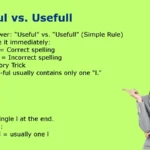
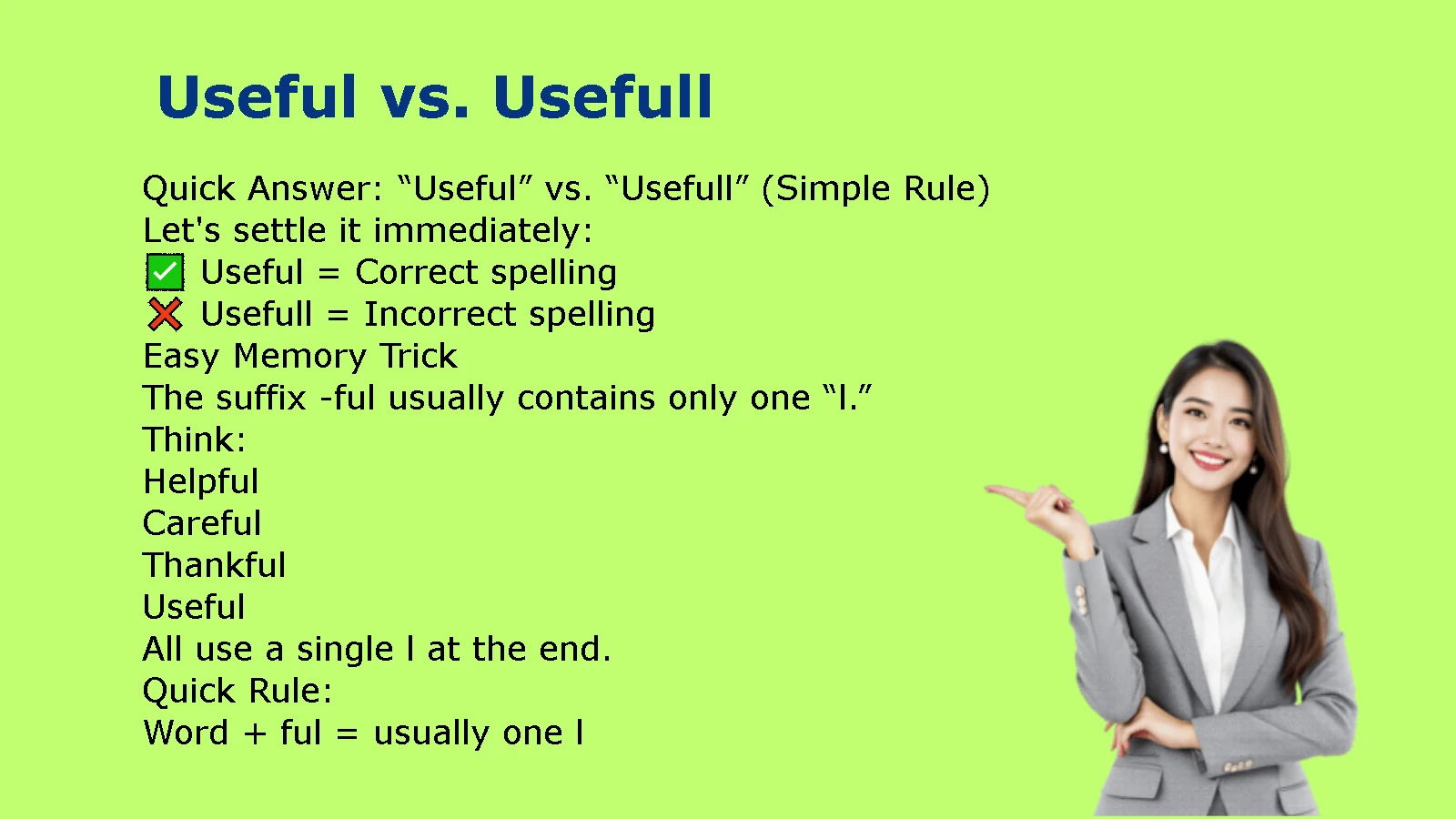
Quick Answer: “Useful” vs. “Usefull” (Simple Rule)
Let’s settle it immediately:
✅ Useful = Correct spelling
❌ Usefull = Incorrect spelling
Easy Memory Trick
The suffix -ful usually contains only one “l.”
Think:
- Helpful
- Careful
- Thankful
- Useful
All use a single l at the end.
Quick Rule:
Word + ful = usually one l
What Does “Useful” Mean?
The word useful describes something that helps you, serves a purpose, or provides value.
Simple Definition
Useful = helpful or practical
Examples
- This guide is very useful.
- Her advice was useful during the interview.
- The new software is useful for managing projects.
- A flashlight is useful during power outages.
In each example, the item or information provides practical benefit.
Why Do People Write “Usefull”?
The mistake is understandable.
Many people see the word full and assume use + full = usefull.
However, English follows a different spelling pattern when -ful acts as a suffix.
The Source of the Confusion
Consider these words:
- Full
- Beautifully
- Successfully
- Carefully
Because double “l” appears frequently in English, many writers naturally add an extra one.
The Reality
When -ful is used as a suffix, it almost always keeps just one l.
That’s why:
- Useful ✅
- Careful ✅
- Helpful ✅
- Thankful ✅
Not:
- Usefull ❌
- Carefull ❌
- Helpfull ❌
The Grammar Rule Behind “Useful”
Here’s the rule that solves the problem.
The “-ful” Suffix Rule
The suffix -ful means:
“full of” or “having”
Examples:
| Base Word | Correct Form | Meaning |
| Help | Helpful | Full of help |
| Care | Careful | Full of care |
| Use | Useful | Full of use |
| Thank | Thankful | Full of thanks |
Key Insight
Although the word full has two Ls, the suffix -ful has only one.
That’s why useful is correct.
“Useful” Explained With Examples
Let’s look at how people use the word in everyday English.
At Work
- This report contains useful information.
- The training session was useful.
- The checklist proved useful during the project.
At School
- The teacher shared useful study tips.
- This website is useful for research.
- Her notes were extremely useful.
In Daily Life
- A spare charger is useful when traveling.
- Maps are useful in unfamiliar places.
- A first-aid kit is useful in emergencies.
Common Pattern
In every example, useful means beneficial, practical, or valuable.
“Usefull” Explained
Now let’s discuss the incorrect version.
Is “Usefull” a Real Word?
No.
Usefull is simply a spelling mistake.
It does not appear as a standard English word in modern dictionaries.
What Happens If You Use It?
In formal writing:
- It may be flagged by spell checkers.
- Editors will usually correct it.
- It can make writing appear less polished.
Example
Incorrect:
❌ This article was very usefull.
Correct:
✅ This article was very useful.
The Biggest Mistake Writers Make
The most common error is assuming that the suffix works exactly like the word full.
What People Think
Use + full = usefull
What English Actually Does
Use + ful = useful
Why It Matters
Once you learn the suffix rule, you’ll automatically spell dozens of words correctly.
Side-by-Side Comparison Table
Here’s a quick reference you can save.
| Word | Correct? | Meaning |
| Useful | ✅ Yes | Helpful or practical |
| Usefull | ❌ No | Incorrect spelling |
Quick Rule
If you’re choosing between the two, useful wins every time.
Real-Life Examples of “Useful”
Let’s see the word in context.
Everyday Sentences
- The feedback was useful.
- This app is useful for budgeting.
- She gave me useful advice.
- The tutorial was useful for beginners.
- These tools are useful for homeowners.
Mini Scenario
A coworker asks:
“Was the meeting worth attending?”
You reply:
“The presentation was useful and gave us clear next steps.”
Perfect usage.
Common Words That Follow the Same Rule
Learning related words makes the rule easier to remember.
Examples
- Helpful
- Careful
- Thankful
- Hopeful
- Meaningful
- Powerful
- Thoughtful
- Skillful
Notice something?
Every one uses one L in -ful.
Words People Commonly Misspell
Many writers make the same mistake with similar words.
Incorrect vs. Correct
| Incorrect | Correct |
| Carefull | Careful |
| Helpfull | Helpful |
| Thankfull | Thankful |
| Hopefull | Hopeful |
| Usefull | Useful |
Pattern to Remember
If the word ends in -ful, it almost always uses one l.
Easy Memory Tricks for “Useful”
Need a fast way to remember?
Trick #1: One Purpose, One L
Useful means something serves one purpose.
Think:
One purpose → One L
Trick #2: Match Similar Words
Remember:
- Helpful
- Careful
- Useful
All share the same ending.
Trick #3: Trust the Suffix
The suffix is -ful, not -full.
When Writers Are Most Likely to Make This Mistake
The error usually appears when:
Writing Quickly
People type by sound rather than spelling.
Using Mobile Devices
Autocorrect doesn’t always catch every typo.
Learning English
Many learners assume the suffix keeps both Ls from the word full.
Editing Less Carefully
Small spelling mistakes can slip through final reviews.
How to Avoid the Mistake Every Time
Want a foolproof system?
Step 1
Ask:
“Am I adding the suffix -ful?”
Step 2
Remember:
The suffix has one L.
Step 3
Check similar words:
- Helpful
- Careful
- Thankful
Step 4
Write:
Useful
Done.
What to Use Instead
There is no situation where usefull is the preferred spelling.
Always use:
✅ Useful
Never use:
❌ Usefull
Simple as that.
Quick Decision Guide (Use This Instantly)
When you’re unsure, follow this:
Need the word meaning practical or helpful?
↓
Write useful
↓
Never add the second L
↓
You’re correct
FAQ: “Useful” vs. “Usefull”
Is “usefull” ever correct?
No. Standard English uses useful only.
Why does “full” have two Ls but “useful” has one?
Because full is a standalone word, while -ful is a suffix that normally uses one L.
Do dictionaries recognize “usefull”?
No. Major English dictionaries list useful as the correct spelling.
Is “useful” formal or informal?
It works in both formal and informal writing.
Are there other words with the same spelling rule?
Yes. Helpful, careful, thankful, hopeful, and meaningful all follow the same pattern.
Case Study: A Small Error That Changed First Impressions
A job applicant submitted a resume that included:
“Strong communication skills and usefull project management experience.”
The hiring manager noticed the mistake immediately.
What Happened?
The candidate was qualified.
But the spelling error made the document look less professional.
The Fix
The corrected sentence became:
“Strong communication skills and useful project management experience.”
A tiny change created a much stronger impression.
Lesson
Even small spelling mistakes can affect credibility.
Key Facts You Should Remember
- Useful is the correct spelling.
- Usefull is incorrect.
- The suffix -ful uses one L.
- Many writers make the mistake because of the word full.
- Similar words include helpful, careful, and thankful.
- Learning the suffix rule prevents multiple spelling errors.
Final Takeaway: The One Rule That Never Fails
Here’s the truth.
The debate between “useful” vs. “usefull” is actually very simple once you know the spelling rule.
Useful is always correct.
Usefull is always incorrect.
Whenever you add the suffix -ful, remember that English normally uses only one l. The same pattern appears in words like helpful, careful, and thankful.
So the next time you’re typing and hesitate, use this simple rule:
If it means practical or helpful, write “useful.”
One L. No confusion. No mistakes. Just correct English every time.