Ever paused while writing and wondered whether Intention vs. Intension is the correct choice? These two words look almost identical, but they have very different meanings in English grammar, vocabulary, and academic writing.
You’re not alone. Many writers, students, and professionals confuse these commonly mixed-up words because of their similar spelling and pronunciation. And here’s the kicker: using the wrong term can weaken your written communication, create confusion, and make your work appear less polished.
But don’t worry—understanding the difference is simpler than it seems.
In this guide, you’ll learn the meaning of Intention vs. Intension, how each word is used in different contexts, and the key distinctions that separate them. We’ll also explore word definitions, usage examples, language rules, and easy memory tricks to help you choose the right word every time.
Whether you’re improving your writing skills, expanding your English vocabulary, or avoiding common grammar mistakes, this article will give you the clarity you need. Let’s dive in and settle the confusion once and for all.
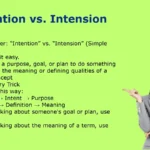
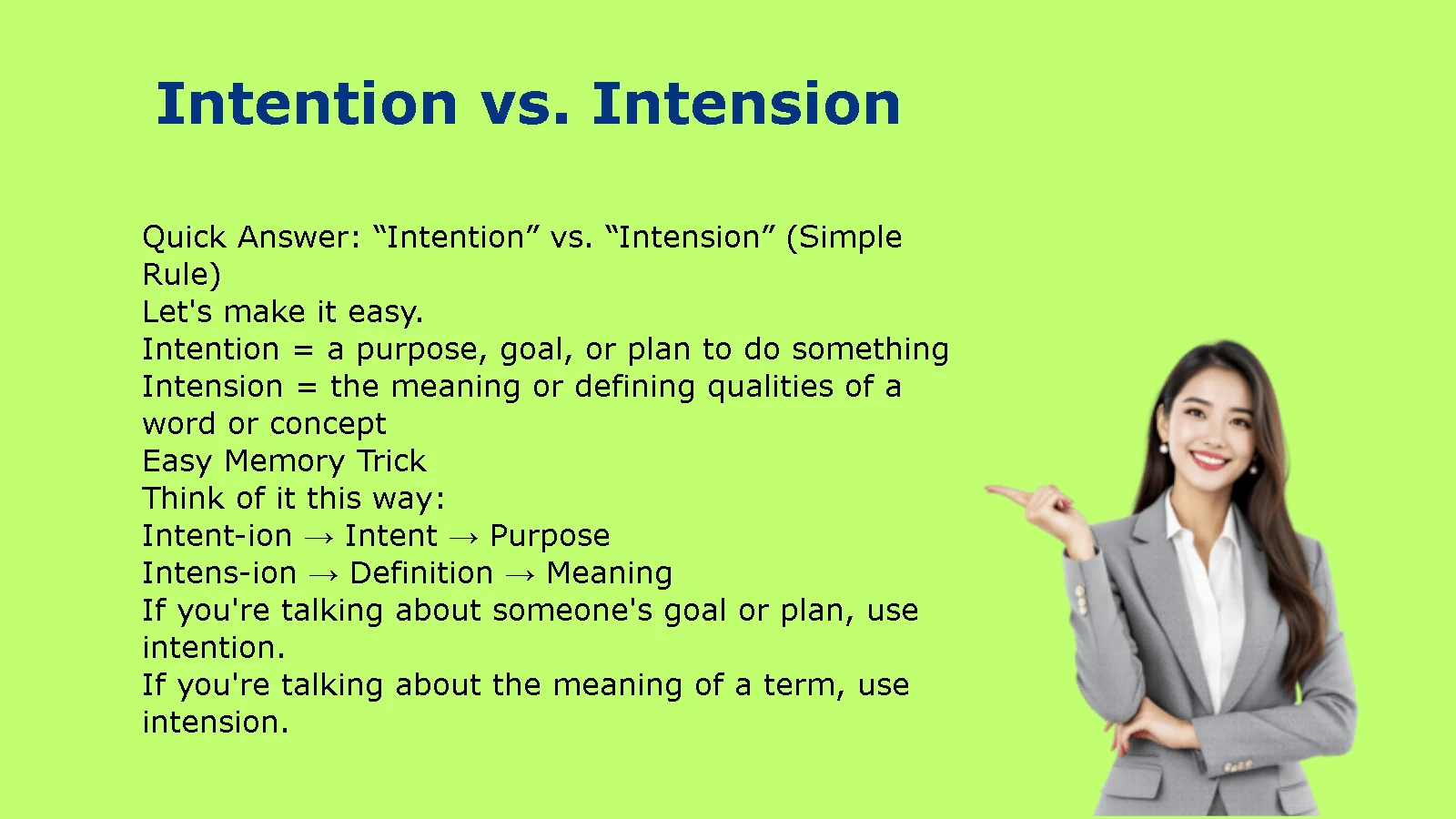
Quick Answer: “Intention” vs. “Intension” (Simple Rule)
Let’s make it easy.
Intention = a purpose, goal, or plan to do something
Intension = the meaning or defining qualities of a word or concept
Easy Memory Trick
Think of it this way:
Intent-ion → Intent → Purpose
Intens-ion → Definition → Meaning
If you’re talking about someone’s goal or plan, use intention.
If you’re talking about the meaning of a term, use intension.
How People Actually Use “Intention” and “Intension”
Here’s where the confusion starts.
Most people regularly use intention in daily speech.
Very few people ever use intension outside academic subjects.
In Everyday Conversations
People say:
- “My intention was to help.”
- “She had good intentions.”
- “I intend to finish the project.”
You’ll almost never hear someone use intension in casual conversation.
In Academic Settings
You may encounter intension in:
- Philosophy
- Logic
- Linguistics
- Semantic analysis
Why This Happens
One word belongs to everyday English.
The other belongs to specialized academic language.
That’s why many people mistakenly assume they’re spelling variations of the same word.
The Core Difference Between “Intention” and “Intension”
Let’s simplify the distinction.
Intention = Purpose
An intention is something you plan, desire, or aim to do.
Example:
“I had no intention of hurting your feelings.”
The speaker is talking about their goal or purpose.
Intension = Meaning
An intension describes the essential characteristics that define a concept.
Example:
“The intension of the word ‘bird’ includes having feathers and wings.”
Here, we’re discussing meaning, not purpose.
Key Insight
Intention deals with actions.
Intension deals with definitions.
“Intention” Explained Clearly (With Examples)
The word intention appears everywhere in English.
Standard Meaning
An intention is:
- A plan
- A goal
- A purpose
- Something you aim to do
Common Examples
- “My intention is to improve my writing.”
- “She left with the intention of returning.”
- “They had good intentions.”
Workplace Example
Manager:
“My intention is to complete the project by Friday.”
This refers to a goal, not a definition.
Key Takeaway
If you’re discussing what someone wants to do, thinks about doing, or plans to do, use intention.
“Intension” Explained Clearly (With Examples)
Now let’s look at the less common word.
Standard Meaning
In logic and linguistics, intension refers to the defining properties of a concept.
Example
Consider the word:
Bachelor
Its intension might be:
- Adult
- Human
- Male
- Unmarried
These qualities define what a bachelor is.
Academic Example
“The intension of the term ‘triangle’ is a three-sided polygon.”
We’re describing meaning and defining characteristics.
Key Takeaway
Use intension only when discussing the meaning or conceptual definition of something.
The Biggest Mistake People Make
The most common error is assuming intension is simply a misspelling of intention.
What Goes Wrong
People write:
“My intension was to help.”
This is incorrect.
The correct sentence is:
“My intention was to help.”
Why It Happens
The words:
- Look similar
- Sound similar
- Share related Latin roots
But their meanings are completely different.
Lesson
Whenever you’re talking about goals or plans, choose intention.
Side-by-Side Comparison Table
| Word | Meaning | Common Usage | Risk of Confusion |
| Intention | Purpose, goal, or plan | Everyday English | Low |
| Intension | Defining meaning of a concept | Academic fields | High |
Real-Life Examples of “Intention”
Let’s see how the word appears naturally.
Common Situations
- “I had every intention of calling you.”
- “Her intention was to apologize.”
- “They acted with good intentions.”
- “Our intention is to expand the business.”
Mini Scenario
Teacher:
“What was your intention when writing this essay?”
The teacher is asking about the student’s purpose.
Real-Life Examples of “Intension”
Now compare those with examples of intension.
Common Situations
- “The intension of the concept is difficult to define.”
- “Linguists study the intension of words.”
- “The intension of ‘vehicle’ includes means of transportation.”
- “Philosophers debate conceptual intensions.”
Mini Scenario
Professor:
“What is the intension of the term ‘democracy’?”
The discussion focuses on meaning and defining qualities.
Why “Intension” Is So Rare
Many English speakers go years without encountering this word.
Everyday Language Doesn’t Need It
Most conversations focus on:
- Plans
- Goals
- Actions
Therefore, people use intention frequently.
Specialized Fields Do
Fields such as:
- Linguistics
- Philosophy
- Logic
- Semantics
Need a term for conceptual meaning.
That’s where intension becomes useful.
Key Insight
For most writers, intention is the word you’ll use 99% of the time.
How to Avoid Confusion Every Time
Want a foolproof method?
Ask Yourself a Question
Are you talking about:
A plan or goal?
→ Use intention
A definition or meaning?
→ Use intension
Check the Context
Sentence:
“My _____ was to become a doctor.”
The blank refers to a goal.
Correct answer:
Intention
Another Example
“The _____ of the word includes several characteristics.”
The blank refers to meaning.
Correct answer:
Intension
Why This Works
The context immediately reveals which meaning is needed.
What to Say Instead (Clear Alternatives)
Sometimes a synonym helps.
Alternatives for “Intention”
- Goal
- Purpose
- Aim
- Objective
- Plan
Example:
“My purpose was to help.”
Alternatives for “Intension”
- Definition
- Meaning
- Concept
- Essence
- Characteristics
Example:
“The definition of the term is clear.”
Quick Tip
If a synonym fits naturally, you’ve probably chosen the correct word.
Quick Decision Guide (Use This Instantly)
When you’re unsure, follow this:
Talking about a goal?
→ Intention
Talking about a meaning?
→ Intension
Writing everyday English?
→ Usually intention
Writing about linguistics or philosophy?
→ Possibly intension
Simple. Reliable. Done.
FAQ: “Intention” vs. “Intension”
Is “intension” a real word?
Yes. It’s a legitimate English word used mainly in philosophy, logic, and linguistics.
Which word is more common?
Intention is far more common and appears frequently in everyday speech and writing.
Can I use “intension” instead of “intention”?
No. They have different meanings and are not interchangeable.
Why do people confuse them?
Because they look and sound similar while differing by only one letter.
Which word should students use most often?
In general writing and communication, you’ll almost always need intention.
Case Study: A Common Writing Error
A university student submitted an essay containing this sentence:
“My intension was to explain the issue clearly.”
What Happened
The professor marked it as incorrect.
Why?
Because the student was discussing a goal, not a definition.
The Correct Version
“My intention was to explain the issue clearly.”
Lesson
Even a single letter can change the entire meaning of a word.
Key Facts You Should Remember
- Intention means purpose, plan, or goal.
- Intension means defining meaning or characteristics.
- Intention is common in everyday English.
- Intension is mostly used in academic subjects.
- The words are not interchangeable.
- Context determines the correct choice.
- Most writers need intention, not intension.
Final Takeaway: The One Rule That Never Fails
Here’s the truth.
The difference between intention vs. intension is much simpler than it first appears.
If you’re talking about what someone plans, wants, or hopes to do, the correct word is intention.
If you’re discussing the defining meaning of a concept in philosophy, logic, or linguistics, use intension.
Remember this simple rule:
Purpose = Intention
Definition = Intension
When in doubt, ask yourself whether you’re talking about a goal or a meaning.
Because once you know that distinction, you’ll never confuse “intention” vs. “intension” again.